
When the House Goes Silent: 7 Ways to Fill the Space Left by Your Ragdoll Cat
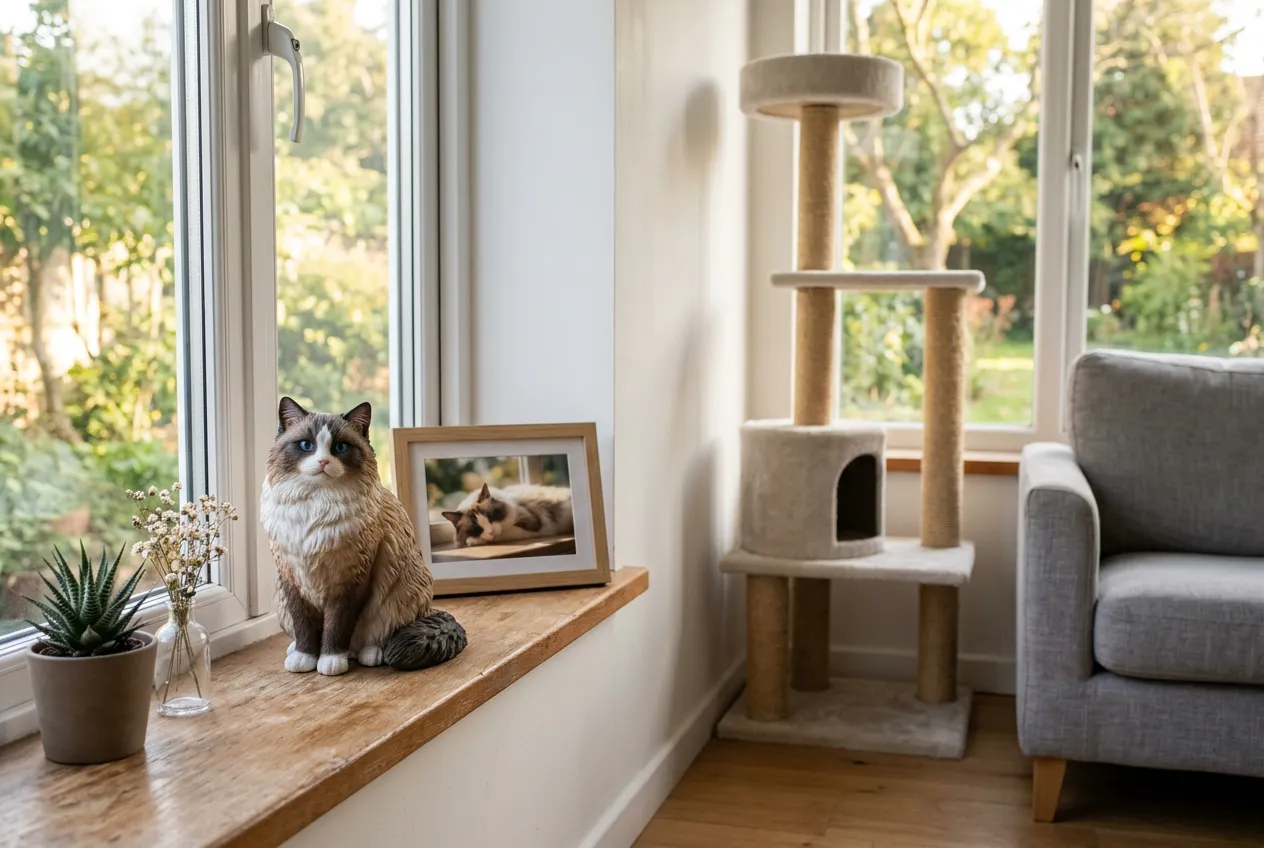
Two years ago, the front porch screen door would bang shut at 6 PM and a Ragdoll cat would chirp from somewhere deep in the house—that low, rolling trill that sounded like a question and a greeting at once. Now the door bangs shut and there's just... the bang. If you're navigating ragdoll cat loss, that missing sound is where the grief lives.
Quick Takeaways
- Grief after losing a Ragdoll is neurologically unique — their breed-specific social bonding creates deeper attachment patterns than most cats
- Restructure your daily soundscape first — the absence of sound triggers more grief responses than visual reminders
- Guilt about relief is the most common hidden emotion — and it says nothing about how much you loved them
- A physical anchor for memory helps your brain process loss — consider a custom pet figurine or dedicated memorial space
- Timelines don't apply — your grief isn't "too much" at three months or three years
Why Ragdoll Loss Hits Different (And the Science Behind It)
Here's something most pet grief articles won't tell you: losing a Ragdoll cat is not the same as losing other cats. That's not breed snobbery—it's attachment science.
Ragdolls were literally bred for human companionship. They go limp when you hold them (hence the name). They follow you room to room. They greet you at the door. They're sometimes called "puppy cats" because their social bonding patterns mirror dogs more than typical felines. What this means, neurologically, is that your brain formed a co-regulatory relationship with your Ragdoll that most cat owners never experience.
Co-regulation is a concept from attachment theory: two nervous systems learning to calm each other. Your Ragdoll's purr wasn't just cute—it was literally downregulating your cortisol levels. That warm weight on your lap in the evening was training your body to associate relaxation with their presence. When that's gone, your nervous system doesn't just feel sad. It feels dysregulated. Unmoored.
So when someone says "it was just a cat," they're not just being insensitive. They're factually wrong about what was happening in your brain.
| Ragdoll Trait | Bonding Impact | Why Loss Feels Amplified |
|---|---|---|
| Following owner room-to-room | Creates constant co-presence | Every room now triggers absence |
| Vocal communication (trills, chirps) | Builds call-and-response patterns | Brain keeps "listening" for responses |
| Going limp when held | Deep tactile bonding | Phantom weight sensation on lap/chest |
| Greeting at door | Arrival ritual dependency | Coming home becomes a grief trigger |
| Sleeping on/near owner | Nighttime co-regulation | Sleep disruption is common and severe |
That table isn't just informational—it's a map of your grief triggers. And knowing your triggers is the first step toward navigating them instead of being ambushed by them.

1. Rewrite Your Sound Environment (The Most Overlooked Step)
Most grief guides jump straight to journaling or memorial rituals. We're not going to do that. Because in our experience working with thousands of families after pet loss, the thing that destabilizes people fastest isn't the visual absence—it's the acoustic void.
Think about it. Your Ragdoll was a soundtrack. The soft thud of them jumping off the bed. The rhythmic crunch of kibble at 7 AM. That specific purr frequency (Ragdolls tend to purr louder and lower than most breeds, often in the 25-50 Hz range that research has linked to tissue healing and stress reduction). The little mrrp when they wanted attention.
Now picture this: It's Tuesday morning. You're making coffee. The kitchen is just... the sound of the coffee maker. No padding feet on tile. No expectant meow. The refrigerator hum is suddenly the loudest thing in the room, and it's oppressive in a way you can't articulate.
Here's what actually helps more than "playing music to fill the silence": Be intentional about your sound environment, but don't try to mask the absence. Your brain needs to form new acoustic associations with your space.
Specific steps:
- For the first two weeks, introduce one new ambient sound source per room you shared most with your cat. Not music with lyrics—that demands cognitive attention. Think rain sounds, a small tabletop fountain, or a low-volume podcast in the background.
- After two weeks, start reducing the ambient sound gradually. Your brain is building new baseline expectations for what your home sounds like. Rushing this creates avoidance patterns.
- Keep one room "quiet" on purpose. This is counterintuitive, but having a designated space where you sit with the absence—rather than running from it—gives your brain a controlled environment to process. Grief researchers call this dosing: exposing yourself to the painful stimulus in manageable amounts.
The mistake most people make is trying to fill every second of quiet immediately. That's not healing. That's avoidance wearing a coping costume.
"Grief doesn't need to be filled. It needs to be sat with until it changes shape."
2. Address the Guilt You're Not Talking About
We need to talk about the thing you're probably not telling anyone.
Maybe your Ragdoll was sick for months. Maybe the last few weeks were hard—really hard. The subcutaneous fluids, the medication schedules, the vet visits that cost more than your rent. And when it was finally over, somewhere underneath the crushing sadness, you felt... relief.
And then the guilt hit like a freight train.
That wave of relief you felt when their suffering ended? It doesn't make you a bad person. It makes you someone who loved them enough to prioritize their comfort over your own need to keep them close. The guilt that follows that relief is one of grief's cruelest tricks—a phenomenon psychologists call cognitive dissonance in bereavement. Your brain is holding two true things simultaneously: "I'm devastated they're gone" and "I'm relieved the suffering stopped." Because those feel contradictory, your mind tries to resolve the tension by generating guilt.
Here's what we want you to hear: relief and love are not opposites. They're actually evidence of the same thing. You were carrying an enormous caregiving burden, and your nervous system was running on cortisol and adrenaline for weeks or months. Relief is your body's physiological exhale. It's not a moral failing.
Some people also feel guilt about the timing of euthanasia—the "too soon or too late" spiral. Did we wait too long? Did they suffer that last night? Should we have done it a week earlier? This is agonizingly common, and we've heard it from more families than we can count. The truth is that there is almost never a "perfect" moment, and the fact that you're agonizing over it means you were paying close attention to their quality of life. That's not negligence. That's devotion.
If the guilt is persistent—if it's been months and you still can't think about the final days without a shame spiral—that's worth exploring with a therapist who specializes in pet bereavement. The Association for Pet Loss and Bereavement maintains a directory of counselors who actually understand that this grief is real.
3. Rebuild Your Transition Rituals
Here's something a behavioral psychologist would tell you that a well-meaning friend probably won't: your grief is partly a habit disruption problem.
That sounds cold. It's not meant to be. But your daily life with a Ragdoll was built on dozens of micro-rituals—tiny behavioral loops that structured your day. The morning feeding. The post-work greeting. The evening lap session. The bedtime routine where they'd knead the blanket for exactly ninety seconds before settling.
When those rituals vanish overnight, your brain doesn't just feel sad. It feels structurally confused. Neuroscience calls this a prediction error—your brain keeps expecting the next step in the sequence and getting nothing. Each prediction error generates a small stress response. Multiply that by thirty or forty micro-rituals per day, and you understand why the first few weeks feel so physically exhausting even though you're "not doing anything."
The fix isn't to replace your cat (we'll get to that). The fix is to consciously build new transition rituals for the moments that hurt most.
The Three Hardest Transitions (And What to Do With Them)
Coming home: This is the big one. Ragdolls are notorious greeters. That empty entryway is brutal. New ritual: Before you open the door, pause. Take one breath. Say their name out loud if you want to. Then walk in. The pause gives your brain a beat to adjust its expectation before the prediction error hits.
Evening wind-down: If your Ragdoll was a lap cat (and let's be honest, they all were), evenings are going to feel hollow. New ritual: Get a weighted blanket. Seriously. The deep pressure stimulation activates the same parasympathetic response that your cat's weight on your lap used to trigger. It's not the same. Nothing will be. But your nervous system will recognize the input.
Waking up: Many Ragdoll owners report that mornings are the worst because there's a split second before full consciousness where you forget. Then you remember. New ritual: Put something on your nightstand that you reach for first thing—a glass of water, a specific book, your phone with a particular app open. You're giving your waking brain a new "first action" to replace the old one (which was probably reaching down to pet a cat who was sleeping beside you).
| Transition Moment | Why It Hurts | New Ritual Suggestion | Timeline to Feel Easier |
|---|---|---|---|
| Coming home | Ragdoll greeting is gone | Pause-breathe-name at the door | 2-4 weeks |
| Evening wind-down | No lap weight or purring | Weighted blanket + ambient sound | 3-6 weeks |
| Morning wake-up | Split-second forgetting | New "first reach" object on nightstand | 4-8 weeks |
| Meal prep in kitchen | No cat underfoot begging | Change your kitchen routine order | 2-3 weeks |
| Bedtime | No kneading, no warmth | Heated blanket on their side of bed | 6-10 weeks |
Those timelines aren't prescriptive—they're averages from what we've observed. Your mileage will vary. But having a rough expectation can prevent the "why isn't this getting better" panic that hits around week three.
"The hardest part isn't the big moments. It's the forty small ones every day that nobody warns you about."
4. Create a Physical Anchor for Memory (Why Your Brain Needs This)
Okay, here's where we get into something that sounds a little woo-woo but is actually grounded in memory consolidation research: your brain processes grief better when it has a physical object to anchor the memory to.
This isn't sentimentality. It's neuroscience. When you're grieving, your brain is doing something called memory reconsolidation—it's taking all those experiences with your Ragdoll and figuring out where to "file" them now that the relationship has changed from present-tense to past-tense. This process is disorienting because the memories keep getting activated (you hear a sound, you see their favorite spot) but there's no new input to attach them to.
A physical memorial object gives your brain a destination. Instead of memories floating around untethered, triggering grief responses at random, they have somewhere to land. You look at the object, you feel the feelings, and your brain goes "okay, this is where we process this." Over time, the object becomes associated with the love more than the loss.
What works as an anchor varies person to person. Some options we've seen families use:
- A dedicated shelf or nook with their collar, a photo, and maybe their favorite toy. Keep it visible—tucking it in a closet tells your brain the memories are something to hide from.
- A garden stone or plant. Especially effective if your Ragdoll liked watching birds from the window—put the memorial where you can see it from their favorite perch.
- A custom figurine that captures their specific look. This is where something like PawSculpt's 3D-printed figurines can be genuinely meaningful—because Ragdolls have such distinctive colorpoint patterns and those big blue eyes, a generic cat memorial doesn't really capture your cat. PawSculpt uses full-color resin 3D printing where the color is built directly into the material, so your Ragdoll's specific seal point or blue mitted pattern is reproduced with real accuracy. It's not a painted figurine that might chip—the color is part of the structure itself.
"We've seen families heal by holding something tangible. Grief needs an anchor, and the more specific it is to your pet, the more your brain recognizes it as theirs."
— The PawSculpt Team
The counterintuitive insight here: don't wait until you "feel ready" to create a memorial. The research on grief processing suggests that earlier engagement with memorial activities (within the first few weeks, not months) actually supports healthier long-term adjustment. Waiting until you feel ready often means waiting until avoidance has become a habit.
5. Navigate the "Just Get Another Cat" Problem
Someone is going to say it. Maybe they already have. "You should get another Ragdoll!" Said with genuine kindness and absolutely zero understanding of what you're going through.
Here's the thing about this advice: it's not entirely wrong, but the timing and framing are almost always terrible.
The anxiety about getting another pet is one of those emotions that pet owners rarely admit but deeply feel. It comes in layers. There's the guilt ("am I replacing them?"), the fear ("what if I can't love another cat the same way?"), and the dread ("I can't go through this loss again"). All of these are completely normal, and all of them are worth examining rather than either acting on impulsively or avoiding indefinitely.
From an attachment theory perspective, here's what's actually happening: your brain built an internal working model of your relationship with your Ragdoll. That model doesn't disappear when they die. It's still active, still expecting input. Getting a new cat doesn't overwrite that model—it creates a new one alongside it. This is why people who get a new pet "too soon" often feel confused and guilty: they're running two attachment systems simultaneously, and the old one keeps interfering with the new one.
The research (and our own observation from years of working with grieving pet families) suggests a few guidelines:
- There's no universal "right" timeline. But if you're still in acute grief—crying daily, unable to look at photos, struggling with basic routines—a new pet is likely to complicate your processing rather than help it.
- The urge to get the same breed immediately is worth examining. Sometimes it's healthy (you genuinely love the Ragdoll temperament). Sometimes it's an unconscious attempt to recreate what you lost, which sets the new cat up for an impossible comparison.
- When you do feel ready, consider fostering first. It lets you test whether your home feels ready for cat sounds and cat presence again without the permanence pressure.
And look—some people get a new cat within weeks and it's exactly what they needed. We're not here to judge timelines. We're here to say: examine the impulse before acting on it. Make sure you're moving toward something, not running from the grief.
6. Deal With the Silent House When You Live Alone
This section is specifically for those of you who lived alone with your Ragdoll. Because the grief literature barely acknowledges this, and it's a fundamentally different experience.
When you live with other people, there's ambient human activity to partially buffer the absence. Conversations. Footsteps. Someone else in the kitchen. When you live alone, your Ragdoll wasn't just a pet—they were your entire social ecosystem within your home. The only other heartbeat. The only other breathing pattern at night. The only reason you talked out loud in your own house.
The silent house after pet loss when you live alone can trigger something that resembles sensory deprivation. Your brain is accustomed to processing another living being's presence—their movements, sounds, warmth—and suddenly that input channel goes to zero. This isn't just loneliness (though it's that too). It's a genuine reduction in sensory stimulation that can affect your sleep, your mood, and even your cognitive function.
Here's a day-in-the-life of what this actually looks like: You wake up Saturday morning. No alarm, because it's the weekend. But your Ragdoll used to be your alarm—that insistent chirp at 6:30, the paw on your face. Now you wake at 9, disoriented, to a house that feels like it's holding its breath. You make breakfast and realize you haven't spoken a word out loud in fourteen hours. By noon, you feel foggy and irritable and you can't figure out why.
That's sensory deprivation compounding grief. And here's what to do about it:
- Talk out loud anyway. This sounds ridiculous. Do it. Narrate your morning. Talk to their photo. Call a friend on speaker while you cook. Your brain needs to hear a human voice in your space, even if it's yours.
- Introduce non-pet life into your home. Plants that need daily watering. An aquarium with a gentle filter hum. A bird feeder outside the window that creates movement and sound you can observe. You're not replacing your cat. You're giving your senses something to track.
- Leave the house every single day. Even for ten minutes. When you live alone with grief, the home can become a grief chamber where the walls absorb sadness and reflect it back. Breaking the seal daily prevents that feedback loop.
- Rearrange one room. Not their room, not their stuff (unless you're ready). But changing the physical layout of your living space gives your brain new spatial data to process, which interrupts the constant prediction errors of expecting to see them in their usual spot.
The commonly overlooked aspect here: living alone with pet grief can mimic clinical depression symptoms (sleep disruption, appetite changes, cognitive fog, social withdrawal) even in people who aren't clinically depressed. If you're not sure which you're experiencing, err on the side of talking to a professional. There's no prize for toughing it out.
7. Know When Grief Has Shifted Into Something Else
We'll be real with you: most pet grief articles end with "give yourself grace" and a sunset metaphor. We're going to end with something more useful.
Normal grief changes over time. Not linearly—not in stages, despite what you've heard—but it changes. The acute phase (first 2-6 weeks for most people) involves frequent crying, sleep disruption, appetite changes, and intrusive thoughts about your cat. The integration phase (which can last months or years) involves less frequent but sometimes intense waves, gradually increasing ability to remember with more warmth than pain, and slow rebuilding of routines.
What's not normal—and what warrants professional support—is when the grief doesn't shift at all after several months. Psychologists call this prolonged grief disorder, and it was only recently recognized as a clinical diagnosis (added to the DSM-5-TR in 2022). It's characterized by:
- Persistent, intense longing that doesn't fluctuate
- Inability to engage in daily activities months after the loss
- Feeling that life has no meaning or purpose without the pet
- Intense anger or bitterness about the loss that doesn't soften
- Difficulty trusting others or feeling emotionally numb
This isn't about judging your grief as "too much." It's about recognizing when your brain might be stuck in a processing loop and could use professional help to move through it. The ASPCA has resources specifically for pet bereavement that can help you assess where you are.
One more thing nobody tells you: grief can feel like it's getting worse around the 3-4 month mark. This is actually normal and has a neurological explanation. During the acute phase, your brain is partially protected by shock and stress hormones. As those wear off, the full weight of the loss lands. Many people panic at this point, thinking they're "going backward." You're not. You're just finally feeling it without the buffer.
A Note on Shame
We want to name one more hidden emotion: shame about the intensity of your grief. The feeling that you're grieving "too hard" for "just a cat." The embarrassment when you cancel plans because you can't stop crying three weeks later. The way you minimize it at work—"oh, my cat died" said quickly, casually, as if it's a minor inconvenience—because you've learned that most people don't grant cat grief the same legitimacy as other losses.
Your grief is proportional to your bond. And your bond with a Ragdoll—a breed that was literally designed to maximize human attachment—was real, deep, and neurologically significant. Anyone who doesn't understand that simply hasn't experienced it.
Filling the Space Without Erasing What Was There
Let's go back to that front porch. The screen door still bangs shut at 6 PM. Maybe it always will. But here's what's different now: you've stopped expecting the chirp. Not because you've forgotten it—you couldn't if you tried—but because your brain has slowly, painfully built a new acoustic map of your home. One that holds space for what was there and what's there now.
The seven approaches above aren't about "getting over" your Ragdoll. There's nothing to get over. They're about getting through—restructuring your environment, your rituals, and your understanding of what's happening in your brain so that the grief becomes something you carry rather than something that carries you.
Some families find that a tangible memorial helps with that carrying. A photo on the mantel. A paw print in clay. A precision-crafted figurine that captures the exact way your Ragdoll tilted their head or tucked their paws. Whatever form it takes, the point is the same: giving your love somewhere to live now that your cat's body can't hold it anymore.
The screen door bangs. You walk inside. And somewhere in the house, there's a shelf with a small figure that has blue eyes and a familiar tilt—and for a second, your nervous system settles. Not because the grief is gone. Because it found its anchor.
That's enough. That's the whole thing.
"Love doesn't end at the last heartbeat. It just finds a different place to live."
Frequently Asked Questions
How long does grief last after losing a Ragdoll cat?
The acute phase—frequent crying, sleep disruption, difficulty concentrating—typically runs 2-6 weeks. But the integration phase, where grief comes in waves rather than constant presence, can last months or even years. There's no finish line, and anyone who gives you a specific timeline is oversimplifying. The grief doesn't disappear; it changes texture.
Is it normal to feel guilty after putting my cat to sleep?
Extremely normal. The "too soon or too late" spiral is one of the most common experiences in pet bereavement. Relief that their suffering ended and devastation that they're gone can absolutely coexist—that's cognitive dissonance, not a character flaw. If the guilt persists for months, a pet bereavement counselor can help you work through it.
Why does my house feel so empty after my cat died?
Your brain built dozens of co-regulatory patterns with your Ragdoll—their sounds, their weight, their movement through rooms. When all of that input drops to zero simultaneously, your nervous system experiences something close to sensory deprivation. It's not just emotional emptiness; it's a measurable reduction in the stimulation your brain was calibrated to expect.
How soon should I get another cat after losing one?
There's no universal answer, but examine the impulse before acting. If you're still in acute grief, a new pet often complicates processing rather than helping it. Consider fostering first to test whether your home feels ready for feline presence again. And if you're drawn to getting the exact same breed immediately, sit with whether that's genuine preference or an attempt to recreate what you lost.
Is it normal to still cry months after losing a pet?
Yes—and here's why it might even feel worse around month three or four. During the acute phase, stress hormones partially buffer the full impact. As those wear off, the loss lands with its full weight. This isn't regression. It's your brain finally processing without the shock buffer. If intense daily grief persists beyond six months with no fluctuation, consider speaking with a professional about prolonged grief disorder.
What helps with the silence after losing a pet when you live alone?
Intentional sound management works better than just "playing music." Introduce ambient sounds gradually (rain sounds, a small fountain), talk out loud even to yourself, and leave the house every single day to break the feedback loop. Rearranging furniture in one room also helps by giving your brain new spatial data instead of constantly scanning for your cat in their usual spots.
Ready to Honor Your Ragdoll's Memory?
Every Ragdoll has a look that's entirely their own—the specific way their colorpoints fade, the width of their mittens, that particular shade of blue in their eyes. After navigating ragdoll cat loss, many families find comfort in a memorial that captures those exact details. PawSculpt's full-color 3D printing technology reproduces your cat's unique markings directly in resin, creating a figurine that looks like your cat, not just a cat.
Visit pawsculpt.com to explore the process, see examples, and learn about current options