
The Euthanasia Aftermath: 8 Rituals for the First Week After Losing Your Beagle
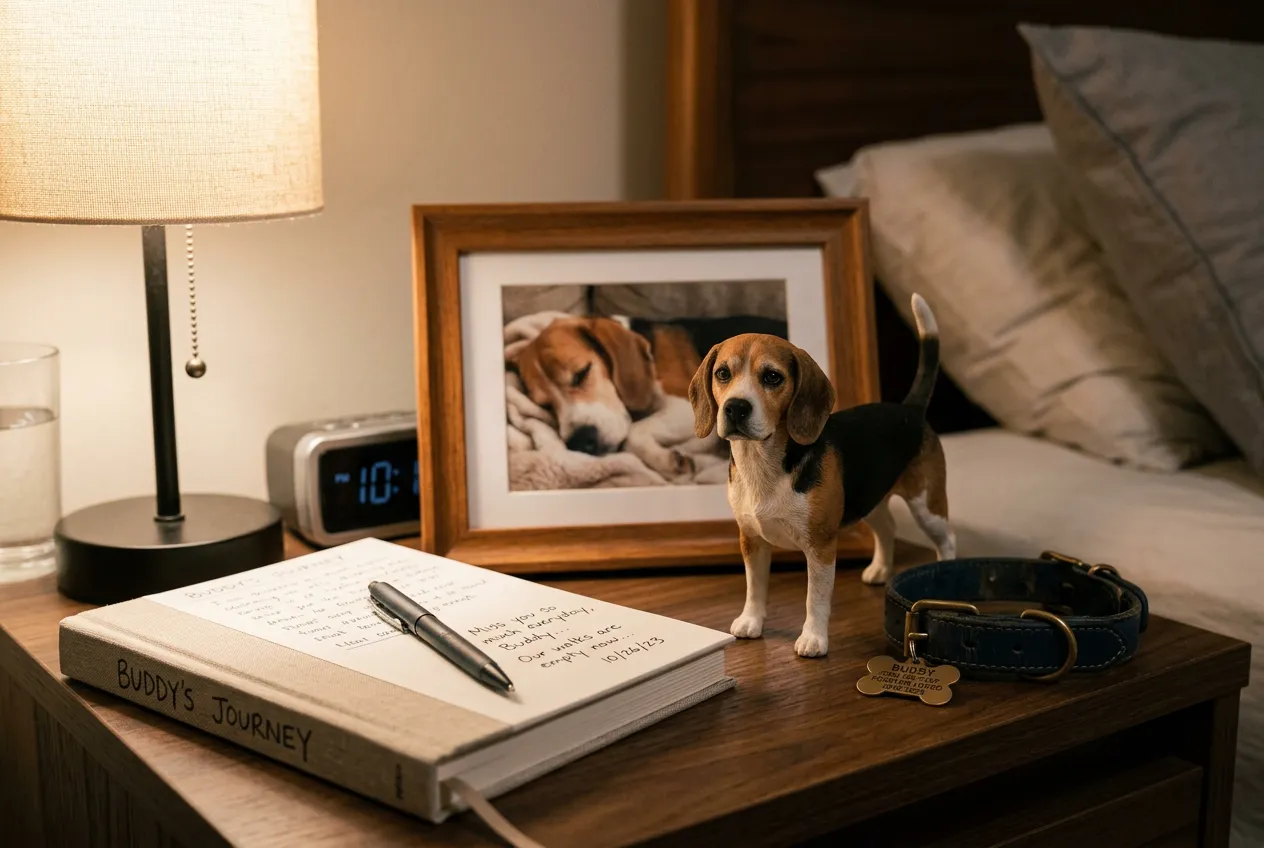
"To live in hearts we leave behind is not to die." Thomas Campbell wrote those words in 1825, and nearly two centuries later, they still crack something open in anyone who has stood in a quiet garden the morning after euthanasia grief took their beagle from the world—stood there hearing nothing but birdsong where a howl should be, feeling the dew soak through their slippers because nobody nudged them back inside.
Quick Takeaways
- The first 48 hours matter most — structure your grief with small, intentional rituals rather than waiting to "feel better"
- Relief after euthanasia is not betrayal — it's a sign you were carrying your beagle's pain alongside your own
- Sound is grief's sharpest trigger — address the silence actively with specific auditory rituals that honor rather than erase
- Physical objects anchor memory — tangible keepsakes like custom pet figurines from PawSculpt give grief a place to rest
- The first week sets the tone — how you move through these seven days shapes your long-term relationship with your beagle's memory
Why the First Week After Beagle Loss Is Unlike Any Other Grief
Most grief literature treats the loss of a pet as a single event—a before and an after, separated by one terrible moment. But anyone who has euthanized a beagle knows the truth is messier than that. The loss actually began weeks or months earlier, during the slow accumulation of vet visits, medications, declined walks, and uneaten kibble. By the time you held your beagle for the last injection, you'd already been grieving.
So the first week isn't the beginning of grief. It's a transition between two kinds of grief—anticipatory and acute—and that distinction matters enormously.
Here's the counterintuitive part: the first week after losing your beagle can feel worse than the weeks of decline that preceded it. During the illness, you had purpose. You were a caregiver. You had tasks—administering pills, monitoring appetite, scheduling bloodwork. That role structured your days and gave your love somewhere to go. Now, suddenly, the role evaporates. And the silence rushes in.
We're not speaking metaphorically about that silence. Beagles are among the most vocal breeds on earth. The American Kennel Club describes three distinct vocalizations: the bark, the bay, and the howl. Your beagle likely used all three—plus an entire repertoire of whines, grumbles, sighs, and that particular throaty sound they made when dinner was thirty seconds late. The acoustic footprint of a beagle in a household is enormous. When it vanishes, the house doesn't just feel empty. It sounds wrong.
That auditory void is what makes beagle loss uniquely disorienting in the first week, and it's why several of the rituals below focus specifically on sound. Not to fill the silence, but to reshape your relationship with it.
| Day | Common Experience | What You Might Feel | What Actually Helps |
|---|---|---|---|
| Day 1 | Numbness, logistical tasks | Shock, surreal calm | Let the numbness be a buffer; handle remains |
| Day 2-3 | The "second wave" hits | Deep sadness, guilt, physical pain | Ritual 1 (The Last Walk) and Ritual 2 (Sound Inventory) |
| Day 4-5 | Attempting normalcy | Anger, isolation, exhaustion | Ritual 4 (The Grief Letter) and community connection |
| Day 6-7 | Stabilizing but fragile | Fear of forgetting, guilt about moving forward | Ritual 7 (The Memory Anchor) and forward-looking plans |

Ritual 1: The Last Walk (Days 1-2)
Within the first 48 hours—before the shock fully fades—take your beagle's leash and walk their route alone.
This sounds brutal. It is. But here's why it works.
A family we worked with recently told us about doing this the morning after their thirteen-year-old beagle, a tricolor named Penny, was euthanized. The husband didn't want to go. The wife insisted. They walked the 1.2-mile loop Penny had taken twice daily for over a decade—past the fire hydrant she always inspected, the neighbor's fence where she'd exchange bays with a German Shepherd, the patch of grass where she'd roll on her back every single time regardless of weather.
"We cried the entire way," the wife told us. "But by the end, we were also laughing. We'd forgotten about the rolling. We hadn't seen her do it in months because she'd been too stiff. The walk brought it back."
The mechanism: grief researchers call this "active remembering"—deliberately engaging with memories rather than being ambushed by them. The difference matters. Ambush memories trigger panic and avoidance. Chosen memories, even painful ones, give you a sense of agency during a period when you feel you have none.
How to Do It
- Bring the leash. Hold it. Let it hang the way it would if your beagle were at the other end. The weight of what's not there is the point.
- Walk at their pace. Not yours. Your beagle stopped at every interesting scent. Stop where they stopped. You won't know exactly where, but your feet will remember some of them.
- Narrate aloud if you can. "This is where you always pulled toward the squirrel." Speaking to your beagle directly during this walk is not irrational. It's ritualistic. Cultures worldwide speak to the deceased during funeral rites.
- End at home. Hang the leash where it always hung. Or don't—put it somewhere new, somewhere intentional. Both choices are valid.
"Grief doesn't need a destination. Sometimes it just needs a familiar path."
Ritual 2: The Sound Inventory (Day 2-3)
This one is unusual, and you won't find it in most pet loss guides. It addresses the specific acoustic grief that beagle owners face.
Sit in the room where your beagle spent the most time. Close your eyes. And listen.
What you'll hear is everything your beagle's presence used to absorb or override—the refrigerator hum, the clock tick, traffic outside, the specific creak of the floor that you never noticed because it was always masked by the click of nails or the rhythm of breathing from a dog bed.
Now—and this is the important part—make a written list of the sounds your beagle made. Not a mental list. A physical, written one. Be as specific as possible:
- The particular pitch of their bay when the mail carrier arrived
- The snuffling sound they made while tracking a scent in the backyard
- The thump of their tail against the couch cushion when you came home
- The soft groan as they settled into their bed at night
- The sound of them drinking water—that messy, enthusiastic lapping
This list serves two purposes. First, it's a memory preservation exercise. Sounds are the first sensory memories to fade, often within weeks. Writing them down while they're still vivid protects them. Second, it externalizes the grief. The silence in your house is overwhelming precisely because it's undifferentiated—one massive absence. Breaking it into specific, named sounds makes it comprehensible. You're not mourning "silence." You're mourning the thump, the bay, the snuffle, the groan. Each one a small, nameable loss rather than one impossible one.
The Counterintuitive Step
Don't play recordings of your beagle's sounds yet. If you have videos with their bark or bay, resist the urge in the first 48-72 hours. The auditory system processes familiar sounds with a speed that bypasses conscious thought—hearing your beagle's howl in the raw early days of grief can trigger a physiological stress response (racing heart, hyperventilation) that feels like re-living the loss. Save the recordings for Ritual 6, when you'll be ready.
Ritual 3: The Guilt Reckoning (Day 2-4)
We need to talk about what you're actually feeling right now, because we'll bet it isn't just sadness.
If you chose euthanasia for your beagle, there is a specific, poisonous thought circling your mind. It might sound like: Did I do it too soon? Or: Did I wait too long? Or perhaps the cruelest version: What if they would have gotten better?
This is the euthanasia guilt spiral, and it affects the vast majority of pet owners who choose humane euthanasia. It doesn't matter how clear the veterinarian was about the prognosis. It doesn't matter how much your beagle was suffering. The guilt arrives anyway, because you are a person who loved an animal enough to make the hardest decision a caregiver can make, and love is irrational.
But here's what we rarely hear discussed—there's often something even harder than the guilt. Many beagle owners feel a wave of relief after euthanasia. Relief that the suffering is over. Relief that the 3 a.m. medication alarms are done. Relief that you don't have to watch your best friend deteriorate anymore. And then—immediately, ruthlessly—guilt about the relief.
That wave of relief you felt when their suffering ended? It doesn't make you a bad person. It makes you someone who loved them enough to prioritize their comfort over your own need to keep them close. The guilt that follows that relief is one of grief's cruelest tricks—it takes your most compassionate impulse and reframes it as selfishness.
The Ritual
Write two letters to your beagle. Not one. Two.
Letter One: The Apology. Pour every guilty thought onto paper. Everything you think you did wrong. Too many treats. Not enough walks in the final months. The time you got frustrated when they had an accident on the carpet. The appointment you wonder if you should have made sooner. Write it all.
Letter Two: The Defense. Now write as if you are your beagle's advocate—a lawyer defending your case. List every good decision you made. The expensive food. The specialist consultation. The extra blanket on cold nights. The hours spent on the floor beside them. The fact that you were there at the end, that your face was the last thing they saw and your voice was the last sound they heard.
Read both letters. Then—and only then—destroy the first one. Tear it, burn it (safely), shred it. Keep the second.
"You didn't end their life. You ended their pain. Those are not the same thing."
"We've worked with thousands of families in the aftermath of pet loss, and the ones who heal best aren't the ones who grieve perfectly—they're the ones who let themselves grieve honestly."
— The PawSculpt Team
Ritual 4: The Forty-Eight-Hour Freeze (Days 1-3)
Do not wash your beagle's bedding for at least forty-eight hours.
This isn't sentimentality. It's neurochemistry.
Scent is processed by the olfactory bulb, which feeds directly into the amygdala and hippocampus—the brain regions governing emotion and memory. Your beagle's scent on their bed, their blanket, their favorite spot on the couch is literally a chemical bridge between your present (without them) and your past (with them). Severing that bridge too quickly can intensify the sense of unreality that accompanies early grief.
| Item | Preserve? | Duration | Rationale |
|---|---|---|---|
| Dog bed/blanket | Yes | 1-2 weeks minimum | Primary scent carrier; most comforting |
| Collar | Yes, indefinitely | Store in a sealed bag to preserve scent | Portable memory anchor |
| Food/water bowls | Your choice | Remove when ready | Some find them comforting, others triggering |
| Toys | Yes | Weeks to months | Lower scent retention but high visual/tactile value |
| Leash | Yes | Indefinitely | Ritual object; see Ritual 1 |
| Grooming brush | Yes | Weeks | May contain fur; irreplaceable |
A few additional notes. If you have another pet in the home, they also need olfactory continuity. Dogs and cats understand death imperfectly, but they understand absence acutely. Leaving your beagle's bedding in place gives a remaining pet the chance to process the change through scent rather than through bewildering, unexplained absence.
When to wash: You'll know. One day, the scent will shift from comfort to anchor—from something that warms you to something that holds you in place. That's the day.
What About the Collar?
Many owners agonize over what to do with the collar. Here's our take: don't decide now. Put it in a ziplock bag to preserve the scent and any residual fur. Place the bag somewhere you won't encounter it accidentally (a closet shelf, not a kitchen drawer). In three to six months, you'll know whether you want to display it, store it, incorporate it into a memorial, or let it go. The first week is not the time for permanent decisions about permanent objects.
Ritual 5: The Notification Ritual (Days 2-4)
You need to tell people. This is harder than it sounds, and not for the reason you'd expect.
The difficulty isn't the act of saying the words. It's the variation in responses you'll receive—and how unprepared you'll be for how much those responses matter.
Some people will say exactly the right thing. Others will say, "It was just a dog." (If someone says this to you, know two things: they are wrong, and you are allowed to limit your contact with them during this period.) Some will share their own pet loss stories at length, which can feel either deeply connecting or exhausting depending on your state. Some will immediately ask, "Are you going to get another one?"—a question that can feel, in the first week, like asking a widow at the funeral if she's planning to remarry.
Here's the commonly overlooked aspect: many beagle owners feel a deep shame about the intensity of their grief. They feel they should be "over it" faster because the lost loved one was a dog, not a human. They compare their grief to others' and find it wanting—or excessive. This internalized judgment can lead to isolation, to hiding the depth of your pain, to performing okayness at work while falling apart in your car during lunch.
You are not overreacting. The AVMA recognizes that the human-animal bond produces grief responses comparable in intensity to the loss of human family members. Your grief is proportional to your love. And you loved a beagle—a breed whose entire evolutionary purpose is companionship, whose eyes evolved to communicate with yours, whose voice evolved to be heard across long distances by human ears. The bond was engineered, biologically and historically, to be profound.
The Practical Approach
- Identify your three safest people. These are the ones who will not minimize, rush, or redirect your grief. Text or call them first.
- Draft a brief message for wider circles (social media, workplace, extended family). Something like: "We said goodbye to [name] this week. We're taking some time. We appreciate your kindness and patience."
- Give yourself permission to ignore responses that don't help. You don't owe gratitude to someone whose sympathy makes you feel worse.
- If you have children, be direct. Children process animal death better with honest, simple language than with euphemism. "Bailey died" is clearer and ultimately kinder than "Bailey went to sleep" (which can create anxiety around bedtime).
Ritual 6: The Controlled Replay (Days 4-6)
Now—and only now—pull out the videos.
You've waited several days. The initial shock has metabolized into something more stable, though no less painful. You're ready to hear their voice again.
Choose one video. Not a highlight reel. Not a montage. One single clip. Ideally one that captures an ordinary moment—your beagle napping, or sniffing something in the yard, or doing that full-body shake after a bath. The mundane moments, it turns out, are the ones that hold the most truth about who your pet actually was, day to day.
Watch it once. Then watch it again, but this time, pay attention to what you hear in the background. Your own voice, probably. The TV. A family member laughing. The clink of dishes. These ambient sounds are a time capsule of your household when your beagle was alive—when the family was complete. They're as much a part of the memory as the bark or the bay.
Why Controlled Replay Works
Uncontrolled replay—scrolling through your camera roll at 2 a.m., cycling through every video, reading every old text where you mentioned your beagle's name—is a form of emotional flooding. It overwhelms the nervous system and can actually impede grief processing by keeping you in a state of acute distress.
Controlled replay is the opposite: a deliberate, boundaried engagement with memory. One video. One viewing (or two). Then put the phone down and sit with whatever surfaced. Journal about it if you can. Talk about it if someone's nearby.
This matters because memory isn't static. Every time you recall something, you slightly alter the memory itself—a well-established principle in cognitive neuroscience. By engaging with your beagle's videos intentionally rather than compulsively, you're more likely to preserve the warmth of the memory rather than coating it with the anguish of the current moment.
"Memory is not a recording. It's a garden—it grows differently depending on how you tend it."
Ritual 7: The Memory Anchor (Days 5-7)
By the fifth or sixth day, a new fear often emerges, one that can feel almost as painful as the loss itself: the fear of forgetting.
You start to wonder—will you remember the exact pattern of their markings? The specific way their ears folded? The precise shade of brown in their eyes? These details, which you knew as well as your own face for years, suddenly feel fragile. Impermanent. And the terror of losing them—of your beagle fading from sharp memory into soft blur—can be acute.
This fear is real, and it's justified. Memory does degrade. Studies in cognitive psychology consistently show that visual and auditory details of familiar stimuli begin to generalize within weeks to months. You won't forget your beagle. But you will, over time, lose specificity. The unique tilt of their head becomes "a beagle tilting its head." Their singular howl merges with the generic idea of a beagle howl.
The ritual: create or commission a memory anchor—a physical, tangible object that preserves the specific details of your beagle, not a generic beagle, not a breed silhouette, but the actual animal who shared your life.
Some families choose framed photographs. Others commission paintings. Some create shadow boxes with collars, tags, and fur clippings. And increasingly, families are turning to technology-driven options like custom pet figurines—three-dimensional reproductions that capture the exact markings, posture, and personality of an individual pet.
This is actually where we first encountered the depth of this need at PawSculpt. When families send us photos of a beagle who has passed, they don't send generic snapshots. They send the photo that "looks most like them"—the one where the expression, the ear position, the body language is most that specific dog. Our digital sculptors then model the figurine in meticulous detail before it's precision 3D printed in full-color resin, capturing markings, coloring, and even the subtle variations in a beagle's tricolor or lemon coat directly in the material itself.
The result isn't a painting or a poster—it's an object you can hold. Pick up. Place on a shelf where your eyes land every morning. That tangibility matters during grief. Grief needs weight. It needs something to rest on.
Other Memory Anchor Options
| Option | Cost Range | Emotional Value | Detail Preservation | Timeframe |
|---|---|---|---|---|
| Framed photo | $ | High (familiar) | Moderate (2D, single angle) | Immediate |
| Custom portrait painting | $$-$$$ | High (artistic interpretation) | Moderate (artist's style) | 2-6 weeks |
| Shadow box (collar, fur, tag) | $ | Very high (sensory) | Low (no visual likeness) | Immediate (DIY) |
| Paw print casting | $ | Moderate (tactile) | Low (shape only) | Immediate or via vet |
| Custom 3D figurine | $$-$$$ | Very high (tangible, specific) | Very high (3D, full color) | Visit site for details |
| Memorial garden stone | $-$$ | Moderate | Low (text/symbol only) | 1-2 weeks |
The point isn't which option you choose. The point is choosing something in the first week, while the details are still vivid. You can always adjust or add later. But beginning the process now—even just selecting photos or gathering materials—gives your grief an active, constructive channel.
Ritual 8: The Threshold Crossing (Day 7)
On the seventh day, do something your beagle never saw you do.
This sounds strange. But it's grounded in a principle that grief counselors increasingly recognize: the danger of the first week is that it becomes the template for the first month, which becomes the template for the first year.
If you spend seven days exclusively in the past—re-watching, re-walking, re-reading—you risk building a grief practice that is purely retrospective. And retrospective grief, over time, calcifies. It stops being a process and becomes a permanent state.
The Threshold Crossing ritual is a small, deliberate act of novelty. It doesn't dishonor your beagle. It honors the part of you that still exists, that still has a future, that your beagle would want to see thriving. (And yes—beagles, of all breeds, would want you thriving. They are relentlessly, almost aggressively, pro-joy.)
What This Might Look Like
- Cook a recipe you've never tried
- Walk a route you've never taken
- Visit a park in a different town
- Start reading a book in a genre you don't usually touch
- Rearrange one room (not your beagle's space—somewhere else)
- Call someone you haven't spoken to in a year
The act itself is less important than its function: it creates a tiny pocket of experience that belongs to your life after loss—proof that you can exist in a new configuration, even if that configuration is painful, even if it's temporary, even if you return to the couch and cry immediately afterward.
You are not replacing your beagle by doing something new. You're acknowledging that your life continues, and that continuation is not a betrayal. It's actually the opposite. It's the most beagle thing you can do—keep moving, keep sniffing, keep following the trail wherever it leads.
Myth vs. Reality: What Most People Get Wrong About Pet Euthanasia Grief
Myth 1: "You'll know when you're ready to move on."
Reality: There is no moment of readiness. There is no bell that rings, no morning where you wake up and think, "Ah, I'm done grieving now." What actually happens is that grief changes shape. It starts as a flood—omnipresent, inescapable. Over weeks and months, it recedes into pools that you encounter unexpectedly: a beagle at the park, the sound of baying on a TV show, the click of nails on hardwood in a dream. You don't move "on." You move with. The grief walks beside you, gradually taking up less of the path.
Myth 2: "Getting another dog will help you heal faster."
Reality: Getting another dog while in acute grief often creates complicated bonding with the new animal. You may unconsciously compare the new dog to your beagle—and the new dog will always lose that comparison, because they're competing against a memory that is polished, idealized, and immune to the irritations of daily life. The general guidance from veterinary behaviorists is to wait until your grief has shifted from acute to integrated—typically several months at minimum. You'll know you're approaching readiness when you can think about a new dog with excitement rather than as a replacement strategy.
Myth 3: "Children get over pet loss quickly."
Reality: Children often grieve longer than adults expect, but they grieve differently. A child may seem fine for days, then dissolve into tears at a seemingly unrelated trigger. They may express grief through behavioral changes—sleep disturbance, irritability, regression—rather than through verbal processing. The first week is critical for children: how you model grief in these seven days teaches them whether sadness is something to be expressed or suppressed. Let them see you cry. Let them see you remember. Let them participate in whatever rituals feel appropriate for their age.
The Sounds That Remain: A Note on Living With Acoustic Ghosts
We want to end the main body of this article with something specific to beagle owners, because it's a phenomenon we've heard described dozens of times, and we've never seen it discussed in a pet loss resource.
In the weeks after losing a beagle, many owners report hearing phantom sounds—a bay, a bark, the jingle of a collar tag—in the edges of other noises. The refrigerator cycles on and for a split second, you hear a grumble. The wind pushes a branch against the window and you hear nails on glass. A child's distant shout carries a frequency that, for one disorienting moment, sounds exactly like a howl.
You are not losing your mind. This is pattern completion—the brain's tendency to fill in expected sensory data. For years, your auditory system was calibrated to a soundscape that included your beagle. It takes time to recalibrate. The phantom sounds will fade, typically within three to six weeks. But while they last, they can be startling, comforting, or both.
Some owners find them unbearable. Others describe them as visits. We won't tell you how to interpret them. But we will tell you this: they are proof of how deeply your beagle was woven into the fabric of your daily life. Not just into your heart—into your nervous system. Into the way your brain literally processes reality.
That depth of integration doesn't disappear in a week, or a month, or a year. It becomes part of you. And carrying it forward—into a life that will eventually include laughter again, and maybe even another set of paws—isn't just possible. It's what your beagle, with their boundless, indiscriminate, full-throated love for being alive, would bay at you to do.
The garden where you stood that first morning, hearing nothing but birdsong? You'll stand there again. And one day—not soon, but eventually—the birdsong won't sound like absence. It will sound like morning. And your beagle's memory will be there too, not as a wound, but as warmth. Not as silence, but as a sound so familiar it has become part of your own heartbeat.
That's not forgetting. That's the deepest kind of remembering there is.
Frequently Asked Questions
How long does grief last after pet euthanasia?
There's no universal timeline, and anyone who gives you a specific number is oversimplifying. Acute after euthanasia grief—the intense, daily, consuming kind—typically lasts two to four weeks for most people. But grief doesn't end so much as evolve. It shifts from a constant presence to an intermittent one, surfacing at triggers (a beagle at the park, a familiar sound, an anniversary). Many owners describe still feeling pangs years later, and that's entirely normal. The goal isn't to stop grieving. It's to reach a point where grief coexists with daily functioning and, eventually, with joy.
Is it normal to feel guilty after euthanizing my dog?
Extremely normal—and almost universal. The guilt often centers on timing: "Was it too soon?" or "Did I wait too long?" Both questions are unanswerable in a way that satisfies, because both reflect the impossible position euthanasia puts you in. You made a decision under conditions of uncertainty, guided by love. That's not something to feel guilty about, even though the guilt will likely visit anyway. If it persists beyond several weeks or interferes with daily life, consider speaking with a pet loss support counselor.
Is it normal to feel relief after putting a pet down?
Completely. Relief after euthanasia is one of the most common—and least discussed—emotional responses. It typically reflects months of caregiving exhaustion and empathetic suffering on your pet's behalf. The relief is not about being glad your beagle is gone. It's about being glad their pain is over. If guilt follows the relief (as it almost always does), revisit Ritual 3 in this article.
How do I memorialize my beagle after euthanasia?
The options range from immediate and free (a journal entry, a dedicated walk) to long-term keepsakes (framed photos, shadow boxes, memorial garden stones, paw print casts, and custom 3D-printed figurines that capture your beagle's exact appearance). The most important thing is to start while details are vivid—within the first week if possible. You can always add to or change your memorial approach later.
When should I get another dog after losing one?
Wait until the desire for a new dog comes from a place of readiness rather than a desire to fill the void. Rushing into a new pet while still in acute beagle loss grief can create unfair comparisons and complicated bonding. Most behaviorists suggest waiting at least several months. A good litmus test: when you can look at a beagle puppy and feel delight without immediately feeling disloyal, you're moving toward readiness.
Do other pets in the household grieve when a companion dies?
Yes. Remaining pets may show decreased appetite, searching behavior (checking the deceased pet's usual spots), increased vocalization or unusual quiet, lethargy, or clinginess. Leave your beagle's bedding in place for a period to allow surviving pets to process through scent. If behavioral changes persist beyond two to three weeks, consult your veterinarian.
Ready to Honor Your Beagle's Memory?
The first week after losing your beagle is a landscape no one can navigate for you—but you don't have to walk it empty-handed. A custom PawSculpt figurine, digitally sculpted by master 3D artists and precision printed in full-color resin, captures the exact markings, expression, and spirit of your beagle—not a generic breed likeness, but your dog, rendered in three dimensions you can hold.
For many families navigating after euthanasia grief, having a tangible, permanent representation of their beagle becomes the memory anchor that turns fear of forgetting into confidence of remembering.
Visit pawsculpt.com to see the process, explore examples, and learn about current options and guarantees