Taking Your Aging Akita's Paw Print Early Isn't Giving Up: A Japanese-Inspired Ritual
"The grief process is not linear." That line from Humane World for Animals comes back on the drive home from the vet, the back seat still smelling of your old dog's warm, dusty coat.
Making a paw print keepsake, senior Akita resting beside you, can feel like rehearsing a goodbye you aren't ready to say. It doesn't have to be. Done slowly and with intention, it becomes something closer to a portrait session: a way of paying attention to a life while it is still here.
Taking your aging Akita's paw print early is not giving up. It is an act of attention. Anticipatory grief before a pet dies is common, and making a keepsake while your dog is alive lets you record the present calmly, on your own terms, rather than in the rushed hours after a loss.
Quick Takeaways
- Grieving before a loss is common, and you can feel it while still loving your dog fully and still hoping.
- A paw print taken on a calm afternoon, on a soft cloth and a low table, can feel like a ritual of presence rather than an ending.
- In a multi-dog home, choose a time and space where your senior Akita isn't jostled, and decide deliberately how the other dogs fit in.
- Gather more than the print: scent, photographs, a few written lines, and other keepsakes all hold different parts of a memory.
- Support exists before a loss too, including free helplines and anticipatory grief groups.
Why an Early Paw Print Can Feel Like a Betrayal
There can be a particular guilt that arrives before the loss itself. You notice your Akita takes the porch steps one at a time now. You notice the long naps, the gray creeping into the muzzle, the way the curled tail rests a little lower on the back. And then, almost involuntarily, you start thinking about afterward. The thought can feel disloyal, as though imagining the absence might somehow hurry it along.
The ASPCA names this plainly: coping with the impending loss of a pet is one of the hardest experiences an owner faces, and anticipatory grief before a pet dies is common. That word, common, is worth holding onto. It suggests the ache you feel while your dog is still sleeping in the next room is not a malfunction of love. You might think of it as love doing what love does when it can see the horizon.
So why does reaching for the clay feel like surrender? Perhaps because keepsakes can seem like artifacts of death. You might imagine them made in the aftermath, assembled from what's left. But consider a portrait: it can be a record of presence, made to hold a living moment still. A paw print can be the same.
Go one level deeper and the guilt may reveal something else. You may fear that preparing for grief means you will "move on" too quickly afterward, that a keepsake is a kind of permission slip to stop hurting. But grief may not work by permission. The Cornell University College of Veterinary Medicine describes pet grief as having no prescribed timeline, varying from person to person, and rarely following a straight path. Making something now may simply mean that when the time comes, you'll have something you made together.
And there is an even quieter reason to do it early: your dog is part of the ritual. Picture an old Akita lying on a folded cotton cloth, sniffing the cool, mineral smell of fresh clay, tolerating your fussing with that dignified half-interest the elderly reserve for silly humans. That scene is only available now.
The Ritual: A Low Table, a Folded Cloth, and Unhurried Attention
To be clear about what "Japanese-inspired" means here: this is not a historical custom with a documented lineage. It's a ritual you build yourself, borrowing a mood rather than a tradition. Low furniture close to the floor. Natural materials. A folded cloth instead of a plastic tray. The idea that the care you bring to an ordinary act can make it meaningful.
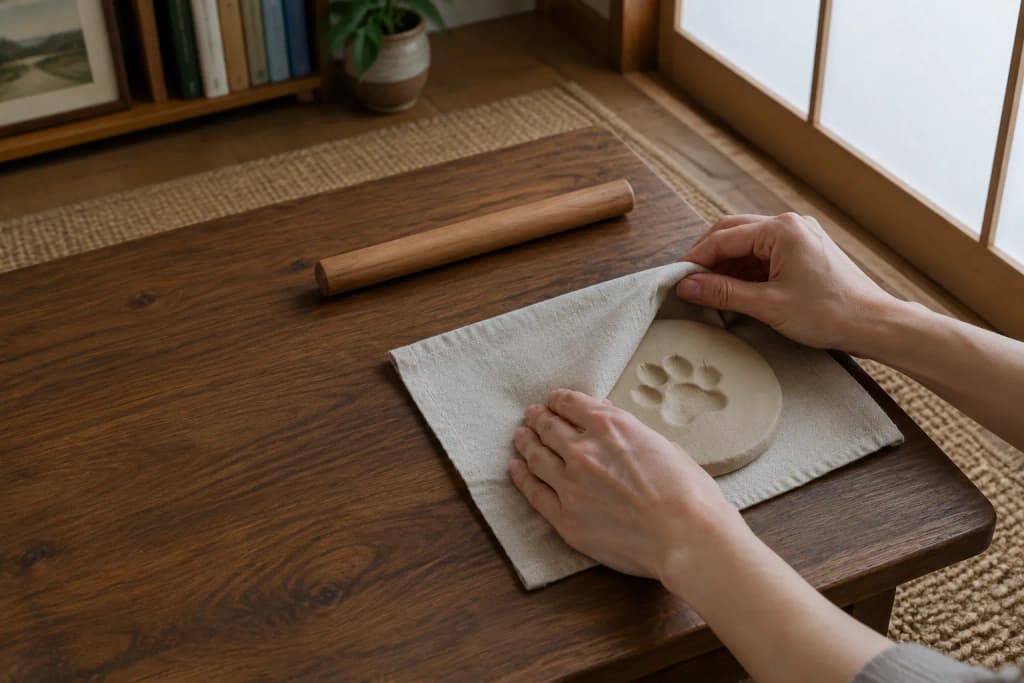
Imagine it this way. A late afternoon, the sliding door open a few inches so the room smells faintly of rain on the porch boards. A low wooden table, low enough that your senior dog doesn't have to stand or climb. On it, a folded square of soft cotton that smells like the laundry and, after a minute, like your dog. A disc of clay softened in your palms. A damp towel nearby. No rush. Your phone set aside, except for the photographs you'll want later.
The steps themselves are simple:
- Prepare the space first. Lay out everything before you bring your dog in, so you're not rummaging while they wait.
- Let your dog settle. If they'd rather lie down, work with a lying paw. A print does not need to be taken standing.
- Warm the clay or ink. Cold, stiff clay requires more pressure. Softer material asks less of a tired body.
- Press gently and briefly. Cradle the paw, lower it, lift it. One clear print is plenty, and a few attempts are fine too.
- Clean the paw right away. A damp, warm towel, then a moment of rest and something your dog loves.
- Write the date and a few words. On the back of the disc, on a card beside it, or in a notebook.
If your dog has sore joints, tender paws, or a medical condition that makes handling uncomfortable, ask your veterinarian before you begin. Your vet can tell you whether there's a better day, a better position, or a reason to skip clay in favor of something gentler.
Common Mistakes and Better Moves
Mistake: Waiting for the "perfect" day when your dog seems strongest.
Better move: Choose an ordinary good day. The print doesn't need to be flawless; it needs to be taken while you both can be present for it.
Mistake: Pressing hard to get a deep, crisp impression on the first try.
Better move: Use softer material and accept a shallower print. A faint impression made gently may mean more to you than a perfect one that left your dog uneasy.
Mistake: Treating the session as a task to finish before the vet appointment or the bad news.
Better move: Frame it as an afternoon spent together. Sit on the floor afterward, breathe in that familiar smell of warm fur and old blanket, and let the clay dry on its own schedule.
Making Room for the Other Dogs in the House
A senior dog in a multi-dog home lives inside a busy household. Younger dogs bump, sniff, crowd the food bowl, and treat any human crouched on the floor as an invitation to play. None of that makes for a calm ritual.
This section is practical rather than behavioral, because how each dog responds is something you know far better than any article could. A few options to think about:
- Separate the time. Do the print while someone else takes the younger dogs for a walk, or in a room with the door closed. Your senior Akita gets undivided attention, and you get a few minutes without managing the pack.
- Bring the others in afterward, if it feels right. Some people like the idea of the whole household being part of the day. Once the print is set aside safely, the others can come in, sniff the cloth, and share in the treats.
- Take prints from everyone, eventually. If you'd like a set, consider taking the younger dogs' prints on a separate day. That way your senior dog's session remains their own, and you aren't quietly signaling to yourself that this is only about loss.
There's a subtler question underneath the logistics, too. If you have several dogs, you may feel a strange loyalty conflict: that making something special for the oldest dog is unfair to the others, or that loving the young ones fully is a betrayal of the old one. This may be the guilt about moving on, arriving early and in disguise. Your heart is not a fixed container to be rationed. The younger dogs' energy in the house doesn't diminish what your Akita means, and taking time to honor one doesn't take anything from the rest.
What to Gather Besides the Print
A paw print captures one thing remarkably well: shape. The particular spread of the toes, the size of the pad, the evidence of weight pressed into something soft. But a dog is far more than shape, and a memory collection can hold several kinds of material.
Scent. You might forget to plan for this sense, and it may be the one that moves you most later. The particular smell of your dog's neck. The bed that smells like sun-warmed fur and a little like the backyard. The cotton cloth from the paw print session, folded and set aside without washing. Some people keep a favorite blanket or collar sealed in a bag or a lidded box. Nothing preserves scent perfectly or forever, but the attempt itself can be a comfort.
Photographs, taken with intention. Not just the snapshots you already have, but deliberate ones: the dog in good light, from several angles, with the coat and markings clearly visible. The red and white of an old coat by a window. The curl of the tail. The way your dog lies with head up, watching the door. These photos serve memory, and if you ever decide on a sculpted keepsake, they also become the reference material an artist works from.
Writing. Cornell notes that writing and art are among the ways some people find support in remembrance. It doesn't need to be polished. A list of your dog's habits. The words they responded to. What the house sounds and smells like when they're in it. A letter to them, if that feels natural. Written now, it carries details that might blur with time.
Sound and video. The thump of a tail against the floor. The soft complaint at dinnertime. A short video of an ordinary evening may hold more than a carefully staged one.
Objects. A collar, a tag, a worn toy, a brush with some fur still caught in it. These don't need curating yet. Just set aside a box.
Thinking about Akita memorial ideas this way, as a collection rather than a single object, can take pressure off any one keepsake to carry everything. The paw print doesn't have to be the whole memorial. It's one texture among many.
When a Paw Print Becomes a Portrait
Some people find that the paw print, set on a shelf, starts to ask for company. A print records the paw. It doesn't record the face, the posture, the particular way your dog looked at you. That's where some families turn to a sculpted portrait, while others are content with photographs and the print itself. There's no right answer, and a figurine is one option among many.
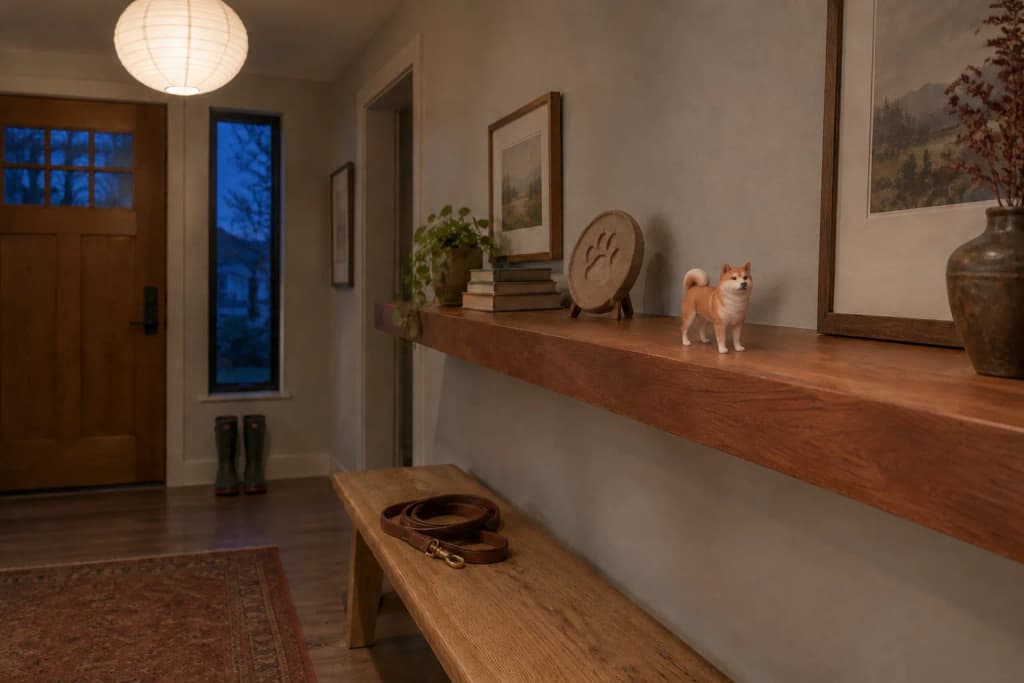
If you're considering one, it helps to understand what you'd actually be getting. PawSculpt makes custom memorial figurines that are artistic interpretations, not photo-exact replicas. The guiding idea is a sculpted portrait, not a photocopy. Here's how the process works:
- Your reference photographs are reviewed.
- An artist digitally sculpts the portrait.
- You confirm the artist preview before anything is printed. Five revisions on the preview are included.
- The approved model is printed in full color in resin on a Mimaki 3DUJ-553. Mimaki lists the equipment as capable of more than 10 million colors, which is a statement about the printer's capability, not a promise about any single figurine.
- Supports are removed, the surface is inspected, and a transparent protective coat is applied.
The color comes from the printer itself rather than from paint applied afterward. The finished piece is meant for indoor shelf display.
There's a reason to think about this while your dog is still with you, and it isn't urgency. It's reference. The photographs you take on a calm afternoon, in good light, with your dog lying exactly the way they always do, give an artist far more to work with than a handful of blurry phone shots gathered in grief. You can take those photos now and decide about a figurine later, or never. The photos are worth having either way.
Some practical facts, for anyone weighing it:
- Figurines range from 2.5 to 6 inches tall. List prices for a single figurine are $429 (2.5-inch), $489 (3-inch), $589 (4-inch), $789 (5-inch), and $999 (6-inch), in USD. A black acrylic base is included.
- A 40% deposit starts the order. A full refund is available before the order enters the IN_DESIGN status; once the artist starts modeling, the deposit becomes non-refundable.
- The first artist preview typically arrives within 7 days after complete references are available and the order enters IN_DESIGN.
- Delivery takes 27 to 40 days after final payment in the US, and 33 to 47 days internationally. No separate shipping fee is added at checkout, though international customers remain responsible for local customs duties, taxes, or import fees.
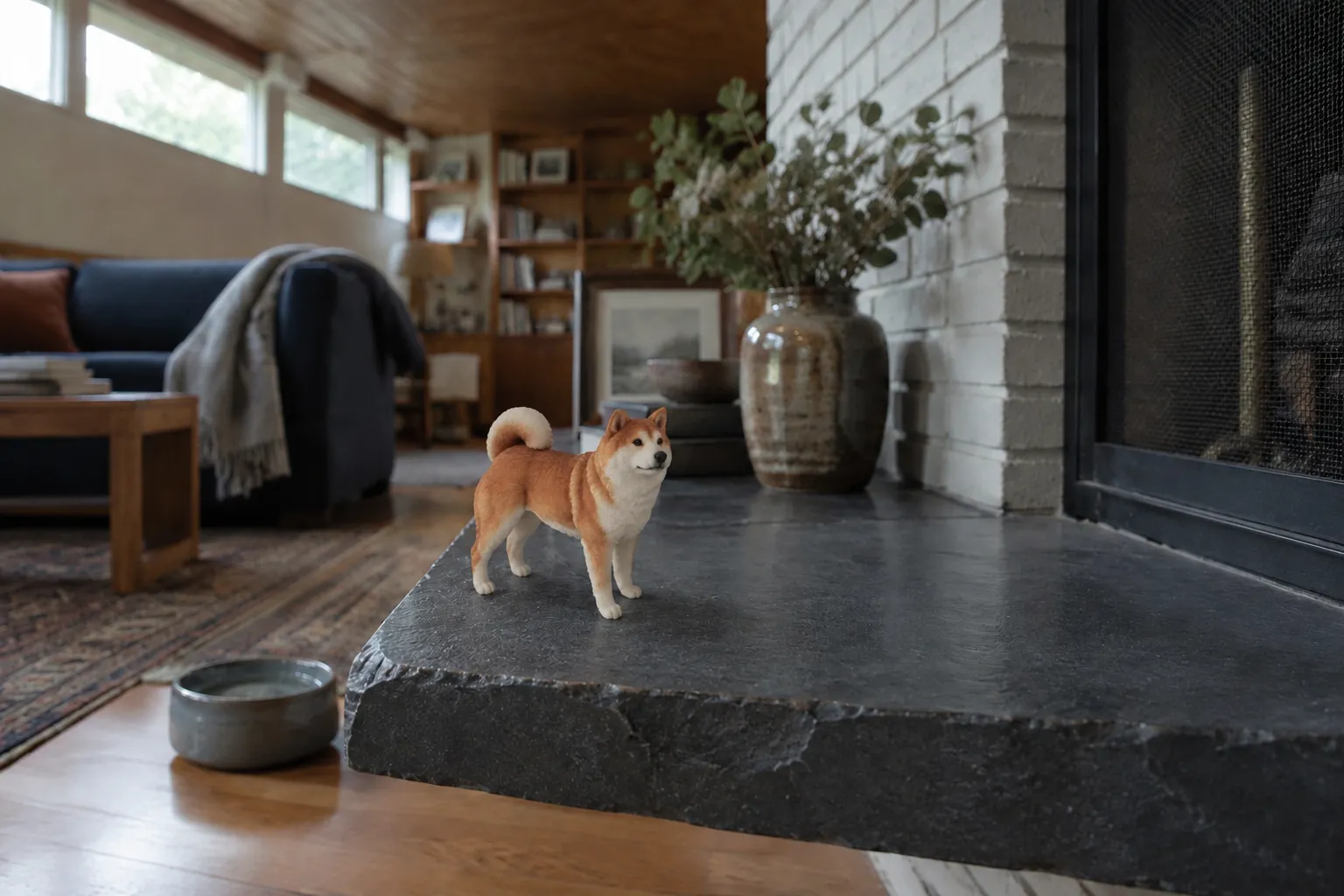
If your household includes more than one dog, a second pet can be added for $179. For larger pieces of 4 inches and up, an extra pet is $199. A small toy can be added for $30, and a nameplate for $9. Picture a figure of an old Akita lying with head up, a tiny clay disc and a folded cloth beside it, and a nameplate reading "Kuma." That's one way to bring the ritual and the portrait together. You can see more examples among the custom pet sculptures.
Support for the Grief That Arrives Early
The paw print, the photographs, the collection of small things: none of these are substitutes for support. If the weight of anticipating your dog's death is pressing on your days, there are people whose work is precisely this.
Humane World for Animals and Cornell both note that loss and grief can affect sleep and daily routine. Cornell's Feline Health Center, writing about grief after the loss of a cat, says there's no correct way to grieve and lists sadness, anxiety, tiredness, guilt, and even relief among normal responses. It also points to professional grief counseling when loss affects daily functioning or sleep.
A few resources drawn from veterinary institutions and hospice providers:
- Tufts University Cummings School of Veterinary Medicine runs a free pet loss support helpline staffed by veterinary students, Monday through Thursday from 6 to 9 pm Eastern, with 24-hour voicemail. Callers are assured a caring, non-judgmental listener.
- Lap of Love Veterinary Hospice offers virtual pet loss support groups, some free and some fee-based, led by certified pet loss coaches. Some of their offerings include anticipatory grief support and support for children.
- The Ohio State University Veterinary Medical Center has an Honoring the Bond program, where veterinary social workers support owners through pet illness, loss, and grief, including quality-of-life decisions and bereavement referrals.
- Cornell University College of Veterinary Medicine gathers pet loss resources and notes that compassionate people, remembrance, writing, and art can help some people.
There's a philosophical comfort in the fact that these programs exist at all. Veterinary institutions recognize the human-animal bond as worth honoring. Your grief, early or late, can be taken seriously by people who have studied this bond closely. You might find it helps to see your grief not as sentimentality but as a response to a real relationship.
And when you feel guilty about the future, about the day you might laugh again, or bring a new dog home, or put the clay disc on a higher shelf, remember what Humane World for Animals says: grief is normal, and it's okay, even important, to mourn the relationship you had. Mourning and living need not be opposites. The print you make on a rainy afternoon, with the door cracked open and the room smelling of wet wood and old fur, is proof that you paid attention. That attention doesn't expire, however your grief unfolds.
Frequently Asked Questions
Is it morbid to take a paw print while my Akita is still alive?
No. Anticipatory grief before a pet dies is common, and making a keepsake now lets you record your dog calmly, while they can be part of it, rather than in the rushed hours after a loss.
What's the gentlest way to take a paw print from a senior dog?
Let your dog lie down, warm the clay or ink so it needs less pressure, press briefly, and clean the paw right away. If your dog has tender joints or paws, ask your veterinarian first.
Should I include my other dogs in the ritual?
That's your call. Some people do the print while the younger dogs are out, so the senior dog gets calm, undivided attention, then let the others join for treats afterward if it feels right.
How long does a PawSculpt memorial figurine take?
The first artist preview typically arrives within 7 days after complete references and the IN_DESIGN status. Delivery is 27 to 40 days after final payment in the US, or 33 to 47 days internationally.
Where can I find support for anticipatory grief?
Tufts runs a free pet loss helpline with 24-hour voicemail. Lap of Love offers virtual groups, including anticipatory grief support. Ohio State's Honoring the Bond program has veterinary social workers.
When You're Ready to Hold More Than a Paw Print
There's no deadline on any of this. The clay can dry on the windowsill, the cloth can stay folded in a drawer, and the photographs can wait on your phone until you know what you want them for.
If, someday, you'd like a sculpted portrait to sit beside the print, PawSculpt's pet memorial figurines begin with your reference photos and an artist preview you confirm before anything is printed, with five revisions included. Start whenever it feels right, whether that's this season, next year, or not at all.