
Missing Your Beagle More in Year Two Isn't Backward: A Family Walking Ritual
Why does the park feel harder to walk past now, nearly two years on, than it did the week your beagle died? If you typed something like "delayed grief beagle second year" into a search bar tonight, you aren't backward.
No. Missing your beagle more in year two is not a step backward. Grief after losing a pet isn't linear and has no prescribed timeline, so a heavier second year can be part of the path. A simple, repeated family walk can give that ache somewhere to go, and give children a role in remembering.
Quick Takeaways
- Grief after a pet's death is not linear, according to Humane World for Animals. A harder second year doesn't mean you've failed at healing.
- There's no prescribed timeline for pet grief, and responses vary from person to person, so everyone in your family may be in a different place.
- A family walking ritual tends to feel easier when it's simple, repeatable, and gives each person, including kids, a small role they can choose.
- You may feel afraid of forgetting your beagle's scent, sounds, and shape. Writing, art, photos, and keepsakes can hold what memory alone feels too fragile to carry.
- If grief is disturbing your sleep or daily routine, free and professional pet loss support exists, and reaching out is a reasonable next step.
Why the Second Year Can Ache More Than the First
You may have braced yourself for the first year. The first birthday without them. The first holiday where nobody nosed through the wrapping paper. The first spring when the back door opened and nothing came running.
And maybe you made it through. Maybe you even felt a little proud.
So why now? Why does the second autumn hit you sideways, on an ordinary Tuesday, when you catch the smell of wet leaves on the walking path and your hand reaches for a leash that isn't there?
Here's what may be happening. The first year can have a kind of scaffolding to it. People may check in. You expect the hard dates. You may be half-numb, half-busy, moving through the firsts like items on a list. The second year may have no list. The casseroles may have stopped long ago. Friends might assume you've "moved on." And the grief, which never actually left, may finally have room to sit down beside you.
That isn't regression. Humane World for Animals puts it directly: the grief process is not linear, your grief is normal, and it's okay, even important, to mourn the relationship you had with your pet. Cornell University's College of Veterinary Medicine describes grief as a gradual journey that rarely follows a straight path, with no prescribed timeline and responses that vary between people.
Read that again, slowly, if you need to. Rarely follows a straight path.
The feelings themselves can be a jumble, too. The Cornell Feline Health Center, writing about the loss of a cat but speaking to anyone who has lost an animal they loved, notes that there's no correct way to grieve and no normal timeline. Grief may include sadness, anxiety, tiredness, guilt, or even relief, and all of those are normal.
Relief, too. If your beagle's last months were hard, you may carry a secret, guilty exhale alongside the sorrow. That doesn't make your love smaller. It means you were there for all of it.
If your beagle's decline was long, you might have started grieving well before the last day. The ASPCA notes that anticipatory grief before a pet dies is common, and that coping with the impending loss of a pet is one of the hardest experiences an owner faces. Some of what you feel now may be the long tail of a goodbye that began much earlier.
The Fear of Forgetting Lives in Your Nose
Let's talk about something you might not have expected.

It may not only be the face you're afraid of losing. It may be the smell.
Picture it. A hypothetical evening, any evening, the kind you used to have without noticing. Rain has just stopped. The porch boards give off that dark, mineral smell of wet wood. Your beagle comes in from the yard and shakes, and suddenly the whole kitchen smells like damp fur and cut grass and something warm underneath, something that was simply them. Maybe their paws had that faintly toasted, corn-chip smell people joke about. Maybe their ears smelled like the inside of a sun-warmed blanket.
You never tried to memorize it. Why would you? It was always going to be there.
And now, in the second year, maybe the old fleece blanket in the closet doesn't smell like much of anything anymore. Maybe you pressed your face into the leash last week and caught only leather and dust. Maybe that moment, more than any anniversary, is what cracked you open.
That may be the fear of forgetting. It can whisper that if the scent goes, the bond goes with it. That if you can't summon the exact weight of their head on your knee, you're somehow letting them slip away.
Here's a gentler way to see it.
Some people think of the bond with an animal as a kind of spiritual contract. You promised to feed them, walk them, keep them safe, and stay with them at the end. They promised, in their own wordless way, to follow you from room to room, to lift their nose at the door, to be present. That contract doesn't dissolve when a blanket stops smelling like fur. The presence you shared was never stored only in fabric.
Memory may change shape. It doesn't have to vanish. The scent may fade from the leash, but the memory of the scent, the rain, the porch, the shake, can be told, written down, drawn, and walked. Which brings us to the ritual.
A Family Walking Ritual for the Second Year
A ritual is just a repeated act you give meaning to. It doesn't need candles or special words. It needs a route, a reason, and permission to feel whatever comes up along the way.

A walk makes sense for a dog you loved. Your beagle may have been the reason you walked at all. Their route lived in your legs. Walking it again, together, on purpose, can turn an old habit into sacred space.
Before you plan anything, check whether this fits your family right now.
Decision Checklist: Is a family walking ritual right for you?
Answer yes or no to each question.
- Do you or someone in your family still think of your beagle when passing a familiar walking spot, like a park or neighborhood loop?
- Would most of your household be willing to walk together, even briefly, at least once?
- Do you have children who seem to want a way to talk about your dog but don't always find the words?
- Does the idea of returning to the old route feel tender rather than unbearable for most of you?
- Are you looking for something simple and repeatable rather than a one-time event?
If you answered yes to three or more, the ritual below may fit. If the old route feels unbearable to anyone, consider a new route, a shorter walk, or one of the other memorial ideas further down. There's no wrong choice.
Choose the route your beagle would have chosen
Not the scenic one. Their one. The loop around the park where they dragged you toward the same patch of clover every single time. The block where they stopped at the hydrant like it was a newspaper.
If the original route is too far, or you've moved, pick a park that smells right. Cut grass, damp earth, pine, whatever carries the season you remember best.
Carry one object
Pick one thing to bring along. The coiled leash is the obvious choice. A child might want to bring something of their own, a knit mitten your beagle once stole and chewed, a ball, a tag. One object is enough. It's not a costume. It's a thread connecting this walk to all the others.
Let whoever is carrying it decide how. Looped over a wrist. Tucked in a pocket. Held in both hands like something breakable.
Walk at beagle pace
Here's the heart of it. Don't walk at your pace. Walk at theirs.
Stop where they would have stopped. Pause at the tree they always sniffed. Breathe in when you get there. What does it smell like today? Wet bark? Somebody's barbecue three yards over? Leaves going soft after rain?
It might feel a little silly at first. That's fine. Walking at someone else's pace is an act of attention, and attention is one of the oldest forms of love.
Make one naming stop
Choose a spot along the route, a bench, a corner, the gate, and stop there together. Each person shares one thing. It can be a memory, a smell, a sound, a habit, or a single word.
"The way she howled at the mail truck."
"His ears flipped inside out when he ran."
"The blanket smelled like popcorn."
Nobody has to speak. Someone can pass. Someone can cry. Someone can laugh so hard they snort. All of it belongs.
Come home through the same door
End where your beagle's walks ended. If that was the back door, come in that way. Hang the leash on its hook, or set it on the bench beside the door, wherever it used to live.
That return can matter. It can close the circle. You went out with them in your hearts, and you came home together.
Decide how often, together
There's no right frequency. Some families choose the anniversary. Some choose a birthday, a first snowfall, or the first warm Saturday of spring. Some walk once and find that once was what they needed.
Ask everyone. Write the answer down. Let it change.
Helping Kids Grieve a Dog Without Rushing Them
If you have children, the second year may look different for them than it does for you. One child may seem fine for months, then crumble at the sight of another beagle at the park. Another may talk about your dog constantly while you can barely say the name out loud. Grief responses vary between people, and that includes the people in your own house.
You don't need to have it figured out to walk beside them.
The walking ritual can give kids something to hold onto: a job. Consider letting each child pick a role.
- The leash keeper carries the object and decides where it rests at home afterward.
- The smell finder notices scents along the route and names them out loud. Rain, grass, mud, the bakery on the corner.
- The story keeper remembers what everyone shared at the naming stop and, if they want, writes or draws it later.
- The pace setter decides where to stop, the way your beagle used to.
Let them switch roles. Let them opt out. A child who'd rather stay home this time hasn't failed the ritual. They're telling you something about where they are, and that's worth hearing.
Use plain, honest words about what happened when they ask. You can say your dog died, that you miss them, and that missing them can come back bigger sometimes. Admitting that you're sad too can be a gift. It may show them grief isn't something to hide.
Some kids may feel the fear of forgetting, too. A child might worry they can't remember what your beagle looked like when they were little. Drawings, a shared photo album, or a small keepsake they can hold may help them feel the memory is safe somewhere outside their own head.
If you're looking for support built for children, some pet loss providers offer it. Lap of Love Veterinary Hospice is one, offering children's pet-loss support alongside its other grief services.
Beagle Memorial Ideas That Can Live Alongside the Walk
The walk is one way to keep your beagle's spirit moving through your life. It doesn't have to be the only one. Cornell notes that remembrance, writing, art, and support resources can help some people. Some, not all. Choose what feels true to your family.
A walk journal
Keep a small notebook by the back door. After each ritual walk, someone writes down what was shared at the naming stop and one smell from the route. Over time, it becomes a record of how your memories shift and settle. Years from now, someone can open it and find "the blanket smelled like popcorn" in a seven-year-old's handwriting.
Children's art
Invite kids to draw the route, their dog, or one moment from the walk. Frame one. Tape the rest inside the journal. Art doesn't have to look like your beagle to hold their presence.
A scent decision
If an old blanket or collar still carries something of them, you might decide, as a family, whether to fold it away for special moments or keep it out where it can be held. There's no right answer here either. Some people find comfort in touching it often. Others want to protect what's left. Talk about it together.
A remembrance gathering
Some veterinary centers hold annual remembrance ceremonies for pets that have died. The Ohio State University Veterinary Medical Center's Honoring the Bond program is one example, rooted in the idea that the human-animal bond deserves to be recognized and honored. You can borrow that spirit at home, too. Invite a neighbor who loved your dog, walk the route, share stories on the porch afterward.
A physical keepsake for the shelf
Some families want something they can see every time they pass the back door. A framed photo works beautifully. So can a sculpted figure.
PawSculpt makes custom pet memorial figurines as sculpted portraits, not photocopies. An artist reviews your reference photos and digitally sculpts the portrait, and you confirm the artist preview before anything is printed. The result is an artistic interpretation of your beagle, not a photo-exact replica, which some people find fits memory better anyway. Memory isn't a photograph either.
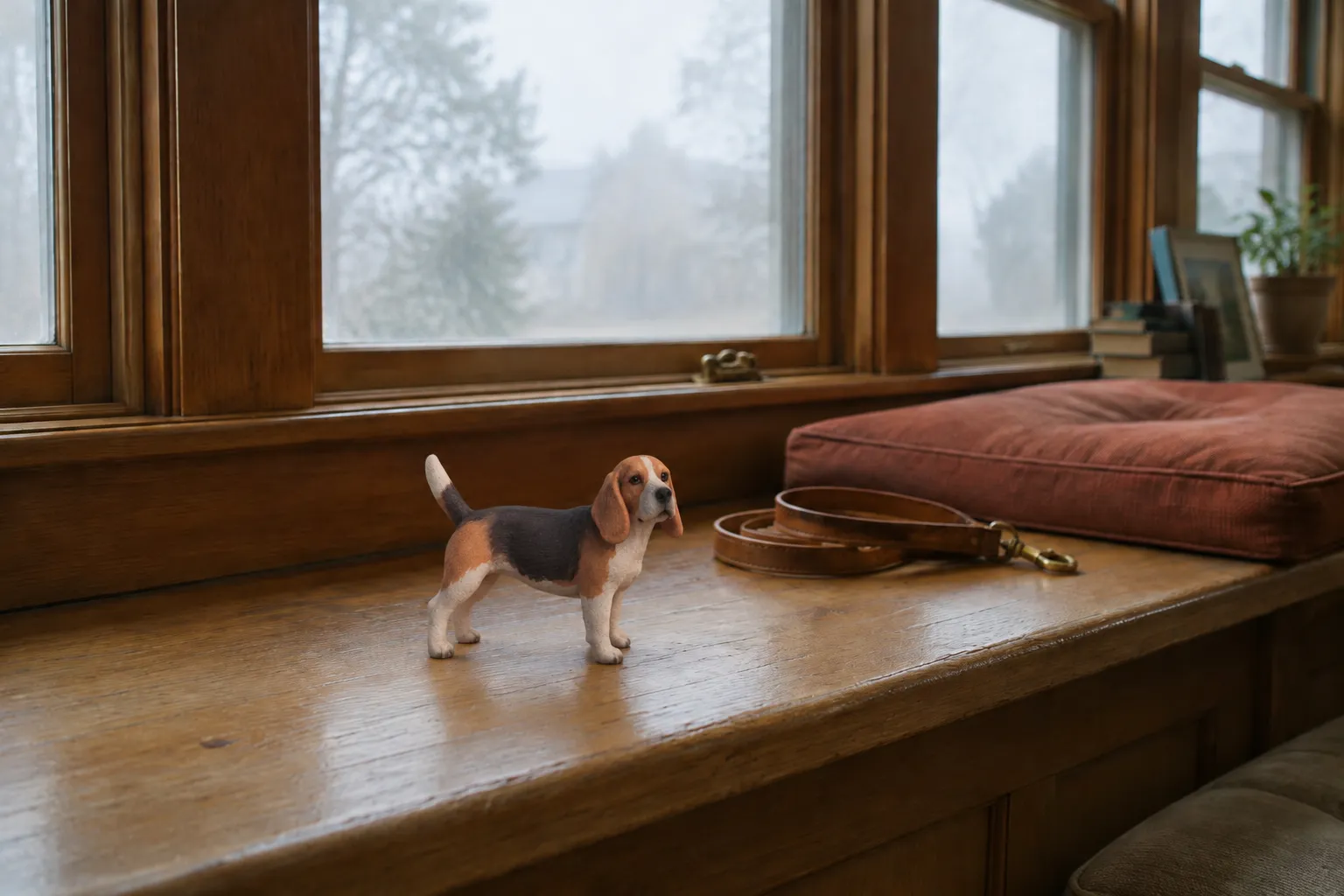
If you picture a figure sitting on the bench by the back door, nose lifted, long ears relaxed, beside the coiled leash and a small mitten, that's the kind of scene a sculpted portrait can hold. It's one option among many. Photos, writing, and the walk itself are just as real.
When the Weight Is Too Heavy to Carry on a Walk
Rituals help some people some of the time. They aren't a cure, and they aren't meant to replace real support.

Loss and bereavement may disturb sleep and routine, according to Cornell. If you've noticed that the second year has started to change how you sleep, eat, work, or move through your days, that's worth paying attention to. The Cornell Feline Health Center notes that professional grief counseling is an option when loss affects daily functioning or sleep.
You don't have to wait until it's unbearable. Here are places to start:
- Tufts University's Pet Loss Support Helpline is free and staffed by veterinary students on Monday through Thursday evenings (Eastern), with 24-hour voicemail. Talking with a supportive, non-judgmental person can help with grief.
- Lap of Love Veterinary Hospice offers virtual pet loss support groups, some free and some fee-based, led by certified pet loss coaches in small-group and one-on-one sessions.
- Veterinary social work programs like Ohio State's Honoring the Bond exist to support owners through pet illness, loss, and grief, and social workers there can help with bereavement referrals.
Reaching out in year two is not a sign that something went wrong in year one. It's a sign that you loved someone, and that the love is still looking for somewhere to land.
Frequently Asked Questions
Is it normal to grieve my beagle more in the second year than the first?
Yes. Grief after a pet's death is not linear and has no prescribed timeline. A heavier second year can simply be part of a path that rarely runs straight, not a sign you're doing something wrong.
How can I help my kids grieve our dog during a family walk?
Give each child an optional role, like carrying the leash, naming smells, or keeping stories. Let them opt out, use honest words, and look into children's pet-loss support from providers like Lap of Love.
What if I'm afraid I'm forgetting what my beagle smelled like or looked like?
Some people feel that fear. Writing down memories, saving children's drawings, keeping photos, or choosing a keepsake can hold what feels too fragile to trust to memory alone.
When should I look for professional grief support after losing my dog?
If grief is affecting your sleep or daily functioning, professional counseling is an option. Free resources like the Tufts Pet Loss Support Helpline are also available, with 24-hour voicemail.
How does a custom memorial figurine work, and how long does it take?
At PawSculpt, an artist sculpts your pet digitally from your photos. The first preview typically arrives within 7 days of IN_DESIGN, and delivery is 27-40 days (US) or 33-47 days (international) after final payment.
A Keepsake for the Bench by the Back Door
If your family would like something to sit beside the leash where the walks begin and end, a sculpted memorial figurine of your beagle is one way to give that presence a shape.
Here's how it works at PawSculpt, plainly:
- Photos first. Your reference photographs are reviewed, then an artist digitally sculpts the portrait.
- You see it before it's made. The first artist preview typically arrives within 7 days after complete references are available and the order enters IN_DESIGN. Five revisions on the preview are included, and nothing prints until you confirm it.
- Printed in full color. The approved model is printed in full-color resin on a Mimaki 3DUJ-553, equipment capable of more than 10 million colors. Supports are removed, the surface is inspected, and a transparent protective coat is applied. It's made for indoor shelf display.
- Sizes and prices. Single figurines are 2.5-inch $429, 3-inch $489, 4-inch $589, 5-inch $789, or 6-inch $999 USD, with a black acrylic base included. A nameplate with your beagle's name is $9, and an extra toy is $30.
- Deposit and refunds. A 40% deposit starts the order. A full refund is available before the order enters IN_DESIGN. Once the artist starts modeling, the deposit becomes non-refundable.
- Delivery. 27–40 days in the US or 33–47 days internationally after final payment. No separate shipping fee is added at checkout for worldwide delivery. International customers remain responsible for local customs duties, taxes, or import fees.
If you're hoping to have it by Christmas 2026, the last order-by date is November 10 for US delivery and November 3 for international delivery. Confirm the preview and pay the balance promptly. Orders placed after the cutoff are delivered in January, and the artist preview, arriving within about 7 days of IN_DESIGN, can be shared as the gift in the meantime.
If you'd like to explore other styles first, you can browse custom pet sculptures for a sense of how a sculpted portrait interprets an animal you love.
And if a figurine isn't right for you, the walk is still there. The route, the leash, the naming stop, the smell of rain on the path. Your beagle's legacy doesn't depend on any object. It lives in the way your family still stops at that one tree.