8 Angles of a Poodle: Why the 'Continental Clip' is a Nightmare to Photograph but a Dream to 3D Print
You are sitting on your front porch, watching the late afternoon sun hit your dog’s coat, realizing that the intricate geometry of that standard poodle cut creates shadows and highlights no camera ever seems to capture quite right. The specific way the light curves around the "jacket" and gets lost in the density of the topknot is a physical phenomenon your eyes appreciate, but your iPhone flattens into a singular, dark blob.
Quick Takeaways
- The "Black Hole" Effect — Cameras struggle with dynamic range on dense poodle fur, flattening 3D volume into 2D silhouettes.
- Cognitive Completion — Your brain fills in the hidden anatomy under a Continental Clip, but a photo cannot trigger this same spatial processing.
- Tactile Memory — We bond through touch; a custom figurine engages haptic feedback loops that photographs physically cannot.
- Structural Integrity — The Continental Clip is architectural; 3D printing is the only medium that builds this structure voxel-by-voxel rather than imitating it.
The Cognitive Dissonance of the Continental Clip
Let’s get technical about why you love this haircut, and why it drives you crazy to document it. The Continental Clip—the hallmark of the show Poodle—is not just "hair." From a cognitive psychology standpoint, it is a manipulation of mass and void. It changes how the mammalian brain processes the silhouette of an animal.
When you look at a Labrador, your brain processes a continuous outline. When you look at a Poodle in a Continental Clip, your brain is forced to engage in modal completion—the psychological phenomenon where the mind "fills in" the missing gaps between the pom-poms, the rosettes, and the jacket to perceive a whole dog.
Photography often fails Poodles because a camera lens lacks binocular disparity. It has one eye. It cannot see around the curve of the ribcage. It flattens the elaborate sculpture of the grooming into a sticker. This is why, when you scroll through your camera roll, the photos rarely feel like your dog. They feel like pictures of a shape.
However, this specific architectural complexity is exactly why the Standard Poodle is the "final boss" level for 3D modeling and printing—and why the results, when done correctly, are scientifically fascinating.
Angle 1: The Geometry of the Jacket (Volume vs. Outline)
The "jacket"—that thick mane covering the chest and ribcage—is the anchor of the Continental Clip.
The Photographic Failure:
In photography, we deal with occlusion. The fur is so dense that light gets trapped within the follicles (especially in black or dark blue Standards). A photograph records this as a void—a lack of data. You lose the sense of the dog's actual muscular structure beneath the hair. You know your dog is powerful and athletic, but the photo just shows a fluffy rug.
The 3D Advantage:
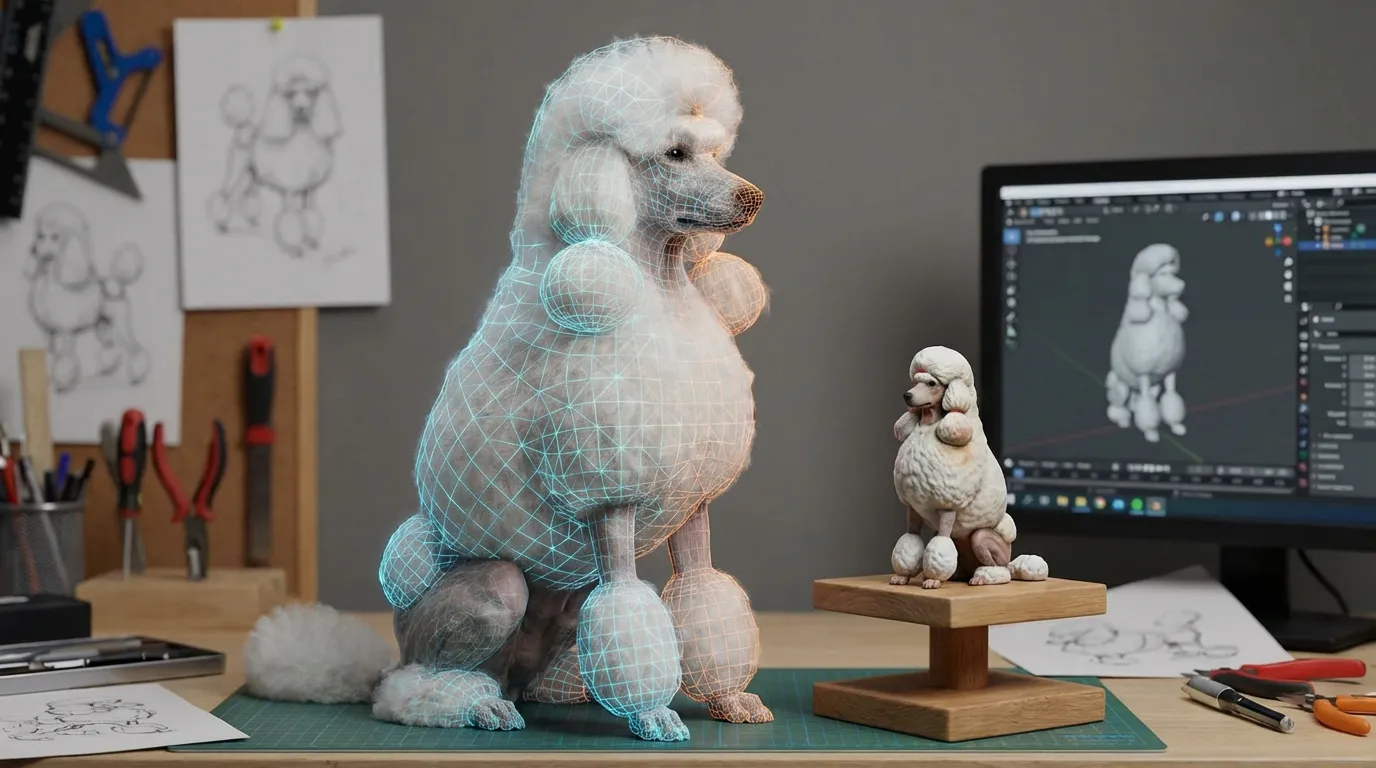
In the world of full-color 3D printing, we don't deal with light absorption; we deal with volumetric data. When a digital artist sculpts the jacket for a figurine, they aren't just drawing the outline. They are calculating the displacement.
"We have to mentally shave the dog, build the anatomy, and then 'grow' the hair back on top digitally to ensure the center of gravity is correct."
— The PawSculpt Team
This ensures that when you hold the figurine, your hand recognizes the mass. It triggers a proprioceptive recognition—the feeling of weight and balance that matches your memory of the living animal.
Angle 2: The Rosettes (Symmetry and Pattern Recognition)
Those two round pom-poms on the hips? They are a nightmare for 2D composition but a triumph for 3D geometry.
The Brain's Demand for Symmetry
Humans are biologically wired to seek symmetry. It signals health and genetic fitness. In a photo, if the dog is standing slightly off-angle (even by 5 degrees), the perspective distortion makes one rosette look oval and the other circular. This triggers a subtle "uncanny valley" response in your brain. Something looks "off," even if you can't articulate it.The Voxel Solution
Our technology doesn't rely on perspective. We use voxels (volumetric pixels). Think of them as microscopic building blocks. In a 3D print, the rosettes are true spheres (or oblate spheroids, depending on your groomer's style). They occupy physical space.When you rotate a PawSculpt figurine on your desk, your visual cortex processes the changing shape of the rosettes exactly as it would the real dog. There is no distortion, only true perspective.
Angle 3: The Topknot and Structural Integrity
The topknot is an act of defiance against gravity. It relies on the stiffness of the hair shaft and, let's be honest, a fair amount of hairspray in the show ring.
The Physics of Hair:
Capturing the "wispy" nature of a topknot in a solid material is one of the hardest challenges in manufacturing. Most generic figurines render this as a solid helmet, which looks ridiculous. It lacks the negative space—the air between the hairs.
Why Resin Wins:
Because we use full-color resin 3D printing (not cast molding), we can print texture resolutions as fine as a human hair. While we can't print individual strands floating in air (they would break), the texture mapping on the surface of the print mimics the way light scatters off the hair tips. This creates the illusion of softness on a hard surface, a tactile trick that delights the brain.
Angle 4: The Shaved Face (The Emotional Center)
This is where the biology of bonding lives. The Poodle's shaved face reveals the micro-expressions that furry-faced breeds (like Goldens or Sheepdogs) often obscure.
Facial Recognition Software (Yours)
Your brain has a dedicated area called the fusiform face area (FFA) specifically for recognizing faces. Because the Poodle's face is exposed, your FFA is highly active when looking at them. You see the slight lift of an eyebrow, the tension in the lip.The Detail Threshold:
A standard ceramic figurine or a hand-painted model usually fails here. Paint is a layer added on top of the surface, which inevitably softens and blurs the sharp details of the eyes and muzzle.
At PawSculpt, the color is embedded in the material. We aren't painting eyes onto a blank face; we are printing the iris, the pupil, and the eyelid as distinct colored materials fused together. This preserves the "snip" of the nose and the intelligence in the eyes that Standard Poodle owners know so well.
| Feature | Photography Limit | 3D Print Advantage |
|---|---|---|
| Eye Contact | Often reflects glare/flash (red eye) | Permanent, clear gaze |
| Muzzle Texture | Looks flat/smooth in 2D | Captures the velvety "shaved" texture |
| Expression | Frozen in a split second (often blurred) | Curated to show their "resting" personality |
Angle 5: The Bracelets (Kinetic Energy)
The pom-poms on the ankles (bracelets) serve a visual function: they accentuate the movement of the dog. They are designed to make the trot look floaty and ethereal.
Static vs. Dynamic:
In a still photo, a bracelet often looks like a heavy weight dragging the leg down. It loses its context of motion.
In a 3D sculpture, we can utilize dynamic posing. By slightly angling the bracelets and shifting the weight of the figurine, we imply potential energy. The brain looks at the statue and anticipates movement. It’s a cognitive trick called implied motion, where neurons in your motion-processing centers fire even though the object is stationary.
Angle 6: The Tail Pom (The Mood Indicator)
The tail is the emotional barometer of the dog. In a Continental Clip, the tail pom acts as a literal exclamation point at the end of the spine.
The Counterintuitive Insight:
Most people think the face is the most important part of a pet portrait. But for Poodle owners, the tail set is equally critical for recognition. A low tail implies fear; a high tail implies alertness.
If a figurine gets the tail angle wrong by even 10 degrees, the owner will subconsciously reject it. It won't "feel" like their dog. This is why our digital sculptors spend an inordinate amount of time adjusting the axial rotation of the tail base before printing.
Angle 7: The Contrast of Textures (Haptic Perception)
Here is where we leave the visual and enter the tactile. A Standard Poodle is a study in contrasts: the velvet of the shaved skin versus the dense cloud of the jacket.
Sensory Mismatch:
When you touch a photograph, you feel glass or paper. There is a sensory mismatch between what you see (soft fur) and what you feel (smooth gloss). This creates a subtle cognitive distance.
The Voxel Texture:
Our 3D prints have a natural, fine-grain texture resulting from the layer-by-layer printing process. While it is hard resin, the visual texture—the way the color data simulates depth—combined with the physical ridges of the print, offers a much more complex sensory experience. It engages your fingertips in a way a photo cannot.
Angle 8: The Color Complexity (Beyond Black and White)
Standard Poodles rarely come in simple colors. You have Silvers that clear over years, Blues that look black in shade and slate in the sun, and Apricots with cream points.
The Limitations of Acrylics:
If you were to hire a traditional artist to paint a figurine, they would mix paints on a palette. They are limited by the chemistry of the pigment. To get "silver," they often use metallic flakes, which looks artificial.
Full-Color 3D Printing:
Our technology mixes colors the way a monitor does—blending millions of colors at the voxel level. We can achieve the "blue" sheen of a black poodle's coat or the complex, muddy gradients of a Café au Lait coat without a single drop of paint. The color is structural. It won't chip off because it is the object.
"Grief isn't a problem to be solved. It's a love story that continues after the last chapter."
Why Tangibility Matters for Bonding
Why go through all this trouble? Why not just frame a photo?
Psychologists have long studied attachment theory and transitional objects. When we lose a pet, or even when we just miss them while at work, our grief or longing is often somatic—we feel it in our bodies. We miss the physical presence.
A photograph engages the eyes, but it ignores the hands. Holding a physical object that represents your dog releases trace amounts of oxytocin—the bonding hormone. It grounds you. It provides a focal point for memory that is three-dimensional, just like the living animal was.
For a breed as architecturally complex as the Standard Poodle, a 2D image simply leaves too much data out. It captures the shadow, but not the substance.
Frequently Asked Questions
Why is the Continental Clip so hard to replicate in figurines?
The clip relies on negative space and varying hair densities. Traditional molding often fails to capture the "airiness" of the topknot or the sharp contrast between shaved skin and pom-poms, resulting in a figurine that looks like a solid block rather than a groomed coat.Do you hand-paint the complex coat colors of Poodles?
No. We use advanced full-color 3D printing technology. The color is built directly into the resin voxel-by-voxel as it prints. This allows for complex gradients—like the clearing of a Silver or the blue sheen of a Black coat—that are incredibly difficult to replicate with traditional acrylic brushes.Can you fix the "black blob" effect from my photos?
Yes. This is the primary advantage of our digital sculpting process. Our artists understand canine anatomy. Even if your reference photos are dark and lack definition, we use the visible silhouette and our knowledge of the breed's structure to reconstruct the muscle and fur texture that the camera missed.How durable are the thin parts like the tail or ankles?
Full-color resin is a sturdy material, similar to a high-quality ceramic or hard plastic. However, the anatomy of a Poodle is naturally fine-boned. We recommend displaying your figurine in a safe place, such as a curio cabinet or deep shelf. The UV-resistant clear coat adds a layer of protection, but these are art pieces meant for display, not play.Ready to Celebrate Your Pet?
The Standard Poodle is a masterpiece of biology and grooming artistry, and a flat photo rarely does that justice. Whether you are honoring a champion who has crossed the rainbow bridge or celebrating the goofy, elegant friend currently sleeping on your sofa, a custom PawSculpt figurine captures the volume, the texture, and the unique personality that makes them yours.
Free instant AI preview • 3D artist preview within 7 days • 5 free revisions