The Calico Challenge: How to Map Your Cat's Chaos for a 3D Artist (A 'Patch-by-Patch' Guide)
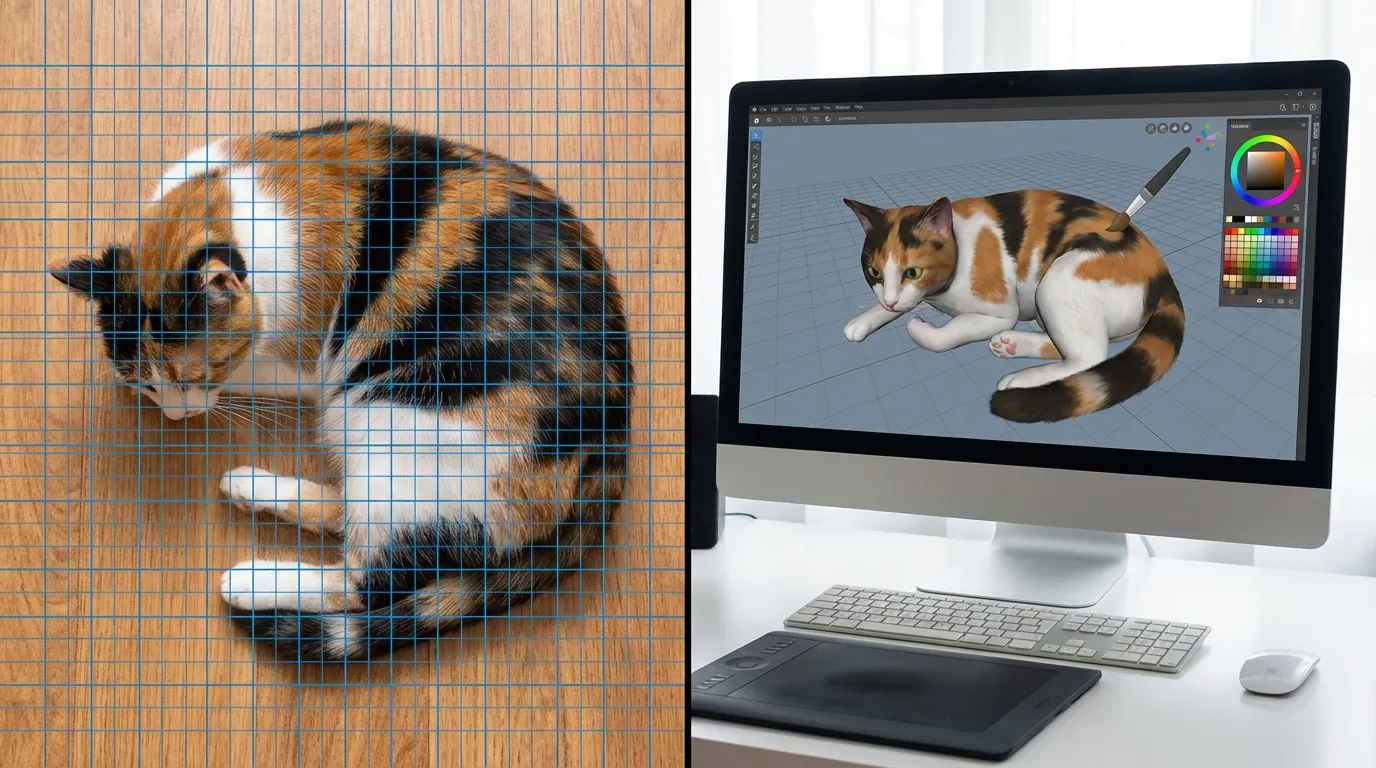
Sunlight fractures across the duvet, illuminating the chaotic geography of Nutmeg’s back—a sudden mountain range of burnt orange rising from a valley of obsidian fur. It’s not just a coat pattern; it’s a fingerprint of her soul, shifting with every breath she takes, a living map of calico cat patterns that defies simple description.
Quick Takeaways
- The "Map" is 3D — A single photo flattens the soul; you need angles that show how colors wrap around the muscle.
- Lighting is Spiritual Clarity — Avoid flash; use soft, natural window light to reveal the true depth of the ginger and black.
- The "Hidden" Geography Matters — The belly and inner legs often hold the secret patterns that define their unique energy.
- Video > Static Images — A slow-motion video captures the flow of the coat better than a dozen still shots.
- Trust the Technology — PawSculpt's full-color 3D printing embeds the pattern into the material, capturing the gradients that hand-painting misses.
The Sacred Geometry of the Calico
To love a calico is to love a creature of distinct, vibrant contradictions. In many spiritual traditions, the calico is seen as a bringer of fortune—the Maneki-neko beckoning good luck—but those of us who share our homes with them know the energy is far more complex. Their coats are not merely fur; they are celestial maps. The interplay of white (spirit), black (grounding), and orange (vitality) creates a unique energetic signature that is never repeated in the history of the universe.
When you decide to immortalize this companion, you face a profound challenge. How do you translate a being of such chaotic beauty into a static form? The mistake most people make is thinking of the pattern as "surface decoration."
A calico’s markings are deep. They interact with the bone structure. A patch of black might accentuate the curve of a hip; a splash of orange might highlight the inquisitive tilt of an ear. To capture the calico cat patterns accurately for a 3D artist, you must stop looking at your cat as a picture and start seeing them as a landscape. You are the cartographer of their physical vessel.
"We don't just model the fur; we model the history written on their coat. Every patch is a chapter."
The Ritual of Observation: Seeing Beyond the Fur
Before you even pick up a camera, you must engage in the ritual of true seeing. We often look at our pets, but rarely do we study the specific boundaries of their being.
Sit with your cat in a quiet moment. Trace the lines where the colors meet. Are the transitions sharp, like a cliff edge? Or do they blur like smoke, the black fading into grey before becoming white? This distinction is critical.
The Borderlands of Color
In the world of high-end 3D modeling, the "transition zone" is where the realism lives. A generic figurine looks like a toy because the colors are painted on top, often with hard, unnatural lines.PawSculpt uses full-color 3D printing technology, which means we don't paint the surface. We print the color voxel by voxel (a 3D pixel) throughout the resin itself. This allows us to capture the "smoke" transitions—the dithering of hairs where an orange patch bleeds into a white chest.
Counterintuitive Insight: The most important part of your cat's pattern isn't the center of the big colored spots—it's the edges. Focus your attention on the boundaries.
Mapping the Cardinal Directions
To create a vessel that truly holds your cat's presence, you need to provide the artist with a 360-degree understanding of the subject. Think of this as casting a circle. You need the view from the North, South, East, and West.
The North View (The Spine Line)
This is the view most pet owners forget, yet it is the most crucial for a calico. The spine is the central meridian of the map.- The Ritual: Wait until your cat is eating or resting in a loaf position. Stand directly above them.
- The Goal: Capture the asymmetry. Calicos are rarely symmetrical. Does the black saddlebag on the left connect to the orange shoulder on the right? This "aerial view" anchors the entire sculpture.
The East and West (The Profiles)
Here is where the personality often lives.- The Specifics: Get down on their level—belly to the floor. Do not photograph from a standing human perspective. Enter their world.
- What to look for: Note how the leg patterns connect to the body. A common error in lesser models is "floating legs," where the pattern on the shoulder doesn't flow naturally down the limb.
The South View (The Face and Chest)
The face is the seat of the soul. For a calico, the facial markings often create an expression that is permanent—a split face that looks half-serious, half-playful, or a "mask" that gives them a bandit-like quality.- The Detail: Look closely at the nose leather and the lips. Calicos often have mottled nose leather—pink with black freckles. These tiny details are what trigger the emotional recognition when you unbox your figurine.
Visualization: The Cartographer's Guide to Lighting
Lighting changes how we perceive the "terrain" of the coat. Use this guide to ensure you are capturing the true energy of the colors.
| Light Source | Spiritual/Visual Effect | Suitability for 3D Modeling |
|---|---|---|
| Direct Sunlight (Noon) | Harsh Truth. High contrast. Washes out white, creates deep shadows in black. | Poor. Hides details in the dark patches. |
| Overcast/Window Light | Soft Revelation. Even, gentle illumination. Reveals the texture within the black fur. | Excellent. The "Gold Standard" for reference photos. |
| Indoor Bulb (Yellow) | Distorted Aura. Casts a warm glow that turns white fur yellow and orange fur muddy. | Avoid. Alters the true color values. |
| Camera Flash | Artificial Shock. Flattens the image, causes "red eye," and creates unnatural reflections. | Terrible. Destroys the depth of the coat. |
The Hidden Geographies: Belly, Chin, and Paws
There are sacred spaces on your cat that are rarely seen by strangers. The belly, the inner thighs, the underside of the chin. These are the areas of vulnerability. When a cat exposes their belly to you, it is a profound spiritual contract of trust.
To map these areas for a custom figurine requires patience and gentleness.
The Belly Map
You cannot force this. You must wait for the "roll." When they stretch out in a sunbeam, snap a quick photo of the undercarriage.- Why it matters: Even if the figurine is standing, the white underbelly reflects light onto the legs. If the artist guesses the belly color wrong, the whole "weight" of the figure feels off.
The Toe Beans and Paw Pads
Calicos have chaotic paw pads. One might be pink, another black, another a mix of both.- The Detail: Try to get a clear shot of the paws. We digitally sculpt these pads. Knowing that your figurine has the exact same speckled toe bean as your beloved companion creates a private connection—a secret only you know is there.
"Grief isn't a problem to be solved. It's a love story that continues after the last chapter."
The Energy of "Tortitude" and Posture
A calico is never just a pattern; it is an attitude. The veterinary world and cat enthusiasts alike often speak of "tortitude"—the feisty, strong-willed nature of tortoiseshells and calicos. While science debates the genetic link, the spiritual truth is undeniable: these cats possess a fiery energy.
How do you map attitude?
It’s in the posture. A standard "sitting cat" pose might not honor a calico who spent 90% of her life stalking birds or sleeping in a contorted pretzel shape.
The Glare: Calicos often have a very direct, intense gaze. Capture photos where they are looking through* the lens, not just at it.
- The Tail: Is the tail a question mark? A bottle brush? A low-sweeping rudder? The tail is the conductor of their energy. Ensure you capture its resting state.
The 3D Artist’s Translation: From Photo to Resin
Once you have gathered your map—your collection of photos and videos—what happens next? This is where the alchemy of 3D printing preparation begins.
At PawSculpt, we don't use automated scanning. A human artist, trained in anatomy and digital sculpting, reviews your "map." They look at the photos and mentally construct the 3D form.
The Myth of the Brush
Many people assume custom figurines are hand-painted. In the past, they were. But a brush is a clumsy tool for the intricate chaos of a calico coat. A brush stroke has thickness; it sits on top of the model.We utilize full-color resin printing. This technology allows us to blend colors at a microscopic level. We can replicate the "salt and pepper" effect where white hairs sprinkle into a black patch. We can capture the translucency of an ear tip in the sunlight. The color is integral to the piece, just as the soul is integral to the body.
"We don't paint on the stripes; we build the color into the resin itself. It’s the difference between wearing a costume and having a skin."
— The PawSculpt Team
When the Map Becomes a Memorial
For many of our clients, this mapping process happens in the twilight of their pet's life, or it is a frantic gathering of old photos after they have passed. This is heavy work. It is grief work.
Scouring hard drives for photos of a cat who has crossed the Rainbow Bridge can feel like reopening a wound. But we invite you to view it differently. View it as a final act of service. You are gathering the pieces of their legacy.
If you are missing a specific angle—perhaps you never took a photo of their tail from the left side—do not panic. Our artists are intuitive. We can look at the surrounding patterns and the breed genetics to reconstruct the missing geography with high probability. We work with you, revising the digital model until you feel that spark of recognition. "Yes," your heart will say. "That is her."
According to research on the human-animal bond, creating a tangible memorial can significantly aid in the processing of grief, providing a physical anchor for memories that might otherwise feel like they are slipping away.
Frequently Asked Questions
How many photos do I need for a complex calico pattern?
While more is always better, quality trumps quantity. We ideally need the "Cardinal Directions" (Front, Back, Left, Right) and a face close-up. If you have 5 clear photos, that is better than 50 blurry ones. For complex calicos, a 10-second video walking around the cat is the holy grail of reference material.Can you capture the tiny ginger freckles on the nose?
Yes. Because we sculpt digitally and print with high-fidelity color lasers, we can place pigment with extreme precision. Those "beauty marks" are often the details that make the owner cry happy tears, so we prioritize them.My cat has passed and I don't have a photo of her back. What do I do?
This is very common. Don't worry. We can use "artistic reconstruction." We look at the visible patterns on the sides and shoulders and, using our knowledge of feline genetics and coat flow, we create a logical and natural continuation of the pattern. You will see a 3D preview to approve before we ever print.Why do you use 3D printing instead of hand-painting?
Hand-painting often leaves brush strokes and can look "thick" or cartoonish on small scales. Full-color 3D printing allows for gradients, shading, and complex patterns (like tabby stripes inside a calico patch) that are incredibly difficult to achieve by hand. It ensures the figurine looks like a miniature version of your pet, not a painted doll.Ready to Celebrate Your Pet?
Every pet has a story worth preserving, but a calico wears her story on her back. Whether you're honoring a beloved companion who's crossed the rainbow bridge or celebrating your furry friend's unique "tortitude" today, a custom PawSculpt figurine captures those chaotic, beautiful details that make your pet one-of-a-kind.
Free instant AI preview • 3D artist preview within 7 days • 5 free revisions