Flopy Ears, Sharp Detail: How a Beagle Figurine Compares to a Flat Canvas Print (Side by Side)
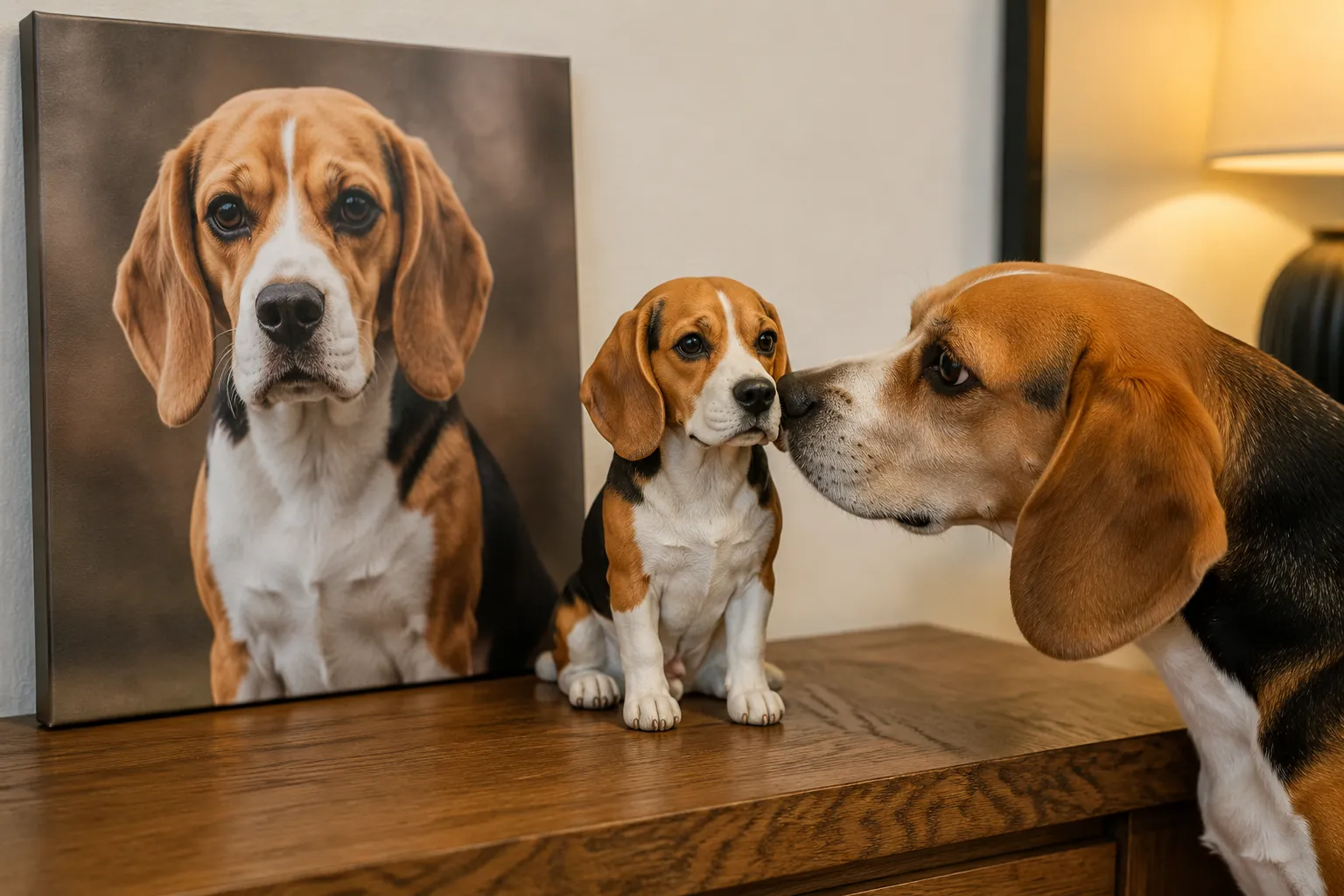
What sound does your Beagle make when he dreams? That low, muffled "woof" pushed into a couch cushion around 9 p.m.? Now imagine that same dog on your shelf. A Beagle figurine vs canvas print comes down to one quiet question: which one will your hands remember?
Quick Takeaways
- A canvas freezes one angle; a figurine holds every angle — including those flop-ear profiles you loved most.
- Floppy-ear breeds reveal a figurine's quality fast — the ear fold is where cheap work falls apart.
- Full-color 3D printing embeds color into the resin — it won't flake, peel, or fade like surface coatings.
- Photos make or break the result — three good reference angles beat twenty blurry ones, and you can see examples of finished work at PawSculpt's custom pet figurines.
- A figurine isn't "better" than a canvas — it's a different sense — touch versus sight, presence versus picture.
Let's Settle the Real Question First: Touch or Sight?
Here's something nobody tells you when you start shopping for pet keepsakes. The choice between a canvas and a figurine isn't really about which one "looks more like" your dog. Both can look like your dog. The honest difference is which sense you're trying to feed.
A canvas feeds your eyes. You hang it, you glance at it, you walk past it forty times a day until it becomes wallpaper in the best way. A figurine feeds your hands. You pick it up. You turn it. You set it down facing the window. That difference sounds small. It isn't.
We've shipped figurines to thousands of pet families, and the same comment comes back over and over: "I didn't expect to hold it so much." People reach for the figurine the way they used to reach for the dog. That reflex — the hand moving before the brain decides — is the whole thing.
"A photo shows you what your dog looked like. A figurine reminds your hands what your dog felt like."
So before you compare price tags or resolution specs, ask yourself the quieter question. When you miss your Beagle, do you miss seeing him, or do you miss the weight of him leaning into your shin under the dinner table? Your answer points you to the right format faster than any feature list.
The Beagle problem (and why it's actually a gift)
Beagles are a stress test. We say that with affection. That breed has three features that punish lazy craftsmanship and reward careful work: the long, low-hanging ears, the tricolor coat with its hard color borders, and that soft, slightly worried brow.
On a flat canvas, those ears are a shape and a shadow. Done. On a figurine, those ears have to exist in space — they fold, they catch light on the leather edge, they hang at the exact droop angle that made your dog look perpetually mid-thought. Get the droop wrong by ten degrees and it stops being your Beagle. It becomes a Beagle.
That's the counterintuitive part. The thing that makes Beagles hard to render in three dimensions is exactly the thing that makes a great figurine feel alive. The difficulty is the payoff.
Floppy Ear Dog Figurine Detail: Where Quality Lives or Dies
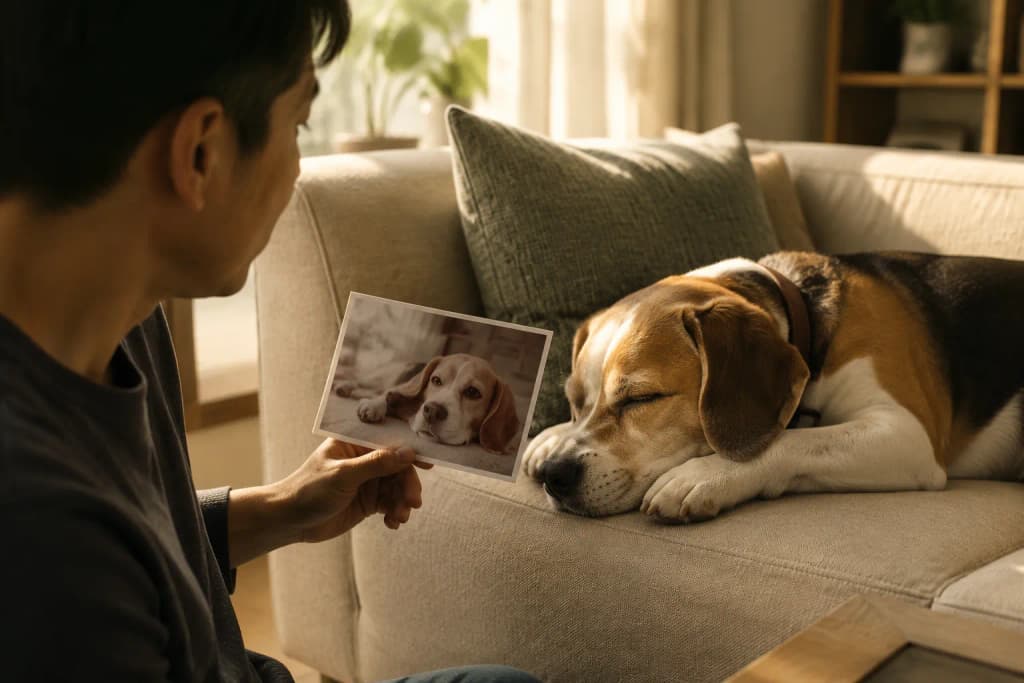
Let's get into the shop-floor reality, because this is where a floppy ear dog figurine detail separates real work from a melted-looking toy.
When our digital sculptors build a Beagle in software like ZBrush or Blender, the ears are the longest conversation. Floppy ears are thin. In the real dog, that ear flap might be a few millimeters of skin and fur. Translate that honestly into a small figurine and you've got a feature that's both delicate and structurally awkward.
Here's the engineering tension nobody mentions. Sculpt the ear too thin and it becomes fragile — a snag-and-snap waiting to happen the first time it tips over on a shelf. Sculpt it too thick and it reads as stiff, like a ceramic dog. The craft is finding the honest middle: thin enough to look like a real ear caught mid-flop, thick enough to survive a decade on your bookcase.
The fold is the tell
Want to judge any floppy-ear figurine in three seconds? Look at where the ear meets the skull.
Cheap or rushed work treats the ear like a flat paddle glued to the head. The fold is a hard seam. But a real Beagle ear emerges from a little gather of skin, rotates, and then the leading edge rolls slightly outward as it falls. That rotation and roll is the detail that fools your eye into believing.
When we sculpt it right, you can run your thumbnail along the inside edge of the ear and feel the subtle ridge where the cartilage would be. That's not decoration. That's the difference between "looks like a dog" and "looks like him."
Personal aside: Honestly, the ear is the part our team argues about most. We've sent versions back and forth where the only note was "the left ear is sitting half a millimeter too high — he looked more curious than that." Sounds obsessive. But that's the half-millimeter that makes a customer cry the good kind of cry when they open the box.
Why a canvas dodges this whole problem
A flat print never has to solve the ear in space. The photographer already solved it — light, angle, focus, done. Whatever the camera caught is what you get, forever, from one fixed point of view.
That's a strength and a limit. The strength: a great photo on canvas is gorgeous and effortless. The limit: you're locked to that one moment, that one angle, that one lighting. You'll never see the back of those ears. You'll never see how they looked from his eye level.
A figurine asks more of the maker precisely because it gives you more to walk around. There's no free lunch in either direction.
How Full-Color 3D Printing Actually Works (No Paint Involved)
Time to clear up the biggest misconception we hear. People assume a custom figurine is a blank white model that somebody sits down and paints with tiny brushes. That's an older, slower, and frankly less consistent way of doing things. It's not how we work, and understanding why matters for what you're buying.
PawSculpt uses full-color 3D printing — the kind of technology where the color is printed directly into the material, voxel by voxel. A voxel is just a 3D pixel: a tiny cube of material that the printer places with its own color already assigned. Think of it like the difference between coloring in a drawing versus printing a photo where the ink is the image.
So your Beagle's tricolor coat — the black saddle, the tan face, the white chest and paws — isn't a coating applied on top. The color is part of the resin itself. That distinction has real consequences for how long your keepsake lasts, which we'll get to.
From your photo to a physical Beagle: the real workflow
Here's the actual sequence, the same one we walk through on every order. No mystery, no marketing fog.
- Reference gathering. We start with your photos. More on what makes a good one below, but the short version: we need to understand your dog's proportions and markings from more than one angle.
- Digital sculpting. A master 3D artist hand-models your pet in sculpting software. This is genuine craftsmanship — it's just done with a digital stylus instead of clay. They're shaping anatomy, coat flow, ear droop, the set of the eyes.
- Color mapping. The artist paints the markings onto the digital model (in software), placing the saddle, the muzzle line, the white blaze exactly where your dog wears them. This data tells the printer what color each voxel should be.
- Full-color printing. The printer builds the figurine layer by layer in UV-cured photopolymer resin, depositing color and material together. Photopolymer just means a resin that hardens when hit with UV light.
- Post-processing. The raw print gets washed, fully cured, and its support structures removed. Then we apply a clear protective coat — the only manual finishing step — for durability and a consistent sheen.
That's it. No brushes. No acrylics. No waiting for paint to dry. The vibrancy you see comes straight out of the print, locked into the resin.
A quick, honest word on print technology
You'll see terms like SLA, MSLA, and DLP thrown around. They're all resin printing methods that cure liquid resin with light — they differ mainly in how they flash that light (a laser, an LCD screen, or a projector). For full-color work, the relevant family is closer to PolyJet/MJF-style processes, where color is part of the deposition.
What you actually care about as a buyer is layer height — how thin each printed slice is. Finer layers mean smoother surfaces and crisper small features like that ear edge. Layer heights in fine figurine work often land in the 25–50 micron range (a micron is a thousandth of a millimeter; a human hair is roughly 70 microns across). We're stating that as a typical industry range, not a fixed spec.
"The color isn't painted on and waiting to chip. It's printed in — part of the material, the way markings are part of the dog."
What "authentic, not plastic-perfect" really means
Here's a bit of straight talk most companies won't give you. A full-color 3D print has a fine surface texture — a subtle grain from those print layers. Under raking light (light hitting from a low angle), you can sometimes catch a whisper of it.
We're not going to pretend that's a flaw to hide. It's the honest fingerprint of the process, and the clear coat smooths and protects it. The result reads as a real, handled object with character — not a glossy, mass-produced injection-molded toy. If a company promises you a flawless, seamless, machine-perfect surface, gently raise an eyebrow. Real resin work has texture, and that's a feature.
Beagle Figurine vs Canvas Print: The Side-by-Side That Actually Matters
Enough theory. Let's put them next to each other on the same shelf and judge them on the things you'll actually notice in daily life.
The table below isn't about which is "better." It's about matching the format to what you need from it.
| What you care about | Canvas Print | Full-Color 3D Figurine |
|---|---|---|
| Primary sense | Sight (wall presence) | Touch + sight (hold and turn) |
| Angles captured | One fixed view | Full 360°, every profile |
| Floppy ear depth | Implied by shadow | Real fold, real droop, real roll |
| Color durability | Surface ink, can fade with UV | Color embedded in resin |
| Space it occupies | Wall (zero shelf footprint) | Shelf, desk, nightstand |
| Best emotional fit | "I want to see him daily" | "I want to hold something" |
See how neither column wins outright? A canvas is unbeatable for filling a wall and being seen from across the room. A figurine is unbeatable for the hand-reach, the turn-toward-the-light, the presence on a nightstand.
The micro-story that changed how we think about this
One family ordered a figurine of their Beagle, Tucker, after he passed. Weeks later the wife emailed us — not a complaint, just a thought she wanted to share. She said the canvas in the hallway was beautiful, but she walked past it without seeing it most days. The figurine, though, sat on the kitchen windowsill. And every morning, making coffee, she turned him to face the sunrise. Same as she used to do with the dog, who loved that warm spot.
That's the thing a flat print can't do. It can't be tended. A figurine invites a small daily ritual, and rituals are how grief slowly turns into remembering.
When a canvas is genuinely the better call
We'll be real, because trust matters more than a sale. A canvas is the smarter pick if:
- You only have one great photo and it's a perfect, framed-worthy shot. Sometimes one image is the memory.
- You're tight on surface space but have empty walls.
- You want something large and immediate — a three-foot canvas commands a room in a way a small figurine can't.
- Your budget points there. A print is generally the more accessible entry point, and there's no shame in that.
A figurine earns its place when you crave dimensionality and touch — when seeing isn't quite enough.
Is a 3D Pet Figurine Worth It? An Honest Cost-of-Meaning Breakdown
Let's address the question you're actually typing into Google at 11 p.m.: is a 3D pet figurine worth it?
We won't insult you with "you can't put a price on love." You absolutely weigh price against meaning — everyone does. So let's weigh it honestly, using the dimensions that matter rather than dodging the question.
| Factor | What you're really paying for | Worth-it signal |
|---|---|---|
| Permanence | Color in the resin won't peel or flake | You want decades, not years |
| Dimensionality | Every angle of your pet preserved | You loved a specific profile |
| Daily interaction | Something to hold, turn, place | You're a "reach for it" person |
| Craftsmanship time | Hours of digital sculpting per pet | You want your dog, not generic |
| Breed difficulty | Floppy ears, complex coats handled right | Beagle, Spaniel, Basset, etc. |
The "worth it" math is personal, but here's our field-tested rule of thumb. A figurine is worth it when your bond was physical. If your relationship with your dog lived in touch — the head on your knee, the lean, the paw on your forearm — then a flat image will always feel like it's missing a dimension. Because it literally is.
If your bond was more visual — a dog you loved photographing, whose best self lived in a particular gorgeous shot — a canvas may satisfy you completely. No upsell needed.
The mistake most people make
The most common error we see isn't choosing wrong between canvas and figurine. It's waiting too long to capture reference photos of a living pet.
Folks assume they'll "do it someday." Then someday arrives under hard circumstances, and the only photos are blurry phone shots from across a room. Sculptors can work magic, but we can't invent the curl of an ear we've never clearly seen.
So here's the actionable bit, whether you order today or in five years: take three clear photos of your pet this week. A profile, a front view, a three-quarter angle. Good light, eye level. File them away. You'll be grateful you did, no matter what you eventually create.
"Every whisker tells a story. Our job is to capture the ones that matter most — the ear that flopped wrong, the brow that always looked concerned."
— The PawSculpt Team
What Photos Work Best (The Part That Decides Everything)
A figurine is only as good as what we have to work from. This is the single biggest factor you control, so let's be specific instead of vague.
The instinct is to send us your favorite photo. The cute one. The one that made you laugh. We love those — but a favorite photo and a useful reference photo aren't always the same thing. A useful reference shows us structure: how the body sits, how the ears hang at rest, where the color borders fall.
Here's what actually helps the sculptors, laid out plainly.
| Angle | Why we need it | Common mistake |
|---|---|---|
| Side profile | Captures ear droop, snout length, posture | Shot from above, distorting proportions |
| Front face | Sets eye spacing, brow, color symmetry | Dark, backlit, or face in shadow |
| Three-quarter | Bridges the two, shows depth | Too far away, dog tiny in frame |
| Coat close-up | Confirms exact marking borders | Blurry, low resolution |
A few field-tested tips that punch above their weight:
- Shoot at your pet's eye level, not standing over them. A downward phone shot makes a Beagle's snout look stubby and the head look balloon-ish. Get on the floor.
- Use soft, even daylight. Near a window on an overcast day is perfect. Harsh midday sun blows out white chests and crushes the black saddle into a shapeless blob.
- More angles beat more megapixels. Three clear ordinary photos from different sides tell us far more than one stunning shot.
- Capture them at rest. Ears in their natural resting flop tell the truth. A photo mid-zoomie has the ears flying — fun, but not how you picture him.
The American Kennel Club's Beagle breed standard is actually a useful sanity check here — it describes the ideal ear set and proportions, which helps both you and us "see" what makes a Beagle read as a Beagle. We cross-reference breed structure against your specific dog so the result is unmistakably yours, not a generic stand-in.
A note on multiple dogs and unusual markings
Got a Beagle with an off-kilter marking — a half-tan ear, a freckled muzzle, a single white sock? Send extra close-ups of exactly that. Those quirks are the soul of the figurine. The "imperfections" are what make people gasp when they open the box, because that's the detail that proves it's him.
If you're ever unsure what to send, our team is happy to look at what you've got and tell you honestly whether it's enough — you can reach out through the PawSculpt contact page before you commit to anything.
Caring for a Full-Color Resin Figurine (So It Outlives the Trend)
You're making something meant to last decades, so let's talk upkeep. The good news: because the color is embedded in the resin, you'll never deal with the flaking or peeling that plagues surface-coated keepsakes. There's no paint layer to chip.
Still, a few simple habits keep it looking right:
- Keep it out of direct, all-day sunlight. We use UV-resistant materials and a protective clear coat, but no resin loves baking in a south-facing window for ten years. A bright room is fine; a sun-blasted sill all summer is asking a lot.
- Dust with a soft, dry brush or microfiber cloth. That fine print texture can hold a little dust in the grain. A quick swipe handles it. Skip harsh chemical cleaners.
- For deeper cleaning, a barely-damp cloth. Then dry it. Don't soak it.
- Mind the thin parts. Those gorgeous floppy ears are the most delicate feature on a Beagle figurine. Lift the piece by the body, not the ears, and you'll never have a problem.
That's genuinely the whole maintenance routine. No re-coating, no touch-ups, no special storage. Set it where you'll see it, turn it toward the morning light now and then, and let it do its quiet job.
"Grief doesn't need a museum. It needs a windowsill, a morning ritual, and something solid to hold."
What to Expect From the Creation Process
People want to know the shape of the journey before they start, so here's the honest arc without pretending to quote exact timeframes (those genuinely vary, and we'd rather you check current details than trust a number that drifts).
The general flow goes like this:
- You submit photos and details. Your dog's name, the angles, any markings you want emphasized.
- A digital preview is created. You get to see the sculpt before anything is printed — this is your chance to weigh in.
- Revisions happen. This is the half-millimeter-ear stage. Tell us if the brow looks too worried or the saddle sits too far back. We'd rather adjust the digital model than have you settle.
- Full-color printing and finishing. Once you approve, the figurine is printed in resin, cured, cleaned, and clear-coated.
- It ships to you. And ideally, it ends up on a windowsill facing the sunrise.
For current turnaround windows, revision details, and the guarantee, head straight to pawsculpt.com — we keep those details updated there rather than baking them into an article that might age.
The part we'd flag as most important: don't skip the preview review. The families happiest with their figurines are the ones who spoke up during the preview stage. "His ears flopped a little lower." "She had a wider blaze." Those notes are gold. The digital stage is exactly when changes are easy and free of waste.
The Emotional Truth Nobody Puts in the Product Description
We'll close the main section with something honest, because you deserve more than a feature list.
A keepsake doesn't fix anything. It won't fill the spot at the foot of the bed or stop you from reaching for the leash hook out of pure muscle memory. We've heard from enough families to know that grief doesn't bargain. The pet-loss community at the Association for Pet Loss and Bereavement talks about this well — there's no shortcut, no object that closes the wound.
But here's what a figurine does do. It gives the love somewhere to land. When the missing hits — and it hits in sound first, doesn't it, the absence of nails clicking on hardwood, the silence where the morning stretch-and-yawn used to be — your hand has somewhere to go. You pick him up. You turn him toward the light. You set him down.
That's not magic. It's just enough.
Frequently Asked Questions
Is a Beagle figurine really better than a canvas print?
Neither is objectively better — they feed different senses. A canvas is unbeatable for wall presence and being seen daily from across the room. A figurine wins when you want to hold something, turn it, and see every angle including those flop-ear profiles. Choose based on whether your bond lived in sight or in touch.
Is a 3D pet figurine worth the money?
It's most worth it when your relationship with your pet was physical — the lean, the head on your knee, the weight against your shin. A figurine restores the dimension a flat photo can't. If your bond was mostly visual, a canvas may satisfy you completely, and that's a perfectly good choice.
Do you hand-paint the figurines?
No. We use full-color 3D printing, where the color is printed directly into the resin, voxel by voxel — the color is part of the material, not a layer on top. The only manual finishing step is applying a clear protective coat for durability and a consistent sheen.
What photos work best for a custom Beagle memorial figurine?
Three clear ordinary photos beat one stunning blurry one. Send a side profile, a straight-on front face, and a three-quarter angle, all shot at your dog's eye level in soft daylight. Add a close-up of any unique markings. Capture the ears at natural rest, not mid-zoomie.
Will the color fade, peel, or chip over time?
Because the color is embedded in the resin rather than coated on the surface, there's nothing to flake or peel. We use UV-resistant materials with a protective clear coat. To preserve long-term vibrancy, keep it out of all-day direct sunlight and dust it gently with a soft cloth.
Why are floppy ears so hard to get right on a figurine?
Floppy ears are thin, delicate, and have to exist in real space — they fold, droop, and roll at the leading edge. Too thin and they're fragile; too thick and they look stiff. The fold where the ear meets the skull is the tell. That's exactly why a well-made floppy-ear figurine feels so alive.
Ready to Celebrate Your Pet?
Every pet has a story worth preserving. Whether you're honoring a Beagle who's crossed the rainbow bridge or celebrating a goofy, ear-flopping companion still snoring on your couch, a custom PawSculpt figurine captures the details that make your dog one-of-a-kind — the exact ear droop, the worried brow, the markings only your dog wears. When you're weighing a Beagle figurine vs canvas print, remember it's not about which looks more like him. It's about which one your hands will reach for.
Visit pawsculpt.com to explore our full-color 3D printing process, preview options, revision flexibility, and quality guarantee.