
How to Display Your Whippet Figurine So Guests Actually Ask About It — A Beginner's Placement Guide
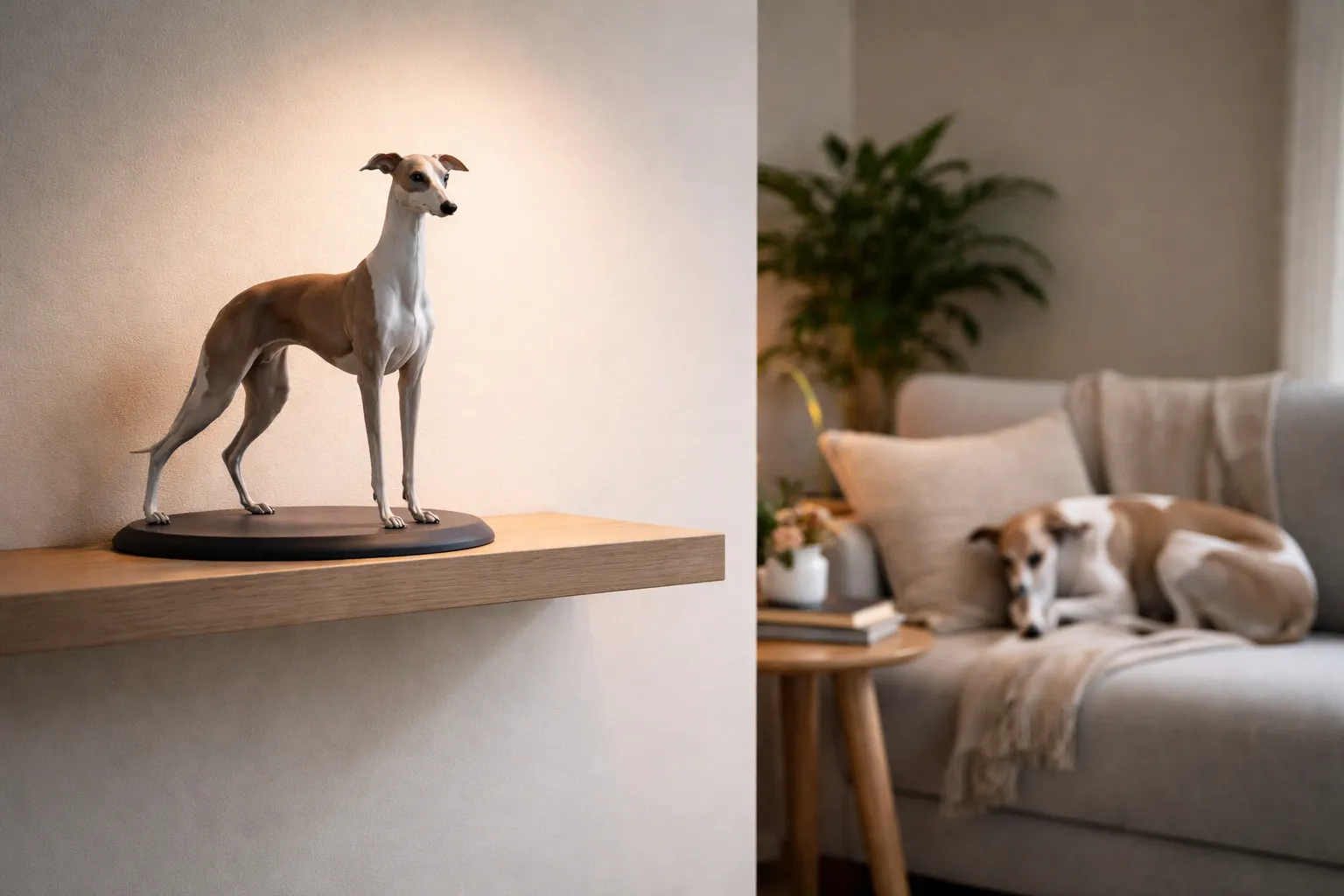
You're standing in your living room, holding a full-color 3D printed Whippet figurine, and you already know—you're about to put it somewhere forgettable. A shelf. A mantel corner. Somewhere it'll collect dust instead of conversation. Let's fix that.
Quick Takeaways
- Eye-level placement beats top-shelf placement — guests notice what's at their natural sightline, not what's above their heads
- Lighting direction matters more than brightness — a single angled light source reveals the figurine's dimensional detail
- Negative space is your secret weapon — surrounding your figurine with emptiness draws the eye faster than crowding it with décor
- A custom 3D printed figurine deserves context — pair it with one meaningful object that tells the story behind the piece
- The "three-second rule" determines conversation starters — if a guest can't identify what makes it special in three seconds, reposition it
Why Most Figurine Displays Fail (And Nobody Tells You)
Here's the thing nobody talks about in home décor guides: placement isn't about aesthetics alone—it's about narrative. You can put a gorgeous piece in a "beautiful" spot and it'll still go unnoticed. Why? Because you treated it like decoration instead of what it actually is—a portal.
Your Whippet figurine isn't a vase. It isn't a candle. It's a compressed story. The curve of that deep chest, the tuck of those impossibly thin legs, the brindle pattern printed directly into the resin at a resolution often in the 25–50 micron range (that's thinner than a human hair)—all of it carries meaning. And meaning needs a stage, not a shelf.
"The best figurines don't decorate a room. They haunt it—gently."
The counterintuitive insight most display guides miss: the goal isn't to make your figurine look good. It's to make your figurine look inevitable. Like it belongs so completely in that spot that removing it would leave a wound in the room's energy. That's when guests stop, point, and ask.
We've worked with thousands of pet families at PawSculpt, and the ones who get the most comments on their figurines aren't the ones with the fanciest shelves. They're the ones who understood something spiritual about placement—that where you put a sacred object determines whether it radiates or retreats.

Understanding Your Figurine's Physical Properties (Before You Place It)
Before we talk about where, we need to talk about what. Because full-color resin 3D print has specific material properties that affect display decisions—and ignoring them leads to the two most common failures we see: UV fading and thermal warping.
What You're Working With
Your figurine is made from UV-cured photopolymer resin with embedded pigments. That's a mouthful, so here's what it means in plain English: the colors aren't sitting on top of the material like paint on a wall. They're baked into the resin itself, voxel by voxel (a voxel is basically a 3D pixel), during the printing process. Then a clear coat is applied for protection and sheen.
This matters for display because:
- Direct sunlight is the enemy. UV light degrades photopolymer resin over time. Not catastrophically—we're talking months to years of direct exposure—but why risk it? You wouldn't hang an oil painting in a sunbeam.
- Heat sources cause subtle warping. Resin has a glass transition temperature (the point where it starts to soften). For most display-grade resins, that's well above room temperature, but placing your figurine directly above a radiator, near a heat vent, or on an electronics surface that runs hot? That's asking for trouble over time.
- The clear coat handles humidity well, but extreme moisture (bathroom steam, outdoor covered porches in humid climates) can cause bloom—a cloudy white haze on the surface.
| Environmental Factor | Safe Zone | Caution Zone | Avoid |
|---|---|---|---|
| Sunlight | Indirect/ambient light | Filtered window light (sheer curtains) | Direct sun exposure |
| Temperature | 60–78°F (normal room temp) | Near warm electronics | Above radiators, heat vents |
| Humidity | 30–60% relative humidity | Kitchens (occasional steam) | Bathrooms, outdoor porches |
| Vibration | Stable surfaces | Near speakers (low volume) | Washing machines, heavy foot traffic |
The Whippet-Specific Challenge
Whippets have a unique silhouette problem that most breeds don't: extreme length-to-width ratio on the legs. Those elegant, impossibly slender legs that make the breed so striking also make the figurine's center of gravity higher and narrower than, say, a Bulldog figurine.
This means your display surface needs to be genuinely level. Not "looks level." Actually level. A surface that tilts even two or three degrees can create enough lateral stress on those thin resin legs over months to cause micro-fractures at the ankle joints. We've seen it happen—usually on old mantels that have settled unevenly over decades.
A quick phone-level-app check takes ten seconds and saves heartbreak.
The Psychology of Guest Attention (Where Eyes Actually Go)
Let's get into the real science of why some displays spark conversation and others don't. This isn't about taste. It's about how human visual attention actually works in unfamiliar spaces.
The First-Visit Scan Pattern
When someone enters a room they haven't been in before (or haven't been in recently), their eyes follow a predictable pattern. According to environmental psychology research, guests perform what's called a "threat-then-interest" scan:
- Doorways and exits (unconscious safety check)
- Other humans in the room
- Movement (TV, pets, curtains blowing)
- Anomalies at eye level — things that break the expected pattern
That fourth step is your opportunity. Your Whippet figurine needs to register as anomaly—something that interrupts the visual rhythm of the room just enough to pull focus.
The "Pattern Interrupt" Principle
Here's what most display guides get wrong: they tell you to create a "beautiful vignette" with complementary objects. Candles, books, plants, figurine—all arranged prettily. And it does look nice. But it also looks like décor. And guests' brains are trained to skip décor.
What actually works is contrast. Not color contrast (though that helps). Spatial contrast. Your figurine needs to exist in a pocket of visual quiet—surrounded by enough negative space that the eye has nowhere else to land.
Think of it this way: if your figurine is one voice in a choir, nobody hears it. If it's a solo voice in a quiet room, everyone turns.
"A figurine surrounded by nothing becomes everything in the room."
The Three-Second Rule
We developed this heuristic after years of hearing customer feedback about their displays. Here's the test: have someone walk into the room and count to three. If they haven't noticed the figurine, it's in the wrong spot.
Not "noticed it eventually." Not "saw it when they sat down." Three seconds from crossing the threshold. That's your benchmark.
If it fails the three-second test, one of these is usually the problem:
- It's too high (above natural sightline)
- It's too crowded (competing with other objects)
- It's too expected (in a "normal" spot for decorative objects)
- The lighting isn't differentiating it from its surroundings
Room-by-Room Placement Strategy for Your Whippet Figurine
Now let's get specific. Every room in your home has different light conditions, traffic patterns, and conversational dynamics. The right room depends on what you want the figurine to do—and that's a question most people never ask themselves.
Living Room: The Conversation Catalyst
Best for: Guests who stay30+ minutes, dinner parties, family gatherings
The living room is the obvious choice, but obvious doesn't mean wrong—it means you need to be more intentional about the where within the where.
The counterintuitive move: Don't put it on the main focal wall (where the TV or fireplace is). Put it on the approach wall—the wall guests face as they walk toward the seating area. This catches them during movement, when their attention is still scanning, before they've settled into "relaxation mode" and stopped noticing their surroundings.
Specific spots that work:
- A console table behind the sofa (visible to anyone entering, invisible to people already seated—which creates a discovery moment when they stand up to leave)
- A floating shelf at exactly54–58 inches from the floor (average eye level for standing adults)
- Inside a glass-front cabinet with a single LED puck light (the glass creates a "museum effect" that signals importance)
What to pair it with: One item only. A small framed photo of your Whippet, or a single object that tells the story—their collar, a favorite toy, a small plant they used to sniff on walks. The pairing creates narrative. Two objects tell a story. Seven objects tell nothing.
Entryway: The First Impression
Best for: Short visits, delivery people who linger, the moment guests arrive
The entryway is underated for figurine display because people assume it's too transient—guests pass through too quickly. But that's exactly why it works. A striking object in a transient space creates a "wait, what was that?" effect that lingers in the mind and often gets mentioned later: "Hey, what was that figure by your door?"
The key constraint: entryways have variable light throughout the day. Morning sun, afternoon shadow, evening lamp. Your figurine needs to read well in all conditions, which means:
- Place it against a neutral, matte background (not a mirror, not a window)
- Use a warm-toned LED strip or puck light (2700K–3000K color temperature) that stays on regardless of natural light
- Position it at hand height, not eye height—entryways are where people reach for keys, adjust shoes, grab bags. Hand-height objects get noticed because they're in the action zone.
Home Office: The Zoom Background Star
Best for: Remote workers, video calls, the figurine as professional personality signal
Here's a placement strategy nobody talks about: your Whippet figurine as a deliberate Zoom background element. We live in an era where your background is your personal brand during work calls. A distinctive figurine—especially one as elegant and unusual as a Whippet—becomes a conversation starter with colleagues and clients.
The technical requirements for Zoom visibility:
- Place it 18–24 inches behind your head position, slightly off-center (left or right of your head, not directly behind)
- Ensure it's lit from the front or side (backlighting makes it a silhouette on camera)
- The figurine should be large enough to be identifiable on a laptop screen—typically 6+ inches tall for a Whippet in standing pose
One of our customers—a graphic designer—told us she gets asked about her Whippet figurine on nearly every client call. It became her icebreaker. Her brand. That's the power of intentional placement in a digital-first world.
Bedroom: The Private Ritual
Best for: Memorial figurines, deeply personal pieces, the sacred and the quiet
If your Whippet figurine represents a companion who's crossed over, the bedroom might be its true home. Not because guests will see it there—they won't. But because some objects aren't meant to perform. They're meant to hold space.
The bedroom placement is about your relationship with the piece, not anyone else's. It's the last thing you see before sleep. The first thing that catches morning light. A ritual anchor.
For bedroom placement:
- Nightstand, facing the bed — so you see it from your pilow
- Dresser top, near a window with sheer curtains — soft, diffused morning light creates a gentle glow on the clear coat without UV damage
- A dedicated small shelf — even a single floating shelf,8 inches wide, mounted at seated eye level from the bed
The smell of your bedroom—your sheets, your candle, the lingering scent of your morning coffee—becomes associated with the figurine over time. That's not accidental. That's how sacred objects work. They absorb the sensory context of their environment until they become that context.
Lighting: The Single Biggest Factor Nobody Gets Right
We'll be real: lighting accounts for about 60% of whether a figurine display works or fails. You can nail every other variable—height, spacing, background—and still have a forgettable display if the lighting is wrong.
Why Full-Color Resin Responds Differently to Light
Because the color in your figurine is embedded in the resin material itself (not layered on top), it interacts with light differently than a traditionally painted object. The clear coat adds a subtle sheen that catches directional light, while the resin beneath has a slight translucency at thin edges—like ear tips or tail points on a Whippet.
This means:
- Directional light reveals dimension. A single light source from one side creates shadows that emphasize the figurine's sculptural form—the tuck of the waist, the arch of the spine, the delicate musculature.
- Flat, overhead light kills dimension. Standard ceiling lights illuminate everything equally, which makes3D objects look flat and uninteresting.
- Warm light enhances resin's natural warmth. Cool white LEDs (5000K+) can make resin look slightly clinical. Warm white (2700K–3000K) brings out richness.
The Three Lighting Setups That Work
| Setup | Cost | Difficulty | Effect Best For | |
|---|---|---|---|---|
| Single LED puck light (battery) | $8–15 | Easy (adhesive mount) | Dramatic spotlight, strong shadows | Shelves, cabinets, dark corners |
| LED strip behind/below shelf | $15–30 Moderate (requires outlet) | Soft halo/backlight effect | Floating shelves, glass cabinets | |
| Adjustable desk lamp (angled) | $20–50 | Easy (just position it) | Gallery-style directional light | Desks, console tables, mantels |
Our favorite: The single LED puck light, positioned above and slightly in front of the figurine at a 45-degree angle. It mimics museum lighting, costs almost nothing, and runs on batteries so you're not dealing with cords. The shadows it casts behind and beneath the figurine create a sense of gravity and presence that flat lighting simply cannot achieve.
The "Raking Light" Trick from Museum Conservation
Here's an insider technique from the world of fine art conservation: raking light. It's when light hits a surface at an extreme angle (nearly parallel to the surface), revealing texture that's invisible under normal lighting.
For your Whippet figurine, try this: position a small light source so it hits the figurine almost from the side—maybe 15–20 degrees above horizontal. This reveals the subtle surface texture of the full-color 3D print (fine layer lines that give it an organic, non-plastic quality) and makes the fur texture sculpted into the digital model pop dramatically.
It's the difference between "oh, that's nice" and "wait—how is that made? Is that real fur texture?"
"We've learned that the figurines people ask about most aren't the ones in the brightest spots. They're the ones where light and shadow are doing equal work."
— The PawSculpt Team
The Art of Context: What to Place Near (and Far From) Your Figurine
The One-Object Rule
We mentioned this earlier, but it deserves its own section because it's the most violated principle in figurine display. Your Whippet figurine should have exactly one companion object. Not zero. Not three. One.
Zero objects makes the figurine look lonely—like it was placed there temporarily and you forgot to finish decorating. Three or more objects makes it part of a "collection," which the brain processes as a group and skips over individually.
One companion object creates a relationship. A dialogue. The viewer's brain automatically constructs a narrative connecting the two items, which creates engagement and—crucially—questions.
Companion objects that work:
- A small framed photo of your Whippet (creates immediate "oh, that's a real dog!" recognition)
- Their collar or a single tag (the smell of old leather, the jingle of metal—even visual references to smell and sound create sensory engagement)
- A small piece of driftwood or stone from a place you walked together
- A single dried flower or small plant (living green next to preserved form creates a beautiful tension)
Companion objects that don't work:
- Other figurines (competition, not conversation)
- Candles (they become the focal point because of flame/scent)
- Books stacked "decoratively" (reads as generic styling)
- Too-large objects that dwarf the figurine
The Background Matters More Than You Think
The wall or surface behind your figurine is its canvas. And like any canvas, it can enhance or destroy the subject.
Best backgrounds:
- Solid, matte colors (warm whites, soft grays, deep navy, forest green)
- Textured surfaces (raw wood, linen, concrete) that contrast with the figurine's smooth clear coat
- Empty space (a blank wall section is powerful)
Worst backgrounds:
- Busy wallpaper or patterned surfaces (visual noise)
- Mirrors (they double the visual information and confuse the eye)
- Windows (backlighting turns the figurine into a silhouette)
- Other art or photos (competition for attention)
The ideal scenario: your Whippet figurine sits against a surface that's visually quiet but texturally interesting. Think of a smooth, color-rich figurine against a rough plaster wall. The contrast in texture makes both surfaces more interesting.
What We Wish We Knew Sooner
Candid retrospective insights from the PawSculpt team:
On height: We used to recommend mantel placement for everything. Then we started asking customers to send photos of their displays, and we noticed something—the figurines on mantels almost never got mentioned by guests. Too high. Too expected. The ones coffee tables, entry consoles, and desk corners? Those sparked conversations constantly. Lower is almost always better.
On dust: Nobody wants to talk about this, but resin figurines with clear coat are dust magnets in certain environments. If your home has forced-air heating, you'll notice dust accumulating faster than on other surfaces. A glass cloche (a dome-shaped cover) solves this completely while adding a "specimen" quality that actually enhances the display. You can find them for $15–30 at any home goods store.
On the "too precious" trap: Some customers place their figurine so carefully, so protectively, that it ends up in a spot nobody ever sees or interacts with. Wrapped in bubble wrap in a cabinet. Behind glass in a room they never use. We get it—the piece is meaningful, and you're afraid of damage. But a figurine that's never seen is a story that's never told. The clear coat is durable. The resin is solid. Let it live where life happens.
On seasonal rotation: One thing we never expected—some of our most satisfied customers rotate their figurine's location seasonally. Summer on the porch table (shaded, not in direct sun). Winter by the reading chair. Spring on the kitchen windowsill (north-facing). It keeps the piece feeling fresh and gives them a reason to reconnect with it intentionally, like a small ritual of attention.
On scent association: This surprised us. A customer once told us she keeps her Whippet's figurine next to a small dish of dried lavender because her dog used to roll in the lavender bushes in their yard. Every time she catches that scent, she looks at the figurine and feels her dog's presence. The figurine became anchor for a full sensory memory—not just visual, but olfactory. We think about that all the time now.
Common Mistakes That Kill the "Wow" Factor
Mistake #1: The Crowded Shelf
You have a beautiful bookshelf. It's full of books, photos, small plants, candles, travel souvenirs, and now—somewhere in there—a Whippet figurine. The problem isn't that the shelf is ugly. It's that your figurine is one voice in a crowd, and the crowd wins.
The fix: Clear a single shelf completely. Leave only the figurine and its one companion object. Yes, it'll feel "empty" to you at first. That emptiness is the point. It's what makes guests' eyes land there instead of sliding past.
Mistake #2: The Trophy Case Effect
Putting your figurine in a glass display case with other collectibles—Funko Pops, sports memorabilia, travel figurines—sends a specific message: "I collect things." It categorizes your Whippet figurine as a collectible rather than a memorial or portrait. And collectibles don't spark emotional questions. They spark "oh cool, you collect stuff" and then conversation moves on.
The fix: If you want the glass-case look for dust protection, use a solo cloche or single-item display case. The isolation signals that this piece is different. Special. Not part of a collection—a thing unto itself.
Mistake #3: Fighting the Room's Natural Focal Point
Every room has a natural focal point—usually the largest window, the TV, or the fireplace. Placing your figurine directly next to or on the focal point means it's always competing with something that has an inherent advantage (fire moves, TVs glow, windows show the world).
The fix: Place your figurine on the secondary focal axis—the spot your eyes go after they've checked the primary focal point. In a living room with a fireplace, that's often the console table on the opposite wall. In a room with a large window, it's the wall perpendicular to the window. You're not fighting the room's energy. You're catching the rebound.
Mistake #4: Ignoring the Approach Angle
Your figurine has a "best side." For Whippets, it's almost always the three-quarter profile—slightly angled so you see the length of the muzzle, the curve of the neck, and the depth of the chest simultaneously. Straight-on front views flatten the Whippet's most distinctive feature (that incredible side profile). Straight-on side views lose the face.
The fix: Before you commit to a spot, stand where guests will most commonly view it from (the doorway, the sofa, the dining chair) and rotate the figurine until the three-quarter angle faces that viewpoint. This single adjustment can transform a "nice figurine" into a "how is that so lifelike?" moment.
According to the American Kennel Club's Whippet breed profile, the breed's defining physical characteristic is its aerodynamic silhouette—that deep chest tapering to an impossibly narrow waist. Your display angle should celebrate exactly that.
The Spiritual Dimension: Placement as Ritual
We want to talk about something that might feel a little unusual for a "display guide." But we've heard it from enough customers that we think it matters.
Where you place your figurine isn't just a design decision. For many people, it's a spiritual one.
The act of choosing a spot—of clearing space, adjusting light, positioning the piece just so—is a ritual. It's an act of devotion. You're saying: this being mattered. This presence shaped my life. And I'm giving it a permanent place in my home because its energy still lives here.
We've had customers tell us they talk to their figurines. That they touch smooth resin head as they pass by, the way they used to scratch behind their Whippet's ears. That the figurine has become a node in their daily rhythm—a point of connection to something that transcends the physical.
If that resonates with you, consider this: the "best" spot for your figurine might not be the most visible one. It might be the most sacred one. The corner of the kitchen where your dog used to wait for scraps. The spot by the back door where they'd press their nose to the glass. The reading nook where they'd curl against your legs.
These spots won't impress guests. They'll nourish you.
And maybe that's the real answer to "how to display your Whippet figurine so guests actually ask about it." Maybe the figurines that spark the most questions are the ones placed with such obvious intention—such clear love—that visitors can feel the weight of meaning radiating from the spot. They don't ask because the figurine is in a clever location. They ask because they can sense it's in a holy one.
A Quick-Reference Placement Checklist
Before you commit to a spot, run through this:
- The three-second test — Can a guest entering the room spot it within three seconds?
- The eye-level check — Is it between 48–60 inches from the floor (seated or standing sightline)?
- The light test — Is there directional light hitting it from one side, not flat overhead light?
- The negative space test — Is there at least 6 inches of clear space on all sides?
- The background test — Is the surface behind it visually quiet (solid color, matte texture)?
- The angle test — Is the three-quarter profile facing the most common viewing position?
- The companion test — Is there exactly one meaningful object nearby (not zero, not three)?
- The environment test — Is it away from direct sun, heat sources, and high humidity?
- The stability test — Is the surface genuinely level? (Use your phone's level tool.)
- The meaning test — Does this spot feel right to you, not just look right to others?
Closing: The Space You Clear
You started this guide holding a figurine, unsure where to put it. And maybe you expected a simple answer—"put it on the mantel" or "try a floating shelf." But the truth is more interesting than that.
The place where your Whippet figurine belongs isn't determined by interior design rules. It's determined by the quality of attention you bring to the choice. The space you clear—physically and energetically—is the space where your pet's spirit continues to live in your daily world.
That full-color resin form, with its embedded pigments and protective clear coat, with its digitally sculpted accuracy capturing every curve of your Whippet's singular body—it's not decoration. It's a threshold. A thin place where the boundary between presence and absence gets soft.
So put it where you'll feel that softness. Where guests will sense it too, even before they understand why they're drawn to look. Where the light falls just right, and the space around it breathes, and the scent of your home wraps around it like a familiar blanket.
That's where it belongs. You already knew that. You just needed permission to trust it.
And when someone inevitably stops mid-conversation, points, and asks—"wait, is that your dog?"—you'll smile. Because the answer is yes. It still is.
Frequently Asked Questions
Where is the best place to display a pet figurine?
The best spot is at natural eye level—between 48 and 60 inches from the floor—with directional lighting from one side and plenty of negative space surrounding it. Avoid crowded shelves where it competes with other objects. The "approach wall" (the wall guests face as they walk into a room) consistently outperforms mantels and high shelves for sparking conversation.
How do I protect a 3D printed resin figurine from damage?
Full-color resin figurines with a clear coat are more durable than most people expect. Keep yours away from direct sunlight (UV degrades the photopolymer over time), heat sources above normal room temperature, and high-humidity environments like bathrooms. For dust-prone homes with forced-air heating, a glass cloche provides excellent protection while enhancing the display's visual impact.
What lighting works best for displaying a figurine?
A single LED puck light positioned above and slightly in front at a 45-degree angle creates the most dramatic, museum-quality effect. Warm white light (2700–3000K color temperature) enhances the resin's natural warmth. Avoid flat overhead ceiling lights, which eliminate the shadows that give three-dimensional objects their sense of depth and presence.
Can I display a resin figurine near a window?
Yes, but with precautions. North-facing windows with indirect light are ideal. For other orientations, use sheer curtains to filter UV rays. The clear coat provides some UV resistance, but prolonged direct sun exposure over months will eventually affect the embedded pigments. Indirect natural light actually looks beautiful on full-color resin—it's direct beams you want to avoid.
How do I make my figurine a conversation starter for guests?
Apply the three-second rule: if a guest can't spot and identify your figurine within three seconds of entering the room, reposition it. Pair it with exactly one meaningful companion object (a photo, a collar, a small memento) to create narrative context. The combination of visual isolation, intentional lighting, and a story-telling companion object is what transforms "nice figurine" into "tell me about this."
What photos work best for ordering a custom pet figurine?
Clear, well-lit photos from multiple angles are essential for the digital sculpting process. Include front, side, and three-quarter views showing your pet's unique markings, body proportions, and facial features. Natural outdoor light produces the most accurate color reference. For details on photo requirements and the full creative process, visit PawSculpt's FAQ page.
Ready to Celebrate Your Whippet?
Every Whippet has a silhouette that stops people mid-stride—that impossible combination of power and grace frozen in a single form. A custom PawSculpt figurine captures exactly that: the deep chest, the tucked waist, the elegant curve of spine that makes your dog unlike any other. Now you know how to display your Whippet figurine so it gets the attention it deserves.
Visit pawsculpt.com to explore the full process, materials, and service details