The Complete Guide to Ordering a Figurine of a Deceasedachshund — What to Do When You Only Have Old Photos
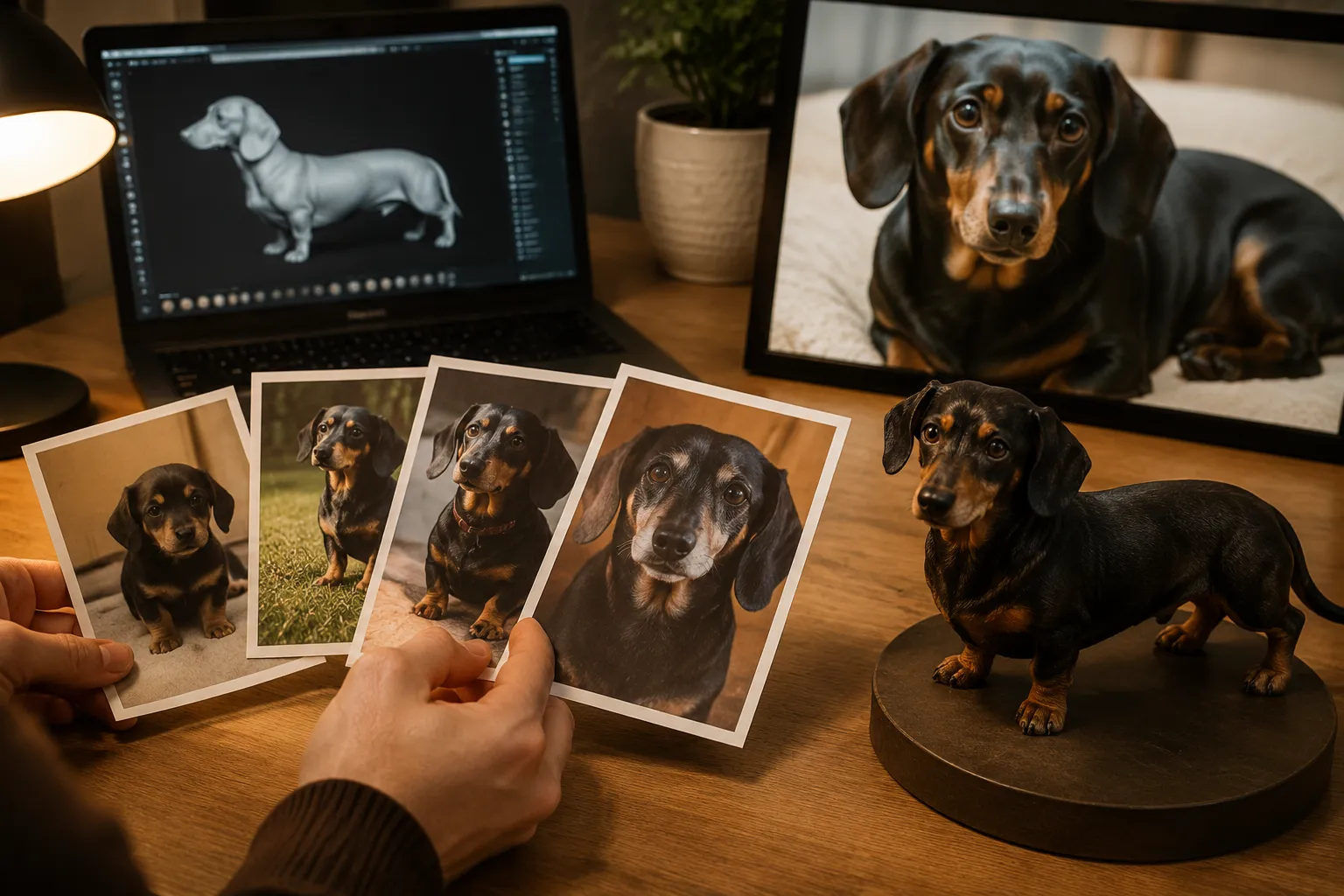
Marcus was kneeling on the cold garage floor, sorting through a box labeled "DUKE — MISC," when his fingers found the envelope of photos—blurry disposable-camera shots of a red Dachshund mid-bark, ears flying, taken at barbecue that must've been 2009. The sound of that bark hit him before the grief did. He wanted a deceased pet figurine made from these imperfect images, and he had no idea if it was even possible.
Quick Takeaways
- Old, blurry photos absolutely work — digital sculptors reconstruct what cameras missed using breed anatomy and your descriptions
- Three to five reference images from different angles dramatically improve accuracy, even if they're low-resolution
- Color accuracy depends on context clues — indoor lighting shifts hues, but experienced artists compensate using breed standards and your input
- Full-color 3D printing embeds pigment directly into resin — explore how PawSculpt's process captures fur patterns without any hand-painting
- A Dachshund's proportions are uniquely tricky — their elongated spine and short legs require specific sculpting expertise to look right, not cartoonish
Why Old Photos Are More Useful Than You Think
Here's the thing most people don't realize: the quality of your reference photos matters less than the variety of information they contain. We've worked with families who had nothing but a single Polaroid from 1998 and a verbal description of their dog's ear shape. And we've produced figurines that made them cry—in the good way.
The reason? A skilled digital sculptor isn't just copying a photograph pixel-by-pixel. They're reconstructing a three-dimensional animal using anatomical knowledge, breed-specific proportions, and the contextual clues hidden in even the worst snapshot.
Think about what a blurry photo actually contains:
- Overall body proportions — even at low resolution, the ratio of leg length to body length is visible
- Ear set and cariage — floppy, semi-erect, or alert
- Coat color distribution — where the dark patches end and lighter areas begin
- Tail position and curve — a Dachshund's tail tells a whole personality story
- General mass and build — was your dog lean and athletic or more of a couch-potato build?
A professional 3D artist uses these data points the way a forensic sketch artist uses witness descriptions. They're not limited by what the camera captured. They're building from what the camera implies.
The Counterintuitive Truth About Photo Quality
Most guides will tell you "the better the photo, the better the figurine." That's partially true but mostly misleading. What actually matters more than resolution is information diversity. One crystal-clear frontfacing portrait gives you less usable data than three grainy shots from different angles.
Here's why: a single high-res photo shows you one moment, one angle, one lighting condition. Three mediocre photos from a barbecue, a walk, and a nap on the couch? Those give you the full dimensional map of your dog's body.
| Photo Quality | Single Photo Value | Multiple Photos Value | What It Tells the Sculptor |
|---|---|---|---|
| Highres, professional | Excellent for face detail | Ideal if varied angles | Exact color, texture, expression |
| Phone camera, decent lighting | Good for proportions | Very useful combined | Body shape, markings pattern |
| Old disposable camera / scan | Limited alone | Surprisingly useful together | Proportions, color zones, ear/tail set |
| Blurry or distant | Minimal alone | Helpful as supplementary | Overall silhouette, size reference |
Marcus had seven photos total. Two were mostly blur. One was taken from behind. One showed Duke mid-shake, face completely distorted. But together? They painted a complete picture of a specific, irreplaceable dog.
How to Audit What You Actually Have
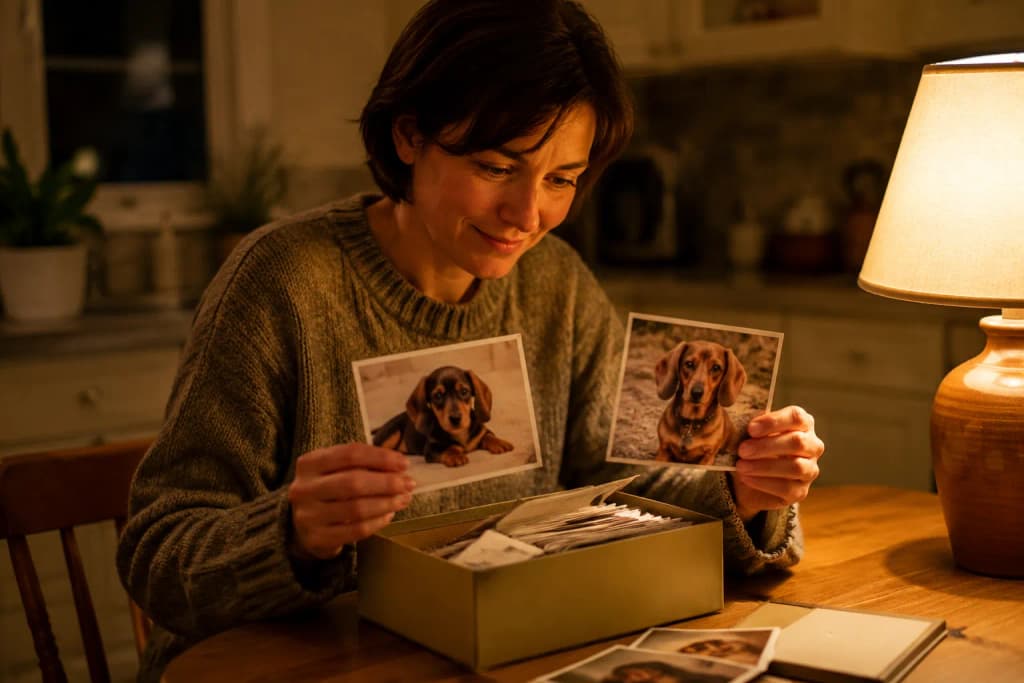
Before you start the ordering process for a Dachshund memorial figurine, take thirty minutes and do a proper inventory. Gather every image you can find—phone backups, social media posts, emails to family, even screenshots from video calls where your dog appeared in the background.
Then sort them into these categories:
- Face/head shots — any angle where you can see eye shape, muzzle length, ear position
- Body profile — side views showing the full silhouette
- Color reference — images where lighting seems most natural (outdoor, overcast day is ideal)
- Detail shots — close-ups of unique markings, scars, collar area, paw color
- Personality shots — these might be blurry, but they show how your dog moved and held themselves
You might end up with fifteen photos total, or you might have three. Both are workable. The key is knowing what you have so you can communicate clearly with the sculpting team about what's documented versus what you'll need to describe verbally.
What If You Literally Have One Photo?
It happens more than you'd think. Maybe your Dachshund passed years ago, before smartphones. Maybe there was a house fire, a lost hard drive, a phone that went through the washing machine. You're left with a single image—maybe not even a great one.
A single photo is still a starting point. Here's what fills the gaps:
- Your verbal description — "His chest had a small white patch shaped like a diamond" or "Her ears were longer than typical for a mini Dachshund"
- Breed standard references — the American Kennel Club's Dachshund breed page provides detailed anatomical descriptions that sculptors use as a baseline
- Similar dog photos — "His coat color was exactly like this dog I found online, but his face was narrower"
- Video stills — even a single frame pulled from a video can provide angle information a photo doesn't
"We've learned that owners remember more than they think. The details come back when you start talking—the way an ear folded, how the tail curled at the tip."
— The PawSculpt Team
One family we worked with had only a single photo of their wire-haired Dachshund taken from above—basically a top-down shot showing the back and ears. Not ideal. But the owner spent twenty minutes describing the dog's face, the exact shade of his beard, the way one ear sat slightly higher than the other. Combined with breed-standard anatomy, that was enough to produce something that made her say, "That's him. That's absolutely him."
The Digital Sculpting Process — What Happens Behind the Screen
So you've submitted your photos. What actually happens next? This is where most memorial companies are vague, and honestly, that vagueness makes people nervous. Let me walk you through the real workflow, because understanding it helps you provide better input and set realistic expectations.
Stage 1: Reference Analysis and Proportion Mapping
The sculptor opens your photos in their3D software—typically ZBrush or Blender—and begins by establishing proportions. For Dachshunds specifically, this is critical and tricky. Their body-to-leg ratio is extreme compared to most breeds, and getting it wrong by even a small margin makes the figurine look like a generic "long dog" rather than your long dog.
The artist will:
- Measure relative proportions from your photos (head-to-body ratio, leg length vs. chest depth)
- Cross-reference against breed standards for the specific Dachshund variety (standard, miniature, or kaninchen; smooth, wire-haired, or long-haired)
- Note any deviations from breed standard that made your dog unique—maybe a slightly longer muzzle, or a deeper chest than typical
This stage is where old photos actually shine. Even a blurry full-body shot gives proportion data that no amount of verbal description can replace.
Stage 2: Base Mesh and Anatomical Blocking
The sculptor builds the basic form—think of it like a clay armature, but digital. They're establishing the skeleton and major muscle groups underneath the surface. This matters because a Dachshund's skin drapes differently over their elongated ribcage than, say, a Labrador's. The underlying anatomy drives how the surface looks.
For Dachshunds, specific anatomical considerations include:
- The keel — that prominent breastbone that juts forward
- Spinal curvature — slight lordosis (downward curve) in the lower back is normal for the breed
- Forechest depth — Dachshunds have surprisingly deep chests relative to their size
- Paw angulation — their front feet often turn slightly outward
Stage 3: Detail Pass and Coat Texture
This is where the magic happens for wire-haired and long-haired varieties especially. The sculptor adds fur flow, individual texture patterns, and surface detail. For smooth-coated Dachshunds, this means capturing the subtle muscle definition visible through short fur. For wire-haired dogs like Duke, it means sculpting that characteristic beard, eyebrows, and rough body coat.
The artist works at resolution that will translate well to the 3D printing process—typically targeting detail that's meaningful at the final print size. There's a practical tradeoff here: extremely fine detail (individual hair strands) won't resolve clearly on a figurine that's, say, four inches tall. The sculptor focuses on the details that read at the intended scale—overall coat texture, major fur direction changes, and distinctive features like a cowlick or a particularly fluffy tail.
"A memorial isn't about perfection. It's about recognition—the moment you see it and your chest tightens because that's them."
Stage 4: Color Mapping
Here's where the process diverges from what most people imagine. There's no painting involved—ever. The sculptor applies color digitally, mapping textures and hues directly onto the 3D model. Think of it like wrapping the sculpture in a perfectly fitted skin of color.
For a custom figurine from old photos, color accuracy is one of the biggest concerns families have. "Will the red be right?" "His black had this brownish undertone in sunlight—can you capture that?"
The honest answer: color matching from old photos requires interpretation. A photo taken under tungsten lighting makes a red Dachshund look orange. A flash photo washes everything toward white. An outdoor photo on an overcast day? That's your most accurate color reference.
The sculptor compensates by:
- Asking you about lighting conditions in the reference photos
- Cross-referencing multiple images to triangulate true color
- Using breed-standard color descriptions as a baseline
- Sending you a digital preview for approval before printing
That preview step is crucial. It's your chance to say "a little darker on the chest" or "his ears were more chocolate than what's shown here."
Full-Color 3D Printing — The Technology That Makes This Possible
Let me get technical for a moment, because understanding the printing process helps you understand both the capabilities and the honest limitations of a pet memorial3D print.
How Full-Color Resin Printing Works
PawSculpt uses full-color 3D printing technology—specifically, a process where color is deposited voxel-by-voxel (a voxel is a 3D pixel) directly into the resin material as it's being built. The color isn't a coating on top. It's part of the material itself, embedded during the printing process.
The printer lays down the figurine in extremely thin layers—often in the 25–50 micron range (for reference, a human hair is about 70 microns thick). At each layer, the machine deposits colored resin in the exact pattern needed, then UV-cures it solid before moving to the next layer.
| Process Stage | What Happens | Duration (Typical) | Key Considerations |
|---|---|---|---|
| Digital sculpt + color | Artist models and textures the pet | Days (varies by complexity) | Revision cycles happen here |
| Print preparation | Orientation, supports, hollowing | Hours | Affects surface quality and strength |
| Full-color printing | Layer-by-layer resin deposition | Hours | Temperature and humidity controlled |
| Post-processing | Support removal, cleaning, curing | Hours | Careful hand-finishing of support areas |
| Clear coat application | Protective UV-resistant coating | Hours (including dry time) | Adds durability and slight sheen |
| Quality inspection | Dimensional and visual checks | Minutes to hours | Under raking light for surface defects |
Why This Matters for Memorial Figurines
The full-color printing approach means your Dachshund's exact markings—that specific daple pattern, the way the tan faded into black on the muzzle, the slightly lighter patch behind the ears—are reproduced with photographic precision directly in the material.
There's no human hand introducing variation with a brush. The color you approved in the digital preview is the color that prints. Period
But let me be honest about limitations too, because trust matters more than sales:
- Surface texture: Full-color resin has a very fine grain—think matte photo paper rather than glossy porcelain. The clear coat adds some sheen, but it's not glass-smooth like a hand-finished collectible figure.
- Color gamut: The printable color range is excellent but not infinite. Extremely saturated neon-bright colors or very subtle pastel gradients can be challenging.
- Scale vs. detail: At smaller sizes (under 3 inches), very fine details like individual whisker bumps may not resolve clearly. Larger prints show more detail.
- Durability: UV-cured photopolymer resin is solid and shelf-stable, but it's not meant to be a dog toy. It's a display piece. Dropping it on tile will likely cause damage.
The Clear Coat — The Only Manual Step
After printing, the figurine receives a clear protective coating. This is the single manual post-processing step (beyond support removal and cleaning). The clear coat serves three purposes:
- UV protection — prevents color fading from sunlight exposure over years
- Surface sealing — protects the resin from dust accumulation in surface texture
- Aesthetic finish — adds a subtle sheen that makes colors pop slightly more
This isn't paint. It's a transparent protective layer, like varnishing a photograph.
Dachshund-Specific Challenges (And How to Solve Them)
Dachshunds present unique challenges for figurine creation that other breeds simply don't. If you're ordering a memorial figurine of any other breed, some of this won't apply. But for Dachshund families—and there are a lot of us—these details matter.
The Proportion Problem
A Dachshund's body is, let's be honest, architecturally improbable. Their spine-to-leg ratio means that a figurine which looks correct from the side can look oddly thick or thin from above. The sculptor has to nail the cross-sectional shape of the ribcage—deep and oval, not round like a Beagle's—while maintaining that characteristic low-slung profile.
Common mistakes in generic pet figurines:
- Legs too long — even a few millimeters makes them look like a different breed
- Body too cylindrical — Dachshunds have a distinct keel and tuck-up
- Head too small — their heads are proportionally larger than you'd expect for their body size
- Tail set wrong — it should follow the spine line, not curve up like a Beagle's
Coat Variety Matters Enormously
The three coat types look like entirely different dogs in figurine form:
Smooth coat: Shows every muscle line and bone structure. The figurine needs to capture the slekness—the visible ribcage outline, the tight skin over the skull, the way light plays across short fur.
Wire-haired coat: Bushy eyebrows, a distinct beard, rough body coat with a softer undercoat peeking through. The texture work in the digital sculpt is critical here. Duke was wire-haired, and Marcus specifically mentioned that his beard was "more scraggly than show-dog perfect"—that kind of detail makes or breaks recognition.
Long-haired coat: Flowing ear feathering, chest fringe, tail plume. The challenge is capturing movement in a static figure—long hair implies motion, and a good sculptor suggests a slight breze effect or natural drape rather than stiff, straight lines.
Color Patterns Unique to Dachshunds
Dachshunds come in more color combinations than almost any other breed. Red, black-and-tan, chocolate-and-tan, cream, blue, Isabella, dapple, brindle, piebald, sable—and combinations thereof. Each presents specific challenges for color reproduction:
- Dapple patterns are essentially random—no two dogs have the same spots, so the sculptor must match your dog's specific pattern from photos
- Red varies enormously from deep mahogany to pale strawberry blonde, and old photos under different lighting make this harder to pin down
- Black-and-tan markings have very specific breed-standard placement (eyebrows, muzzle sides, chest, legs under tail) but individual dogs vary in how much tan shows
For Marcus's Duke—a red wire-haired—the challenge was distinguishing between the warm red of his body coat and the slightly darker, coarser texture of his outer guard hairs. In photos, this looked like a uniform color. In reality, and in Marcus's memory, there was depth and variation.
What to Expect When You Order (The Honest Version)
I'm not going to give you specific timelines or prices here—those change, and I'd rather you get current information directly from PawSculpt's website than rely on numbers that might be outdated by the time you read this.
But I can tell you what the experience is like, because that's what most people actually want to know.
The Emotional Part Nobody Warns You About
Ordering a memorial figurine of a deceased pet is an emotional process. Full stop. You're going to dig through old photos, which means you're going to feel things. You're going to try to describe your dog's unique features in words, and you might find yourself crying while typing "his left ear had a tiny notch from when he got into a fight with the neighbor's cat in 2014."
That's normal. Many families we've worked with report that the ordering process itself—the act of gathering photos, writing descriptions, really looking at their dog's face again—is both painful and therapeutic. It forces a kind of focused remembering that casual grief doesn't always allow.
"Describing your pet to a stranger is an act of love. You're saying: this mattered. This specific creature, with these specific details, existed and was known."
The Preview and Revision Cycle
You'll receive a digital preview—a rendered image of the3D model—before anything gets printed. This is your moment to be specific and honest. Don't approve something that doesn't feel right just to be polite. The sculptor wants your feedback. That's how they get it right.
Common revision requests we see:
- "The ears should hang a little lower"
- "His body was slightly thicker—he was a bit overweight in his later years and I want him remembered that way"
- "The color on the chest needs to be warmer"
- "Can you add the small scar above his eye?"
These are all reasonable, normal requests. The digital sculpting process makes revisions straightforward—it's not like asking someone to re-carve a marble statue. Adjustments happen in software before any physical material is committed.
For current details on revision policies and preview timelines, check PawSculpt's FAQ page.
When It Arrives
The figurine arrives protected in packaging designed for fragile items. The first moment you hold it is... a lot. We hear this consistently from families: there's a physical weight to it that photographs don't prepare you for. It's real in a way that a photo on your phone isn't.
Marcus told us that when he unwrapped Duke's figurine, the first thing he noticed was the beard. "They got the scraggly thing right," he said. "It wasn't perfect and neat like a show dog. It was Duke's actual mesy beard." He put it on his workbench in the garage—right where Duke used to sleep on an old blanket while Marcus worked on projects.
Preparing Your Photos for the Best Possible Result
Let's get practical. You've decided to order. You've gathered your photos. Now, how do you present them to give the sculpting team the best possible starting material?
The Ideal Submission (If You Have It)
- 3-5 photos minimum from different angles
- At least one clear face shot showing both eyes
- One full-body profile (side view)
- Natural lighting preferred (outdoor or near a window)
- A written description of anything the photos don't show clearly
The Realistic Submission (What Most People Actually Have)
- 1-3 photos of varying quality
- Maybe one decent face shot but it's from 2012 and slightly blurry
- A lot of memories that are hard to put into words
- Strong feelings about getting it right
Both of these are completely workable. The difference is that the second scenario requires more communication between you and the sculptor, more revision cycles, and more patience. But the end result can be equally accurate.
Photo Preparation Tips
Before submitting, do these quick checks:
- Crop out distracting backgrounds — the sculptor doesn't need to see your entire living room, just your dog
- Note the lighting conditions — "This was taken indoors under warm yellow lights" helps the artist adjust color expectations
- Flag your best reference — if one photo is most accurate for color or shape, say so explicitly
- Mention what's wrong — "In this photo he looks fat but he was actually lean—bad angle" saves revision time
- Include scale reference if possible — your dog next to a known object helps establish actual size
A Note on Video
If you have video of your Dachshund—even short clips—mention this when ordering. Video provides something photos never can: movement patterns, how the ears bounced when they ran, the way the tail wagged in that specific circular motion. A sculptor can pull reference frames from video and use the motion information to choose a pose that feels alive rather than stiff.
Choosing the Right Pose — More Important Than You'd Think
The pose you choose for a memorial figurine carries emotional weight. It's the version of your dog that will sit on your shelf, your desk, your mantle—potentially for decades. This decision deserves real thought.
Common Pose Categories
The Alert Stand: Classic show-dog stance. Dignified, clear silhouette. Works well for dogs who were proud, confident, regal. For Dachshunds, this shows off their unique profile beautifully.
The Relaxed Sit: Casual, approachable. Good for dogs who were calm, gentle, always nearby. Dachshunds sitting often have that characteristic slight lean to one side.
The Play Bow: Front end down, rear up, tail wagging. Captures energy and joy. Tricky for Dachshunds because their proportions in this pose can look exaggerated—but a skilled sculptor makes it work.
The Curl-Up: Sleeping or resting position. Intimate, peaceful. Many memorial families choose this for dogs who passed in old age. Dachshunds are famous for burrowing into blankets, so a curled pose with a slight blanket edge can be incredibly evocative.
The Characteristic Pose: Whatever YOUR dog did that was uniquely them. Duke's thing was sitting up on his haunches like a meerkat when he heard the garage door open. That's what Marcus chose. It was Duke's pose, not a generic Dachshund pose.
Pose and Printability
Here's an insider detail most companies won't mention: some poses are significantly more challenging to 3D print than others. A standing dog with all four feet on a base? Structurally simple. A dog mid-leap with only one paw touching the ground? That requires internal supports, careful orientation on the print bed, and potentially a thicker connection point to the base.
For Dachshunds specifically, their long unsupported spine means that a stretched-out running pose needs careful engineering to avoid weak point in the middle of the back. The sculptor accounts for this during the design phase—they might slightly thicken the body in a way that's visually imperceptible but structurally necessary.
This isn't a limitation to worry about—it's just context for why certain poses might require minor adjustments from your initial request. The sculptor will explain any structural considerations during the preview phase.
Caring for Your Figurine Long-Term
Once you have your Dachshund memorial figurine, you'll want it to last. Full-color resin with a clear coat is durable for a display piece, but it's not indestructible. Here's what to know:
Do:
- Display away from direct sunlight (the clear coat has UV protection, but no coating is permanent against years of direct sun)
- Dust gently with a soft brush or microfiber cloth
- Keep at room temperature—extreme heat can soften resin over time
- Handle by the base when moving it
Don't:
- Use chemical cleaners or solvents
- Submerge in water
- Leave in a car on a hot day
- Place where it could be knocked off a shelf (resin doesn't bounce)
The clear coat protects against normal handling and light dust accumulation. With reasonable care, these figurines maintain their color and detail for years. We've seen pieces from early production runs that still look exactly as they did when they were printed.
The Emotional Timeline — What Families Actually Experience
Here's something nobody talks about in figurine guides: there's an emotional arc to this process that catches people off guard.
Week 1 (Ordering): A mix of excitement and grief. Digging through photos is harder than expected. Some families report feeling guilty—like they're "replacing" their pet. You're not. You're honoring them.
During Production: Anticipation mixed with anxiety. "What if it doesn't look right?" is the most common worry. The preview step exists specifically to address this.
Arrival Day: Intense. Many families report neding to sit down. The physical reality of holding a three-dimensional representation of their pet triggers a grief response that's different from looking at photos. It's more visceral. More real.
First Week with the Figurine: A settling period. You'll find yourself glancing at it, adjusting its position, maybe talking to it. This is normal. Many owners report that having a physical presence—something with weight and dimension—provides a comfort that flat images don't.
Long-term: The figurine becomes part of the household landscape. It stops triggering acute grief and starts triggering warm memory. Visitors notice it, ask about it, and you get to tell your dog's story. That storytelling is its own form of healing.
Marcus keeps Duke's figurine on the workbench. He told us that sometimes, when he's in the garage working on a project, he glances over and for just a half-second, it feels like Duke is still there keeping him company. "It's not sad anymore," he said. "It's just... nice Like he's still hanging out."
Frequently Asked Questions
Can you make a figurine from blurry or old photos?
Absolutely. Digital sculptors work more like forensic reconstructors than photocopiers. They use breed-specific anatomy knowledge, proportional analysis from whatever images you have, and your verbal descriptions to fill in what the camera didn't capture clearly. Three blurry photos from different angles are often more useful than one sharp photo from a single angle.
How many photos do I need to order a custom pet figurine?
One photo is the minimum, but three to five from different angles is the sweet spot. The key is variety of perspective rather than image quality. A front view, a side profile, and a three-quarter angle together give the sculptor enough dimensional information to build an accurate model. Include a written description of anything the photos don't show.
Is a 3D printed figurine durable enough to display long-term?
Yes—with reasonable care. Full-color resin with a UV-resistant clear coat is designed for years of display. Avoid direct sunlight, extreme heat, and chemical cleaners. Dust with a soft brush. These aren't toys, but they're solid display pieces that maintain their color and detail over time when treated as the kepsakes they are.
How accurate will the colors be if my photos were taken in bad lighting?
This is one of the most common concerns, and it's solvable. The sculptor cross-references multiple images, uses breed-standard color guides as a baseline, and—most importantly—sends you a digital preview for approval. You can request color adjustments before anything is printed. Noting the lighting conditions when you submit photos ("taken indoors under warm bulbs") helps enormously.
What makes Dachshund figurines harder to produce than other breeds?
Their proportions are genuinely unusual. The spine-to-leg ratio, deep keel chest, and breed-specific features (like the wire-haired beard or long-haired ear feathering) require a sculptor who understands Dachshund anatomy specifically. Generic "small dog" proportions produce figurines that look wrong in ways that are hard to articulate but immediately obvious to anyone who loved a Dachshund.
Do you hand-paint the figurines?
No—and this is actually a feature, not a limitation. PawSculpt uses full-color 3D printing technology where pigment is embedded directly into the resin material during the printing process. This means the colors you approved in your digital preview are reproduced exactly, without human variation from a brush. The only manual finishing step is applying a protective clear coat for UV resistance and durability.
Ready to Honor Your Dachshund's Memory?
Every Dachshund has a personality bigger than their body—the stuborn streak, the burrowing obsession, the way they'd bark at absolutely nothing with complete conviction. A custom figurine captures the physical form that housed all that character. Whether you have a folder full of photos or a single faded snapshot from a decade ago, the process of creating a deceased pet figurine starts with whatever you have and builds from there.
Visit pawsculpt.com to see the full process, current options, and service details