9 Reasons a Beagle Figurine is Better Than a Portrait (But Only If You Value Texture Over Paint)
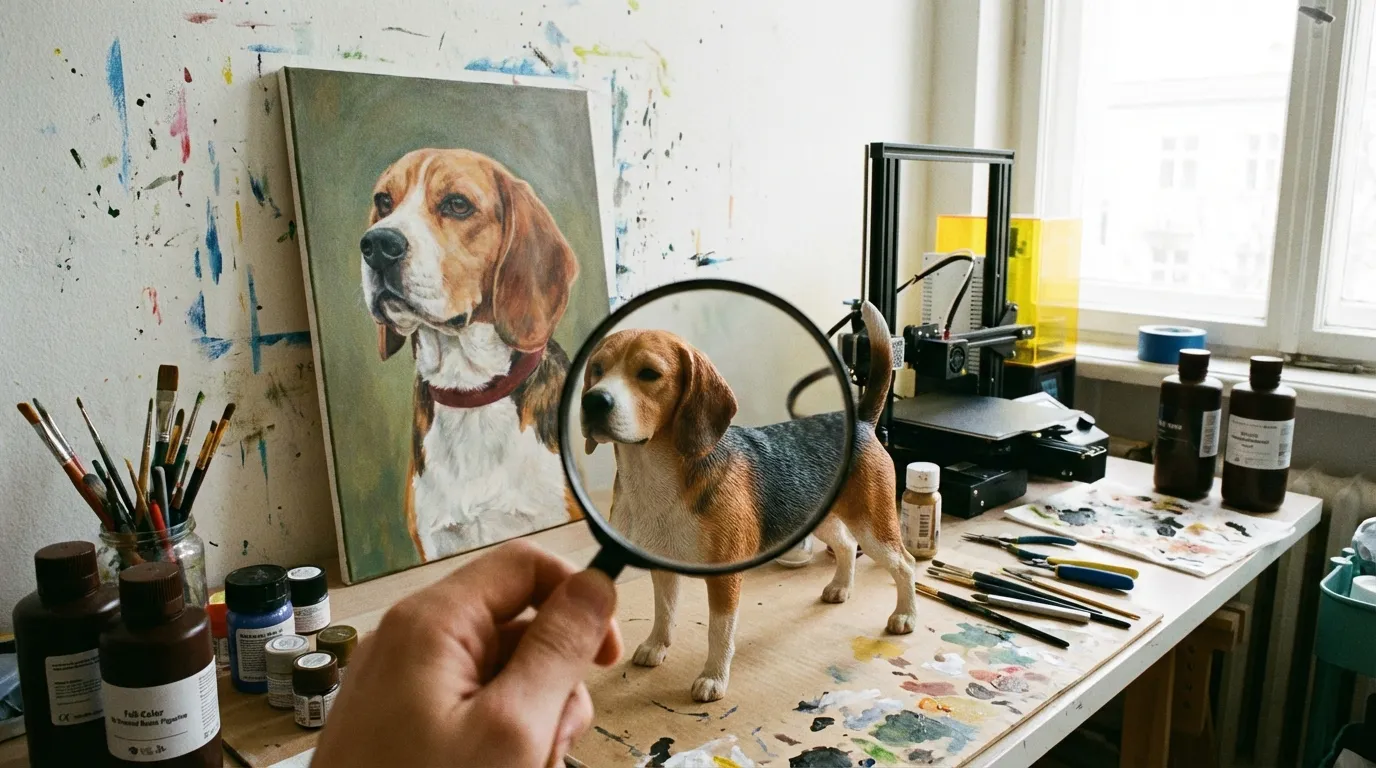
You run your thumb over the cold, smooth glass of a framed photo, but your brain registers a disconnect—the image is flat, trapped behind a barrier, while your fingers ache for the familiar coarse fur and the solid warmth of a living presence.
Quick Takeaways
- Tactile memory recall — Touching a 3D object triggers deeper emotional pathways than viewing a 2D image.
- Accurate coat mapping — Full-color 3D printing captures the chaotic, organic pattern of a Beagle’s ticking better than most brushes.
- Spatial presence — A figurine occupies physical space, mimicking the "weight" of a pet’s presence in a room.
- Customization precision — Digital sculpting allows for exact anatomical replication before creating your custom pet figurine.
1. The Neurobiology of Touch vs. Sight
When we miss a pet, we often think we miss seeing them. But scientifically, attachment is heavily rooted in somatosensory processing—the sense of touch. A portrait engages your visual cortex, which is powerful, but it remains an observation. You are looking at the subject.
A 3D printed figurine engages the haptic system. When you hold a scale model of your Beagle, your brain receives feedback about weight, texture, and temperature. This multi-sensory input reduces the cognitive dissonance of grief or longing. Your brain expects a physical object to occupy space; a photograph is merely a representation of space. By holding a figurine, you are bridging that gap, satisfying a primal biological need to "grasp" what you love.
"Grief isn't a problem to be solved. It's a love story that continues after the last chapter."
2. Capturing the "Beagle Slump" (Anatomy Over Aesthetics)
Beagles have a very specific anatomical signature that is difficult to capture in 2D without it looking like a caricature. It’s the way their spine curves when they sit, the specific density of their muscle mass, and the gravity-defying weight of those velvet ears.
In a painting, the artist has to use shading to imply depth. In additive manufacturing, we don't imply depth; we build it. Our digital sculptors work in a 3D environment (using software like ZBrush) to model the exact posture of your dog. If your Beagle sat with one hip rolled under—a common quirk in the breed due to their hip structure—we sculpt that asymmetry.
A portrait flattens these quirks. A figurine preserves the volume and mass of the dog, allowing you to run your finger down the slope of their back and feel the anatomy, not just see it.
3. The Science of "Ticking" and Coat Chaos
Beagle coats are genetically fascinating. The "ticking"—those small isolated spots of color on the white areas of the coat—creates a visual noise that is incredibly hard to replicate with a paintbrush without it looking muddy or overly deliberate.
Here is where full-color 3D printing diverges from traditional art. Our technology uses a process similar to inkjet printing but in three dimensions. We jet tiny droplets of colored resin that cure instantly under UV light.
Why this matters for Beagles:
Voxel-Level Control: We print at the voxel level (a 3D pixel). This means the color is embedded inside* the material, not painted on top.
- Organic Randomness: We can replicate the chaotic, organic distribution of ticking and mottling found in Beagle fur.
- No Brushstrokes: There are no brushstrokes to distract the eye. The color transition from the deep saddle black to the tan and white is seamless, mimicking the natural growth of hair follicles.
4. Object Permanence and Environmental Integration
Psychologically, pets are "environmental anchors." They move through our homes, changing the energy of a room. A portrait on a wall is static; it stays in one place. It becomes wallpaper.
A figurine has mobility. It creates a phenomenon known as "environmental integration." You can place the figurine on the desk while you work, then move it to the living room shelf in the evening. This mobility mimics the behavior of a living Beagle—a breed known for following its nose (and its people) from room to room.
By having a 3D object that shares your physical environment, you trigger different memory centers than you do when glancing at a fixed point on a wall. It makes the memory feel active rather than passive.
| Feature | 2D Portrait | 3D Printed Figurine |
|---|---|---|
| Sensory Input | Visual only | Visual + Tactile (Touch/Weight) |
| Spatial Interaction | Static (Wall/Frame) | Dynamic (Moveable/360° View) |
| Coat Accuracy | Artist interpretation (Brushstrokes) | Data-driven (Voxel printing) |
| Psychological Impact | Observation | Interaction |
| Durability | Susceptible to fading/tearing | UV-cured Resin (Robust) |
5. The 360-Degree Personality Profile
Beagles are rarely serious from every angle. A portrait forces you to choose one perspective: the regal profile or the goofy head-tilt. But anyone who has owned a Beagle knows that their personality is a sum of all angles.
From the front, they might look attentive. From the back, you see the "cello shape" of their haunches. From the top, you see the broadness of the skull.
A 3D printed figurine offers a 360-degree narrative. You aren't locked into a single expression. As you turn the figurine in your hands, the light catches different planes of the face, revealing different micro-expressions. This is crucial for cognitive recall. We don't remember our pets as static images; we remember them in motion, in 3D space. A figurine aligns closer to how memory actually works.
"We've seen families heal by holding something tangible. Grief needs an anchor."
— The PawSculpt Team
6. Texture as a Memory Trigger
There is a concept in neuroscience called "embodied cognition," which suggests that our thoughts are deeply influenced by our physical body's interactions with the world.
Our figurines are not smooth plastic. Because they are 3D printed using jetting technology, there is a very fine, natural grain to the surface—layer lines that are often in the 20-30 micron range. This texture, while subtle, diffuses light differently than a glossy photo or a smooth oil painting.
When you touch the figurine, that slight texture provides sensory friction. It’s not fur, but it’s not sterile glass either. It feels "made." This tactile input can be incredibly grounding for someone experiencing the anxiety of pet loss. It gives your hands something complex to process, rather than a slick, forgettable surface.
7. The Problem with "Artist Interpretation"
When you commission a painting, you are paying for the artist's interpretation of your dog. They might adjust the lighting, soften the eyes, or change the background. This is beautiful art, but it is subjective.
3D modeling for printing is objective engineering. When our digital sculptors build your Beagle, they are using geometry. They are matching the distance between the eyes, the length of the snout, and the specific set of the ears based on your photos.
If your Beagle had a scar on its nose or a chipped ear, we model that geometry explicitly. We don't "paint it on"; we alter the digital mesh to reflect that physical reality. For owners who are detail-oriented or scientifically minded, this fidelity to physical form is often more satisfying than an artistic impression.
8. Durability and the "Heirloom Factor"
Paper degrades. Canvas can rot or fade. Digital files can get corrupted.
The material we use is a UV-cured photopolymer resin. Once cured, it is chemically stable. The colors are polymerized into the plastic itself. While we apply a clear coat to protect the finish and give it the right sheen, the structural integrity is massive compared to a piece of paper.
From a psychological standpoint, the durability of the memorial object matters. A fragile object (like a photo that can bend) subconsciously signals that the memory is fragile. A solid, weighted resin object signals permanence. It tells your subconscious that this memory is safe, solid, and enduring.
9. The "Uncanny Valley" vs. Stylized Realism
There is a risk in 3D art called the "Uncanny Valley"—where something looks almost real but not quite, making it unsettling. Hand-painted statues often fall into this trap because human hands struggle to paint eyes perfectly symmetrically at a small scale.
Full-color 3D printing avoids this by printing the eyes with perfect geometric symmetry and color layering. We can layer transparent resin over colored resin to create the "lens" effect of a real eye, giving it depth and glint that paint cannot achieve.
However, because the object is clearly a figurine (with the subtle texture of printing), it doesn't try to trick your brain into thinking it's alive. It sits comfortably in the realm of a "perfect tribute" rather than a "creepy replica." It balances realism with the artistic medium of additive manufacturing.
Frequently Asked Questions
How accurate can a 3D printed figurine really be?
Extremely accurate regarding markings and shape. Our artists digitally sculpt the model based on your specific photos to match anatomy. The full-color printing process reproduces your pet's unique patterns directly into the resin, capturing details that hand-painting often misses.Is the figurine fragile?
The UV-cured resin is solid and feels substantial in the hand, similar to a high-quality hard plastic or ceramic. However, like any fine collectible, thin appendages (like a Beagle’s tail or ears) can be vulnerable if dropped on a hard surface like tile or concrete.Do I need professional photos of my dog?
No, you don't need studio shots. We need clear, well-lit photos from multiple angles—front, both sides, and back. Natural lighting is best to ensure we match the coat color correctly. Smartphone photos are perfectly adequate as long as they aren't blurry.How long does the process take?
The entire workflow typically takes 3-5 weeks. This includes the time for our artists to digitally sculpt your pet, the review phase where you approve the 3D model, the actual printing time, and the post-processing steps (cleaning, curing, and clear-coating).Ready to Celebrate Your Pet?
Every pet has a story worth preserving. Whether you're honoring a beloved companion who's crossed the rainbow bridge or celebrating your furry friend's unique personality, a custom PawSculpt figurine captures those details that make your pet one-of-a-kind.
Free instant AI preview • 3D artist preview within 7 days • 5 free revisions