Stop Hiding the 'Ugly' Angles: Why a 360-Degree Scan of Your Bulldog is Vital
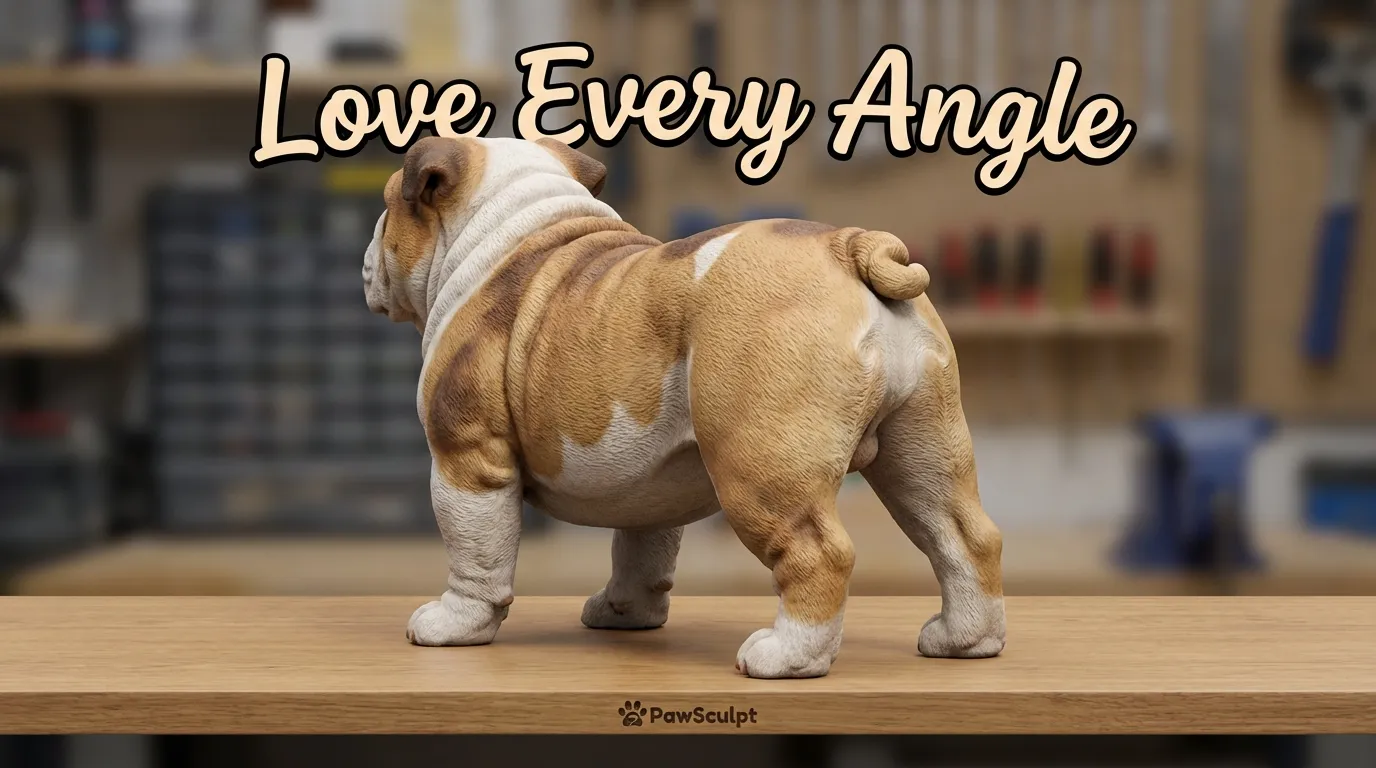
The digital calipers clicked shut, confirming the jowl width was precise to the millimeter, yet the silhouette on my monitor felt hollow. I was staring at a perfect generic Bulldog, missing the specific, chaotic asymmetry of the hip splay that defined this beloved pet.
Quick Takeaways
- Perfection is the enemy — A "flattering" photo often hides the unique structural quirks that make a sculpture look like your dog.
- Volume requires data — 3D artists cannot invent depth from a single front-facing photo; we need to see the "weird" angles to map the geometry.
- Texture is geometry — In full-color 3D printing, wrinkles and rolls aren't just drawn on; they are physical topographies that need to be sculpted.
- Capture the chaos — Use our photo guide to capture the "frog legs," the underbite, and the asymmetrical tail pocket that define your Bulldog's character.
The Geometry of Personality
In the world of additive manufacturing, we talk a lot about "mesh integrity" and "manifold geometry." But when I sit down at my workstation, looking at a folder of client photos, I’m not just looking for clean lines. I’m looking for the weight.
Bulldogs are, structurally speaking, an engineering marvel of mass and compression. Unlike a Greyhound, where the skeleton is visible and defines the form, a Bulldog is defined by soft tissue displacement. It’s about how the fat rolls over the collar, how the chest barrel creates a center of gravity that feels like a bowling ball wrapped in velvet, and how the skin pools around the ankles when they sit.
The biggest mistake pet owners make when submitting reference photos for a Bulldog figurine is curating them. You send the "Instagram" shots—the ones where the lighting is perfect, the dog is sitting up straight, and they look dignified.
But dignity doesn't map to 3D. When we digitally sculpt a model based only on "pretty" photos, we end up with a statue that looks like a breed standard. It looks like a Bulldog. It doesn't look like yours. To capture the soul of the animal, we need the ugly angles. We need the slouch. We need the gravity.
"True realism isn't about capturing the perfect pose; it's about capturing the weight of the moment."
The Problem with "Front-Facing" Bias
Most people photograph their pets the way they photograph humans: from the front, at eye level. In the 3D printing industry, we call this "occlusion." When you take a photo of a Bulldog’s face straight on, the massive structure of the head hides the neck. The chest hides the front legs. The perspective foreshortening makes the rear end disappear entirely.
As a digital sculptor, if I can't see it, I have to invent it. And while I have anatomically correct base meshes for every breed, "anatomically correct" is often the enemy of "emotionally accurate."
The "Sploot" Factor
Consider the hips. Many Bulldogs have a unique hip dysplasia or simply a lack of flexibility that causes them to sit in a "sploot" or "frog dog" position. If you only send photos of your dog standing, I will sculpt the legs tucked underneath them in a standard sit. When you unbox the final full-color 3D print, the color will be right, and the face will be right, but you’ll feel a disconnect. You won't know why, but it won't feel like him.That disconnect happens because the silhouette is wrong. The "ugly" photo of your dog sprawled on the linoleum, legs kicked out like a roasted chicken, is actually the most valuable data point you can give us. It tells us about their flexibility, their joint structure, and their comfort.
Engineering the Wrinkle: A Study in Topology
From a manufacturing standpoint, Bulldogs present a fascinating challenge in full-color resin 3D printing. Our PolyJet-style technology doesn't just print the outer shell; it prints the object voxel by voxel (a 3D pixel). This means we are printing the color into the resin, not painting it on top.
This distinction is critical when it comes to wrinkles.
If a figurine were hand-painted, an artist would take a brush with a dark wash and paint a line to simulate a fold in the skin. But in 3D printing, we have to physically sculpt that trench. We have to create the valley of the wrinkle so that the ambient occlusion (the way light naturally gets trapped in cracks) happens in the real world, on your shelf.
The "Shadow" Trap
Here is where the "ugly" photos become vital. In a flash photo, wrinkles are flattened out. The light fills the cracks, and the dog looks smooth. We need photos taken in "raking light"—light coming from the side—that casts long, harsh shadows across the face.These photos might look gritty or "bad" for social media, but for a 3D artist, they are a topographic map. They tell us exactly how deep the fold over the nose rope is. They show us if the jowls hang vertically or if they splay out onto the floor when the dog is sleeping.
Bulldog Feature Topology Table
| Feature | The "Pretty" Photo | The "Ugly" Reality (What We Need) | Sculpting Implication |
|---|---|---|---|
| The Underbite | Closed mouth, hiding teeth | Mouth slack, crooked teeth visible, drool string | Determines the jaw alignment and chin projection. |
| The "Rope" (Nose Roll) | Clean, wiped dry | Crusty, deep, shadowed, asymmetrical | Defines the depth of the boolean cut in the digital mesh. |
| The Tail Pocket | Hidden by the rump | Lifted tail, showing the swirl or lack thereof | Critical for the rear silhouette and volume distribution. |
| The Paws | Tucked under chest | Splayed toes, long nails, interdigital cysts | Adds the "grounding" weight to the figure. |
The Counterintuitive Insight: Why "Bad" Posture is Good Art
There is a concept in classical sculpture called contrapposto—the counterpoise. It’s the idea that a figure looks more alive when the weight is shifted to one leg, twisting the torso.
Bulldogs are masters of contrapposto, usually by accident. They rarely sit squarely. They lean. They use the wall for support. They rest their heavy heads on their paws because their neck muscles get tired.
When we receive a set of reference photos that are all "posed," we lose this data. We end up sculpting a dog that is holding itself up with an energy that the real dog never possessed.
The "Potato" Phase
In our studio, we refer to the early stage of a Bulldog sculpt as the "Potato Phase." We block out the primary mass of the body. If we stick to the breed standard, we get a symmetrical potato. But real Bulldogs are lumpy potatoes.Maybe your dog had a fatty lipoma on his left flank. Maybe he had a scar on his shoulder from a puppyhood scrap. Maybe his left ear sat slightly lower than his right. These "flaws" are the fingerprints of his life. By hiding them in photos, you are erasing his history.
"We don't want the breed standard; we want the dog that snored on your couch."
The Manufacturing Reality: Overhangs and Supports
Let’s get technical about the printing process. We use UV-cured photopolymer resin. The printer lays down a layer of liquid resin (often in the 20-30 micron range) and blasts it with UV light to harden it instantly.
When printing a Bulldog, we deal with massive "overhangs." The chin, the chest, and the belly are all fighting gravity during the print process.
The Support Strategy
To print a heavy chest that hangs over empty space, the software generates support material—a scaffolding that holds the model up while it prints. In post-processing, we dissolve or break away this support material.- Aesthetic Failure: The dog looks like it has been flattened.
- Structural Weakness: We might create a "suction cup" effect during printing if the curve is too shallow, which can cause layer delamination.
We need photos of your dog rolling over. We need to see the belly spots. We need to see the width of the chest from the bottom up. This data ensures that when we orient the model on the build plate, we are preserving the structural integrity of the print while keeping the visible surfaces pristine.
How to Document the "Ugly" for a Perfect Scan
You don't need a $10,000 LIDAR scanner to get a museum-quality result. You just need to change how you look at your dog. Forget about "cute." Think like a surveyor.
1. The Turntable Video
Instead of taking 50 photos, take one video. Put your dog in a stay (or wait for them to fall asleep—easier with Bulldogs) and walk a slow circle around them. Keep the camera steady.- Why this works: It gives us the transitional data—how the shoulder connects to the neck, how the hip connects to the tail.
2. The "Worm's Eye" View
Get on the floor. Lower than the dog. Shoot upwards.- Why this works: This reveals the "planes" of the face that are usually hidden in shadow: the underside of the jowls, the throat, and the chest projection.
3. The Top-Down "Loaf" Shot
Stand directly over them and shoot straight down.- Why this works: This shows the "waist" (or lack thereof). It shows the curvature of the spine and the width of the shoulders relative to the hips.
4. The Macro Texture Hunt
Get close. Uncomfortably close. Take a photo of just the nose. Just the ear. Just the tail pocket.- Why this works: Our full-color 3D printing tech can reproduce incredibly fine color gradients. If your dog has ticking (small spots) on their ears or a specific gradient of pink-to-black on their nose, we can print that. But only if we can see it.
"Healthy pets make the best subjects. We love seeing the energy in their photos, even if that energy is just a chaotic nap."
— The PawSculpt Team
Post-Processing: The Varnish of Truth
Once the printer finishes its 12-16 hour cycle, we have a raw, matte model. It is covered in support material. The colors look muted, almost chalky.
The post-processing phase is where the magic happens, and it’s why we are so adamant that we do not hand-paint. We clean the model using a water-jet station to remove the supports. Then, we cure it in a UV chamber to finalize the polymer cross-linking.
Finally, we apply a clear coat. This isn't just for protection; it's an optical necessity. The clear coat wets the surface, reducing light scattering and allowing the embedded pigments to pop. It transforms the chalky surface into the vibrant, deep color of a wet nose or a shiny coat.
If we sculpted the "ugly" wrinkles deep enough, the clear coat will pool slightly in the recesses, naturally darkening them and creating a hyper-realistic shadow without a single drop of paint. This is why the geometry matters so much. The physics of the resin and the varnish do the work for us, but only if the digital sculpture provided the right roadmap.
Celebrating the Imperfect
There is a vulnerability in sending "ugly" photos of a pet, especially if that pet has passed away. You want to remember them at their best. You want the young, slim, healthy version.
But memory is tactile. When you hold a figurine, your thumb will naturally drift to the spot you used to scratch. If that spot was a lumpy shoulder or a velvety fat roll, and the figurine is smooth and muscular, the memory won't trigger.
We are not just making models; we are archiving a life. And life, especially Bulldog life, is messy, asymmetrical, and beautifully imperfect. By hiding the ugly angles, you are hiding the truth of who they were.
Give us the drool. Give us the lazy sit. Give us the weird underbite. Let us build a tribute to the dog that actually lived in your house, not the one that lives in a show ring.
Frequently Asked Questions
Why do I need to send photos of my Bulldog's belly?
Belly photos help us determine the curvature of the chest and "undercarriage." This ensures the figurine sits correctly and has the right center of gravity, preventing it from looking flat or unstable. It also helps us map white markings that might wrap around from the chest.Can you fix my dog's eye gunk in the figurine?
Yes. While we argue for the "ugly" angles to capture geometry (like the shape of the eye socket), we can digitally clean up temporary issues like eye gunk, surgical scars (unless you want them kept), or mud. We want the structure of the "ugly" pose, but we can polish the hygiene.My Bulldog has passed away and I don't have 360-degree photos. Can you still help?
Absolutely. Our artists have years of anatomical training. If you have limited photos, we use breed-specific reference meshes to fill in the gaps. We look at the photos you do have to match the markings and key features, then use our knowledge of Bulldog anatomy to infer the rest.Why does the 3D print surface look different than a plastic toy?
Full-color resin printing builds objects layer by layer, typically at 20-30 microns. You may see very fine grain or layer lines upon close inspection, which is a hallmark of the technology. The clear coat smooths this, but the texture feels more like organic stone or ceramic than cheap, injection-molded plastic.Ready to Celebrate Your Pet?
Every pet has a story worth preserving. Whether you're honoring a beloved companion who's crossed the rainbow bridge or celebrating your furry friend's unique personality, a custom PawSculpt figurine captures those details that make your pet one-of-a-kind. Don't settle for a generic model—let us capture the beautiful, messy reality of your Bulldog.
Free instant AI preview • 3D artist preview within 7 days • 5 free revisions