
Why Your Phone Camera Lies: The Difference Between a Photo and a 3D German Shepherd
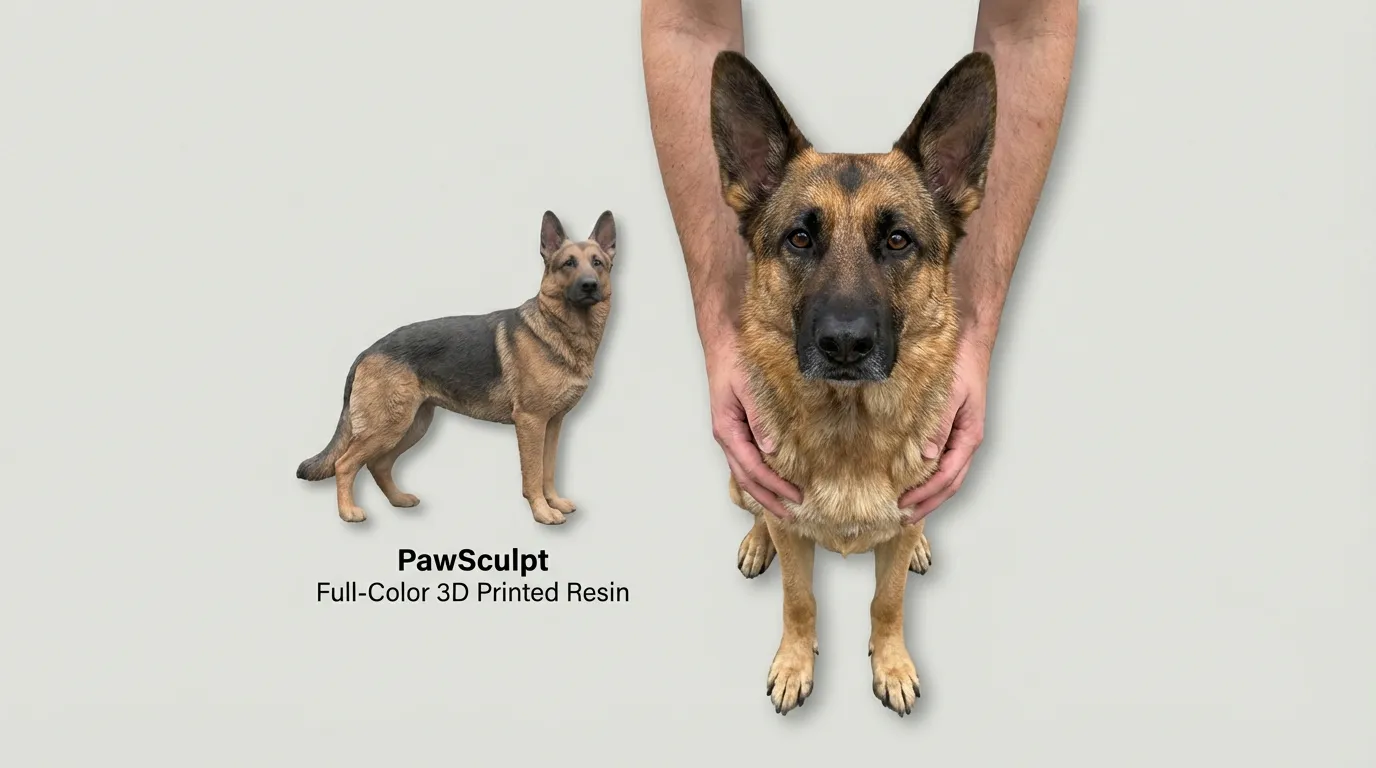
You watch your German Shepherd, ears perked and head tilted just so, and you instinctively reach for your phone to capture the moment—but by the time the shutter clicks, the depth of that gaze has flattened into pixels, losing the very soul you tried to save.
Quick Takeaways
- Photos flatten reality — Camera lenses distort snout length and flatten the muscular depth of breeds like German Shepherds.
- Physical presence matters — Our brains process 3D objects in the same spatial way we process living beings, unlike flat images.
- Subsurface scattering — Real fur and our full-color resin interact with light similarly; photos just reflect it.
- Tactile memory — Holding a custom pet figurine triggers different neural pathways than swiping a screen.
The "Pancake Effect": Why Photos Fail Your Dog
We have all been there. You look at a photo you just took of your dog, and you think, That’s him, but it’s not... him.
It is not just you, and it is not just your camera skills. As engineers and artists who have spent over a decade translating living creatures into physical models, we see this limitation every single day. We call it the "Pancake Effect."
A standard smartphone camera uses a wide-angle lens (usually around 24mm to 28mm equivalent). While great for landscapes, this focal length is a disaster for portraits of long-snouted breeds like German Shepherds. It exaggerates the nose, shrinks the ears, and most importantly, compresses the distance between the eyes and the back of the head.
When we look at our dogs in real life, we use binocular vision. Our two eyes create a stereoscopic map of the dog's volume—the way the ribcage expands, the slope of the croup, the distinct planes of the face. A photo strips all of that spatial data away.
"A photo captures what your dog looked like in a split second. A sculpture captures who your dog is."
This is why, when we receive reference photos for a PawSculpt commission, we often have to "reverse engineer" the camera's distortion. We know that the snout isn't actually that bulbous, and the chest isn't that flat. We have to mentally—and digitally—inflate the dog back to its true, living volume.
The Science of Light: Voxel vs. Pixel
Here is where the engineering gets interesting, and where the difference between a 2D print and a 3D object becomes undeniable. It comes down to how light interacts with the subject.
In a photograph, lighting is baked in. If you took the photo in harsh noon sun, that shadow under the chin is black and permanent. It never changes.
A 3D object, however, interacts with the environment exactly like your actual dog does.
The Role of Subsurface Scattering
German Shepherds have complex coats. They have a dense undercoat and guard hairs that reflect light differently. In our manufacturing process, we use full-color PolyJet-style printing technology. This isn't just dumping ink on a surface.We print with translucent resins where the color is embedded inside the material, voxel by voxel (think of a voxel as a 3D pixel). This allows for something called subsurface scattering.
When light hits a PawSculpt figurine, some of it penetrates the clear coat and the top layers of resin before bouncing back out. This gives the coat a sense of depth and organic "softness" that a hard plastic toy or a flat photo simply cannot achieve. It mimics the way light hits actual fur or skin.
| Feature | Smartphone Photo | Full-Color 3D Print |
|---|---|---|
| Lighting | Static (baked in forever) | Dynamic (changes with room light) |
| Texture | Visual only (smooth screen) | Physical (tactile fur texture) |
| Perspective | Fixed (single angle) | Infinite (viewable from 360°) |
| Distortion | High (lens warping) | None (anatomically corrected) |
The Tactile Connection: Why Holding Matters
There is a counterintuitive insight we have learned after years of working with pet owners, especially those memorializing a pet: Touch is a stronger emotional trigger than sight.
We often hear from owners who have thousands of photos on their camera roll, yet they still feel a sense of distance from their pet. Photos are behind glass. They are cold. You swipe past them.
But the moment someone unboxes a 3D figurine, the reaction is almost always physical. They don't just look at it; they hold it. They run a thumb over the ridge of the shoulder blades.
Psychologically, holding an object occupies the same physical space that the pet once did. It grounds the memory. When you hold a scale model of your Shepherd, your brain recognizes the specific silhouette—the high wither, the slope of the back—and it triggers a recognition that a 2D image simply cannot fire.
"We've seen families heal by holding something tangible. Grief needs an anchor."
— The PawSculpt Team
Our Process: Digital Artistry, Not Magic
We want to be transparent about how we bridge the gap between your flat photos and a 3D reality. There is a misconception that we just scan a photo and a 3D printer spits out a dog. If only it were that easy!
The reality is a blend of artistic intuition and engineering precision.
1. The "Mental Hull" Construction
When our digital sculptors look at your photos, they aren't just copying outlines. They are building a "mental hull." They look at a front-facing photo and a side profile, and their brain (and software) calculates the volume in between. They know the anatomy of a German Shepherd—where the femur connects to the hip, how the neck muscles flare when the dog is alert. They build the skeleton digitally first, then add the muscle, then the fur.2. The Color Injection
This is the part that usually surprises people. We do not paint these figurines. There are no brushes involved.We use advanced additive manufacturing machines that jet millions of droplets of colored resin. We are mixing cyan, magenta, yellow, black, white, and clear resins on the fly, solidifying them instantly with UV light.
This means we can achieve gradients—like that subtle transition from the black saddle to the tan flank on a Shepherd—that are incredibly difficult to achieve with hand-painting. The color is part of the structure itself.
3. The Clear Coat Finish
The only manual step in our physical process is the finishing. After the support material is cleaned away (a process involving water jets and careful abrasion), we apply a specialized clear coat. This isn't just for protection; it wets the surface of the resin, deepening the contrast and making those colors pop, much like how a wet stone looks more vibrant than a dry one.The "Uncanny Valley" of Pet Tributes
You might have heard of the "Uncanny Valley"—that creepy feeling you get when a robot looks almost human but not quite.
In the pet world, we see a different version of this. We see "hyper-realistic" paintings that look stiff, or generic statues that look like a German Shepherd, but not your German Shepherd.
To avoid this, we focus on signature posture.
Does your Shepherd sit with one hip rolled under? Do they have a "lazy" ear that never quite stands up? A photo captures that, sure, but a 3D figure immortalizes it in space.
When we are modeling, we often ask clients for videos, not just photos. We need to see how the dog moves. That slight tilt of the head isn't just a pose; it's an attitude. Capturing that attitude in 360 degrees is what breaks the "Uncanny Valley" and makes the figure feel like a tribute rather than a toy.
Why "Perfect" Isn't the Goal
Here is something we tell almost every client, and it might sound strange coming from perfectionists: Don't aim for a generic breed standard.
We have had clients ask us to "fix" their dog's snaggletooth or straighten a crooked tail in the digital model. We usually advise against it.
The camera lies by making things look perfect and glossy. Real life is messy and textured. The beauty of a 3D printed tribute is that it celebrates the quirks. That scar on the nose from a puppyhood scuffle? That's part of the story. The way the fur clumps on the chest? That's reality.
A 3D print captures the texture of life. It creates shadows and highlights that shift as you move the figurine from your desk to your bookshelf. It feels alive because it interacts with the world, just like your dog does.
Frequently Asked Questions
Why do 3D prints look different than photos?
Photos flatten depth and distort features, especially with wide-angle phone lenses. A 3D print replicates physical volume, interacting with light and space exactly like the real dog. This offers a more accurate perception of presence and eliminates the "flatness" of 2D images.How do you get the colors right without painting?
We use full-color 3D printing technology. The machine mixes colored resins voxel-by-voxel (think of them as 3D pixels) during the print process. The color is embedded in the material itself, allowing for natural gradients and complex coat patterns that are difficult to achieve with hand-painting.Can you fix distortions from my phone photos?
Yes. Our digital sculptors are experts in animal anatomy. We use your photos as reference points, but we correct the "pancake effect" and lens distortion to rebuild the accurate 3D volume of your pet's head and body. We know what a German Shepherd should look like, even if the photo is warped.Do I need a 3D scan of my dog?
No, we do not need a 3D scan. We work effectively from standard photos. Our artists use multiple angles (front, side, back) to mentally and digitally construct the 3D form. However, sending videos can be very helpful as they allow us to see your dog's unique posture and movement better than static images.Ready to Celebrate Your Pet?
Every pet has a story worth preserving. Whether you're honoring a beloved companion who's crossed the rainbow bridge or celebrating your furry friend's unique personality, a custom PawSculpt figurine captures those details that make your pet one-of-a-kind.
Free instant AI preview • 3D artist preview within 7 days • 5 free revisions