
Color Theory for Collectors: Why Your Black Lab Figurine Needs a White Background
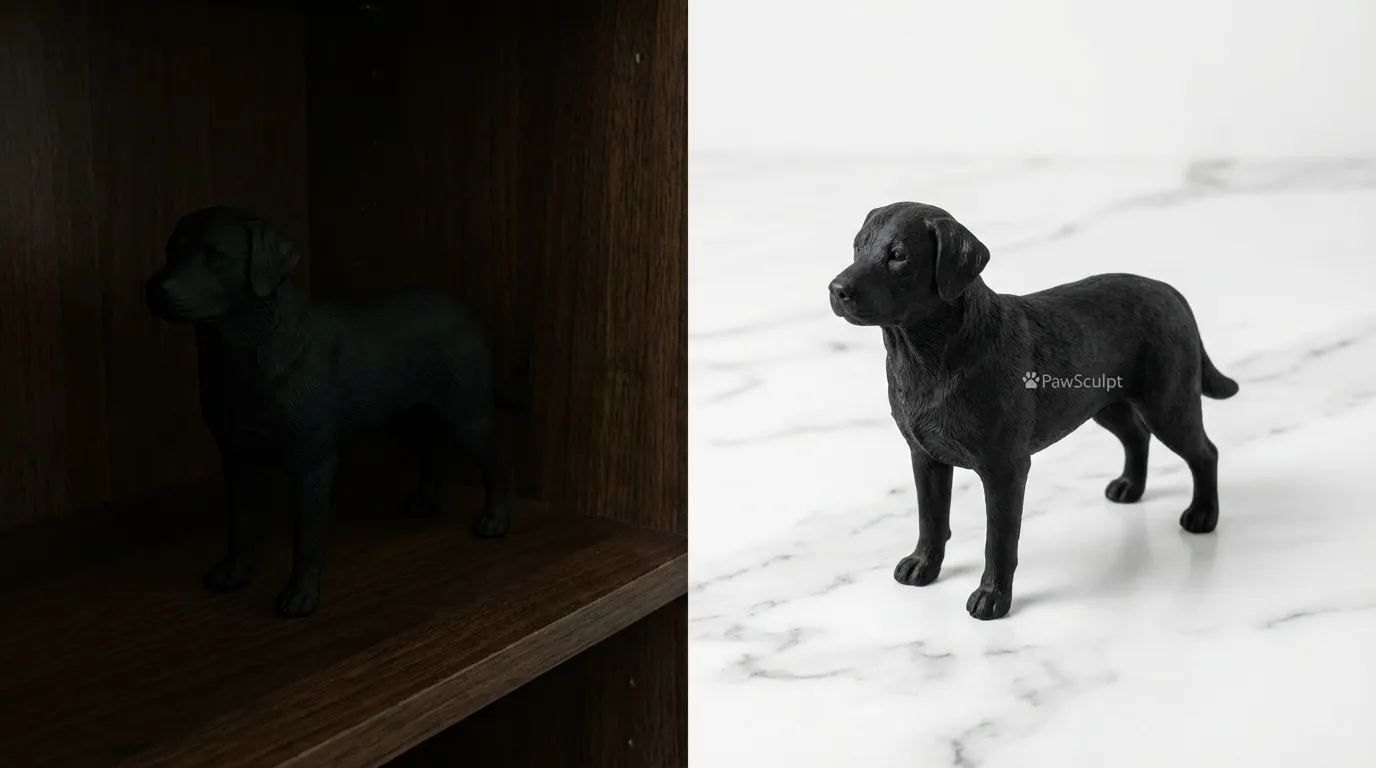
Have you ever placed a photograph of a black dog in a dark frame on a mahogany bookshelf, only to realize later that from three feet away, your beloved pet looks like a vague, shadowy blob?
Quick Takeaways
- Contrast is King — Dark subjects need light backgrounds (and vice versa) to be readable by the human eye.
- Lighting angles matter — Front-lighting flattens texture; raking side-light reveals the 3D printed fur details.
- Material finish affects color — Our clear coat adds depth, but it also reflects light, meaning placement near windows changes the perceived color.
- The "Squint Test" — If you squint and the figurine disappears into the background, you need to move it or change the backing.
- Custom figurines need breathing room — Give your PawSculpt figurine at least 3 inches of clearance to let light wrap around it.
The Engineering of Visibility
We see it all the time in the lab. We spend hours digitally sculpting the subtle brow ridge of a Black Labrador or the complex brindle of a Boxer. We print it on our full-color Stratasys J-series or similar high-fidelity machines, wash the support material, cure it, and apply the clear coat. It looks spectacular on our neutral gray inspection mats.
Then, a customer sends us a photo of the figurine displayed inside a dark walnut cabinet, and they’re disappointed. "It looks darker than the digital proof," they say.
It’s not the print. It’s the physics of light absorption.
When we engineer a full-color 3D print, we are injecting pigmented resin voxel-by-voxel (think 3D pixels). Unlike a hand-painted model where an artist might artificially "highlight" black fur with gray paint to force contrast, our machines print the actual local color of the dog. A black dog is printed black.
If you put a black object against a black background, you are asking your eyes to distinguish between two light-absorbing voids. Without an artificial rim light (like they use in movies), the figurine vanishes.
The "Void" Phenomenon
Here is the counterintuitive insight most collectors miss: The more accurate the figurine, the harder it is to display.
Cheap toys use exaggerated colors—bright blue highlights on black hair—so they stand out anywhere. A museum-quality replica from PawSculpt aims for realism. Real black fur absorbs light. To see the sculpture, you cannot rely on color; you must rely on specularity (how light reflects off the surface texture).
"We don't just print colors; we print shadows. If you hide the shadows in a dark corner, you hide the sculpture."
Background Theory: The Rule of Opposites
Interior designers know this, but pet owners often forget it when creating a memorial shelf or display. The background color shouldn't match the pet; it should frame them.
For Dark-Coated Pets (Black Labs, Rottweilers, Bombay Cats)
You need high-value contrast. "Value" in color theory refers to lightness or darkness, not the hue itself.- Best Backgrounds: White, Cream, Pale Oak, Light Grey, Matte Silver.
- The "Pop" Effect: A white matte background reflects ambient light back onto the rear of the figurine, creating a subtle outline that separates the object from the wall.
For Light-Coated Pets (Samoyeds, Golden Retrievers, White Persians)
These prints are susceptible to "washing out." If you put a white 3D print against a white wall, you lose the silhouette.- Best Backgrounds: Navy Blue, Charcoal, Forest Green, Deep Walnut.
- The "Anchor" Effect: A dark background absorbs the scattered light, forcing the eye to focus on the brightest object in the visual field—your pet.
For Multi-Colored/Patterned Pets (Calicos, Aussies, Spaniels)
This is where it gets tricky. A busy background (like patterned wallpaper) fights with the complex texture of the 3D print.- Best Backgrounds: Solid, muted tones. Pick a minor color from the dog's coat (like the tan in a Rottweiler's eyebrows) and use a muted version of that for the wall or shelf backing.
| Pet Coat Color | Ideal Background Value | Recommended Material/Texture | Avoid |
|---|---|---|---|
| Solid Black | High Brightness (90-100% White) | White marble, birch wood, light concrete | Mahogany, dark shadows, black velvet |
| Pure White | Low Brightness (Dark/Deep) | Slate, walnut, dark felt | White laminate, sun-bleached wood |
| Brown/Chocolate | Cool Neutrals | Sage green, slate blue, cool grey | Warm woods (oak/cherry) that blend in |
| Merle/Brindle | Solid Mid-Tones | Matte paint (no texture) | Patterned wallpaper, wood grain |
Lighting: The Additive Manufacturing Perspective
In our shop, we inspect prints under 5000K (neutral white) raking light. "Raking" means the light hits the object from the side, not the front.
Why? Because 3D printed full-color resin has a specific surface topology. We aren't smoothing this down to a mirror finish—we want you to see the fur texture we sculpted.
If you aim a spotlight directly at the front of the figurine (on-axis lighting), you fill in all the microscopic valleys of the fur texture with light. The figurine looks flat and sticker-like.
The Fix:
Move your light source 45 degrees to the left or right and slightly above. This casts microscopic shadows inside the fur texture, suddenly making the print look "furry" again.
The Clear Coat Factor
We apply a UV-protective clear coat to every PawSculpt figure. This isn't just for durability; it wets the surface to make the colors vibrant (similar to how a wet rock looks more colorful than a dry one).However, clear coats are glossy or semi-glossy.
- Window Warning: Do not place the figurine directly facing a window. The reflection of the window will appear as a giant white square on the dog's chest, obscuring the color pattern.
- Monitor Glow: If you keep the figurine on your desk, the blue light from your monitor will tint the figurine. A Golden Retriever can look sickly green under a cool monitor glow.
Display Surfaces and "Grounding"
A common mistake we see is "floating." This happens when a figurine is placed on a glass shelf. Because the shelf is transparent, the figurine lacks a visual anchor. It looks like it's hovering, which feels unnatural to the brain.
In the 3D printing world, we deal with "orientation" and "bed adhesion." In the display world, you need "visual adhesion."
The Coaster Trick:
If you have a glass cabinet, place a small opaque disk or coaster under the figurine.
- For Black Dogs: Use a light stone or cork coaster.
- For White Dogs: Use a slate or dark wood coaster.
This creates a dedicated stage for the piece and stops the visual confusion of seeing the shelf below through the glass.
"We build these figurines layer by 20-micron layer. Don't let bad lighting erase all that data in a single second."
— The PawSculpt Team
The Psychology of Placement
We've printed thousands of pets. We know that for many of you, this isn't just a piece of decor; it's a piece of your heart.
When you place a memorial object in a high-traffic, cluttered area—like next to the car keys on the kitchen counter—it becomes invisible through habituation. You stop seeing it because it's part of the daily noise.
The Shrine Effect:
Isolate the figurine. Give it "negative space" (empty space) around it. In design, negative space implies importance. A museum puts one statue on a pedestal, not twenty.
If you really want to honor the memory of a pet, or celebrate a current one, clear a 6-inch radius around the figurine. Let the background color and the lighting do the work. When you walk by, the contrast will catch your peripheral vision, drawing your eye to the figurine and triggering the memory.
Frequently Asked Questions
Does the clear coat fade over time?
Our UV-protective clear coat is industrial grade, similar to automotive finishes. However, no resin is 100% immune to UV degradation over decades. We recommend keeping the figurine out of direct, scorching sunlight (like a windowsill in Arizona) to preserve the color fidelity for a lifetime.My dog has very specific markings. Will they show up?
Yes. Because we use full-color 3D printing (injecting cyan, magenta, yellow, black, and white resins), we aren't limited by a painter's brush size. We can print distinct markings down to the millimeter. However, extremely low-contrast markings (like dark grey spots on a black dog) need good lighting to be visible.Can I clean the figurine if it gets dusty?
Absolutely. Use a microfiber cloth or a can of compressed air (from a distance). Do not use harsh chemical cleaners, acetone, or alcohol, as these can dull the clear coat or soften the resin. A damp cloth with water is usually enough.Why does my figurine look different in photos than in real life?
Cameras struggle with dynamic range. A phone camera will often crush the blacks (making a black dog look like a silhouette) or blow out the whites. Your eyes have much better dynamic range than a camera. The figurine usually looks much more detailed in person than in a quick smartphone snap.Do I need a display case?
It's not required for durability, but it helps with dust. 3D printed surfaces have texture (fur), which loves to trap dust. A glass dome or acrylic box keeps it clean, but remember the "floating" rule—put a solid base inside the case!Ready to Celebrate Your Pet?
Every pet has a story worth preserving. Whether you're honoring a beloved companion who's crossed the rainbow bridge or celebrating your furry friend's unique personality, a custom PawSculpt figurine captures those details that make your pet one-of-a-kind.
Free instant AI preview • 3D artist preview within 7 days • 5 free revisions