
Why Your Bengal Cat's Spots Fade in Photos (But Not in 3D Resin)
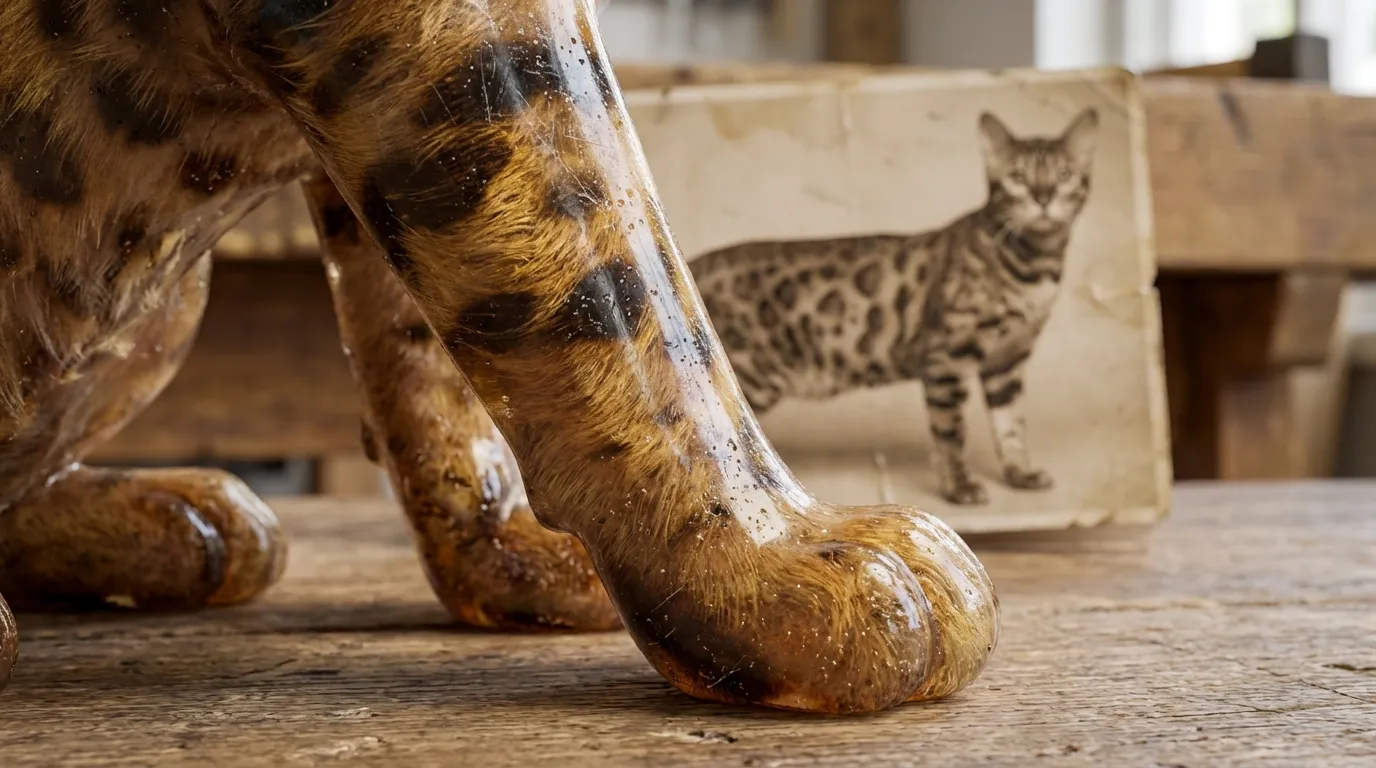
The afternoon sun hits that specific spot on the rug, illuminating a cloud of golden dust motes dancing in the air, but the warm, living weight that used to intercept those beams is gone. You catch yourself staring at the empty space, trying to conjure the precise iridescent shimmer of your Bengal cat memorial, panic rising as the mental image blurs.
Quick Takeaways
- The "glitter" effect in Bengals is caused by hollow hair shafts refracting light, which standard cameras struggle to capture.
- Photos flatten depth, often turning vibrant, multi-toned rosettes into muddy, singular blobs of color.
- Lighting is critical; the magic of a Bengal's coat requires dynamic light interaction, not static pigment.
- Full-color 3D printing mimics organic texture and light absorption better than 2D photography or custom figurines made from opaque clay.
- Memory fades not because you didn't love them enough, but because the brain struggles to hold complex visual patterns over time.
The "Gold Dust" Phenomenon: Why Your Photos Feel Flat
We have all been there. You scroll through your camera roll, swiping past hundreds of images of your Bengal. They are cute, certainly. They show the pose, the size, the general color. But they don't feel like him. They don't capture that liquid-gold movement or the way his coat seemed to generate its own light source when he walked through a dim room.
This isn't a failure of your photography skills. It is a limitation of physics.
The defining characteristic of the Bengal breed—that famous "glitter"—is structurally unique. In most cats, hair shafts are solid. In Bengals (and their wild ancestors, the Asian Leopard Cat), many of the hair shafts are hollow or contain air pockets. This structure acts like a prism. When light hits the fur, it doesn't just bounce off; it enters the shaft, refracts, and scatters.
"Grief isn't just missing their presence; it's the desperate fear that the specific details of their beauty are slipping through your fingers."
When you take a standard photograph, the camera sensor captures a flat representation of light bouncing off a surface. It cannot capture the depth of that refraction. The result is often a flat, orange-brown color where you remember seeing sparkling gold.
The Rosette Complexity
It’s not just the glitter. It’s the rosettes. A true Bengal rosette isn't a dot; it's a multi-layered landscape. There is the dark outer ring, the warm inner fill (often a rich rust or terracotta), and the background coat color (cream, buff, or gold).In a 2D photo, especially one taken indoors, the contrast between the inner fill and the background coat often disappears. The camera compresses the dynamic range. What was a distinct, three-tone marking becomes a muddy smudge. This is why, when we look at photos of our late companions, we often feel a strange sense of dissonance. We know it's them, but the "spark" is missing.
The Fear of Forgetting: A Silent Grief
There is an emotional nuance to losing a Bengal that we rarely discuss in the open, perhaps because it sounds trivial to those who haven't experienced it. It is the fear of forgetting the pattern.
We talk about missing their purr or their weight on our lap. But for Bengal owners, the coat was a map of your relationship. You knew the specific heart-shaped spot on the left flank. You knew the "necklace" markings under the chin. You knew exactly where the glitter was most intense (usually the tips of the ears or the paws).
It is common to feel a sudden, sharp anxiety when you realize you can't mentally visualize the exact placement of those spots.
This isn't vanity. It's not about the cat being "expensive" or "purebred." It's about the intimacy of observation. You spent years looking at that fur—while they slept on your chest, while they chattered at birds in the window. Losing the visual clarity of those markings feels like losing the last tether to their physical reality.
We have spoken to countless owners who feel guilty about this. They think, "I should be missing their soul, not their spots." But the physical and the spiritual are intertwined. The spots were the vessel. Wanting to preserve them in high fidelity is a valid, profound part of mourning.
Why 3D Resin Captures What Photos Miss
This brings us to the difference between a flat image and a physical object. When we look at how 3D print detail interacts with the human eye, we start to understand why a figurine often triggers a stronger emotional recognition than a photograph.
The Science of Subsurface Scattering
In computer graphics and 3D printing, there is a concept called "subsurface scattering." This describes how light penetrates a translucent surface, scatters inside it, and exits at a different point. This is what makes human skin look like skin and not plastic. It's also what makes Bengal fur look alive.Standard opaque materials (like clay or painted ceramic) reflect light directly off the surface. They look "painted on."
However, the full-color resin used in advanced 3D printing (specifically the PolyJet technology we utilize at PawSculpt) is partially translucent. The color isn't painted on top; the color is embedded within the material, voxel by voxel (a voxel is a 3D pixel).
- Light Penetration: Light enters the resin slightly before bouncing back.
- Depth Perception: This mimics the way light interacts with the hollow hair shafts of a Bengal's coat.
- Texture vs. Pigment: The 3D printer lays down material in microscopic layers. This creates a grain that, while not actual fur, catches light in a way that mimics the directionality of a coat.
Comparison: Capturing the Bengal Essence
| Feature | Standard Photograph | Hand-Painted Clay/Ceramic | Full-Color 3D Resin |
|---|---|---|---|
| Light Interaction | Reflective (Glossy) or Flat (Matte) | Surface Reflection Only | Subsurface Scattering (Depth) |
| Rosette Detail | Often compressed/muddy | Dependent on brush size (often simplified) | Exact digital mapping of patterns |
| Texture | None (Smooth paper/screen) | Brushstrokes (artificial texture) | Layer lines mimic organic grain |
| "Glitter" Effect | usually lost or requires flash | Impossible with standard opaque paint | Mimicked through resin translucency |
| Color Accuracy | Dependent on ambient lighting | Dependent on artist's palette | CMYK mixing at microscopic level |
The Problem with "Hand-Painted" for Bengals
There is a romantic idea that "hand-painted" is always better. For many things, it is. But for a Bengal cat memorial, the human hand has limitations that technology does not.
To paint a Bengal rosette realistically, an artist needs to blend three distinct colors in a space often smaller than a pencil eraser. They have to do this hundreds of times across the body. Even the most skilled artisan will naturally simplify the pattern. They will turn complex, organic shapes into circles or ovals. They will flatten the gradient between the rust center and the black outline.
We don't use paintbrushes. We use digital sculpting tools and precision manufacturing.
Our process involves projecting the actual photographic data of your pet onto the 3D model. The printer then replicates that data, dot by dot, in resin. It preserves the asymmetry. It preserves the "messy" edges of the spots that make them look real. It captures the chaos of nature that a human painter subconsciously tries to tidy up.
"The eye knows the difference between a pattern that was painted and a pattern that grew. We strive to capture the latter."
— The PawSculpt Team
Lighting Your Memorial: Bringing the Spots to Life
Once you have a physical representation of your companion—whether it's a figurine, a high-quality print, or a keepsake box—the environment matters. We often see people place their memorials on a dark shelf in a hallway.
For a Bengal, this hides their beauty.
Because the "life" of a Bengal's coat comes from light refraction, we recommend displaying your memorial near a natural light source.
The "Golden Hour" Display
If possible, place the figurine where it will catch the morning or late afternoon sun. Just as your living cat used to hunt for sunbeams, their memorial will look most "alive" when illuminated by warm, directional light. This reveals the texture of the 3D print and allows the colors to glow rather than sit flat.Note: While our materials are UV-resistant, we recommend avoiding direct, scorching midday sun for years on end to prevent any long-term fading. Filtered sunlight is ideal.
Navigating the Guilt of "Moving On"
As you look for ways to memorialize your pet, you might encounter a wave of guilt. Is getting a custom figurine a way of holding on too tight? Or is it a way of replacing them?
We want to address a counterintuitive insight about grief objects: Having a tangible memorial often helps people let go of the pain, not the pet.
When you are terrified of forgetting what they looked like, your brain stays in a state of hyper-vigilance. You constantly check photos. You ruminate on memories. You stress about the fading mental image.
When you have a physical object that faithfully replicates their unique markings—that specific cluster of spots on the shoulder, that one striped leg—your brain can relax. You have "outsourced" the memory preservation to the object. You know their image is safe. This often frees up emotional space to move from "panicked grief" to "gentle remembrance."
"A memorial doesn't replace the hole in your life. It marks the spot so you don't fall in again."
Practical Tips for Gathering Reference Photos
If you are considering a custom 3D portrait, you might worry that your existing photos aren't good enough, especially given what we've said about cameras flattening Bengal coats.
Don't worry. We work with what you have. However, if you are reading this while your Bengal is still with you, or if you are digging through archives, here is what helps us most:
- The "Top-Down" Loaf: We need to see the back pattern. Most people take photos of the face. The back is where the rosette flow is most dramatic.
- Indirect Natural Light: Avoid the flash. Flash creates harsh white hotspots that obscure the pattern. Indirect window light is best.
- Video Footage: Sometimes a 10-second video of your cat walking gives us more information about their body shape and pattern flow than 50 still photos. We can pause and analyze the frames.
- The "Under-Chin" Shot: Bengals often have white or light cream chins and bellies. This transition line is hard to guess, so a photo showing the chest is invaluable.
A Legacy of Light
Your Bengal was a creature of light and movement. They were a wild spirit in a domestic package, bringing the aesthetic of the jungle into your living room. It is entirely normal to miss that visual splendor just as much as you miss their affection.
Preserving those patterns isn't just about copying a coat; it's about honoring the unique biology that made them who they were. Whether through a photo book, a painting, or a 3D resin sculpture, ensuring those rosettes don't fade from memory is a final act of love.
Frequently Asked Questions
Why do Bengal cat markings look dull in photos?
It comes down to physics. Bengal fur often has "glitter"—hollow hair shafts that refract light. Cameras capture a 2D reflection, flattening this effect. Additionally, the complex three-tone rosettes (outer ring, inner color, background coat) often get compressed into a single muddy color by camera sensors, especially in indoor lighting.Can 3D printing actually capture the glitter of a Bengal coat?
It captures the depth that creates the effect. Unlike opaque paint on clay, the full-color resin we use is slightly translucent. This allows light to penetrate the surface (subsurface scattering) before bouncing back, mimicking the organic luminosity of the coat. While it's not actual hair, the interaction with light is much closer to reality than a flat photo.Do I need professional photos to get a custom figurine made?
No. We have years of experience interpreting standard smartphone photos. What helps us most are photos taken in natural light (near a window) rather than with a harsh flash. If you have videos of your pet moving, those are often even better than still photos for understanding the flow of their pattern.Is it normal to worry about forgetting my pet's markings?
Absolutely. This is a specific form of grief anxiety. We rely on our pets' physical presence to ground us, and when that is gone, the fear of the visual memory slipping away can be intense. Securing a highly detailed memorial often relieves this specific anxiety, allowing you to focus on the happy memories rather than the fear of forgetting.Ready to Celebrate Your Pet?
Every pet has a story worth preserving. Whether you're honoring a beloved companion who's crossed the rainbow bridge or celebrating your furry friend's unique personality, a custom PawSculpt figurine captures those details that make your pet one-of-a-kind.
Free instant AI preview • 3D artist preview within 7 days • 5 free revisions