
Will a Bengal's Rosettes Fade Over Time? UV-Stable Color in 3D-Printed Resin, Explained
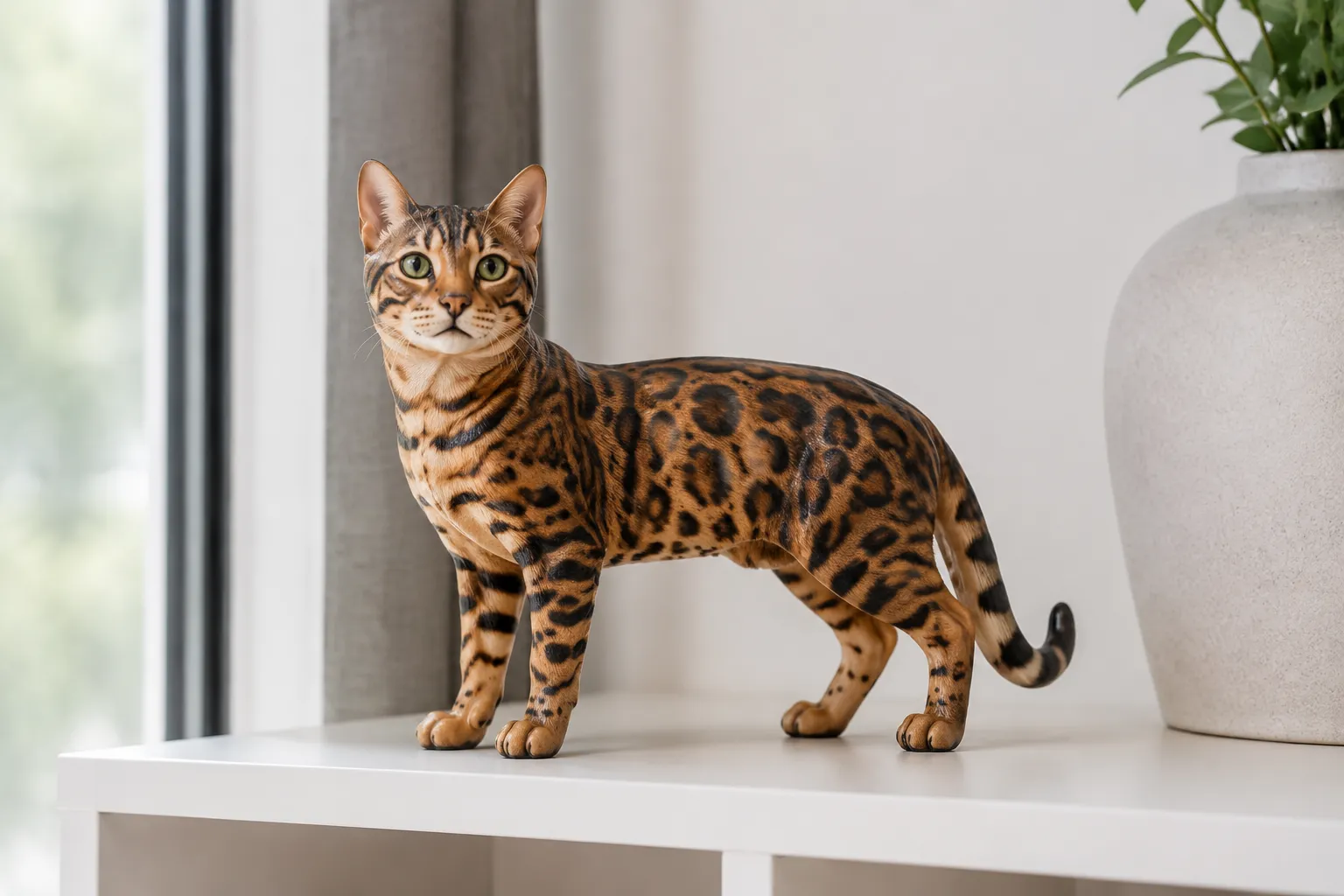
Will a Bengal's rosettes still glow ten years from now, or will they wash out like an old photograph left in a sunny window? That question — "will figurine color fade" — surfaced in a customer's basement, where she'd set her late Bengal's 3D-printed figurine on a shelf beside the dehumidifier, worried the dark spotting would dull before her daughter grew up.
It's a fair worry. And the answer is more interesting than yes or no.
Quick Takeaways
- Color in full-color resin prints is embedded in the material — it doesn't sit on top like a coating that peels.
- UV exposure is the real enemy, not time itself — direct sun fades pigments faster than any clock.
- A quality clear coat acts like sunscreen — it filters UV and protects the surface from handling and dust.
- Display placement matters more than display quality — corners and indirect light preserve color for years.
- For Bengal rosettes specifically, contrast is the thing to protect — learn how custom pet figurines hold that depth over time.
Why a Bengal Is the Hardest Test for Color That Lasts
Here's the thing about Bengals. They're the stress test.
Most cats are a study in soft gradients — a gray tabby, a cream point, a black shorthair. Beautiful, but forgiving. A Bengal is the opposite. Those rosettes (the two-toned spots that look stamped on, dark rims around a lighter center) live or die on contrast. The whole magic of the coat is the difference between the spot and the ground color around it.
So when someone asks whether a figurine's color will fade, what they're really asking about a Bengal is this: will the rosettes blur into the background? Will the depth flatten out until it's just a tan cat with smudges?
That's the right question to ask. And it's why a Bengal makes such a useful example for understanding how color survives in full-color 3D printing.
"Color doesn't fade evenly. The richest tones go first. That's why we obsess over contrast that's built to last."
— The PawSculpt Team
Think about your own photographs. The ones from the seventies that went orange? They didn't lose all their color at once. The blues and the deep reds faded first, leaving behind a muddy warmth. Pigments aren't equal. Some are fragile, some are stubborn.
A Bengal's coat asks a figurine to hold onto exactly the kind of deep, saturated tones that fade fastest in cheap materials. Get it right, and you've basically proven the process can handle anything. Get it wrong, and you've got a sad beige cat in five years.
So let's get into how the color actually gets there in the first place. Because you can't understand fading until you understand where the color lives.
How Color Gets Into the Resin (It's Not What Most People Think)
Most folks picture a figurine the way they picture a model car. A blank shape comes out, then someone sits at a bench with tiny brushes and adds the markings.
That's not how we do it. And honestly, that mental model is why so many people worry about fading — because surface color does fade and chip and peel. If color is a layer sitting on top, it's vulnerable. Scratch it, and you see white underneath.
Full-color 3D printing works differently.
The voxel, explained in plain English
A regular 3D print builds an object out of tiny layers. Full-color 3D printing goes one step further: it controls color at the level of individual voxels. A voxel is just a pixel with volume — a tiny 3D dot of material. Imagine a pixel on your screen, but instead of being flat, it's a microscopic cube of cured resin with its own assigned color.
The printer lays down these colored droplets and cures them with UV light, building your pet up dot by dot, layer by layer. The dark rim of a rosette and the tawny center beside it aren't painted next to each other. They're printed as different-colored material, fused into one solid piece.
So the color isn't on the figurine. The color is the figurine.
"When the color is the material itself, there's nothing to chip off. That changes everything about how it ages."
This is the single most important fact for anyone worried about fading, and it's the part competing articles almost never explain clearly. A surface coating and embedded color age in completely different ways. One flakes. The other holds — as long as the pigment chemistry and the protective layer are doing their jobs.
From your photo to a solid Bengal
The journey starts long before any resin gets cured. Here's the actual workflow:
- Reference photos. Master 3D artists study your photos — ideally several angles, good natural light, the coat in focus. For a Bengal, we want to see how the rosettes flow across the body, because spotting follows the muscle and curves with it.
- Digital sculpting. The pet is hand-modeled digitally in software like ZBrush or Blender. This is where anatomy, posture, and proportion get dialed in. The sculptor is building a 3D model on screen, checking it against your photos from every angle.
- Color mapping. The coat pattern gets applied to the digital model — matched to your cat's actual markings, not a generic Bengal template. This is where rosette placement, ground color, and the subtle warmth of the belly all get set.
- Full-color printing. The finished digital model goes to the printer, which builds it in UV-cured photopolymer resin with the color embedded voxel by voxel.
- Post-processing. Cleaning, curing, support removal, and a protective clear coat. No brushes, no paint. The machine already did the color.
That third step — color mapping — is where a Bengal's difficulty really shows. A lazy job uses a flat brown for the rosettes and calls it done. A good job captures the two-tone structure: the darker outline, the warmer fill, the way the ground color shifts from spine to flank. That depth is what reads as "alive" on a shelf. And protecting that depth over the years is the whole ballgame.
Will Figurine Color Fade? The Honest Answer
Let's be real with you, because you deserve a straight answer instead of a sales pitch.
Yes, any color can fade under the wrong conditions. No material on earth is truly immortal. The pyramids are eroding. Old masters' paintings get restored for a reason. Anyone who promises you "never fades, guaranteed, forever" is either lying or doesn't understand chemistry.
But here's the part that matters: fading is almost entirely about exposure, not about time passing. A figurine kept in reasonable indoor conditions can hold its color for many, many years. The same figurine baking in a south-facing window can show change much sooner.
So the real question isn't "will it fade." It's "what makes it fade, and how do I prevent that." Let's break down the actual culprits.
The four things that actually cause fading
These are the failure modes we think about, ranked roughly by how much damage they do:
| Cause | What it does | How much it matters | Your control level |
|---|---|---|---|
| UV light (sun) | Breaks down pigment molecules, washes out saturation | Highest — by far | High — placement is everything |
| Heat cycling | Can stress resin, accelerate other damage | Moderate | High — avoid windows, vents, attics |
| Abrasion/handling | Wears the clear coat, dulls the surface | Low to moderate | High — display vs. constant handling |
| Time alone | Minimal in stable indoor conditions | Lowest | N/A |
Notice what's at the top. UV light. Everything else is a distant second.
This is the counterintuitive insight most people miss: a figurine doesn't fade because it gets old. It fades because of where it sits. A ten-year-old print in a shaded bookcase can look better than a one-year-old print on a sunny sill. Time is not the villain. Photons are.
"Your figurine isn't aging on a clock. It's aging on a light meter. Move it out of the sun and you've won most of the battle."
Why UV is the enemy (the chemistry, briefly)
Pigments are molecules, and molecules have bonds. Ultraviolet light carries enough energy to break some of those bonds — a process called photodegradation. When the bonds break, the molecule stops reflecting its original color. Multiply that across billions of molecules over years of sun exposure, and you get fading.
Different pigments resist this differently. This is why we care so much about UV-stable resin and pigment selection. A pigment that's "lightfast" (resistant to fading from light) holds its bonds far longer under UV. The good news for full-color prints is that the pigment is locked inside cured resin, which itself provides some shielding — and the clear coat adds another layer of defense.
What "UV-Stable Resin Figurine" Actually Means
This phrase gets thrown around a lot, and most of it is marketing fog. Let's clear it up.
There are two separate things at play, and people conflate them constantly:
One: the resin's own UV stability. Some photopolymer resins yellow or grow brittle under prolonged UV. A more UV-stable formulation resists that yellowing and holds its mechanical properties longer. This matters for the base material — you don't want a white belly turning ivory over time.
Two: pigment lightfastness. This is about the colors themselves resisting photodegradation. You can have a UV-stable resin with poorly chosen pigments, or great pigments in a resin that yellows. You want both.
A genuine UV-stable resin figurine addresses both. And then a clear coat addresses a third front entirely.
The clear coat is basically sunscreen
Here's a detail we love because it's so intuitive once you hear it. The protective clear coat applied during post-processing does for your figurine roughly what sunscreen does for your skin.
A good clear coat:
- Filters some UV before it reaches the pigment, slowing photodegradation.
- Seals the surface so dust, oils from handling, and humidity don't reach the resin.
- Adds a consistent sheen — matte, satin, or gloss — that unifies the look and protects the natural print texture underneath.
- Resists abrasion so everyday handling wears the coat, not the colored material.
This is the only manual step in the whole process where a human touches the surface with a tool, and it's not painting — it's protecting. The color is already done. The clear coat is the bodyguard.
One thing we'll be honest about: no clear coat is a perfect UV blocker. It buys you time and protection, but it's not a force field. Which is exactly why placement still matters even with a great finish. Belt and suspenders.
Curious about the specific materials and finishes we use? The details live on our process page, and they're worth a look if you're the type who likes to know exactly what's protecting your keepsake.
The Craftsman's View: Capturing Light in a Bengal's Coat
Step back from the chemistry for a second.
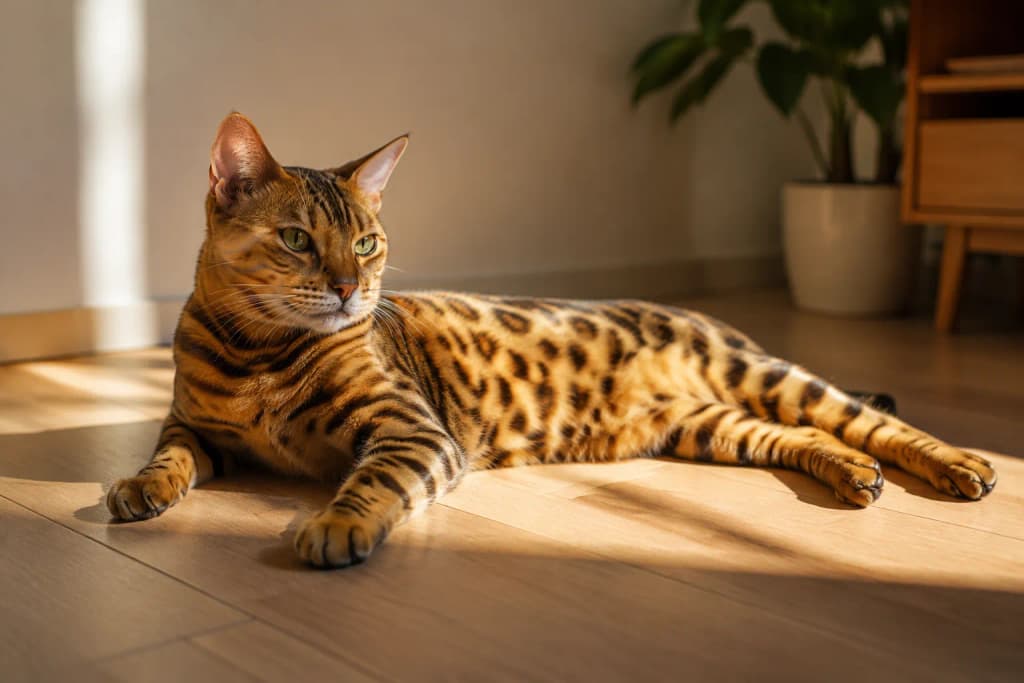
What you're really preserving when you commission a figurine of a Bengal isn't a color code. It's the way light moved across that cat. The glossy sheen Bengals get — what breeders call "glitter," that almost metallic shimmer on the coat — is about how light catches the fur. The rosettes have depth because shadow pools differently in the dark rims than in the lighter centers.
A figurine has to fake all of that with static, cured resin. And the way it pulls it off is through the interplay of printed color and the clear coat's sheen.
This is the artistic problem hiding inside the technical one. Match the colors exactly but flatten the contrast, and the Bengal looks taxidermied — accurate but dead. Push the contrast and the sheen right, and suddenly the resin seems to hold light the way the living coat did. That's the difference between a model and a memory.
"We're not copying a cat's colors. We're trying to catch the way the light used to land on her."
Preservation, in this sense, is an act of attention. The figurine says: this detail mattered enough to keep. The white whisker pads. The faint ticking on the legs. The specific asymmetry of one rosette that was bigger than the rest. When color holds over the years, those decisions hold too.
And that's the quiet reason fading frightens people. It's not vanity about a knickknack. It's the fear that the memory itself is fading — that the thing you made to outlast forgetting will forget first. Understanding that the color is embedded, protected, and stable lets you set that fear down.
What We Wish We Knew Sooner
A candid sidebar from our team — the stuff we learned the hard way, so you don't have to.
- Window light is sneakier than you think. A spot that gets two hours of direct afternoon sun seems harmless. Over years, it's the single biggest fade risk in most homes. We've learned to ask customers where they plan to display before they even order.
- People handle memorial pieces far more than display pieces. A figurine of a pet who passed gets picked up, held, touched. That's beautiful — and it means the clear coat earns its keep. We now think of handling as a feature to protect for, not an edge case.
- Bengals taught us to fight for contrast in the digital model. Early on, we'd nail the colors and lose the depth. The fix wasn't better pigment — it was better color mapping in the sculpt, exaggerating rosette contrast just slightly so it reads right under a clear coat.
- Dust dulls color faster than fading does. A film of household dust can make a vibrant piece look tired in months. The fix is laughably simple (more on that below), and most people never think to do it.
- "Will it fade" almost always means "will I lose her again." We didn't get that at first. Now we answer the emotional question alongside the technical one, because they're the same question wearing different clothes.
How to Display a Pet Figurine So the Color Lasts
This is the practical heart of it. Displaying a pet figurine well is mostly about respecting one rule — keep it out of direct sun — and then a handful of small habits.
Let's make it concrete. Here's where color thrives and where it suffers:
| Location | UV risk | Verdict | Why |
|---|---|---|---|
| Interior bookshelf, away from windows | Very low | Ideal | Stable light, stable temperature |
| Mantel (no direct sun) | Low | Great | Indirect light, honored spot |
| South/west-facing windowsill | Very high | Avoid | Hours of direct UV daily |
| Enclosed glass cabinet (indoor) | Low | Excellent | Dust protection + indirect light |
| Near heating vent or radiator | Low UV, high heat | Avoid | Heat cycling stresses material |
| Basement shelf (dry, no sun) | Very low | Surprisingly good | No UV; just watch humidity |
That last row is worth a note, since this whole article started in a basement. A dry, finished basement is actually a friendly home for a figurine — no direct sun, stable temperature. The only thing to watch is humidity. If your basement runs damp, a small dehumidifier (which our customer already had, smart woman) keeps moisture from working on the surface over time.
The five habits that protect color for decades
- Keep it out of direct sunlight. If you can see the sun from where the figurine sits, the figurine can "see" the sun too. Move it, or filter the window with a UV-blocking film or sheer curtain. This one habit does more than all the others combined.
- Dust gently, monthly. Use a soft, dry brush — a clean makeup brush or a soft paintbrush works beautifully for getting into the texture of fur and rosette detail. Skip the household sprays; they can interact with the clear coat. So what? Dust is the most common reason a figurine "looks faded" when the color is actually fine. You're not fighting chemistry, you're fighting grime.
- Mind the temperature. Keep it away from heat sources — vents, radiators, the top of electronics that run warm. Resin is happiest at comfortable room temperature, the same range you're comfortable in.
- Handle by the base when you can. Skin oils are mild but persistent. For pieces you'll hold often (memorial pieces especially), that's exactly what the clear coat is there for — but lifting from the base or sturdy areas reduces wear on delicate spots like ears, tails, and whiskers.
- Glass display cases are underrated. If you want the highest level of protection, an enclosed case handles dust and adds a small barrier. So what? It turns "occasional maintenance" into "basically none," and it frames the piece like the small monument it is.
Do these, and the honest expectation is that your Bengal's rosettes will look the way they do today for a very long time. Not because of a magic guarantee, but because you've removed the things that actually cause change.
What to Expect When You Commission a Figurine
We won't pin down exact timeframes or policies here — those live on the website and they shift — but we can walk you through the general shape of the creative process so there are no surprises.
The photo stage. This is where you have the most influence over the final result, especially for a Bengal. More on photos in the FAQ, but the short version: clear, well-lit shots from multiple angles, with the coat pattern in focus.
The digital sculpt. Master 3D artists build your pet as a digital model, getting the posture, proportions, and anatomy right before any color goes on. For Bengals, this is where rosette flow gets mapped to the actual body.
The preview. You typically get to see a digital preview and request adjustments before anything is printed. This matters — it's far easier to nudge a rosette in software than after the resin is cured. Revision specifics are on the FAQ page.
The print and finish. Full-color 3D printing builds the piece in UV-stable resin, then post-processing cleans, cures, removes supports, and applies the protective clear coat.
If you've got questions specific to your pet — an unusual coat, a particular pose, a memorial piece with special meaning — it's genuinely worth reaching out through the contact page before you order. We'd rather talk it through than have you guess.
For more on lightfastness and how pigments respond to UV in general, the broader principles are well documented by conservation and materials sources; if you're a deep-diver, even general pet-care authorities like PetMD touch on how environment affects the things we keep around our pets. The core idea travels: protect from sun, control humidity, handle with care.
The Bigger Picture: Why We Keep What We Keep
There's a reason humans have always made small, durable images of what we love.
The ancient Egyptians carved cats from stone and bronze, and we still have those cats four thousand years later. Not because the Egyptians had better technology — they obviously didn't — but because they chose materials meant to outlast the body. The impulse hasn't changed. The materials have.
A full-color resin Bengal figurine is the same impulse with modern tools. It's a small argument against forgetting. When you ask whether the color will fade, you're really asking whether the argument will hold — whether the thing you made to remember her by will keep doing its job after you're not around to maintain it.
Here's our honest answer to that deeper question. Kept reasonably, away from the sun, the color holds for the long haul. The rosettes stay deep. The glitter still catches light from across the room. And the figurine keeps saying what you made it to say.
That's not a sales promise. That's just what the chemistry and a little care add up to.
"We don't make decorations. We make small arguments against forgetting — and we build them to win."
Frequently Asked Questions
Will my pet figurine's color fade over time?
In normal indoor conditions, away from direct sunlight, the color holds for many years. Because full-color 3D printing embeds the pigment inside the resin rather than coating it on the surface, there's nothing to chip or peel. The main thing that causes fading is UV light, so placement is your biggest lever.
What exactly makes a resin figurine "UV-stable"?
It comes down to two factors working together. The resin formulation should resist yellowing and brittleness under UV, and the pigments themselves should be lightfast, meaning resistant to breaking down under light. A protective clear coat then adds a third layer of defense by filtering some UV and sealing the surface against dust and handling.
Where's the best place to display a pet figurine?
An interior shelf away from windows, a mantel without direct sun, or an enclosed glass cabinet are all excellent. The one rule that matters most: keep it out of direct sunlight. If you can see the sun from where it sits, so can the figurine. A dry basement shelf actually works well too, as long as you manage humidity.
Is the figurine hand-painted?
No. The color is printed directly into the resin using full-color 3D printing technology, controlled at the level of individual voxels (tiny 3D dots of material). The pet is digitally sculpted by master 3D artists first, then precision-printed in full color. The only manual step afterward is applying a protective clear coat.
What photos work best for a Bengal figurine?
Several clear, well-lit photos from different angles, with the rosette pattern in sharp focus. Natural daylight is ideal because it shows the true contrast between the dark rosette rims and the lighter ground color. The better the references, the more accurately artists can map those distinctive markings onto the 3D model.
How do I clean it without damaging the finish?
Gently, and dry. A soft brush — a clean makeup brush is perfect — lifts dust out of the textured fur and rosette detail without scratching the clear coat. Skip household sprays and liquid cleaners, since they can react with the protective finish over time. Monthly is plenty for most homes.
Ready to Celebrate Your Pet?
Every pet has a story worth preserving, and a Bengal's rosettes are exactly the kind of detail worth keeping vivid for the long haul. Whether you're honoring a companion who's crossed the rainbow bridge or celebrating the cat napping in the sun right now, a custom PawSculpt figurine captures the markings, the posture, and the personality that make your pet one-of-a-kind — in full-color, UV-stable resin built to resist fading for years to come.
Visit pawsculpt.com to learn more about our full-color 3D printing process, preview and revision options, and quality guarantee.