How Long Does a Full-Color Guinea Pig Figurine Take? A Calm Timeline for First-Timers
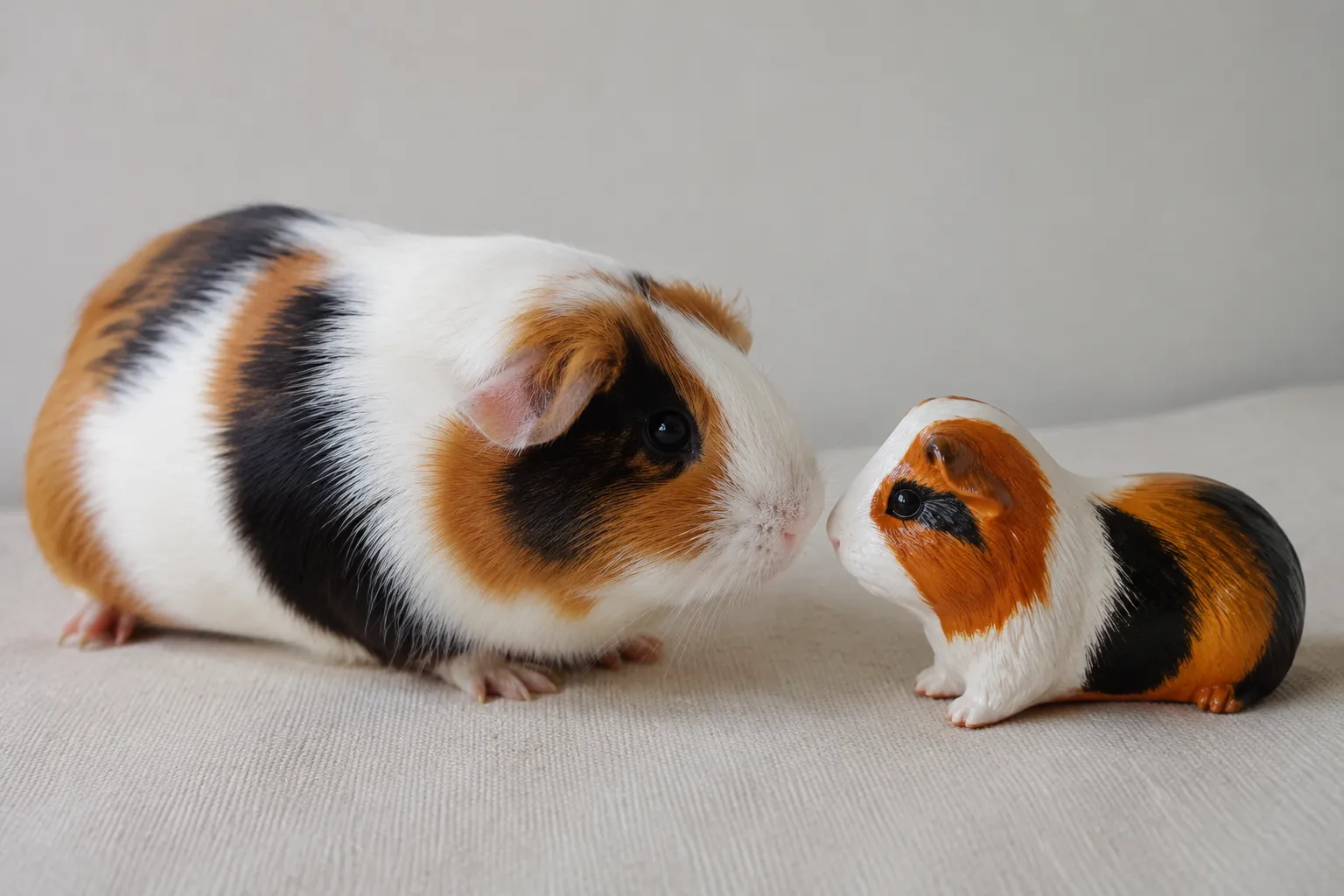
The guinea pig figurine rides in the cupholder now, warm from the sun through the windshield, where a vented travel carrier used to rattle on the way to the vet. Same seat. Same five-minute drive. One small weight has quietly replaced another.
If you searched how long custom figurine takes and ended up here, you're probably holding a phone in one hand and a blurry photo of your piggie in the other. We see you. Let's walk through it together, calmly, the way we'd explain it across a kitchen table.
Quick Takeaways
- Printing is rarely the slow part — the digital sculpt of an unusual coat pattern eats the most time.
- Small pets aren't faster — guinea pig rosettes and agouti banding are deceptively complex to model.
- Good reference photos shave days off the timeline more than any other single thing you do.
- Full-color 3D printing means no drying step — color is baked into the resin, not layered on top.
- For real-world turnaround and revision details, check the current specifics on PawSculpt's custom figurine process rather than guessing.
Why "Small Pet" Doesn't Mean "Quick Turnaround"
Here's the thing most people assume, and it's completely understandable: a guinea pig is tiny, so a guinea pig figurine should be quick. Less animal, less work. Right?
Not quite. And this is the first place where the real timeline surprises people.
We had a customer send us a photo of her Abyssinian piggie—the kind with those swirling cowlicks called rosettes—and she expected a faster turnaround than the family who'd ordered a smooth-coated Labrador the week before. The opposite was true. That Lab's coat was a gentle, predictable flow. Her guinea pig had eight or nine little hair-whorls spiraling in different directions, plus a tri-color patchwork that didn't repeat anywhere on the body.
"A smooth coat is a calm sentence. A rosette coat is poetry—every line has to land in exactly the right place."
So when you ask how long does a custom figurine take, the honest answer starts with a question back at you: what does your pet's coat actually do?
The part of the process you never see
Most of the timeline lives in software, long before any resin exists. A master 3D artist opens reference photos and starts digitally sculpting—building your pet inside a 3D modeling program (think ZBrush or Blender) the way a potter would shape clay, except the clay is virtual and infinitely adjustable.
For a short-haired pet, the artist establishes the body, then "flows" the coat across the surface in one coherent direction. For a guinea pig with rosettes or an Abyssinian's chaotic charm, every cowlick has to be sculpted as its own little event. Miss one, and the whole thing reads as almost your pet instead of your pet.
That "almost" is the enemy. It's also why the sculpt stage—not the printing—is usually the longest leg of the journey.
How Full-Color 3D Printing Actually Works (Plain English)
Let's clear up the biggest misconception we run into. People picture a small white model coming off a machine, then someone sitting at a bench with tiny brushes, dabbing on brown and white and ginger.
That's not what happens here. Not even close.
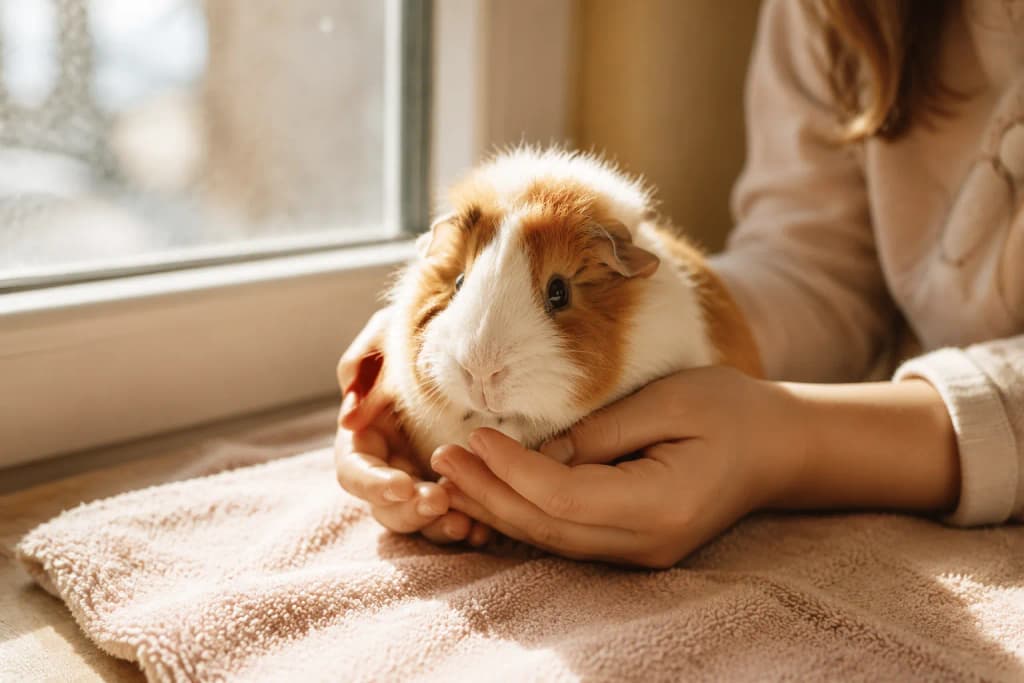
PawSculpt uses full-color 3D printing—a technology family (PolyJet and MJF style) where the printer lays down the color at the same time it builds the shape. The color isn't a coat applied later. It's embedded in the material itself, printed point by point, in a unit called a voxel (think of it as a 3D pixel—a tiny cube of colored resin).
So your piggie's white blaze, the agouti banding on each hair, the warm caramel patch over one eye—all of that gets printed into the UV-cured photopolymer resin (a liquid plastic hardened by ultraviolet light) as the model grows, layer by microscopic layer.
"Color isn't something we add to your pet. It's printed into the very material your pet is made of."
Why this matters for your timeline (and your expectations)
Because there's no waiting for layers of color to dry, the printing itself is mechanical and fairly predictable. A small figurine like a guinea pig often prints in a single overnight run, sometimes faster, depending on size and how it's positioned in the machine.
What you trade for that speed is a different kind of surface. Full-color 3D prints have a faint, natural grain—fine layer lines you can sometimes feel with a fingertip, like the ridges on a vinyl record but far subtler. We don't think of that as a flaw. It's the honest fingerprint of how the object was made. A protective clear coat (the only manual step in the whole process) deepens the color and gives it a gentle sheen, without hiding that the thing was genuinely 3D printed.
If you're expecting the dead-flat, glassy perfection of an injection-molded toy, this will feel different in your hand. Warmer, somehow. More like an object that knows it was made for one specific animal.
The Real Timeline, Stage by Stage
Let's get concrete, because vagueness helps no one. Below is how the work tends to break down. These are typical rhythms across the industry, not a promise—your specific timeline depends on coat complexity, photo quality, and how many small adjustments you want along the way.
| Stage | What's Happening | Typical Driver of Delay |
|---|---|---|
| Photo review | Artist checks angles, lighting, coat clarity | Blurry or single-angle photos |
| Digital sculpting | Hand-modeling your pet in 3D software | Unusual coat patterns, rare poses |
| Color & texture mapping | Painting color into the digital model | Tri-color or banded coats |
| Preview & revisions | You review; artist refines | Number of revision rounds |
| Printing | Full-color resin 3D print | Machine queue, model size |
| Post-processing | Wash, cure, support removal, clear coat | Support density, curing schedule |
| Final QC & shipping | Dimensional and surface inspection | Reprints if QC fails |
Notice where the variability lives. The printing row is one of the most predictable. The sculpting and revisions rows are where days quietly accumulate—and where a guinea pig with an unusual coat costs more time than a larger, simpler pet.
Stage one: getting the sculpt right
The artist works from your photos to build proportions first—skull width, the slope of the back, that low-slung guinea pig silhouette. They run proportional checks, comparing the model against multiple reference angles so the head doesn't drift too large (a common early error) or the rump too flat.
Then comes coat flow. For a smooth American guinea pig, this is relatively direct. For an Abyssinian or a long-coated Peruvian or Silkie, the artist is essentially choreographing hundreds of strands of direction. This is slow, careful work, and rushing it is exactly how you get a figurine that makes you tilt your head and think something's off.
Stage two: the preview is your leverage point
Before anything touches a printer, you typically get a digital preview—a rendered image of the 3D model. This is the single most important moment for you, and most first-timers underuse it.
Look at it the way you'd look at your actual pet. Is the eye spacing right? Does the white patch sit where it really sits? Is the little double-chin (the dewlap) present if your piggie had one?
Speak up here. Catching a coat-pattern error at the preview stage costs minutes. Catching it after printing costs a full reprint. We'll come back to why this stage is also where people accidentally slow themselves down.
The Photos That Make or Break Your Timeline
If there's one place you have direct control, it's here. The quality of your reference photos affects your timeline more than almost anything else, because every ambiguity in a photo becomes a question the artist has to pause and resolve—or worse, guess at.
A family once sent us a single photo of their guinea pig taken from directly above, lit by a phone flash that washed out the entire coat pattern into a flat beige. The artist couldn't tell where the ginger ended and the cream began. That ambiguity added a back-and-forth that good photos would have skipped entirely.
Here's what actually helps, ranked by how much it moves the needle:
| Photo Element | What to Aim For | Why It Matters |
|---|---|---|
| Lighting | Soft, natural daylight, no flash | Flash flattens coat color and detail |
| Angles | 3-5 shots: side, front, top, each side | Lets the artist build a true 3D form |
| Focus | Sharp on the face and coat edges | Blur forces guesses on pattern borders |
| Eye level | Camera down at the pet's height | Avoids distorted proportions |
| Coat detail | At least one close-up of the markings | Rosettes and bands need clear reference |
A small practical tip we love: photograph your guinea pig on a contrasting surface. A ginger-and-white piggie on a dark towel pops; the same piggie on a beige blanket disappears at the edges. Contrast tells the artist where your pet ends and the background begins.
And honestly? A two-minute floor session with treats and your phone, taken near a window in the afternoon, beats a hundred dramatic flash photos. Calm pet, soft light, a few angles. That's the whole recipe.
"Every whisker and rosette tells a story. Our job is to read your photos closely enough to capture the ones that matter."
— The PawSculpt Team
Inside Post-Processing: Where Resin Becomes Keepsake
So the print finishes. You might imagine it's basically done. It isn't, and the steps that follow are genuinely interesting—plus they explain a chunk of the timeline.
1. Washing. Fresh prints carry uncured resin on the surface. The piece gets cleaned so that residue doesn't stay tacky or cause uneven curing. Skip or rush this and you get a slightly sticky, gummy finish.
2. Curing. The print goes under UV light to fully harden the photopolymer. There's a real tradeoff here that practitioners obsess over: under-cure and the piece stays a touch soft and can warp over time; over-cure and the resin grows brittle and prone to micro-cracks, especially in thin parts like ears or feet. Guinea pig ears are thin and delicate, so curing is dialed in carefully.
3. Support removal. During printing, the machine builds little scaffolding structures—supports—to hold up overhanging parts (a tucked foot, the underside of a chin). These get removed by hand, and where they attach, they can leave faint marks called support scars or pitting. A skilled tech places supports in hidden zones—the belly, under the rump—so any scars never land on the face.
4. Light sanding. Where supports were removed, a gentle sanding smooths the contact points. Too aggressive and you erase fine coat detail; too light and you feel a nub. It's a feel-it-with-your-thumb kind of judgment.
5. Clear coat. Finally, a protective varnish goes on. This is the only manual finishing step. It guards against UV fading and handling wear, and it brings the colors up from slightly matte to richly saturated. Run your finger across a finished piece and it's smooth and cool, with that faint underlying grain you can sense more than see.
Orientation: the invisible decision that changes everything
Before any of that, someone decides how the model sits in the printer—its orientation. This sounds technical and boring. It quietly determines the quality of your whole figurine.
Lay a guinea pig flat and the broad back prints beautifully, but the face might need heavy support that scars it. Tilt it and supports shift to less visible areas, but you risk suction-cup effects on large flat undersides (where trapped liquid resin resists the build) unless drain holes are added.
For hollow pieces, technicians add drain holes—small openings, often tucked under the belly—so uncured resin can escape rather than pooling inside and curing into a heavy, unbalanced lump later. None of this is visible in the final piece. All of it affects whether your figurine arrives crisp or compromised.
A Counter-Point: Faster Isn't Always Better
We'd be doing you a disservice if we only sold you on patience. So let's challenge our own advice for a second.
There's a real argument that you shouldn't obsess over every tiny detail in the preview stage. We've watched well-meaning customers request revision after revision—nudging an eye half a millimeter, second-guessing a coat patch that was actually correct—until they'd stretched a smooth project into weeks of anxious back-and-forth. The figurine was great at round two. By round six, they were just chasing a feeling.
Here's the uncomfortable truth: a figurine is a portrait, not a clone. It captures the essence of your pet, the way a good photograph does. If you're hunting for the kind of literal perfection that makes the timeline balloon, you may be looking for something an object simply can't give you—because what you're actually missing isn't a detail. It's the animal.
So our real advice is balance. Catch the meaningful errors at preview—wrong eye color, a missing marking, a misplaced rosette. Let the immaterial ones go. The families who do this tend to be happiest, and they get their keepsake home sooner.
That said—if a detail genuinely matters to you, say so. The dewlap your piggie had. The slightly crooked ear. Those aren't fussy. Those are the things that make you stop in the hallway months later and feel them all over again.
Living vs. Memorial Pieces: The Emotional Timeline Differs
There's an aspect of timing that has nothing to do with machines, and it's one many guides skip entirely.
When the figurine celebrates a living pet—a birthday, an adoption anniversary—the waiting feels like building excitement. Customers refresh their email, eager. The timeline is a countdown to a happy reveal.
When it's a memorial, the same number of days feels completely different. Some families want the piece quickly, almost urgently, because holding something solid helps in the rawest weeks. Others aren't ready and let the project sit, returning to it weeks later when the photos don't sting quite so much.
Both are normal. There is no correct speed for grief, and there's no clock you're failing. If you're creating a memorial keepsake and you need to pause mid-process, that's not a problem to apologize for. It's just where you are.
We mention this because the manufacturing timeline and the emotional timeline are two different things, and conflating them is how people end up frustrated at a process that's actually working fine. The resin doesn't know what the piece means to you. You do.
What to Expect: A Calm Mental Model for First-Timers
Let's pull it together into something you can actually hold in your head, because anxiety usually comes from not knowing the shape of the thing.
Think of your guinea pig figurine moving through four loose phases:
- Translation — your photos become a digital sculpt. The most variable phase, especially for unusual coats.
- Agreement — you review a preview and the artist refines until it reads as your pet. Your input matters most here.
- Manufacturing — full-color 3D printing plus post-processing. The most predictable phase.
- Arrival — quality checks, then it ships to your door.
For exact turnaround windows, revision policies, and current guarantees, we'd point you to the PawSculpt FAQ rather than quote numbers that shift over time. What we can tell you with confidence is that the order of operations above holds true, and that the coat on your specific pet is the biggest wildcard.
Quality control: the last set of eyes
Before anything ships, a finished piece gets inspected. Technicians run dimensional checks (does it match the model's intended measurements?) and symmetry checks (are the ears even, the eyes level?). Then they tilt it under raking light—light skimmed across the surface at a low angle, which throws tiny imperfections into sharp shadow the way late-afternoon sun reveals every bump on a wall.
If something's off—a stubborn support scar on a visible spot, a color that printed muddy—it goes back. That reprint protects you, but it also explains why occasional pieces take a little longer. We'd rather restart than send you an almost.
A few care notes for when it arrives
Your finished figurine is durable but not indestructible—it's cured resin, closer to a quality collectible than a chew toy.
- Keep it out of direct, prolonged sunlight. The clear coat resists UV, but no resin loves a sunny windowsill for years.
- Dust it with a soft, dry cloth or a soft brush for the crevices around rosettes and feet.
- Skip harsh cleaners and solvents—they can dull or cloud the clear coat.
- Mind the thin parts. Ears and feet are the most fragile points on any small-animal print.
Handle it the first time and you'll notice the weight—more than you expect for something so small, cool against your palm, with that whisper of grain under the gloss. That heft is part of why people reach for these pieces. A photo lives on a screen. This lives in your hand.
Frequently Asked Questions
How long does a custom guinea pig figurine take?
It depends heavily on your pet's coat. The digital sculpting and any revision rounds usually take the most time, while the actual full-color printing is quick and predictable. For current turnaround windows, the maker's website is the most reliable source since timing varies with workload and complexity.
Why does an unusual coat pattern add time?
Patterns like Abyssinian rosettes, agouti banding, or tri-color patchwork have to be sculpted detail by detail in 3D software. A smooth, single-direction coat flows quickly; a swirling, multi-whorl coat is closer to choreography. That careful modeling is where the extra days come from, and it's also what makes the result look truly like your piggie.
Is the figurine hand-painted?
No. We use full-color 3D printing, where the color is printed directly into the resin as the model is built, point by point. There's no separate painting step and no waiting for paint to dry. The only manual finishing is a clear protective coat that deepens the color and guards against fading.
What photos should I send?
Aim for soft natural daylight with no flash, and capture three to five angles—both sides, front, and top—plus at least one sharp close-up of the markings. Shoot at your guinea pig's eye level, and place them on a surface that contrasts with their coat so the pattern edges read clearly. Good photos genuinely shorten the timeline.
Are small pets quicker to make than big ones?
Surprisingly, not always. A small pet prints fast, but if it has a complex coat, the sculpting can take longer than a large dog with a simple smooth coat. Size affects print time; coat complexity affects sculpt time—and sculpt time is usually the bigger factor.
Will it feel like cheap plastic?
No. Full-color 3D prints carry a faint, natural grain under the clear coat—you can sense it more than see it. The piece has a satisfying weight and a smooth, cool surface, closer to a quality collectible than a molded toy. That subtle texture is the honest signature of how it was made.
Ready to Celebrate Your Pet?
Every pet has a story worth preserving. Whether you're honoring a beloved companion who's crossed the rainbow bridge or celebrating your guinea pig's swirling, one-of-a-kind coat, a custom PawSculpt figurine captures the rosettes, the markings, and the small details that make your pet impossible to mistake for any other. And now that you know how long a custom figurine takes and where that time actually goes, you can start with calm instead of guesswork.
Visit pawsculpt.com to learn more about our full-color 3D printing process, preview turnaround, revisions, and quality guarantee.