How to Pose, Scale, and Care for Your Great Dane Resin Figurine the Day It Arrives
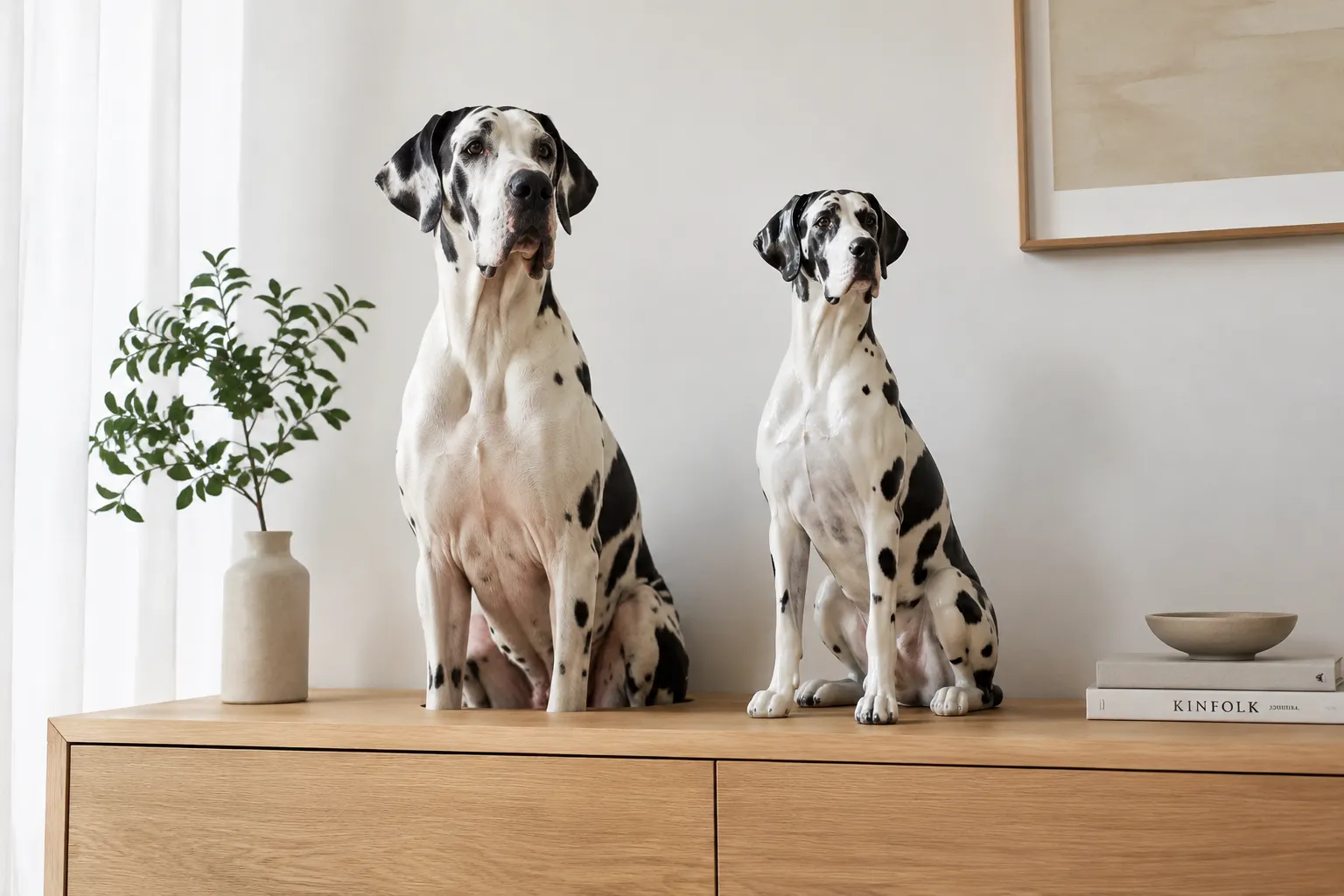
The box sits on your home-office desk, packing peanuts still clinging to the corners, and your first real decision in great dane figurine care arrives before you've even freed the figure: where the afternoon light is going to land on it.
Quick Takeaways
- Acclimate before you handle — let the resin reach room temperature for an hour before posing or placing.
- The legs are the weak point — support the body, never lift a Great Dane figurine by a single limb.
- Pose for physics, not just looks — a wide, low center of mass beats a dramatic tip-prone stance every time.
- Scale feels "off" on purpose — your brain expects Great Dane mass, so placement and sightlines do the heavy lifting.
- Clean with dry, soft tools only — and explore full-color resin pet figurines to understand the material you're caring for.
Why the First Day Decides Everything
Here's the thing most care guides skip: the day a figurine arrives is the single highest-risk moment in its entire life. Not year three. Not the move to a new house. Day one.
Think about the chain of events. The piece traveled in a temperature-swinging truck. It got handled by people who didn't know its fragile points. It's coming out of foam under your excited, slightly clumsy fingers. And it's a Great Dane — which means long, slender legs carrying a deep, heavy chest. That geometry is gorgeous. It's also a lever waiting for a mistake.
So we're going to treat the first 48 hours like a protocol, not a vibe.
A quick morning vignette. Picture this: it's 7 a.m., coffee steam curling in the window light, and the delivery notification buzzes your phone. The instinct is to tear in immediately, hold it up, take the photo for the family group chat. Resist that for sixty minutes. The figure that rode in a cold truck overnight is not at room temperature yet, and cold resin behaves differently than warm resin. That single hour of patience prevents the most common day-one damage we see.
"The first hour after a figurine arrives matters more than the next ten years combined."
What "acclimate" actually means (and why it's not fussy)
Resin — specifically the UV-cured photopolymer your PawSculpt piece is printed from — has a glass transition behavior. In plain English: it gets slightly more rigid and brittle when cold, and slightly more flexible when warm. Neither extreme is where you want to be doing delicate handling.
If the package sat on a porch in winter, or rode in a hot cargo hold in July, the material is at a temperature your living room is not. Give it an hour in the box, then another fifteen minutes out of the box, before you start posing or repositioning anything.
Why it matters: cold-brittle resin under sudden leverage is exactly the scenario that snaps a thin ankle. You're not babying the figure. You're letting physics catch up.
The unboxing sequence that prevents 90% of damage
Most damage doesn't happen during display. It happens during the thirty seconds of unboxing. So slow that part down.
- Open the box on a soft surface — a towel folded on the desk, not a bare hardwood edge.
- Don't pull the figure out by its highest point. With a Great Dane, the highest point is usually the head or an ear, and that's the worst possible handle.
- Free the packaging around the base first, then cradle the body with one open palm under the chest.
- Lift straight up, slow, keeping the legs vertical so no single limb takes a sideways load.
- Set it down on the towel and only then peel away any remaining foam or tape near the feet.
The "so what" here is blunt: every snapped leg we've ever had a customer write to us about happened because the figure got picked up wrong in the first minute, not because it was inherently fragile. Handling beats material almost every time.
A Great Dane Figurine Is an Engineering Problem (Embrace That)
This is the angle nobody tells you, and it changes how you care for the piece for years.
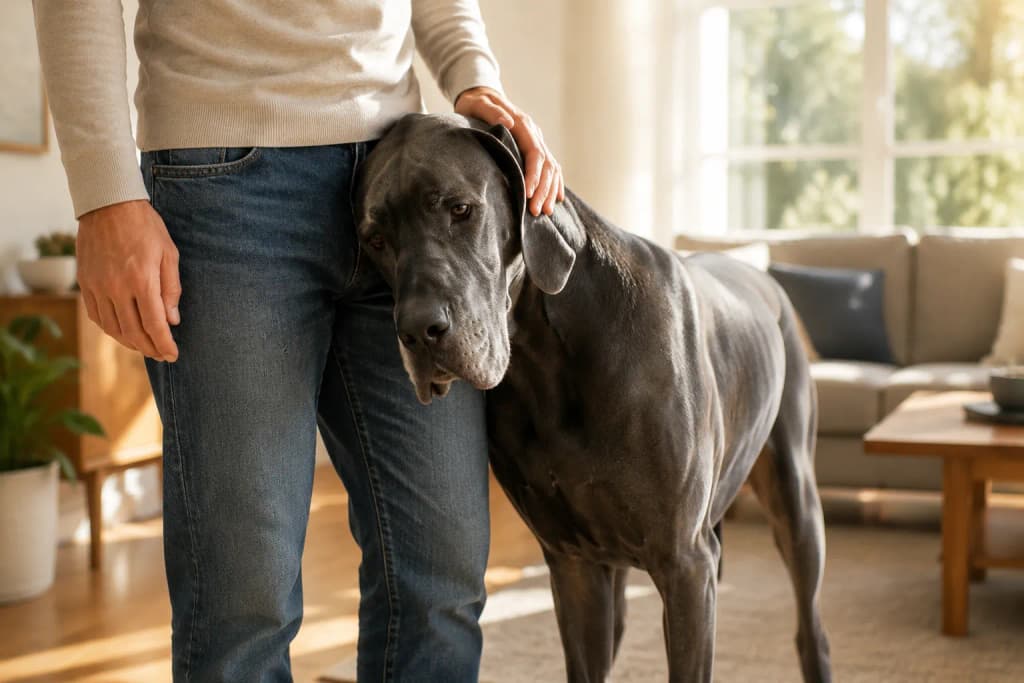
When our digital sculptors model a Great Dane, they're not just chasing a likeness. They're solving a structural puzzle. A Great Dane has the highest leg-length-to-body-mass drama of almost any breed — tall, fine-boned limbs holding up a barrel chest. According to the American Kennel Club's breed profile, these are dogs built like elegant towers. That elegance is exactly what makes the figurine a balancing act.
The counterintuitive truth: the pose you received was an engineering decision before it was an artistic one.
Center of mass, leverage, and why pose dictates lifespan
Let me break the cause-and-effect chain down, because once you see it you'll never place the figure carelessly again.
- A tall figure has a high center of mass. High center of mass plus narrow base equals tip risk.
- Thin legs act as levers. The longer and thinner the lever, the more a small sideways force at the top becomes a large stress at the ankle.
- Resin is strong in compression, weaker in sudden bending. Straight-down weight is fine. Sideways snap is the enemy.
So a four-on-the-floor standing pose, or a sitting pose with the haunches grounding the weight low, is structurally generous. A rearing, mid-stride, or one-paw-lifted pose looks spectacular and asks far more of the material.
Neither is wrong. But your care strategy should match your pose. A dramatic pose simply earns a more protected, less-trafficked display spot.
Here's a quick reference we walk customers through:
| Pose Type | Stability | Stress Points | Best Display Strategy |
|---|---|---|---|
| Standing four-square | High | Even, low risk | Open shelf, anywhere stable |
| Sitting / lying down | Highest | Minimal | Great for high-traffic rooms |
| Mid-stride (one paw up) | Medium | Raised limb, shoulder | Enclosed cabinet, low handling |
| Rearing / playful jump | Lower | Ankles, base joint | Display dome or high shelf only |
| Head-turned / dynamic | Medium | Neck, turned limb | Stable base, minimal repositioning |
The takeaway isn't "avoid dynamic poses." Dynamic poses tell the truest story of a goofy, bounding Dane. The takeaway is: know what your pose is asking of the material, and give it a home that respects that.
The base is not decoration
People underestimate the base. On a large-breed figure, the base is the engineering hero. It widens the footprint, lowers the effective center of mass, and gives the thin legs a shared anchor instead of four independent stress points.
If your figurine came with an integrated base, never display it off the base balanced on its own paws "just to see." That's removing the safety system. If it came baseless by design, the sculptors already engineered the foot contact to distribute load — but that also means a level, non-slip surface matters more, not less.
"On a Great Dane figurine, the base isn't a pedestal. It's the suspension system."
Posing a Pet Figurine: Placement Is the Real Pose
Most pieces arrive in a fixed pose — the sculpt is what it is. So when we talk about posing a pet figurine in your home, we're really talking about staging: angle, height, light, and sightline. This is where you have all the creative control, and most people leave it on the table.
Find the "hero angle" with raking light
In our quality-control bay, we inspect every surface under raking light — light that hits the surface at a low, sharp angle, almost grazing it. Why? Because raking light reveals form. It throws every contour, every fold of the chest, every muscle line into relief.
You can use the exact same trick at home to find your figure's best angle.
Try this tonight: kill the overhead lights. Take a single lamp or your phone flashlight and move it slowly around the figure at about figure-height, watching how shadows rake across the body. You'll hit one position where the dog suddenly looks alive — the chest reads deep, the brow looks intentional, the stance gains weight. That's your hero angle. Build the permanent display lighting to mimic it.
Flat, top-down lighting (your typical ceiling fixture) is the enemy of dimension. It washes everything into a single plane and makes even a beautiful sculpt look like a toy. Side light makes it look like a dog.
Height and sightline: meet the dog at eye level
Here's a subtle one. A real Great Dane is enormous — many can rest their head on a kitchen counter. When you display the figurine down low, on a bottom shelf, your brain reads it as small because you're looking down on it, the way you'd look down at a chihuahua.
Raise the display to between chest and eye level when seated in that room. Suddenly the proportions click. You're looking across at the dog, or slightly up, the way you actually experienced your Dane. The figure doesn't get bigger. Your relationship to it does.
This is the kind of thing that sounds like decor advice but is really perception psychology — and it's the difference between a piece that gets ignored and one that stops every visitor.
A day-in-the-life of good placement
Evening, the lamp clicks on around six. The light rakes across the figure from the left, and the dog's chest deepens into shadow exactly the way it did when the real one stretched out by the door. You catch it from the couch — at eye level, the way you always saw him — and for a second the room holds something it didn't before. That's not luck. That's a forty-minute placement decision you made on day one.
Scale and the Custom Large Breed Figurine Puzzle
This deserves its own section because scale is where large-breed owners get the most surprised — sometimes disappointed for the wrong reasons, and we want to fix that before it happens.
Why your Great Dane figurine might feel "small"
When you order a custom large breed figurine, there's a perceptual trap waiting. You spent years with a 130-pound animal. Your nervous system encoded that mass. So when a beautifully accurate figurine arrives at, say, a common desktop scale, your gut reaction can be "it feels smaller than I expected" — even when the proportions are flawless.
This is not a quality issue. It's an anchoring effect: your brain anchored on the real dog's size, and no shelf-friendly figure can match 130 pounds of living animal.
The fix is twofold:
- Understand it before unboxing, so the first reaction is appreciation, not surprise.
- Use placement to restore presence — eye-level height, side lighting, and negative space around the figure all make it read larger.
A figure crammed onto a crowded shelf shrinks. A figure given breathing room, on its own, lit from the side, commands the space. Same object. Completely different felt size.
Why everything scales together (and why that matters for care)
When a Great Dane is scaled down, every dimension scales with it — including those legs. A leg that's structurally fine at life size becomes proportionally thin at figurine size, because thickness drops faster than length when you shrink a 3D object.
This is the square-cube relationship, and it's why large-breed figurines need more care than, say, a French Bulldog figure. The Bulldog's stubby legs stay chunky and forgiving at any scale. The Dane's elegant legs get genuinely delicate. Your care routine should reflect the breed's geometry, not a generic "figurine" template.
Here's how we think about scale tradeoffs:
| Scale Choice | Detail Captured | Leg Sturdiness | Best For |
|---|---|---|---|
| Smaller / desktop | Excellent surface detail | Thinner, handle gently | Desks, shelves, memorials |
| Medium / display | Strong detail + presence | More forgiving | Living room centerpieces |
| Larger / statement | Maximum presence | Sturdiest legs | Low-traffic, dedicated spots |
If you're still deciding, the website walks through the available sizing for large breeds — worth reviewing how a custom Great Dane sculpture translates to different display footprints before you commit, because the scale shapes both the look and the care.
How Your Figurine Was Actually Made (So You Can Care for It Right)
You can't care well for something you don't understand. So here's the honest, shop-floor version of how your piece came to exist — no marketing gloss. This matters because the manufacturing method dictates the care method.
From photos to a digital sculpt
It starts with your photos. Our master sculptors work in software like ZBrush and Blender, building your dog as a digital 3D model — essentially sculpting in a virtual space where they can push, pull, and refine every form.
What makes good source photos? A few clear shots from multiple angles (front, both sides, three-quarter), in even daylight, showing the full body and the face. The sculptors are doing proportional checks the whole time — head-to-body ratio, the depth of that signature Dane chest, the length and angle of the legs, the flow of the coat and its markings. Profile shots are gold for large breeds because they lock in those long-limbed proportions.
"Every Great Dane is a study in proportion. Get the chest-to-leg ratio right and the whole soul of the dog shows up."
— The PawSculpt Team
Full-color 3D printing: the part people get wrong
Here's where we need to be precise, because there's a lot of confusion out there. Your PawSculpt figurine is not painted. No brushes, no acrylics, no white blank that gets colored in afterward.
Instead, the finished digital model is produced through full-color resin 3D printing — a PolyJet/MJF-style process where the machine jets and UV-cures photopolymer resin layer by layer, with the color pigments embedded directly into the material as it prints. The brindle, the fawn, the black mask, the white chest blaze — those colors are inside the resin, deposited voxel by voxel (a voxel is just a 3D pixel — a tiny cube of material the printer can color individually).
So your dog's markings aren't a surface coat that can chip off like paint. They're part of the cured material itself. That's why a scratch on the clear coat is cosmetic, not catastrophic — the color underneath isn't going anywhere.
Orientation, supports, and the marks of honest manufacturing
A few practitioner details that explain little things you might notice on your piece:
- Print orientation is chosen to balance detail against support needs. Our team angles the model so the most visible surfaces — the face, the chest — print cleanest, while supports land on less-seen areas.
- Supports are temporary scaffolding the printer builds to hold up overhangs (like a lifted paw or a tail). They're removed in post-processing, and the spots where they attached get cleaned and smoothed.
- Look closely under raking light and you may see fine layer grain — subtle horizontal texture. That's the honest signature of additive manufacturing, typically in the 25–50 micron layer range (a micron is a thousandth of a millimeter). It's not a flaw. It's evidence the piece was built up in real, physical layers rather than mass-molded.
Post-processing: washing, curing, and the one manual step
After printing, the piece is washed to remove uncured resin, then fully UV-cured to reach final hardness. Under-curing leaves resin soft and tacky; over-curing makes it brittle — so getting the cure right is its own craft. Then supports come off and those contact points are finished smooth.
The single manual step is the clear coat — a protective varnish applied for durability and a controlled sheen. That's it. It seals the surface, adds UV resistance, and gives the figure its finish. No color is added by hand at any point.
Why you should care: that clear coat is the layer you're actually maintaining. Protect the clear coat and you protect everything.
Long-Term Great Dane Figurine Care
Now the routine. Good news — full-color resin with a clear coat is genuinely low-maintenance. The bad news is that the few things that can hurt it are things people do by accident, with good intentions.
The cleaning rules (and the products that secretly cause damage)
The mistake most people make is reaching for a household cleaner. Don't. Many contain solvents or ammonia that can cloud, soften, or "bloom" a resin clear coat over time. Bloom is that hazy, foggy film that ruins the gloss — and it's often self-inflicted by aggressive cleaning.
Here's the entire safe routine:
- Dust weekly with a dry, soft microfiber cloth or a clean, soft makeup brush for the tight spots between legs and around the face.
- For stubborn grime, use a barely damp cloth with plain water — then dry immediately.
- Never use glass cleaner, alcohol wipes, furniture polish, or "magic" sponges (those are micro-abrasives — they'll dull the clear coat).
- For deep crevices, a can of compressed air at a moderate distance lifts dust without any contact at all.
Why it matters: the clear coat is your figure's skin. Abrasives scratch it, solvents cloud it, and once the gloss is gone, you can't easily get it back.
Light, heat, and the slow enemies
Resin's long-term threats are slow and invisible until they're not.
- Direct sunlight: UV-resistant materials and clear coat help a lot, but no resin loves a south-facing windowsill for years. Bright indirect light is ideal. Direct, all-day sun is the one environment we'd actively steer you away from.
- Heat: keep it off radiators, heating vents, and the top of electronics that run warm. Sustained heat is the classic cause of slow warping, especially in those long Dane legs.
- Cars: never store or transport a figurine in a hot parked car. A summer dashboard can hit temperatures that soften resin enough to deform it. This one surprises people every time.
| Care Task | Frequency | How | Why It Matters |
|---|---|---|---|
| Light dusting | Weekly | Dry microfiber / soft brush | Prevents grime buildup that needs harsh cleaning later |
| Spot clean | As needed | Barely damp cloth, dry immediately | Removes grime without solvent risk |
| Position check | Monthly | Confirm stable, level, no leg load | Catches drift before a fall happens |
| Light/heat audit | Seasonally | Move away from new sun/heat sources | Prevents warping and finish bloom |
| Deep dust (crevices) | Quarterly | Compressed air | Reaches detail no cloth can |
Handling and moving without heartbreak
If you move the figure — dusting day, a new shelf, a house move — go back to day-one rules. Cradle the body, support under the chest, never carry by a leg, head, or ear. For a move, wrap it the way it arrived: soft material around the body, immobilized so the legs can't flex, and transport it in the cabin, not the trunk (temperature again).
A small thing that saves pieces: when setting it down, set the base down first and let it settle, rather than lowering the dog at an angle and letting one leg touch first. One leg taking the full landing is exactly the sideways load resin dislikes.
"Resin forgives almost everything except a sideways shock to a thin leg. Respect the legs and it'll outlast you."
What to Expect From the Creative Process
If you're reading this before ordering — or thinking about a second piece — here's the honest shape of the journey, without us pretending to know your exact timeline (that lives on the site and changes).
The general arc looks like this:
| Stage | What Happens | Your Role |
|---|---|---|
| Photo submission | You share clear, multi-angle photos | Pick the best reference shots |
| Digital sculpting | Artists build the 3D model from your photos | Review and request refinements |
| Preview & approval | You see the digital model before printing | Approve or fine-tune the likeness |
| Full-color printing | The approved model is 3D printed in color | Wait (the hard part) |
| Post-processing | Wash, cure, support removal, clear coat | None |
| Delivery | Packed and shipped to you | Follow day-one care above |
The preview stage is the one to take seriously. This is where you catch a too-narrow chest or a head angle that's not quite your dog. It's far easier to refine pixels than resin. For the specifics on revisions, turnaround, and guarantees, the PawSculpt FAQ has the current details, and the contact page is there if your Dane has unusual markings worth flagging early.
We'll be real about one limitation: we're not veterinarians, and a figurine is a keepsake, not a substitute for the dog. What it can do is hold a specific posture, a specific tilt of the head, the exact set of those expressive Dane eyes — and give your memory something physical to land on.
Bringing It All Together
Go back to that box on your desk, the foam still clinging, the light deciding where it wants to fall. You know now that the next hour matters more than the next decade — that the figure needs to warm up, that the legs are levers, that the base is a suspension system, that side light makes a sculpt breathe while overhead light flattens it into a toy.
You also know the truth of the object itself: a digital sculpt of your dog, built form by form, then printed in full-color resin with the markings cured right into the material, sealed under a clear coat that's now yours to protect. Not painted. Not fragile in the ways people assume. Just specific — specifically your Great Dane, at the proportions and pose that make him unmistakably him.
So here's the one action that outweighs the rest: tonight, before you settle on a shelf, do the lamp test. Find the angle where the chest deepens and the stance gains weight and the dog looks back at you across the room. Then build the display around that moment.
Because good great dane figurine care isn't about keeping a thing pristine on a shelf. It's about placing a memory where the light can keep finding it.
Frequently Asked Questions
How do I clean a resin Great Dane figurine?
Keep it simple and dry. Dust weekly with a soft microfiber cloth or a clean makeup brush for tight spots between the legs. For stubborn grime, a barely damp cloth with plain water works — just dry it immediately. Skip glass cleaners, alcohol wipes, furniture polish, and abrasive "magic" sponges, since all of those can dull or cloud the protective clear coat over time.
Why do the legs on my Great Dane figurine feel so delicate?
It's the breed's geometry. Great Danes have long, fine-boned legs, and when a 3D object scales down, thickness shrinks faster than length, so those legs become proportionally thin. They also act as levers — a small sideways force at the top becomes a big stress at the ankle. Support the body, never lift by a single leg, and you'll avoid the most common damage.
Is my custom figurine hand-painted?
No, and this is a great thing to understand for care. PawSculpt uses full-color resin 3D printing, where the pigments are embedded directly into the material as it prints, voxel by voxel. There's no paint layer to chip. The only manual step is a clear protective coat, which is the surface you're actually maintaining.
Can I keep my figurine on a sunny windowsill?
We'd steer you toward bright indirect light instead. The resin and clear coat are UV-resistant, but no resin loves years of direct, all-day sun. Just as important, keep it off radiators, heat vents, and warm electronics, and never leave it in a hot parked car — sustained heat is the classic cause of slow warping in those long legs.
Why does my new figurine look smaller than I pictured?
That's a perception quirk, not a quality issue. You spent years with a massive dog, so your brain anchored on that size and any shelf-friendly figure feels small by comparison. Fix it with placement: raise it to eye level, light it from the side, and give it open space around it. Same figure, far more presence.
What photos should I send for the best result?
Clear, well-lit shots from multiple angles — front, both sides, and a three-quarter view — plus a good face photo. Even daylight beats harsh flash. For a large breed especially, profile shots are gold because they lock in the long-limbed proportions and that deep chest the sculptors need to get exactly right.
Ready to Celebrate Your Pet?
Every pet has a story worth preserving. Whether you're honoring a gentle giant who's crossed the rainbow bridge or celebrating the goofy, bounding Dane currently taking up your whole couch, a custom PawSculpt figurine captures the proportions, the posture, and the personality that make your dog one-of-a-kind — printed in full color, built to last with the right great dane figurine care.
Visit pawsculpt.com to learn more about our preview process, refinement options, and quality guarantee.