When Your Bernese Mountain Dog's Figurine Doesn't Match: A Technical Deep-Dive into Scaling Issues
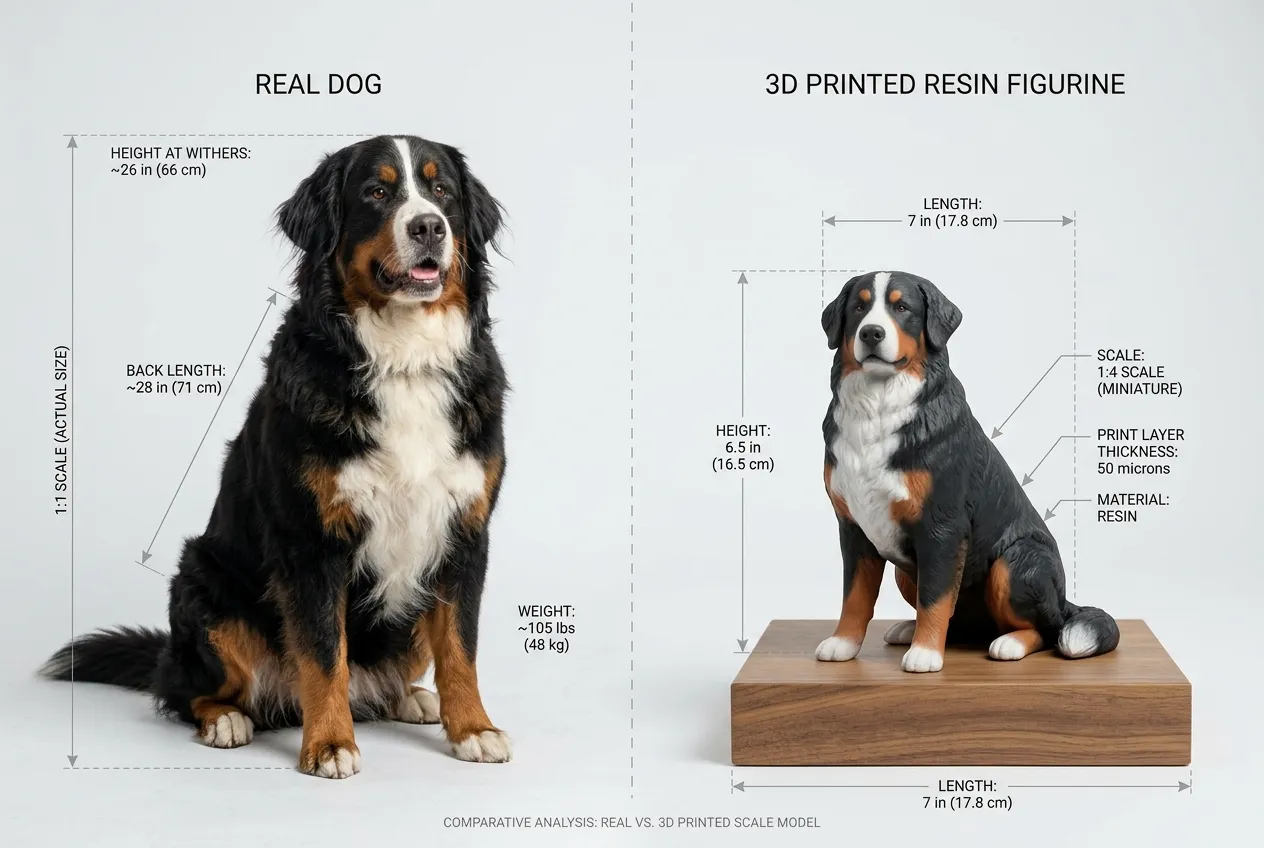
Why does a custom pet figurine of your Bernese Mountain Dog sometimes feel “off” the second it lands in your palm—before you can even explain why? The paws look a touch too light, the chest too narrow, and that familiar big-dog weight you expect just isn’t there.
Quick Takeaways
- Scale errors start in photos — use eye-level, full-body shots with a familiar size reference.
- Big breeds expose tiny mistakes — broad chests and heavy paws punish bad proportional shortcuts.
- Print size changes perception — shrinking a large breed figurine can exaggerate thin legs and small heads.
- A better result starts with a stronger brief — PawSculpt’s custom pet figurine process works best with clear, varied reference photos.
- Quality isn’t just sharp detail — the best large breed figurine balances anatomy, color mapping, and durability.
Why Bernese Mountain Dog Figurines Are Harder Than Most Owners Expect
Here’s the part most generic guides miss: large-breed figurines are not just “small figurines made bigger” or “big dogs made smaller.” They’re their own design problem.
A Bernese Mountain Dog has a very particular physical presence. Not just markings. Not just fluff. Presence. The breed carries visual mass through the chest, neck ruff, shoulder width, and heavy bone structure. If any one of those is compressed by even a little, the figurine may still look like a dog... but not your dog, and not really a Bernese.
We’ve seen this pattern a lot with families reviewing previews. They won’t always say, “the scapular angle looks shallow” or “the metacarpals seem underscaled.” They’ll say something much more accurate in plain English: “He looks too delicate.” That’s the tell.
And honestly, that instinct is usually right.
The overlooked problem: scale is emotional before it’s technical
Most people assume a mismatch comes from color. Reasonable guess. Berners are tri-colored, with clear black, rust, and white regions, so if the blaze or socks are wrong, your eye catches it fast.
But in our experience, proportion causes deeper disappointment than color does. A slightly softened rust tone may still feel okay. A head that reads 6% too small relative to the body? That changes the whole dog.
That’s the counterintuitive bit. We forgive color variation faster than we forgive shape variation, because shape is what tells our hands and eyes, “Yes, that’s them.”
"With Berners, the scale of the chest and paws matters almost more than the markings."
Why Berners punish shortcuts
Some breeds hide scaling shortcuts better. A slim-coated dog with a simple silhouette can tolerate small compression errors. Bernese Mountain Dogs can’t.
Why? Because they have:
- A broad thorax — the ribcage and chest need real volume
- Substantial forelegs — not chunky for cartoon effect, but structurally convincing
- A thick neck-to-shoulder transition — this area carries a lot of the breed identity
- Long coat flow over a heavy frame — fur cannot replace anatomy underneath
- A large head with soft but strong planes — too narrow and the dog looks juvenile or generic
The mistake most people make is assuming the fur will do the heavy lifting. It won’t. Coat detail can decorate bad proportions, but it can’t rescue them.
A quick real-world scenario
A family sends in gorgeous backyard photos: golden light, grass brushing the pasterns, tail curled in a lazy sweep. In the phone images, their Berner looks majestic.
But then the figurine preview feels slimmer than expected. Why? Because every photo was taken from slightly above, on a wide phone lens, with the front half turned away. The dog’s shoulder mass got visually compressed, the head looked relatively larger in some shots, smaller in others, and the artist had to reconcile conflicting geometry.
That’s not bad artistry. That’s bad source geometry.
The Real Source of 3D Printing Scaling Problems: It Starts Before Printing
Let’s get practical. A lot of readers search “3D printing scaling” and assume the printer literally resized the model incorrectly. That can happen in manufacturing generally, sure, but for custom pet work, that’s rarely the first culprit.
Most scaling issues begin in reference interpretation and digital sculpt proportioning.
Step 1: Photo-to-sculpt workflow is where the figurine is won or lost
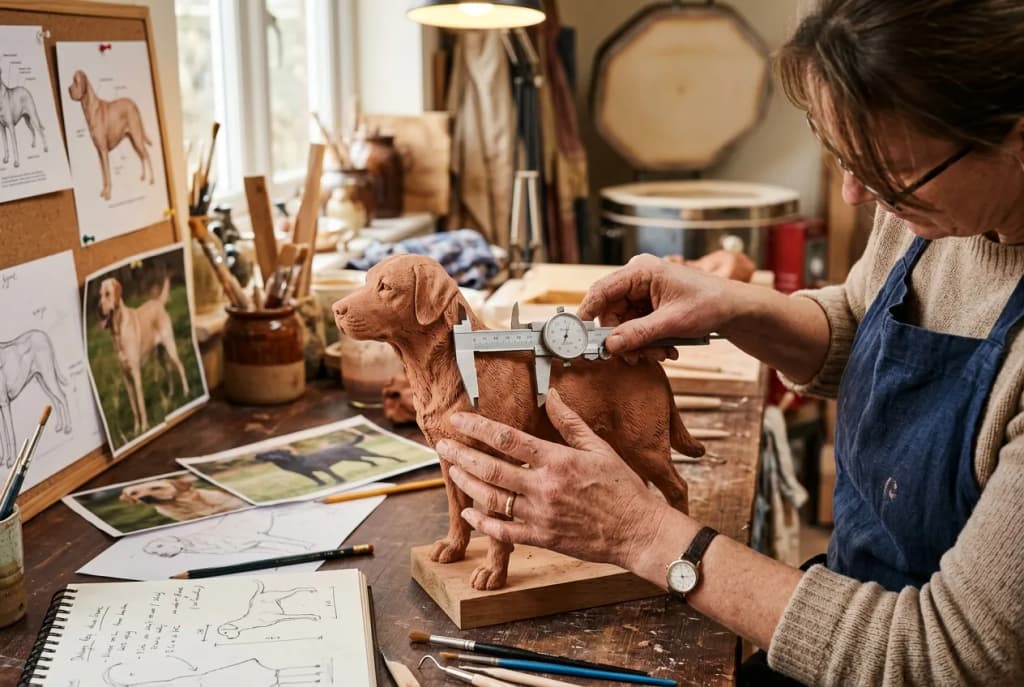
At PawSculpt, as with any serious full-color figurine studio, the physical object begins as a digital sculpt. That means a 3D artist studies your photos, builds the form in software such as ZBrush or Blender, and establishes the anatomy before the model is printed in color.
That sounds straightforward. It isn’t.
A good artist has to evaluate:
- Overall proportions — head-to-body ratio, leg length, chest depth, back length
- Breed structure — what belongs to a Bernese generally
- Individual variation — what makes your Bernese look like your Bernese
- Coat behavior — where fur adds width versus where actual bone and muscle add width
- Pose distortion in photos — especially from phone lenses and awkward angles
This is where we’ll be blunt: a sculptor is not tracing fur outlines. They’re reconstructing a dog in three dimensions from imperfect 2D evidence.
That’s why good source photos matter so much.
What reference photos work best for a large breed figurine
Here’s our top-pick framework for Berners. If you want a figurine that reads correctly in the hand, give the artist photos that show the dog the way another dog would see them—at body level, not from above.
This table shows what helps and what creates trouble.
| Photo Type | Why It Helps | Typical Problem if Missing | Best Practice |
|---|---|---|---|
| Eye-level side view | Establishes back length, chest depth, leg proportion | Body becomes too short or too slab-sided | Take outdoors on level ground |
| Front view at chest height | Shows shoulder width and front-leg spacing | Figurine reads narrow or “dainty” | Keep dog standing naturally |
| Three-quarter view | Helps connect head size to body mass | Head/body ratio gets guessed | Use soft daylight, no zoom distortion |
| Rear three-quarter view | Shows hindquarter volume and tail set | Tail thickness and croup shape become generic | Avoid crouched or sitting poses |
| Close-up head shot | Captures blaze shape, ear set, muzzle breadth | Face becomes breed-like but not individual | Include neutral expression if possible |
Worth noting: the best photo set is boring. Not dramatic. Not cinematic. Boring, clear, level, and honest.
And yes, we all love the shot where your Berner is charging through snow with their coat flying. Keep that one for your wall. It’s not your best engineering reference.
The hidden enemy: phone lens distortion
This one catches almost everyone.
Most phone cameras use wide-angle lenses by default. Wide lenses make whatever is closest to the camera look bigger, and whatever is farther away look smaller. So if your dog’s nose is slightly closer, the muzzle can appear oversized. If the rear half is farther back, the body can look tapered.
That distortion is not dramatic enough for most owners to notice, but it’s dramatic enough to matter in a figurine.
The fix:
- Stand farther back
- Use 2x or 3x optical zoom if your phone has it
- Keep the camera at the dog’s mid-body height
- Avoid shooting down from standing height
- Capture at least one photo with the dog squarely planted
This matters because digital sculpting is full of proportional checks. We compare one image against another, against breed norms, and against simple visual anchors like elbow height to chest depth. Distorted photos poison those comparisons.
Breed standard helps, but only up to a point
For anatomical sanity checks, many artists cross-reference the breed’s typical structure. The American Kennel Club’s Bernese Mountain Dog breed guide is useful for understanding general balance, coat, and mass distribution.
But here’s the nuance: a custom figurine is not a breed-standard trophy model. It’s a portrait.
So the sculpt has to live in the sweet spot between “recognizably Bernese” and “specifically your dog.” If your dog had a slightly narrower muzzle, a heavier dewlap, a softer topline with age, or a chest that broadened after maturity, those are not mistakes. Those are identity cues.
And identity cues matter more than theoretical perfection.
Large Breed Figurine Scaling: Where Digital Sculpting Gets Tricky
Once the reference set is in place, the next challenge is sculpt translation. This is where we see the biggest gap between what owners assume and what actually happens in production.
A large breed figurine at shelf scale has to preserve the visual power of a 90-pound dog in an object you can hold in one hand. That sounds poetic, but it’s also a serious geometry problem.
Shrinking a big dog changes what the eye expects
A Bernese in real life communicates mass through a few things all at once:
- the spread of the front feet on the ground
- the depth of the brisket
- the padded, substantial muzzle
- the weighty fall of coat over the shoulders
- the slight visual heaviness in the lower forequarters
When you reduce that dog to figurine size, thin features shrink faster perceptually than broad features. In other words, even if the model is mathematically scaled down correctly, it may look underbuilt.
That’s why experienced figurine makers do more than hit “scale to 75 mm” or “scale to 100 mm” and call it done.
We make judgment calls.
The counterintuitive insight: sometimes a technically exact scale looks wrong
This surprises people, but it’s true. A perfectly proportional digital reduction can produce a figurine that feels too fragile or visually too slight for the breed.
Why? Because human perception isn’t a caliper. When a model gets smaller, tiny radii, narrow ankles, ear edges, and fur separation all lose visual authority. You still need the object to read correctly from normal viewing distance.
So a good production team often makes controlled adjustments such as:
- slightly reinforcing leg thickness for durability and visual balance
- preserving head width so the face doesn’t look pinched
- softening hyper-fine coat breakup that would print muddy or trap supports
- maintaining tail strength if the tail is lifted or detached from the body
This isn’t “making it cartoonish.” It’s compensating for scale reality.
Detail versus durability is not a theoretical tradeoff
We’ll say this plainly: the most accurate-looking Bernese figurine can also be the easiest one to break if no one respects material limits.
Full-color resin printing delivers beautiful color transitions and strong visual fidelity, but like all photopolymer-based systems, it involves tradeoffs. Some formulations are relatively rigid. Some have better toughness. Most sit on a spectrum where higher crispness can come with more brittleness, especially in thin protruding parts.
That means a figurine artist has to think beyond appearance:
- Will the lower legs survive handling?
- Is the tail too isolated?
- Are ear tips too thin?
- Does coat texturing create fragile edges?
- Is the base doing enough structural work?
The standout here is this: quality is not the maximum amount of detail possible. Quality is the maximum believable detail that survives the object’s real life.
"The best figurine isn’t the sharpest one on screen. It’s the one that still feels right in your hand years later."
A day-in-the-life moment most owners know
It’s early evening. You’re straightening the entryway table, fingers brushing a cool ceramic bowl, keys, mail, and that figurine beside the leash hook.
You pick it up without thinking. What registers first isn’t color. It’s the feel: whether the figurine has enough visual and physical steadiness to echo the dog who used to thump against your leg on the way outside. That tiny pause—“yes, that’s him” or “hmm, something’s off”—is almost always a scale-and-form reaction.
That’s why this topic matters so much.
How Full-Color 3D Printing Affects Figurine Quality and Scale Perception
Let’s talk manufacturing, because a lot of confusion lives here.
PawSculpt creates figurines through full-color resin 3D printing, which means the pet is digitally sculpted first, then precision printed in color directly in the resin material. The color is embedded during the print process rather than added later as a separate manual coloring step.
That distinction matters technically and visually.
What full-color printing actually does
In practical terms, a full-color system builds the figurine layer by layer using UV-cured photopolymer resin with embedded pigments or a similar multi-material color process, depending on the platform. You may hear technologies compared loosely to PolyJet or other color additive workflows.
For pet owners, the simple version is this:
- The shape comes from the digital sculpt
- The color map comes from the artist’s texturing work
- The printer reproduces both together in the physical part
- The figurine is then cleaned, cured, support-processed, and clear-coated
- There is no separate brush-applied color stage
That last point is important because people often imagine figurines as white prints that later get colored. That’s not the process here.
Why scale issues can look like color issues
This is one of the most overlooked aspects in the whole category.
Because Berners have bold markings, owners often interpret proportion problems as color-placement problems. For example:
- a chest that is too narrow makes the white blaze feel oversized
- a slightly underscaled muzzle makes the tan eyebrow spots feel too dominant
- legs that are too slim make white socks appear longer
- a compressed neck makes the facial mask feel disconnected from the body
So yes, color placement matters. But often it’s form driving color perception, not the other way around.
That’s why experienced teams review the sculpt and the texture together, not separately.
The print-process realities that affect large dogs
Let’s get a bit nerdy—but plain English nerdy.
In resin-based additive manufacturing, the part has to be oriented in the machine. Orientation means choosing the angle the model sits at while printing. That choice affects:
- visible layer stepping
- where supports attach
- risk of suction forces during printing
- how much post-processing will mark the surface
- dimensional stability in delicate areas
A Bernese figurine is tricky because it combines broad masses with soft transitions and multiple support-sensitive regions: ears, tail, chest fur edges, belly, and legs.
If a figurine is oriented poorly, you can run into classic failure modes:
- Support pitting — tiny marks left where support contact points were removed
- Surface bloom or haze — a whitish or cloudy cast from incomplete cleaning or cure imbalance
- Warping — slight bending or distortion, especially in thin sections
- Suction cup effects — vacuum-like forces in hollowed or cupped geometry that can stress the print
- Over-cure or under-cure — too much or too little UV exposure, affecting toughness and finish
These aren’t abstract shop terms. They change what you see and feel.
Orientation logic for Bernese models
We’re not huge fans of one-size-fits-all orientation advice, because every pose behaves differently. But generally, a good production team is thinking something like this:
- Hide support marks in less visible zones such as undersides or base transitions
- Protect the face first because readers forgive many things before they forgive facial damage
- Avoid broad horizontal “shelves” that trap resin or increase suction loads
- Manage coat texture direction so layer artifacts don’t fight the fur flow
- Stabilize isolated features like tails and ear tips without over-supporting them
Typical fine-detail layer heights in resin workflows are often in the 25–50 micron range. A micron is one-thousandth of a millimeter. That’s very fine. But fine layers do not erase bad orientation, weak support strategy, or a sculpt that was too thin to begin with.
And that’s the big takeaway: resolution can’t fix proportion.
Hollowing, drain holes, and the durability question
Depending on size, some resin parts may be printed solid, while others can involve hollowing—creating an internal cavity to reduce material use, manage curing, and control mass. Hollow prints often need drain holes, which are small openings that allow uncured resin and cleaning fluid to escape.
For collectible pet figurines, the decision to hollow or keep areas more solid depends on:
- overall size
- wall thickness
- pose stability
- risk of trapped resin
- finish requirements
- long-term structural reliability
For a Bernese, broad body volume can invite hollowing logic, but if not handled carefully, hollow designs can create weak zones or awkward internal stress. Good teams think several steps ahead here.
This table gives a practical snapshot of the tradeoffs.
| Production Choice | Upside | Downside | Best Use for Bernese Figurines |
|---|---|---|---|
| Very fine layer height | Smoother surfaces, cleaner facial transitions | Longer print time, doesn’t solve weak design | Face and coat transitions |
| Heavier leg reinforcement | Better durability in handling | Can look clumsy if overdone | Small-format figurines |
| Aggressive coat texture | Strong fur effect up close | Can trap supports or print muddy | Limited to thick ruff areas |
| Hollow body sections | Reduces mass, manages curing in larger parts | Requires drainage strategy and smart wall design | Larger figurines only |
| Conservative orientation | Better survival and fewer failures | May leave marks in less ideal spots | Complex poses with tail lift |
Post-processing is where good prints stay good
After printing, the figurine goes through post-processing. For readers new to 3D printing, that means the cleanup and finishing work that turns a fresh print into a display-ready object.
Typical steps include:
- Support removal
- Cleaning/washing
- UV curing
- Surface inspection
- Light correction of support areas if needed
- Clear coat application
The clear coat is not there to disguise bad work. It’s there to add protection and unify sheen. Some owners expect a glass-smooth toy-like finish, but that’s not what quality collectible full-color resin usually looks like. A good piece often retains a very fine natural print grain or layer character under the clear coat. Authentic, not fake-perfect.
And honestly, we prefer that.
Quality control under raking light
Here’s a true shop-floor habit: raking light inspection.
That just means looking at the figurine under a low-angle light so tiny surface disruptions become visible. Support scars, pitting, faint print lines, asymmetry, and texture inconsistencies jump out under this kind of lighting.
For a Bernese figurine, a team should be checking:
- facial symmetry
- eye placement and muzzle balance
- front-leg thickness consistency
- tail alignment
- coat flow direction
- surface defects on dark areas, where marks often show more clearly
Dark coats are unforgiving. A black flank on a Bernese can reveal haze and pitting faster than a lighter-colored dog would.
"Scaling mistakes usually show up first in the paws, chest, and head—not because those areas are hardest to print, but because they carry the breed’s identity."
— The PawSculpt Team
The Most Common Bernese Mountain Dog Figurine Mismatches—and What Causes Them
This is the section we wish more buyers could read before they approve anything.
Because once you know the common failure patterns, you stop looking only at “is it cute?” and start asking the right quality questions.
1. The figurine looks too slim
This is probably the most common complaint with a bernese mountain dog figurine.
A true Berner should feel substantial without looking overweight. If the figurine looks elegant in a retriever way rather than grounded in a Bernese way, the likely causes are:
- side photos taken from above
- chest depth underbuilt in sculpt
- fur volume used instead of structural width
- legs scaled too thin for visual balance
- body narrowed to reduce support complexity
Why it matters: Berners are not airy dogs. Their silhouette should have gravity.
2. The head feels too small—or too puppy-like
A slightly underscaled head can make the whole figurine read wrong fast. On the flip side, some artists overcorrect and end up with a broad, rounded puppy face on an adult dog.
Usually this comes from:
- inconsistent photo angles
- lens distortion
- failure to distinguish fur puff from skull width
- over-smoothing planes in the muzzle and stop
The fix is not “make it fluffier.” The fix is rebuild the head mass against the body mass.
3. The paws don’t feel heavy enough
This one is subtle and incredibly important.
Bernese paws should look planted. Even in a relaxed pose, they shouldn’t feel dainty. Tiny front feet can make the whole dog seem toy-like.
What causes it:
- all-over scaling reduction without selective compensation
- concern about print merging between toes
- over-thinning for delicacy
- poor base integration
A lot of owners can’t name this issue, but they feel it immediately in hand.
4. The white markings look “wrong” even when they’re technically accurate
This sounds contradictory, but it happens all the time.
A blaze can match the reference photo closely and still feel off because the head shape is off. White socks can be correctly placed yet look too long because the legs are too slim. The chest patch can seem oversized because the brisket is too narrow.
That’s why we review markings as proportion-dependent features, not isolated decals.
5. The coat looks busy but not believable
There’s a temptation in digital sculpting to add lots of fur breakup, especially for long-haired breeds. It can look impressive on a monitor.
But on a physical figurine, too much micro-texture can:
- muddy up in print
- catch supports in awkward places
- make the body look lumpy
- obscure clean anatomy
- create fragile edges
What actually helps more than hyper-detail is directional coat flow—the sense that the fur grows over a real body.
A quick comparison checklist
Use this table when reviewing a Bernese figurine preview or final piece.
| Area | What “Right” Looks Like | Common Mismatch | What Likely Went Wrong |
|---|---|---|---|
| Head | Broad, calm, balanced with body | Too small, too round, or pinched | Distorted references or weak proportion checks |
| Chest | Deep and substantial | Narrow or flattened | Above-angle photos, underbuilt torso |
| Front legs | Strong, planted, believable | Spindly or fragile-looking | Over-thinning for detail or scale |
| Paws | Heavy, grounded | Tiny or toy-like | Uniform downscaling without compensation |
| Coat | Flows over anatomy | Busy, lumpy, overly shaggy | Fur replacing structure |
How to Judge Figurine Quality Like an Insider
You do not need to become a manufacturing engineer to spot a strong figurine. But a few insider checks will save you from focusing on the wrong things.
Start with silhouette, not face
Everyone zooms into the face first. We get it. It’s emotional.
But our top recommendation is this: look at the whole silhouette from arm’s length before you inspect the face up close. If the outline doesn’t read “Berner” immediately, micro-detail won’t fix it.
At a glance, ask:
- Does the dog feel broad enough through the chest?
- Do the legs support the body convincingly?
- Does the head belong to this body?
- Is the tail set natural for the pose?
- Does the figurine feel stable, not top-heavy?
If the answer is “mostly yes,” then move inward.
Then assess the hierarchy of detail
Not every detail deserves equal sharpness. That’s another thing generic articles rarely mention.
A good figurine has a detail hierarchy, meaning the most important features are given the clearest definition:
- Face and expression
- Overall proportions
- Marking placement
- Coat flow
- Fine fur breakup and tiny texture
If a piece nails item 5 but misses item 2, it’s not a good piece. It’s a distracting piece.
Feel matters more than people admit
Texture tells the truth.
Pick up the figurine gently and notice:
- whether the base and paws feel confident
- whether thin parts feel risky
- whether the clear coat feels even, not gummy
- whether transitions feel intentional rather than rough from support removal
That tactile check is important because our brains combine touch and sight. A figurine that visually appears strong but physically feels frail often leaves a faint disappointment you can’t quite explain.
And yes, that matters for memorial pieces especially.
"If the silhouette is wrong, no amount of surface detail will make it feel like your dog."
Surface defects owners should actually care about
Not every tiny artifact is a crisis. Full-color resin prints are physical objects, not screen renders. But there are some defects worth watching for:
- noticeable support pits on the face or chest
- cloudy patches in dark areas
- asymmetrical ears or eyes
- wavy leg lines that suggest distortion
- rough support nubs left in visible areas
- sticky feel or odor, which may suggest cure/cleaning issues
If a figurine has one minor mark in a hidden underside area, that’s a lot less concerning than poor chest proportion or facial asymmetry.
That’s the ranking. And it helps to know it.
A note on care and longevity
Large-breed figurines sometimes have extended tails, ear tips, or leg spacing that deserve a little care in display. Keep them:
- out of prolonged direct sun
- away from high-heat zones like radiators or sunny dashboards
- on stable, vibration-free shelves
- handled by the base, not by the tail or head
For general pet health or mobility concerns that affect how your dog stands in photos—arthritis, posture changes, weight shifts—we always suggest checking with a veterinarian rather than guessing. The AVMA pet owner resources are a solid place to start if you’re noticing body changes and want context.
We’re figurine people, not vets. But pose and anatomy do intersect with real-life health changes, especially in older large breeds.
What to Expect From a High-Quality Custom Pet Figurine Process
If you’re ordering or evaluating a custom pet figurine, it helps to know what a thoughtful process looks like without turning the whole thing into a factory manual.
The best process is collaborative, not magical
A strong figurine doesn’t happen because someone “just gets it” from one cute picture. It comes from a clear workflow:
- Reference gathering
- Digital sculpt creation
- Proportion and likeness review
- Color/marking refinement
- Full-color 3D printing
- Cleaning, curing, support finishing, and clear coat
- Final quality control
That sequence matters because each stage can either preserve or degrade likeness.
If you rush past reference quality, later steps get harder. If you skip proportion review and focus only on markings, you may approve a nicely colored wrong dog.
What a thoughtful review process looks like
We’ve learned from years working with pet families that the best customer feedback is specific and comparative, not vague.
Instead of saying:
- “Something seems weird”
Try saying:
- “The chest feels too narrow compared to his real stance.”
- “Her paws should look heavier and a little more planted.”
- “The head seems slightly small relative to the shoulders.”
- “His blaze is good, but the muzzle looks slimmer than in most of our photos.”
That gives a sculptor something usable.
This is where PawSculpt’s FAQ page can help set expectations around the general custom process and what kinds of source materials support the best outcome.
One customer pattern we see a lot
A family sends ten adorable photos, but eight are close-up face shots and two are sitting poses. The face is easy to recognize. The body becomes a guess.
Then the preview arrives and the comment is: “The face is him, but the body isn’t.” We’ve seen versions of that many times.
It’s fixable more often when caught early. But the real lesson is simple: full-body geometry is not optional for large breeds.
What to check before approving a preview
Our curated shortlist:
- Head-to-body ratio
- Chest depth and width
- Front-leg sturdiness
- Paw size
- Tail thickness and position
- Marking boundaries on the face and chest
- Overall “weight” of the dog
Don’t get lost in eyelashes and tiny fur edges before these are right.
Why a museum-quality result still won’t look “factory perfect”
PawSculpt positions its work as museum-quality, and that fits the category in the right sense: careful digital craftsmanship, serious likeness work, and advanced full-color 3D printing technology that captures markings directly in resin.
But museum-quality doesn’t mean injection-molded sameness. It means the opposite. It means a portrait object with nuance.
So expect:
- vibrant, integrated color
- accurate markings with natural variation
- fine printed texture under clear coat
- slight evidence of the medium rather than fake smoothness
- a figurine that feels made, not mass-produced
That’s a good thing.
If your Bernese already has age-related changes, say so
This is a commonly overlooked aspect that changes likeness a lot.
Older Berners may carry:
- a softer topline
- thicker elbows from posture changes
- a leaner face
- altered paw stance
- coat thinning in specific regions
If you want the figurine to represent your dog in their senior years, mention that directly. Otherwise, an artist may unconsciously normalize toward a younger, more textbook Bernese structure.
And that can erase the very details you love.
How to Get Better Photos for a Bernese Mountain Dog Figurine
Let’s finish the practical side with the one thing that improves outcomes fastest: better photos.
The good news? You do not need pro equipment. You need good angles, steady light, and honest scale cues.
Our top-pick photo checklist
Take these outdoors if you can. Backyard grass, driveway concrete, porch boards—any stable, level surface works.
Aim for:
- One full side view at dog height
- One straight-on front view at chest height
- One three-quarter front view
- One three-quarter rear view
- Two close head shots in neutral light
- One favorite personality photo for expression reference
Try to photograph your dog standing naturally, not stretched forward by a treat. A baited stack can distort neck length and weight distribution if overdone.
Texture and lighting tips that really help
Because Berners are dark-coated, detail can disappear fast.
Use:
- bright shade or soft morning light
- backgrounds that contrast with black fur
- slightly dampened coat only if it reflects the dog’s usual look (not slicked down)
- enough distance to avoid wide-angle exaggeration
Avoid:
- harsh noon sun
- deep indoor shadows
- flash
- heavy portrait blur modes
- extreme close-ups for body references
The goal is to show the texture of the coat and the true edges of the body without blowing out the white or crushing the black into one dark shape.
Include one “scale truth” photo
This is our favorite overlooked tip.
Add one unglamorous photo with a familiar object in frame—something like a standard patio step, a bench leg, or a person’s lower leg at a normal distance. Not because the artist will literally measure from it, but because it gives a reality check on mass and height.
A Bernese beside a common object tells the eye, “right, this is a big dog.” That helps when translating presence into a figurine.
If you’re between preserving memory and chasing perfection
A lot of families get stuck here, especially after loss. They delay sending photos because they want “the best possible ones.”
Honestly, use the best set you have now.
Some families build photo books. Some frame collars. Others keep a paw print impression. And increasingly, people choose 3D pet sculptures because they want something tangible with real dimensional presence—something that can sit in the everyday spaces where memory actually happens.
If your photo set is imperfect, say what matters most:
- “His broad chest”
- “Her sleepy expression”
- “Those huge front paws”
- “The white blaze was slightly crooked”
- “He always looked sturdy, never delicate”
That kind of note helps more than people realize.
The Bottom Line on Figurine Quality for a Bernese
If your Bernese Mountain Dog figurine doesn’t match, the issue usually isn’t that someone missed a stripe. It’s that scale, mass, and visual weight got lost somewhere between photo, sculpt, and print.
And that’s fixable—sometimes by better references, sometimes by a more experienced digital sculptor, sometimes by a production team that understands that a large-breed figurine has to preserve presence, not just pattern.
So here’s the practical next step: pull up your photo folder and sort it ruthlessly. Keep the clear side view, the front chest-level shot, the honest standing pose, and the face close-up that really feels like your dog. Toss the dramatic but distorted ones to the bottom of the stack.
That little bit of curation changes everything.
Because in the end, a good figurine isn’t just about likeness on a screen. It’s about the moment your fingers close around it—the smooth clear-coated surface, the steadiness of the paws on the base, the familiar heft of a dog who always took up more room in your life than their body ever could.
Frequently Asked Questions
Why does my Bernese Mountain Dog figurine look too small or slim?
Usually, that problem starts before printing. Overhead photos, wide-angle phone distortion, and missing full-body references can lead to a digital sculpt that underestimates chest width, paw size, or overall mass. With Berners, even a small proportional miss makes the figurine feel too delicate.
What photos work best for a custom pet figurine?
The strongest set includes one eye-level side view, one front view at chest height, a couple of three-quarter angles, and clear head shots in natural light. We also recommend one simple “scale truth” photo with a familiar object nearby. That helps the artist understand the dog’s real-world presence, not just markings.
Does full-color 3D printing mean the figurine is colored afterward?
No. In full-color resin 3D printing, the color is part of the manufacturing process itself. The figurine is digitally sculpted, then printed in full color directly in the resin, followed by cleaning, curing, support removal, inspection, and a protective clear coat.
Why are large breed figurines harder than small dog figurines?
Because reducing a large dog to shelf size changes perception. Thin features start looking thinner, visual weight can disappear, and the balance between durability and realism gets tighter. A large breed figurine needs careful proportion control so it still feels grounded and sturdy.
What should I check before approving a figurine preview?
Start with the silhouette from a normal viewing distance. Check the head-to-body ratio, chest depth, leg thickness, paw size, and overall stance before zooming into tiny details. If those fundamentals are right, the figurine quality is usually on solid ground.
Where can I ask questions about the custom process?
If you’re comparing options or want clarity on source photos and workflow, it’s smart to review a studio’s help resources first. For PawSculpt-specific questions, the custom figurine contact page and support materials are the best place to get current details.
Ready to Celebrate Your Pet?
Every pet has a story worth preserving. Whether you're honoring a beloved companion who's crossed the rainbow bridge or celebrating your furry friend's unique personality, a custom PawSculpt figurine captures those details that make your pet one-of-a-kind.
If you’ve been frustrated by custom pet figurine quality that misses your Bernese’s true size, stance, or presence, starting with the right photos and the right full-color 3D process makes a real difference.
Visit pawsculpt.com to learn more about our process and guarantees