
What to Expect When You Order a Custom Bernese Mountain Dog Figurine for the First Time
Five years ago, that front porch held two rocking chairs, a coffee mug, and a Bernese Mountain Dog named Clover sprawled across the welcome mat like she owned the deed to the house—now it holds one chair, the same mug, and a full-color 3D printed figurine of Clover catching morning light exactly where she used to sleep. That figurine is what happens when someone decides to order a custom Bernese Mountain Dog figurine for the first time and actually follows through.
Quick Takeaways
- Your photos are the blueprint — the quality of your reference images directly determines the quality of your figurine
- Full-color 3D printing isn't what you think — colors are embedded in the resin, not applied afterward
- Bernese markings are uniquely challenging — the tricolor coat requires careful digital sculpting to get right
- Expect a collaborative process — you'll review a digital preview and can request adjustments before anything prints
- Start exploring your options at PawSculpt — see exactly how the custom figurine process works from photo submission to finished piece
Why Bernese Mountain Dogs Are One of the Hardest Breeds to Get Right (And Why That Matters to You)
Here's something most people don't consider when they start shopping for a custom pet figurine: not all breeds are created equal from a manufacturing standpoint. A solid-white Samoyed is a fundamentally different challenge than a Bernese Mountain Dog, and if you don't understand why, you might set yourself up for disappointment.
Bernese Mountain Dogs carry what's called a tricolor coat pattern—that deep jet black, the warm rust, and the bright white chest blaze. According to the American Kennel Club's breed standard, these markings follow specific patterns, but here's the catch: every individual Berner's markings are as unique as a fingerprint. The rust points above the eyes, the white stripe down the muzzle, the way the black saddle feathers into the rust on the legs—these are the details that make your dog your dog.
From a digital sculpting perspective, that means the artist can't just pull up a generic Bernese template and call it a day. They need to study your specific dog's color boundaries, where the rust fades to black, how the white blaze tapers. In full-color 3D printing, every one of those transitions gets printed voxel by voxel—think of voxels as tiny 3D pixels—directly into the resin material. There's no "close enough" with a breed this distinctive.
| Bernese Feature | Why It's Challenging | What the Artist Needs From You |
|---|---|---|
| Tricolor boundaries | Color transitions must be precisely mapped | Clear, well-lit photos showing all three colors |
| Thick double coat | Fur depth and flow direction affect the sculpt | Side-angle shots showing coat texture |
| Facial rust markings | Placement varies wildly between individuals | Head-on photo with visible eyebrow dots |
| White chest blaze | Shape is a signature identifier | Front-facing photo, standing if possible |
| Feathered legs/tail | Volume and curl vary by dog | Full-body profile shot, not cropped |
The counterintuitive insight here? The more "standard" you think your Berner looks, the harder the artist has to work. Because if you say "just make a normal Bernese," the result will look like a stock image—not like your dog. The magic is in the asymmetries, the slightly crooked blaze, the one ear that always flopped more than the other. Those "imperfections" are the whole point.
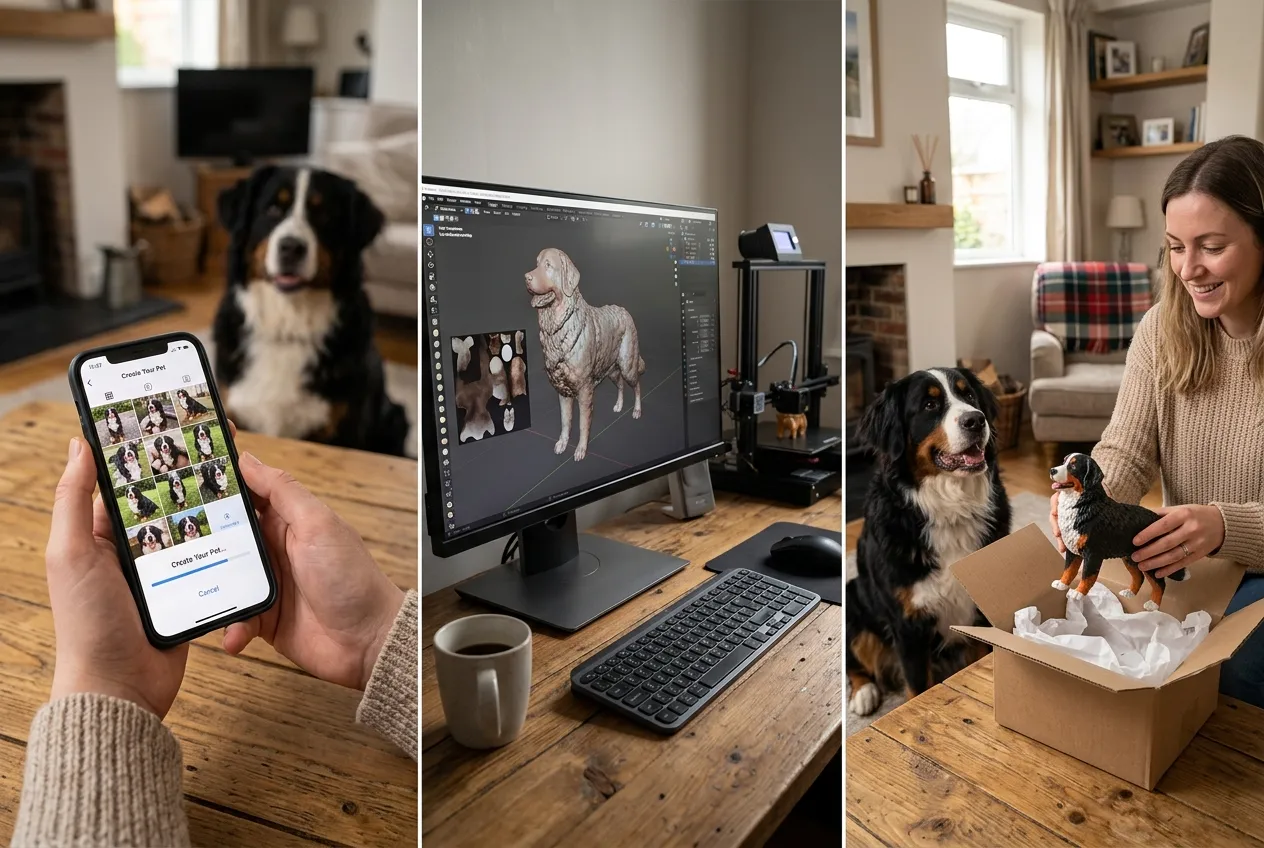
What Actually Happens When You Order a Custom 3D Printed Dog Figurine
Alright, let's walk through this honestly, because the process is more involved than most people expect—and more collaborative than most companies let on. We're going to break it down stage by stage so you know exactly where your money and time are going.
Stage 1: Photo Submission (Your Most Important Job)
This is not hyperbole: the photos you submit will determine 80% of the outcome. We've seen orders where someone submitted a single blurry phone pic taken at arm's length in a dim living room, and we've seen orders with 15 carefully selected shots from multiple angles in natural light. The difference in the final figurine is staggering.
Here's what actually helps:
- 3-5 photos minimum, covering front, both sides, and a three-quarter angle
- Natural daylight — not flash, not overhead kitchen lights, not that golden-hour Instagram filter
- Your dog standing naturally — posed shots where they're sitting pretty are fine as a secondary reference, but standing gives the sculptor proportional data they can't get otherwise
- One close-up of the face — straight on, eyes visible, ears in natural position
- At least one shot showing coat color accurately — check it against reality before submitting. Phone cameras notoriously shift reds and blacks
Here's a mistake most people make: they send their favorite photos instead of their most useful photos. That gorgeous shot of your Berner bounding through snow? Beautiful. Useless for sculpting. The sculptor can't see body proportions, coat pattern, or ear set. Save the action shots for Instagram. Send the boring, well-lit standing shots for your figurine.
Stage 2: Digital Sculpting (Where the Art Lives)
This is the part that separates a custom figurine from a mass-produced trinket, and it's where I want to get a little technical—because understanding what happens here will change how you evaluate the preview.
A digital sculptor opens professional 3D software—tools like ZBrush or Blender—and begins building your dog from scratch. Not from a template. Not from a scan. From reference photos, anatomical knowledge, and breed-specific understanding.
They're working through a checklist that looks something like this:
- Proportional blocking — establishing the overall body mass, leg length relative to body, head-to-body ratio
- Anatomical refinement — sculpting the skull shape, muzzle width, ear placement, chest depth
- Coat flow — this is huge for Berners. The fur doesn't just "sit there." It flows in specific directions, parts along the spine, feathers at the legs. The sculptor builds this directionality into the surface texture digitally
- Color mapping — using your photos to place the exact tricolor boundaries onto the 3D model. Every rust dot above the eyes, every edge of the white blaze
- Expression and posture — capturing the way YOUR dog carries itself. Some Berners have that noble, head-up look. Others have that goofy, tongue-out, "I just rolled in something" energy. This is where soul enters the equation
"Every whisker direction, every ear angle—these aren't decorative choices. They're identity markers. Miss one, and you've made a beautiful figurine of someone else's dog."
— The PawSculpt Team
The sculptor isn't guessing. They're cross-referencing your photos constantly, checking proportions, zooming in on coat details. It's meticulous digital work that typically spans hours per figurine.
Stage 3: Your Preview (The Moment You Actually Have Power)
Here's where a lot of first-time buyers underestimate their role. You'll receive a digital preview—a rendered image of the 3D model—before anything gets printed. This is your chance to say "the ears need to be wider" or "his right eye has a slightly lighter brown ring" or "the tail curves more to the left."
Most people look at the preview and say "looks great!" within thirty seconds. That's a mistake.
Take your time. Compare it directly against your photos. Show it to someone else who knows your dog. Look at it the next day with fresh eyes. The things that bother you a little now will bother you a lot when it's a physical object on your shelf for the next twenty years.
Common preview feedback that actually improves the result:
- "The muzzle is slightly too narrow"
- "The rust color should be warmer/darker"
- "His body is stockier than that—he was a big boy"
- "The white blaze should extend further between the eyes"
- "Can the pose be more relaxed? He was a lazy guy"
For details on PawSculpt's specific revision process and what's included, check their FAQ page—policies can change, so it's better to get that info straight from the source.
Stage 4: Full-Color 3D Printing (The Technology Behind the Magic)
Okay, let's talk about how this actually works, because there's a ton of confusion out there. People hear "3D printed" and picture those wobbly, ridged plastic things from a desktop printer. That's not this. Not even close.
Full-color resin 3D printing is a completely different technology. Here's the short version: the printer builds your figurine layer by microscopic layer—often in the 25 to 50 micron range (for reference, a human hair is about 70 microns). As each layer is deposited, color is embedded directly into the resin material. The cyan, magenta, yellow, and black pigments are mixed at the voxel level to produce the full color spectrum.
This means the color isn't sitting on top of the figurine like paint on a wall. It's part of the figurine. The jet black of your Berner's saddle, the rust of their eyebrows, the white of their chest—all of it is baked into the resin itself during printing.
| Aspect | Full-Color 3D Print (What We Do) | Traditional Figurine (What People Imagine) |
|---|---|---|
| Color application | Embedded in resin during printing | Applied after with brushes and paint |
| Color durability | Part of the material itself | Can chip, fade, or peel over time |
| Texture | Fine-grain 3D print surface with clear coat | Smooth, glossy hand-finished surface |
| Consistency | Machine-precise color placement | Varies by individual painter's skill |
| Detail resolution | Excellent—limited by print resolution | Excellent—limited by painter's hand |
| Production style | Digital sculpt → machine print | Physical sculpt → mold → cast → paint |
Let me talk about tradeoffs for a second, because no process is perfect and I'd rather you know what you're getting.
Detail vs. durability. Full-color resin produces beautiful detail, but resin is inherently more brittle than, say, PVC or ABS plastics. A figurine that falls off a shelf onto hardwood could chip or crack. This isn't a flaw—it's physics. Thinner extremities (ear tips, tail ends) are the most vulnerable. That's why display placement matters.
Print orientation and supports. The printer can't build a figurine floating in midair. It needs tiny support structures—think scaffolding—that hold the model during printing. Where those supports attach can leave minor marks called support pitting. A skilled operator orients the model strategically to put support contact points in the least visible areas (the belly, the base underside, between the legs). Post-processing addresses most of this, but it's worth knowing.
Surface finish. A 3D print has a characteristic micro-texture from the layer-by-layer build process. It's not rough—at 25-50 microns, you'd need a magnifying glass to see individual layers—but it's also not the glassy-smooth surface of an injection-molded toy. It has a subtle, organic quality. We'll be real: some people love this because it gives the figurine an almost tactile warmth. Others expect something more "plastic-perfect." Know which camp you're in before you order.
"A figurine isn't a replacement. It's a ritual object—something you hold when the missing gets loud."
Stage 5: Post-Processing (The Finishing Touches)
After printing, the figurine goes through several critical steps:
- Washing — the printed part gets cleaned to remove uncured resin. This is usually done in an isopropyl alcohol bath or specialized cleaning solution
- UV curing — the figurine is placed in a UV light chamber to fully harden (cure) the resin. Under-curing leaves the surface tacky and prone to yellowing over time. Over-curing can make the resin brittle and cause warping. Hitting the sweet spot matters
- Support removal — those scaffolding structures get carefully clipped away and the contact points are smoothed
- Surface inspection — quality control under raking light (light angled sharply across the surface) reveals any imperfections, pitting, or rough spots that need attention
- Clear coat application — this is the one manual finishing step. A protective clear coat gets applied to seal the surface, add UV resistance, and give the figurine its final sheen. Think of it like the clear coat on a car—it protects what's underneath and enhances the visual depth
That clear coat does more than look pretty. Resin can be susceptible to bloom—a whitish haze that develops on the surface over time, especially in humid environments. A proper clear coat seals against moisture and dramatically extends the figurine's lifespan.
What We Wish We Knew Sooner
Look, we've processed a lot of orders. Hundreds and hundreds of custom pet figurines. And there are things we've learned along the way that we wish we could go back and tell ourselves—and our customers—from day one.
The "perfect" photo doesn't exist. We used to ask customers for "the perfect photo" and they'd agonize over it. Now we ask for "the most useful photos." There's a difference. Stop trying to find one magical image. Send us five decent ones from different angles. We'll piece together the truth from the collection.
People underestimate how emotional the preview moment is. This catches folks off guard. They think they're going to evaluate a digital render objectively, like reviewing a proof for a business card. Then they see their dog—sometimes a dog who's already passed—looking back at them from the screen, and it hits. We've had customers need a day before they could even give feedback. That's normal. That's healthy. There's nothing wrong with needing a minute.
Pose matters way more than people think. Everyone defaults to "standing alert" because it seems like the "right" pose for a figurine. But we've found that the figurines people treasure most are the ones in their dog's signature pose. The head tilt. The play bow. The sprawl. If your Berner's whole personality was flopping on cool tile with all four legs splayed out—that's a valid figurine pose, and honestly, it's probably the one that'll make you smile every time you look at it.
The base isn't just structural. Some people want their figurine on a plain base, some want grass or a path. But consider this: the base sets the context. It tells the story of where your dog belonged. Front porch? Garden? Kitchen floor? The base can evoke a place that holds as much meaning as the dog itself.
Don't wait for "someday." This is the big one. We get a lot of orders from families who say, "I wish I'd done this while she was still here." Getting good photos of a living, wiggly dog is honestly easier—and the process is joyful instead of bittersweet. If your Berner is snoring on the couch right now, go take some photos. Seriously. Right now. The light's probably fine.
The Spiritual Weight of a Physical Object
Let's shift gears and talk about something that the product description will never capture.
A figurine is an object. Resin. Clear coat. A thing that sits on a shelf and collects dust if you let it. But the function of that object in your life—that's something else entirely.
We've watched enough families go through this process to know that for many of them, ordering a custom Bernese Mountain Dog figurine isn't a shopping experience. It's a ritual. It's the act of saying: this life mattered enough to be preserved in physical form. Not a photo behind glass. Not a digital file in a cloud somewhere. Something you can hold.
There's an energy transfer that happens when you first unbox the finished figurine. We've heard it described a dozen different ways. "It felt like she was in the room." "I put it on the mantle and the house felt warmer." "My kids talk to it before bed."
These aren't irrational responses. They're spiritual ones. The human-animal bond doesn't follow the same rules as other relationships. It's pre-verbal, body-to-body, presence-based. And when that presence is gone, a tangible stand-in—something with mass and weight and visual accuracy—can anchor the spirit of that bond in a way that photos can't.
"The bond doesn't end. It just changes medium."
We're not suggesting a figurine replaces your dog. Nothing does. But it creates what some grief counselors call a continuing bond object—a physical thing that gives your love somewhere to land. A sacred space in miniature.
For Bernese Mountain Dog families specifically, this carries extra weight. Berners have a notoriously shorter lifespan for their size—often 7 to 10 years according to most breed resources. That abbreviated timeline means the intensity of the bond is concentrated. You know going in that the time is limited. A figurine becomes not just a memorial but an acknowledgment: I knew the terms. I signed up anyway. And I'd do it again.
How to Take Reference Photos That Actually Work
Let's get practical again. Because this is where most first-time orders succeed or stumble, and the advice online is usually way too vague.
Lighting Setup
Forget studio lighting. You don't need it. What you need is diffused natural light—the kind you get near a large window on a cloudy day, or in open shade outdoors. Avoid:
- Direct overhead sun (creates harsh shadows under the muzzle and body)
- Flash photography (washes out the rust tones in a Berner's coat and makes the black look artificially shiny)
- Indoor lamps with warm bulbs (shifts the white chest markings to yellow)
The goal is to see the actual colors of your dog's coat as your eye sees them, not as your phone's auto-processing interprets them.
Angles That Matter
Here's a quick reference for the shots that give a sculptor the most to work with:
| Angle | What It Shows | Pro Tip |
|---|---|---|
| Front-facing, standing | Chest blaze, facial symmetry, leg width | Get at your dog's eye level, not looking down |
| Left profile | Body proportions, coat flow, ear carriage | Make sure tail is visible and not cropped |
| Right profile | Catches asymmetric markings you might miss | Compare to left side for differences |
| Three-quarter (45°) | Depth of muzzle, chest depth, 3D shape of head | The single most useful angle for sculpting |
| Top-down (optional) | Back markings, coat part line | Stand on a chair or stairs if needed |
| Close-up face | Eye color, nose detail, rust marking placement | Natural expression, not mid-bark |
The "Character Shot"
This is the one nobody tells you about. Beyond the technical reference photos, send one photo that captures your dog's personality. Maybe it's the head tilt they did when they heard a weird noise. Maybe it's the way they draped themselves over the arm of the couch like a furry throw blanket. Maybe it's the look they gave you when you said "walk" but it was raining.
This photo won't be used for proportional accuracy. It'll be used for soul accuracy. The sculptor looks at it and thinks, "Ah, this was a goofy dog" or "this was a dignified old lady." And that understanding shapes subtle choices—the angle of the head, the set of the jaw, whether the tongue is slightly out.
That's the difference between a figurine that looks like your dog and one that feels like your dog.
Material Care and Display: Making It Last
Resin figurines are durable, but they're not indestructible. Here's the honest truth about what to do—and what to avoid—once your figurine arrives.
Display placement matters. UV-resistant clear coat extends color life significantly, but no material is immune to prolonged direct sunlight. A spot that gets eight hours of direct sun daily will degrade any resin over years. Indirect light or a spot that gets a few hours of morning sun? Totally fine.
Dust it gently. A soft, dry microfiber cloth works best. No cleaning sprays, no water baths, no compressed air (which can leave moisture). If dust builds up in fine details (between toes, under ears), a clean, dry, soft-bristle brush—like a clean makeup brush—handles it.
Temperature extremes are the enemy. Resin can become more brittle in very cold environments and softer in extreme heat. Don't display your figurine on a windowsill that turns into a solar oven in summer or in an unheated garage. Normal room temperatures—anywhere you're comfortable—are perfect.
Handle from the base. This is basic but people forget. The thinnest, most delicate parts of a Bernese figurine are the ear tips, the tail plume, and potentially the feathered leg fur. Pick it up by the base, not by the dog.
If it breaks. Accidents happen. Small chips or breaks in full-color resin can often be repaired with cyanoacrylate glue (super glue), though the repair point may be visible. For significant damage, reach out to the company—many have options for repair or replacement. You can contact the PawSculpt team for guidance if something happens.
The Ordering Process: A First-Timer's Honest Timeline
Here's what most people want to know but nobody tells them straight: what does the whole experience actually feel like, emotionally and practically, from "I want to do this" to "I'm holding the figurine"?
The decision phase is usually the longest part. People sit on the idea for weeks, sometimes months. They browse the website, look at examples, think about which photo to use, wonder if it's "worth it," question whether a figurine is "too much." If this is you right now—that hesitation is normal. You're not buying a product. You're committing to an act of preservation. That deserves deliberation.
The submission phase is surprisingly quick. Once you decide, uploading photos and providing notes about your dog (name, personality, preferred pose) takes maybe 15-20 minutes. The key is having your photos ready. Don't rush this—refer to the photo guide above.
The waiting-for-preview phase tests patience. You've submitted everything, and now the sculptor is working. This is where first-timers tend to get anxious. "Did they get the photos? Are they working on it? What if they get the colors wrong?" Breathe. This is the part where craftsmanship takes time. For current processing details, visit pawsculpt.com directly.
The preview phase is emotional. We covered this above, but it bears repeating: you might cry when you see the digital render. That's not a sales tactic—it's just what happens when someone carefully reconstructs your dog's likeness in three dimensions and shows it to you. Review it carefully, give honest feedback, and don't rush approval.
The printing and finishing phase is hands-off for you. The approved model goes to the printer, gets built layer by layer in full color, then goes through post-processing. You wait. Maybe you start thinking about where you'll display it.
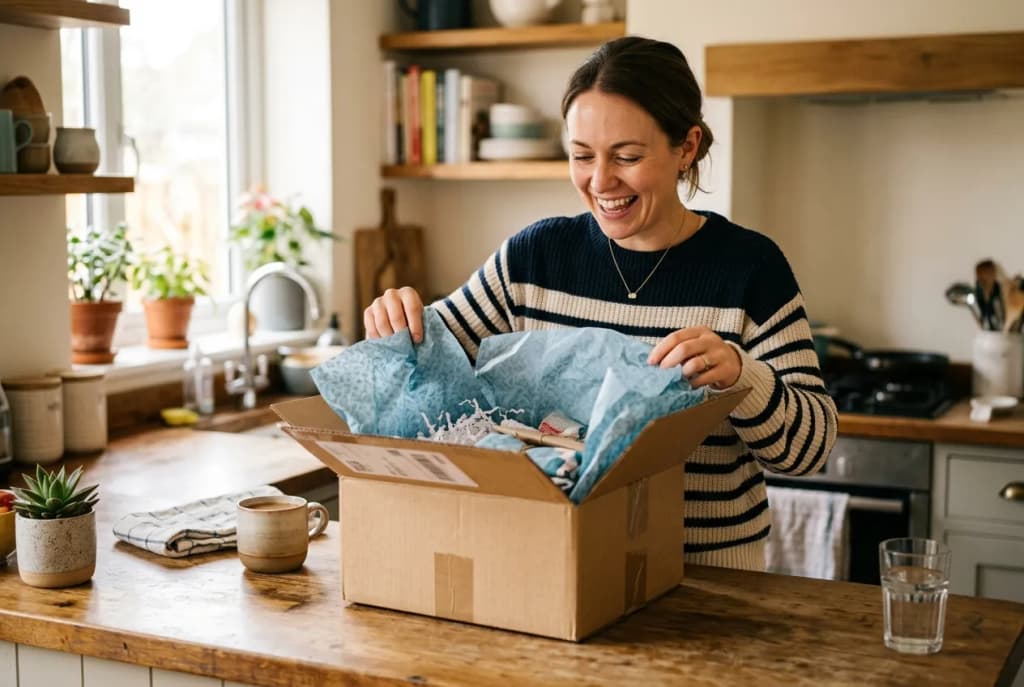
The unboxing. This is the moment. The package arrives. You open it. And there's your dog—smaller than life, heavier than you expected, more detailed than you imagined. The light catches the clear coat and the colors glow. The fur texture has depth. The expression is right.
Some people put it on the shelf immediately. Some hold it for a while first. Some set it in the spot where their dog used to sleep, just for a minute, just to see it there. All of these are correct.
Common Concerns First-Time Buyers Have (Answered Honestly)
"What if it doesn't look like my dog?"
This is the number-one fear, and it's legitimate. But the digital preview step exists specifically to catch this. You see the model before it prints. If the ears are wrong, you say so. If the expression is off, you say so. No reputable company prints a figurine you haven't approved. The preview is your safety net.
"Is 3D printing 'cheap' compared to traditional figurines?"
This is a perception problem, not a reality problem. Full-color resin 3D printing is a sophisticated manufacturing process—the machines cost six figures, the materials are specialized, and the digital sculpting is skilled labor. The word "3D printed" makes people think of desktop hobby printers spitting out plastic trinkets. Production-grade full-color printing is a completely different universe.
"Will the colors be accurate?"
Color accuracy in full-color 3D printing is excellent, but there's a nuance: digital colors on your screen and physical colors in resin aren't identical. Every monitor displays color differently. The sculptor calibrates for the print medium, not for how colors look on your laptop. Minor tonal differences between your screen preview and the final piece are normal and usually negligible.
"How fragile is it?"
More durable than fine porcelain, less durable than a rubber toy. Treat it like you'd treat a nice ceramic mug—don't drop it, don't throw it in a bag, don't let the cat knock it off the shelf. Displayed thoughtfully, it'll last decades.
"Is this weird? Am I being 'that person' about my pet?"
We'll be straight with you: we've filled orders for police K-9s, service dogs, childhood pets from thirty years ago, dogs who are very much alive and just very loved, and everything in between. There's no "too much" when it comes to honoring a bond. If it matters to you, it matters. Full stop.
Closing: Light on the Porch
Here's what I keep coming back to. That front porch we started with—the one with the rocking chair and the morning light and the space where Clover used to sprawl.
The figurine didn't fill that space. Nothing can. But it changed the quality of the emptiness. Instead of an absence, there's a presence. Instead of a gap in the morning routine, there's a small, solid, full-color reminder that says: she was here. She was real. She was loved in the specific, daily, ordinary way that only a dog can be loved—the kind that shows up as muddy paw prints and fur on the couch cushions and that particular sigh she made when she finally settled in for the night.
If you're thinking about ordering a custom Bernese Mountain Dog figurine for the first time, the process is more collaborative, more emotional, and more technically interesting than you probably expected. The technology is real. The artistry is real. And the result—a museum-quality, full-color replica of the dog who changed your life—is something that earns its place on whatever shelf, mantle, or bedside table you choose.
The light still hits that porch every morning. And now there's something there to catch it.
Frequently Asked Questions
How long does a custom pet figurine take to make?
The timeline depends on the company, current order volume, and complexity of the piece. The process involves several stages—digital sculpting, your preview and feedback, printing, and post-processing—each of which takes time to do properly. Rather than guessing, check the provider's website directly for current turnaround estimates.
What photos work best for ordering a custom dog figurine?
Submit 3-5 well-lit photos from different angles. Natural daylight is your best friend. Include front-facing, both side profiles, a three-quarter angle, and a close-up of the face. Your dog should be standing naturally, and avoid heavy filters or flash photography. The clearer and more representative the photos, the more accurate the final figurine will be.
Are 3D printed pet figurines durable?
Full-color resin figurines protected with a clear coat hold up very well under normal display conditions. They're not fragile like fine porcelain, but they're not bouncy like a rubber ball either. Think of them as being comparable to quality ceramics—display them thoughtfully, avoid drops onto hard surfaces, and they'll last for decades.
How accurate are the colors on a custom 3D printed figurine?
Highly accurate. In full-color 3D printing, pigments are embedded directly into the resin at the voxel level, so your dog's exact markings—every rust point, every edge of the white blaze—are reproduced faithfully. Slight tonal differences between your screen preview and the physical piece are normal because monitors and resin display color through different mediums.
Can I request changes before my figurine is printed?
Absolutely. Any reputable custom figurine company will provide a digital preview—a rendered image of your 3D model—before printing begins. This is your opportunity to request adjustments to the pose, proportions, expression, or color accuracy. Don't rush this step. Compare the preview against your reference photos carefully.
Is a custom pet figurine a good memorial gift?
It's one of the most personal gifts you can give someone grieving a pet. Because the figurine is modeled from their specific dog's photos, it captures the unique details that made that animal irreplaceable. We've seen recipients describe unboxing the figurine as one of the most meaningful moments in their grieving process.
Ready to Bring Your Bernese to Life?
Every Bernese Mountain Dog carries a legacy—in the weight of their paws on the kitchen floor, in the particular geometry of their white blaze, in the way they leaned their full body against your legs like they were holding you up. A custom PawSculpt figurine preserves those sacred details in full-color resin, capturing the spirit of the companion who shaped your daily life.
Whether you're ordering a custom Bernese Mountain Dog figurine as a memorial or celebrating a living, slobbery goofball who's currently hogging your couch, the process starts with your photos and ends with something permanent.
Visit pawsculpt.com to explore the full process, see examples, and learn about current service details