The Five Photos That Make or Break Your German Shepherd's Custom Figurine
The GPS said four minutes to the vet, but your German Shepherd was panting hard in the backseat, and you grabbed your phone—not to call ahead, but to snap a photo of him mid-yawn, all teeth and tongue, because some part of your brain whispered you might want this later. That impulse photo? It's probably the worst possible reference for a custom dog figurine. And the best photos for the job are almost certainly not the ones you think.
Quick Takeaways
- Your phone's "best" photo isn't the sculptor's best photo — dramatic angles and filters actively hurt the digital modeling process
- Five specific angles unlock 90% of your German Shepherd's unique geometry — and most owners only submit one or two of them
- Lighting matters more than camera quality — soft, even outdoor light reveals coat patterns that studio flash destroys
- Ear position is the single most-revised feature — get it right in your reference shots and you'll save yourself revision rounds
- PawSculpt's team can guide you through the photo submission process — but better input always means a more accurate figurine
Why Most Photo Guides Get This Completely Wrong
Here's what frustrates me about every "how to photograph your pet" article out there: they're written for Instagram. They'll tell you to get down on your dog's level, use portrait mode, find golden-hour light. All solid advice—for social media. Completely different game when those photos become the blueprint for a three-dimensional object.
A figurine isn't flat. It has a back. It has an underside. It has the space between the ears where the skull curves in a way that's unique to your specific dog. Portrait mode literally blurs out the details a digital sculptor needs most.
We've processed hundreds of German Shepherd orders at PawSculpt, and the pattern is remarkably consistent: owners send their five favorite photos, and we need to ask for five different ones. Not because the originals are bad photos—they're often gorgeous—but because they're solving the wrong problem.
The counterintuitive truth? The most useful reference photo for a custom figurine is one you'd probably never post online. It's a little boring. The lighting is flat. Your dog might not even be looking at the camera. But it shows the sculptor exactly what they need to build your pet in three dimensions.
Let me walk you through the five shots that actually matter—and the science behind why your brain has been steering you toward the wrong ones.
Photo #1: The Dead-On Front Profile (And Why Your Brain Hates It)
There's a concept in psychology called the mere-exposure effect—we prefer images that match what we're used to seeing. You look at your German Shepherd from a slight angle roughly 80% of the time. Straight-on? Almost never. That's why a true front-facing photo feels "off" to most owners. The head looks too wide. The ears seem too far apart. It doesn't look like your dog.
But it does. And it's the single most important reference image for digital sculpting.
What the sculptor sees that you don't
A dead-on frontal shot reveals:
- Ear set width and symmetry — German Shepherds famously have ears that aren't perfectly matched. One tilts slightly. One sits a millimeter higher. These micro-asymmetries are what make your dog look like your dog and not a generic breed model.
- Muzzle width relative to skull — this ratio varies enormously within the breed
- Eye spacing and shape — are they almond-shaped and tight, or slightly rounder? How deep-set?
- Chest width and shoulder placement — critical for getting the stance right
How to actually get this shot
Don't chase your dog around with the camera at face height. Instead:
- Sit on the floor about four feet away from your dog
- Hold a treat at your forehead level — this brings their gaze straight to the lens
- Use burst mode and take 15-20 shots in quick succession
- Pick the one where both ears are fully upright (German Shepherds cycle through ear positions constantly)
The smell of that treat—whether it's freeze-dried liver or a chunk of cheese—will keep their nose pointed right at you. That's what you want. Not the cute head-tilt. The straight, alert, "you have food and I'm locked in" stare.
"The photo you'd never frame is often the photo that makes the figurine feel alive."
— The PawSculpt Team
Photo #2: The True Side Profile — Your Shepherd's Architectural Blueprint
If the front shot is the face, the side profile is the skeleton. It's where we extract the proportions that define your dog's silhouette—and German Shepherds have one of the most distinctive silhouettes of any breed.
That sloping topline. The angulation of the rear legs. The tuck-up of the belly. According to the American Kennel Club's German Shepherd breed standard, the ideal GSD is "longer than tall, deep-bodied, and presents an outline of smooth curves rather than angles." But your dog isn't a breed standard. Your dog is a specific animal with specific proportions, and the side profile captures them.
The mistake most people make
They photograph from slightly above, looking down. This compresses the legs and exaggerates the back length. It makes every German Shepherd look like a dachshund.
You need to be at your dog's shoulder height. For most GSDs, that means your camera is about 22-26 inches off the ground. Kneel, or better yet, set your phone on a low stool and use the timer.
What makes a perfect side profile
| Element | What to Check | Common Problem |
|---|---|---|
| Body angle | Dog standing perpendicular to camera | Dog is angled 20-30°, distorting proportions |
| Leg visibility | All four legs visible and separated | Legs overlap, hiding structure |
| Tail position | Natural hang or gentle curve | Tail tucked (stressed) or straight up (excited) |
| Head position | Looking straight ahead, not at camera | Head turned toward you, hiding neck line |
| Ear position | Alert and natural | Pinned back or one ear flopped |
Here's a detail that trips people up: your dog's tail matters more than you think. The tail is one of the first things people notice on a finished figurine because it defines the emotional "read" of the piece. A relaxed, gently curved tail says calm confidence. A tucked tail reads as anxious. Get a shot where the tail is in its natural resting position—usually a gentle saber curve for a GSD.
The smell trick that works every time
Have someone stand about ten feet to your left or right holding something with a strong, familiar scent. Not a treat—a sock. Your sock, ideally. The dog will orient toward the smell with mild curiosity rather than food-driven intensity, giving you that natural, alert-but-relaxed side profile.
Photo #3: The Three-Quarter View — Where Personality Lives
This is the money shot. Not because it's the most technically useful (that's the front profile), but because it's where your dog's personality becomes three-dimensional.
A three-quarter view—roughly 45 degrees from straight-on—shows the sculptor how the planes of the face relate to each other in depth. How far the muzzle projects. How the brow ridge creates shadow over the eyes. Whether the stop (that angle between forehead and muzzle) is pronounced or gentle.
Why this angle triggers the strongest emotional response
There's real neuroscience here. Research on face perception shows that humans process three-quarter views faster and with more emotional engagement than straight-on or profile views. It's called the three-quarter advantage, and it's been documented in studies on both human and animal face recognition. Your brain reads a three-quarter view as more "real" because it contains depth cues that flat angles don't.
This is why, when you look at your finished figurine from this angle, it either feels exactly right or something feels off. The three-quarter view is the angle of recognition—the angle at which you know your dog.
Getting it right
- Stand at a 45-degree angle to your dog's face
- Keep the camera at eye level with the dog (not yours—theirs)
- Capture the near eye fully visible and the far eye partially visible
- Make sure the ear on the far side is visible behind the head
One thing we wish more people knew: this is the angle where coat color transitions matter most. German Shepherds have that gorgeous saddle pattern, and the way the black blends into the tan varies wildly from dog to dog. Some have a hard line. Others have a gradual fade with individual hairs mixing colors over an inch or more.
In full-color 3D printing—the technology PawSculpt uses—color is embedded directly into the resin material during printing, voxel by voxel. Think of it like a full-color inkjet printer, but in three dimensions. The printer lays down colored resin at resolutions often in the 25-50 micron range (that's roughly half the width of a human hair per layer). So those subtle color transitions in your GSD's coat? They can be reproduced—but only if the reference photos actually show them clearly.
A three-quarter shot in soft, diffused outdoor light is the best way to capture those transitions. Direct sunlight creates harsh shadows that hide the blending. Overcast days are your best friend.
"Your dog's coat tells a story in gradients. Full-color 3D printing can read that story—but only if the photos speak clearly."
Photo #4: The Overhead/Back Shot — The One Nobody Thinks to Take
This is the photo that separates a good figurine from one that makes you do a double-take. And almost nobody sends it unprompted.
Think about it: you spend most of your time looking at your German Shepherd from the front or side. But a figurine sits on a shelf, and people walk around it. The back and top of your dog need to be just as accurate as the face—and those are the angles you almost never photograph.
What the back reveals
- Ear shape from behind — the backs of German Shepherd ears have a distinctive convex curve, and the fur on the back of the ear is often a different shade than the front
- Saddle pattern extent — how far does the black extend down the sides? Where does it stop?
- Tail set and fur flow — the way tail fur fans out or lies flat
- Body width and rib spring — is your dog barrel-chested or more tucked?
- Spine line — the topline slope that's so characteristic of the breed
The digital sculpting perspective
When our 3D artists build a German Shepherd in software like ZBrush or Blender, they're essentially constructing a digital clay model from every angle simultaneously. They'll rotate the model hundreds of times during the sculpting process, checking it against reference photos from each direction. A missing angle means the sculptor has to guess—and guessing is where inaccuracies creep in.
The back/overhead shot is particularly important for coat flow. Fur doesn't just have color; it has direction. On a German Shepherd's back, the fur flows from the neck toward the tail in a pattern that's visible from above. When the digital model's fur texture matches this flow, the finished 3D print looks natural. When it doesn't, something feels subtly wrong even if you can't articulate why.
The practical how-to
Stand directly behind your dog while they're standing naturally. Then take one shot at their back height, and one from above (stand on a step stool if needed, or just raise your phone overhead).
The scent of rain on warm pavement, the earthy smell of your backyard after a storm—these are the moments when your GSD is most likely to stand still and alert, ears forward, body naturally posed. They're scenting the air. Grab your phone.
| Photo Angle | Primary Purpose | What It Captures | Difficulty Level |
|---|---|---|---|
| Front profile | Facial symmetry & structure | Ear set, eye spacing, muzzle width | Medium — need cooperation |
| Side profile | Body proportions & silhouette | Topline, leg angles, tail set | Easy — just need distance |
| Three-quarter | Personality & depth | Facial planes, expression, coat transitions | Easy — most natural angle |
| Back/overhead | Rear accuracy & coat flow | Saddle pattern, ear backs, body width | Hard — unusual angle |
| Detail close-ups | Unique markings & features | Scars, spots, eye color, nose texture | Easy — just zoom in |
Photo #5: The Detail Close-Ups — Because the Devil (and the Love) Is in the Details
This isn't one photo. It's three or four. And they capture the things that make your German Shepherd irreplaceable.
Every GSD owner knows what I'm talking about. That one spot on the left ear where the fur grows in a tiny whorl. The scar on the nose from that time they investigated a rosebush too aggressively. The way one eye has a slightly lighter ring of amber around the pupil.
These details are what transform a figurine from "a German Shepherd" to "my German Shepherd."
What to photograph up close
- Eyes — color, shape, any unique markings around them. Get within 12 inches. Use natural light.
- Nose — color (fully black? Slightly brown at the edges?), texture, any scars or spots
- Paws — nail color, any white markings on toes, fur between pads
- Any unique markings — a white chest patch, a spot on the belly, an unusual color on the tail tip
- Ears — both the front and inside, especially if there's color variation
Why your phone's camera actually excels here
Modern smartphone cameras have excellent macro capability. For close-up detail shots, your phone is genuinely better than most point-and-shoot cameras because of computational photography—the software processing that sharpens details and manages depth of field automatically.
The key is lighting. Get near a window. Soft, indirect daylight. No flash—ever. Flash flattens color and creates hotspots that wash out the subtle variations in your dog's coat.
A word about the printing process
Here's where understanding the technology helps you take better photos. In full-color resin 3D printing, color information is mapped onto the digital model's surface before printing. The 3D printer then reproduces those colors by mixing pigmented resins during the build process—the color is literally inside the material, not sitting on top of it.
This means the color data from your photos gets translated into the digital model's texture map. If your close-up photos accurately capture that your dog's nose is 90% black with a tiny brown spot near the left nostril, the digital artist can map that exactly. If the photo is dark or blurry, they have to approximate. And approximation, while skilled, is never as good as accurate reference.
After printing, the figurine goes through post-processing: cleaning, UV curing (hardening the resin with ultraviolet light), support removal, and finally a clear coat application. That clear coat—the only manual finishing step—adds a protective sheen that makes the colors pop. But the colors themselves? They were decided by the printer, based on the digital model, based on your photos.
The chain is only as strong as the first link.
What We Wish We Knew Sooner
After years of working with German Shepherd owners specifically, our team has accumulated some hard-won insights that we genuinely wish we could go back and tell every customer on day one:
Indoor photos almost always have a color cast. Your living room light makes your dog look warmer (more orange) than they actually are. LED bulbs add a blue or green tint that's invisible to your eye but shows up in photos. If you're only sending indoor shots, the digital sculptor is color-correcting based on assumptions. Take at least your detail shots outdoors in shade.
Wet fur and dry fur are different dogs. We've had customers send post-bath photos and wonder why the figurine's coat looks darker than expected. Wet fur clumps, darkens, and hides the undercoat. Always photograph dry fur.
German Shepherds change color as they age. A three-year-old GSD often has a significantly different saddle pattern than the same dog at seven. If you're memorializing a pet who's passed, try to find photos from the specific age you want captured. Don't send puppy photos and adult photos mixed together without telling us which version you want.
The "airplane ears" problem is real. German Shepherds cycle through ear positions constantly—full upright, slightly back, one up and one sideways (we call these airplane ears). Decide which ear position represents your dog's personality and make sure at least three of your five reference photos show that position consistently. Inconsistent ear positions across references create confusion in the sculpting process.
Blurry is worse than boring. A sharp, well-lit photo of your dog sleeping is more useful than a dynamic action shot that's motion-blurred. Sharpness preserves detail. Detail is everything.
The Lighting Cheat Sheet: When and Where to Shoot
You don't need photography equipment. You need the right time of day and the right location.
| Lighting Condition | Quality for Figurine Reference | Why |
|---|---|---|
| Overcast outdoor, midday | ★★★★★ Excellent | Even light, no harsh shadows, true colors |
| Open shade (under a tree/porch) | ★★★★★ Excellent | Soft, directional light reveals coat texture |
| Golden hour (sunrise/sunset) | ★★★☆☆ Okay | Beautiful but adds warm color cast to fur |
| Direct midday sun | ★★☆☆☆ Poor | Creates deep shadows that hide detail |
| Indoor with window light | ★★★☆☆ Okay | Good if window is large and dog is close to it |
| Indoor with overhead lights | ★☆☆☆☆ Bad | Color cast, uneven lighting, harsh shadows under muzzle |
| Flash (any kind) | ☆☆☆☆☆ Terrible | Flattens everything, causes eye shine, washes out color |
The best scenario? A cloudy day. Your backyard. Your dog standing on grass (green reflects a tiny bit of fill light up into the belly and chin, reducing shadows). That's it. That's the studio.
If you can smell the damp earth after a light rain, even better—your dog will be alert, nose working, ears forward. Perfect posture for reference photos.
Common German Shepherd-Specific Challenges (And How to Handle Them)
German Shepherds present unique challenges for custom figurine creation that don't apply to, say, a French Bulldog or a Golden Retriever. Knowing these upfront will save you frustration.
The black-and-tan gradient problem
GSDs don't have simple color blocks. The transition from black saddle to tan legs is a gradient—individual hairs mixing black and tan over a zone that can be anywhere from half an inch to three inches wide. Photographing this gradient accurately requires:
- Diffused light (see above)
- Multiple angles showing the same transition zone
- No post-processing filters on your phone (turn off "vivid" or "enhanced" color modes)
The double coat texture issue
German Shepherds have a dense undercoat beneath longer guard hairs. In digital sculpting, representing this dual-layer coat is one of the more complex challenges. The sculptor needs to see how the coat lies—where it parts, where it fluffs, where it lies flat against the body. Photos taken right after brushing show this best. Photos of a matted or windblown coat make the sculptor's job significantly harder.
The black German Shepherd dilemma
If your GSD is solid black or very dark sable, photography becomes genuinely difficult. Dark fur absorbs light and loses detail in photos. Here's what works:
- Shoot in bright, even light (overcast day, no exceptions)
- Slightly overexpose — tap your dog in the phone's viewfinder and slide the exposure up a touch
- Look for the photo where you can see individual fur texture even in the darkest areas
- Send a note telling the sculptor your dog is darker than the photos might suggest (cameras automatically brighten dark subjects)
The "my dog won't stand still" reality
German Shepherds are working dogs. They want to be doing something. Getting them to stand in a neutral pose for reference photos can feel impossible.
Practical solution: exercise them first. A 30-minute walk or fetch session takes the edge off. Then bring them to your photo spot while they're in that calm-but-alert post-exercise state. Have treats ready. Work fast—you've got maybe a 5-minute window.
Alternatively, if your dog has a reliable "stay" command, use it. But don't force a tense, uncomfortable stay. A relaxed stand is always better than a rigid one.
What Happens After You Submit: The Photo-to-Figurine Pipeline
Understanding what happens on the production side helps you appreciate why photo quality matters so much. Here's the actual workflow, simplified:
- Reference review — The digital artist studies all submitted photos, identifying the key features, proportions, and unique details that define your dog
- Digital sculpting — Using software like ZBrush, the artist builds a 3D model from scratch, constantly cross-referencing your photos. This isn't automated—a human artist is making creative and technical decisions about every curve and angle
- Texture mapping — Color information from your photos is mapped onto the 3D model's surface. This is where coat patterns, eye color, nose color, and markings get applied digitally
- Client preview — You see the digital model and can request adjustments before anything is printed
- Full-color 3D printing — The approved model is printed in full-color resin. Colors are embedded in the material during printing—there's no separate coloring step
- Post-processing — The printed figurine is cleaned, UV-cured for hardness, supports are carefully removed, and a protective clear coat is applied
- Quality inspection — The finished piece is checked under raking light (light at a sharp angle that reveals any surface imperfections), compared against the approved digital model, and measured for dimensional accuracy
The whole process involves real craftsmanship at every stage—it's just that the craftsmanship is digital and technical rather than traditional. The sculptor's skill with digital tools is every bit as demanding as traditional sculpting. Arguably more so, because they're working from 2D photos to create a 3D object that needs to be accurate from every angle simultaneously.
For specific details about turnaround times, revision policies, and pricing, check PawSculpt's FAQ page—those details are better found there than in a blog post that might become outdated.
The Psychology of Why This Matters So Much
Let's talk about why you're reading this article in the first place. It's probably not because you're casually curious about 3D printing technology. It's because you love your German Shepherd—or you loved one who's no longer here—and you want to get this right.
Attachment theory, originally developed to describe human bonds, applies powerfully to the human-animal relationship. Research on the human-animal bond shows that pet owners form attachment patterns with their animals that mirror those formed with human family members. The loss of a pet activates the same neural grief pathways as losing a human loved one. This isn't sentimentality—it's neurobiology.
When you commission a figurine of your dog, you're engaging in what psychologists call continuing bonds—maintaining a connection with a loved one through tangible objects, rituals, or representations. It's a healthy, well-documented grief response. The figurine isn't a replacement. It's an anchor.
And here's the part that connects directly to photo quality: the uncanny valley applies to pet figurines too. If the figurine is close to your dog but slightly off—wrong ear angle, slightly wrong color, proportions that are 90% right—it can actually feel worse than a generic dog figurine. Your brain detects the near-miss and flags it as wrong. It's unsettling rather than comforting.
That's why the photos matter. Not because we're perfectionists (though we are). Because a figurine that's 98% accurate feels like your dog. One that's 90% accurate feels like someone else's dog wearing your dog's coat. The difference between those two experiences comes down to reference photo quality more than any other single factor.
"A figurine that's almost right is harder to love than one that's clearly abstract. Accuracy is kindness."
Your Pre-Shoot Checklist
Before you grab your phone and head outside, run through this:
- [ ] Dog is dry and recently brushed — coat lying naturally
- [ ] Treats ready — high-value, strong-smelling (liver, cheese)
- [ ] Helper recruited — someone to hold treats or stand where you need the dog to look
- [ ] Phone settings checked — HDR on, filters off, highest resolution selected
- [ ] Location scouted — overcast day, open shade, simple background (grass, concrete, plain wall)
- [ ] Dog exercised — 20-30 minutes of activity beforehand
- [ ] Time budgeted — plan for 15-20 minutes of shooting to get all five angles
- [ ] Backup plan — if your dog isn't cooperating today, try tomorrow. Forced photos look forced.
And one more thing: take way more photos than you think you need. Shoot 50-100 images across all five angles. Storage is free. The sculptor will thank you for having options.
The Photo You Already Have (That You Forgot About)
Here's something we've noticed that surprises people: the best reference photo you own might already exist on your phone. Not in your favorites album—buried in your camera roll from a random Tuesday when the light happened to be perfect and your dog happened to be standing still.
Scroll back. Look for the boring photos. The ones you took to show the vet a skin spot. The one your partner took of the dog waiting by the door. The one from the backyard where you were actually photographing your garden and your GSD wandered into frame.
These accidental photos are often better references than any staged shoot because the dog is natural, the lighting is incidental (and often good), and nobody was trying to make it look cute.
The scent of your morning coffee still hanging in the kitchen air, your dog standing by the back door in that patch of window light, looking at nothing in particular. That's the photo. That's the one.
Closing: Back to the Backseat
Remember that panicked photo from the car? The mid-yawn shot with the blurry background and the overhead angle and the weird shadow from the headrest?
It's a terrible reference photo. But it's a perfect memory. Keep it. Love it. Just don't submit it as your primary reference for a custom pet figurine.
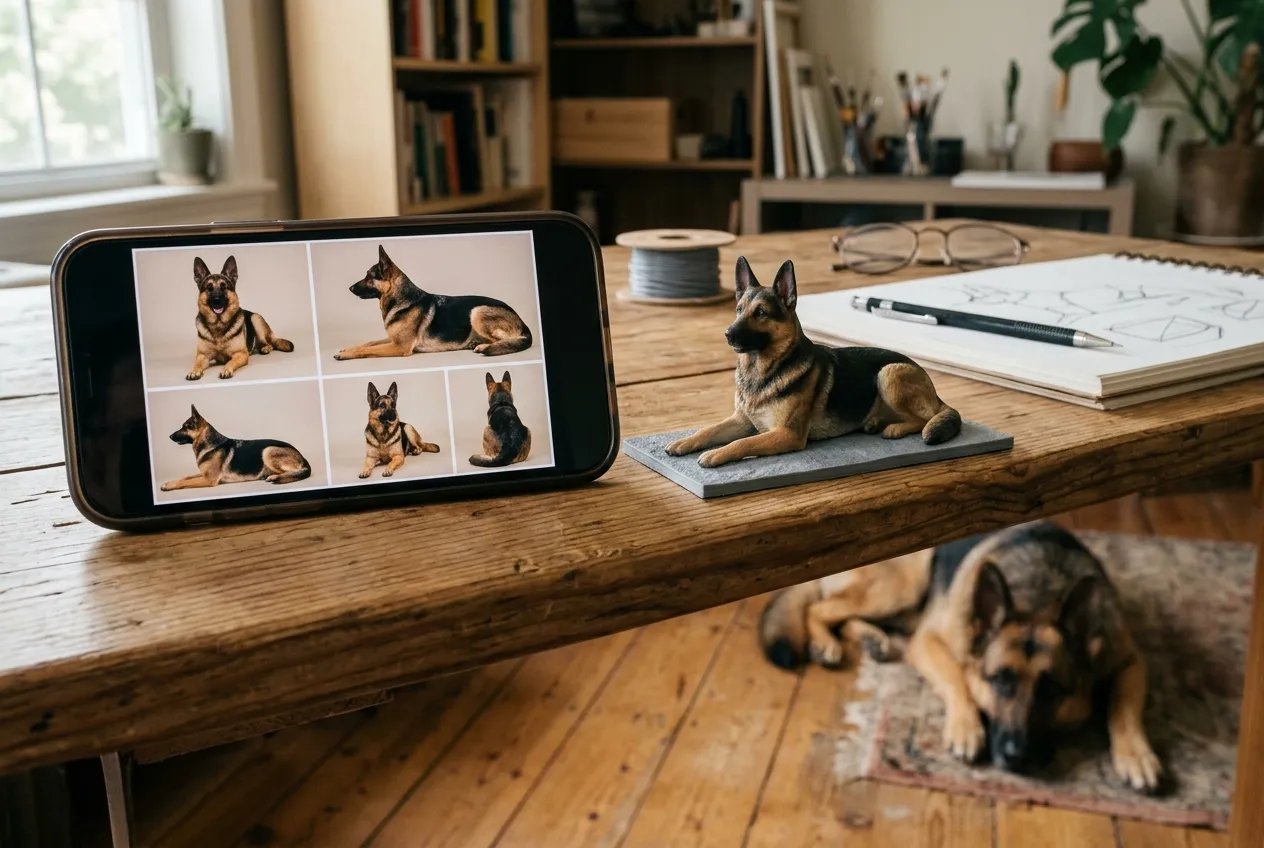
The five photos that make or break your German Shepherd's figurine aren't the ones that make you emotional. They're the ones that make the sculptor accurate. Front. Side. Three-quarter. Back. Details. Shot in soft light, on a dry coat, with a calm dog.
That's it. No expensive camera. No photography degree. Just five deliberate angles and the patience to wait for a cloudy day.
Your German Shepherd deserves to be captured exactly as they are—not a generic version, not an almost-right version, but them. The slightly asymmetrical ears. The specific way the black fades to tan behind the shoulders. The nose scar from the rosebush incident. All of it.
And it starts with five photos you probably haven't taken yet. So go take them. Your future self—holding that figurine, running a thumb over the tiny ears that look exactly right—will be glad you did.
Frequently Asked Questions
What are the best photos for a custom dog figurine?
You need five key angles: a dead-on front profile, a true side profile, a three-quarter view, a back or overhead shot, and several detail close-ups of eyes, nose, paws, and unique markings. Shoot in soft, diffused outdoor light—overcast days are ideal. Make sure your dog's coat is dry and recently brushed, and turn off any color-enhancing filters on your phone. Quantity helps too; aim for at least 10-20 usable images across all angles.
How many reference photos should I submit for a custom pet figurine order?
More is always better. We recommend 10-20 photos minimum, but some of our best results have come from customers who submitted 30-50 images. The sculptor uses them as cross-references, checking one angle against another to build an accurate 3D model. Don't self-edit too aggressively—a photo you think is "boring" might be exactly what the artist needs.
Do I need a professional camera to take good reference photos?
Not at all. Modern smartphones take excellent reference photos for custom figurines. What matters far more than camera quality is lighting (soft, natural, no flash), sharpness (hold still or use burst mode), and color accuracy (turn off vivid or enhanced modes). A sharp iPhone photo in good outdoor light beats a DSLR shot taken under yellow indoor bulbs every time.
What lighting works best for photographing a German Shepherd for a figurine?
Overcast outdoor light is the gold standard. Open shade—under a porch or large tree—is a close second. Both provide even, diffused illumination that reveals true coat colors and texture without harsh shadows. Avoid direct midday sun, indoor artificial lighting, and flash of any kind. If your GSD is very dark or solid black, slightly overexpose the image to retain fur detail in the dark areas.
Why does my German Shepherd's figurine need a photo from behind?
Because a figurine exists in three dimensions, and people will see it from every angle. The back and overhead views reveal your dog's saddle pattern extent, the shape and fur of the ear backs, tail set and fur direction, and overall body width. These details are invisible from the front or side. Without back reference photos, the digital sculptor has to estimate—and estimates are never as accurate as real data.
Are PawSculpt figurines hand-painted?
No. PawSculpt uses full-color 3D printing technology where color is embedded directly into the resin material during the printing process. Think of it like a 3D color printer—pigments are deposited voxel by voxel as each layer is built. The only manual finishing step is applying a protective clear coat after printing. This approach ensures consistent, accurate color reproduction that matches your pet's actual markings as captured in your reference photos.
Ready to Capture Your German Shepherd?
You've got the five angles. You know the lighting. Now it's about taking those photos and turning them into something you can hold. Whether your German Shepherd is curled up on the couch right now or lives on in the photos on your phone, a custom figurine built from the best photos for a custom dog figurine captures them exactly as they are—every asymmetrical ear, every coat gradient, every detail that makes them yours.
Visit pawsculpt.com to learn more about the full-color 3D printing process, preview options, and current turnaround details.