The 'Touch' Factor: Why the Texture of Your Rat Figurine Matters for Memory
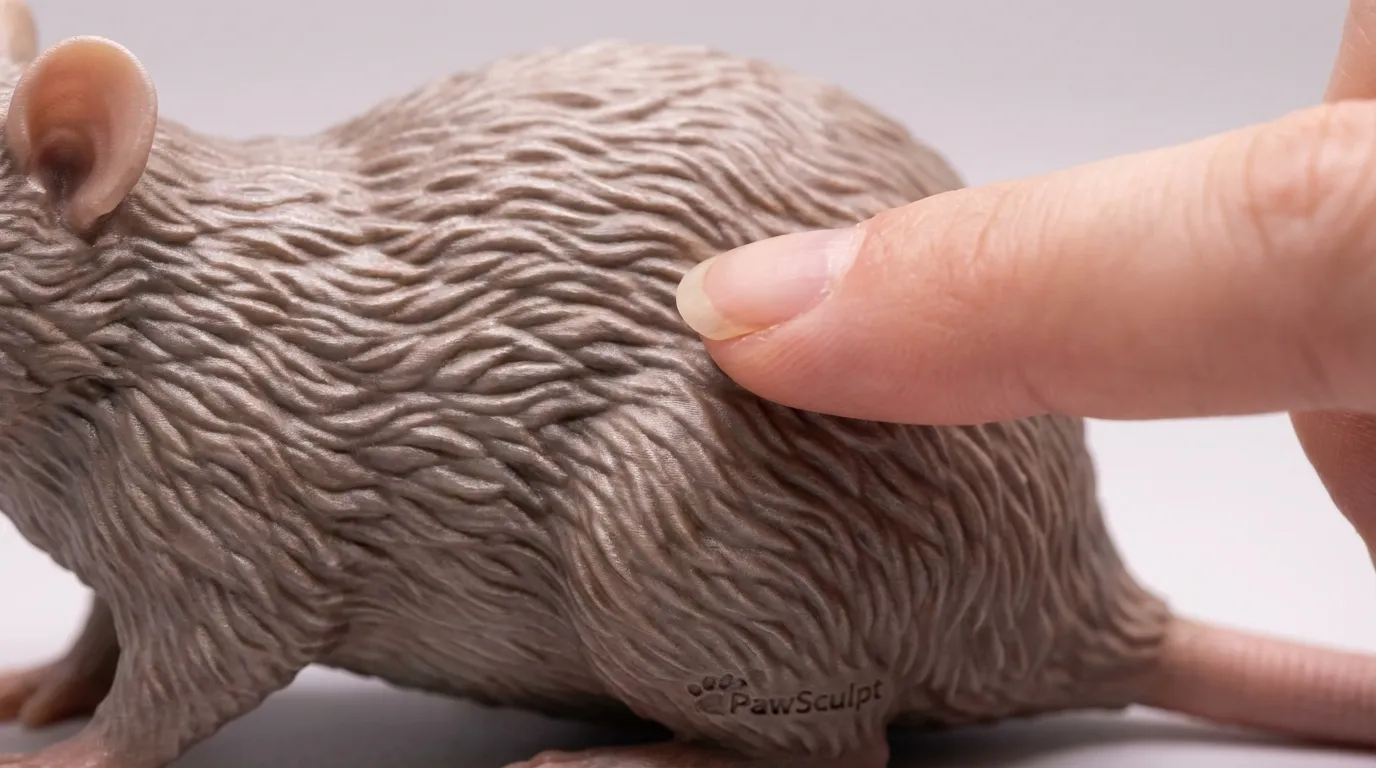
Rats possess approximately 60 vibrissae (whiskers) on their muzzle, sensory tools so acute they can distinguish texture differences as small as 30 microns. Standing on a gravel walking trail, watching the light hit the rough stones, I realized that for a rat memorial figurine to feel authentic, it cannot be smooth—it must speak the language of texture that our hands remember.
Quick Takeaways
- Texture Triggers Memory — Our fingertips contain thousands of receptors that link directly to emotional centers; a smooth surface often fails to evoke the memory of fur.
- The "Paint" Problem — Traditional hand-painting fills in microscopic details; direct manufacturing preserves the geometry of every hair strand.
- Voxel-Level Precision — Advanced 3D printing places color inside the material, creating depth that mimics organic biology.
- Preserving the Unique Coat — From the crimped fur of a Rex to the wrinkles of a hairless, custom figurines rely on digital sculpting to capture specific breed topography.
The Physics of Tactile Memory
We often talk about "seeing" our pets again, but in the shop, we talk about the haptics of grief. When you lose a dog, you miss the weight. When you lose a rat, you miss the texture.
Rats are uniquely tactile companions. They ride on shoulders, nuzzle into necks, and spend hours grooming. Your fingers know the specific coarseness of a buck’s guard hairs or the velvet softness of a dumbo doe. This is "haptic memory"—a sensory imprint that persists long after the visual memory begins to fade.
In my fifteen years working in additive manufacturing, I’ve learned that the "Uncanny Valley" isn't just visual; it’s tactile. If you reach out to touch a memorial of your rat and your finger meets cold, perfectly smooth plastic or glazed ceramic, the illusion breaks. The brain rejects it. It feels like a toy, not a tribute.
To bridge that gap, we have to move beyond the idea of a "statue" and think about surface topography. We aren't just printing an image; we are printing a terrain.
Why "Hand-Painted" Fails the Rat Coat
There is a romantic notion in the collectible world that "hand-painted" is the pinnacle of quality. In many artistic mediums, it is. But when we are trying to replicate the intricate, chaotic texture of a rat's coat at a small scale, paint is actually an enemy.
Here is the shop-floor reality: Paint has thickness. It has viscosity.
When an artist digitally sculpts a rat, they are carving strands of fur that might be only fractions of a millimeter deep. If you take that high-resolution geometry and apply a layer of acrylic primer, then a base coat, then a wash, and then a highlight, you are effectively filling in the valleys of the sculpt. You are smoothing out the very details that make the piece look alive.
The "Self-Leveling" Effect
Most paints have a self-leveling agent. This is great for painting a car or a wall where you want a glass-like finish. It is disastrous for a Rex rat’s curly coat. The liquid settles into the low points of the model, erasing the shadow definition that our eyes interpret as depth.At PawSculpt, we utilize full-color resin 3D printing. This is a fundamentally different approach. We don't print a white shape and color it later. The machine jets tiny droplets of photopolymer resin—some clear, some cyan, magenta, yellow, black, or white—voxel by voxel (a voxel is a 3D pixel).
The color is suspended within the geometry. This means we can maintain crisp, sharp edges on the fur texture because there is no layer of paint sitting on top to soften it. The "color" and the "shape" are created simultaneously.
Digital Sculpting: The Art of Flow
Before a printer ever warms up, the texture is born in the digital realm. This is where the artistry happens. We don't just apply a generic "noise" filter to the model to make it look bumpy. That looks like concrete, not fur.
Analyzing the "Grain"
A rat's coat has a specific flow. The fur on the bridge of the nose is short, stiff, and points upward. The fur behind the ears is downy and chaotic. The guard hairs along the spine are long and sleek.Our digital artists work in software like ZBrush, using a stylus to hand-model these flow patterns. We look at reference photos not just for color, but for the "grain" of the animal.
"A photograph captures a moment, but a texture captures a feeling. We sculpt the way the light hits the fur, not just the color of the fur itself."
The Challenge of the Rex
The Rex rat, with its curly, sheep-like wool, is one of the hardest textures to capture. In a traditional casting process (like bronze or resin casting from a silicone mold), the undercuts of those curls would tear the mold.With additive manufacturing, we can print geometry that is impossible to mold. We can sculpt the tight, chaotic curls of a Rex coat with deep recesses. Because the support material is soluble (it dissolves away in the post-processing bath), we can achieve deep textures that create genuine shadows.
| Coat Type | Sculpting Challenge | Manufacturing Solution |
|---|---|---|
| Standard (Smooth) | Creating sleekness without looking like plastic. | Micro-texture "grain" added to break up specular highlights. |
| Rex / Double Rex | Deep curls and chaotic directionality. | High-resolution geometry with deep recesses; impossible to mold, perfect for printing. |
| Hairless / Patchwork | Skin wrinkles, warmth, and subtle translucency. | Subsurface scattering simulation in color profile; smoothing geometry while keeping skin folds sharp. |
| Satin | High gloss and light refraction. | Tuning the clear coat application to enhance specularity on specific high points. |
The Material: Photopolymer Resin and the "Warmth" Factor
One of the complaints I often hear about ceramic or stone memorials is that they are "cold." They sap the heat right out of your hand.
The photopolymer resins we use in full-color 3D printing have a thermal conductivity closer to wood or hard rubber than stone or metal. When you hold a resin print, it warms up to your body temperature relatively quickly.
Brittleness and Care
I need to be honest about the trade-offs here. Achieving this level of detail requires a material that is hard and rigid. The resin is cured by UV light, turning from a liquid to a solid instantly.This results in a material that is incredibly detailed but brittle. These are not action figures. They are closer to glass in terms of fragility. If you drop a PawSculpt figurine on a hardwood floor, the delicate ears or the tail—which we sculpt to scale, meaning they are quite thin—can snap.
This is the price of accuracy. To make the tail "unbreakable," we would have to make it artificially thick, which ruins the silhouette. We choose accuracy over durability every time, because this is a memorial, not a toy.
The Tail: A textural Masterpiece
Let’s talk about the tail. For non-rat owners, the tail is often the part they dislike. For rat lovers, the tail is iconic. It has a specific texture: scales arranged in rings, interspersed with fine bristles, warm to the touch.
In our digital sculpting process, we pay obsessive attention to the tail scales. We don't just draw lines around a cylinder. We sculpt the slight overlap of the scales.
When this is printed in full-color resin, we can actually vary the gloss level. The tail often needs a slightly different light reflection than the fur. While we apply a uniform clear coat for protection, the underlying geometry of the scales breaks up the light in a way that mimics that unique, slightly grippy texture of a real rat tail.
Lighting: How Texture Interacts with the Room
Why does texture matter for a visual object? Because of how it catches the light.
If you place a smooth object on a shelf, it has a single, bright highlight (specular reflection). It looks manufactured.
A textured object—one with millions of microscopic printed fur strands—diffuses the light. It creates soft shadows and gradients. When the sun moves across the room, the figurine changes. The shadows in the fur deepen. This dynamic interaction with light makes the figurine feel "present" in the room in a way a flat photograph never can.
The "Raking Light" Inspection
In our quality control process, we use what’s called "raking light." We turn off the overheads and shine a flashlight across the surface of the print at a low angle.We aren't looking for color accuracy here; we are looking for surface continuity. We are checking to make sure the layer lines (a natural byproduct of 3D printing, usually around 25-30 microns thick) are blending naturally with the sculpted fur texture.
Sometimes, the layer lines actually help. Because fur has a grain, if we orient the print correctly, the microscopic layers of the print align with the direction of the fur, enhancing the effect of density.
Post-Processing: The Human Touch in a Digital Process
I mentioned we don't hand-paint, and that is true. But that doesn't mean these aren't crafted. The post-processing of a full-color 3D print is a delicate art.
- Support Removal: The print emerges from the machine encased in a gel-like support material. We have to carefully remove this without snapping those fragile whiskers.
- Cleaning: The model goes through a specific chemical bath to remove uncured resin. If we wash it too long, the color fades. Not long enough, and it feels sticky. It’s a chemistry balancing act.
- The Clear Coat: This is the most critical manual step. The raw resin has a matte, slightly chalky finish. To bring out the vibrancy of the color (the "wet look" that reveals the pigment), we apply a UV-resistant clear coat.
This clear coat seals the texture. It protects the resin from yellowing (though we still recommend keeping figurines out of direct sunlight, as all photopolymers are UV-reactive).
"We don't use brushes to add color, but we use our hands to reveal it. The clear coat is the breath of life that makes the colors pop."
— The PawSculpt Team
Grounding Techniques: Using the Figurine for Grief
I’ve worked with grief counselors who suggest "grounding objects" for people dealing with loss. Anxiety and grief can feel like floating away. A physical object brings you back to the room.
Because of the high-fidelity texture of our prints, many owners use them as worry stones. Tracing the line of the spine, feeling the curve of the ears.
The "Thumb Rub" Phenomenon
We have seen returned figurines (usually sent back for a different reason) where the head or back is polished smooth. The owner has rubbed that spot so many times—just like they used to pet their rat—that they have worn down the clear coat and polished the resin.To me, that is the highest compliment. It means the object was doing its job. It was absorbing the grief.
Durability vs. The "Toy" Aesthetic
I want to circle back to the material properties because this is where expectations often clash with reality.
A "toy" rat made of PVC plastic is indestructible. It is also usually painted with a spray mask, has low detail, and visible mold seams.
A PawSculpt figurine is a collectible. It is closer to a piece of jewelry.
Material Specs:
- Technology: PolyJet / Multi-Jet Fusion hybrid approach.
- Resolution: 600 x 600 DPI (dots per inch) in the XY axis.
- Layer Thickness: ~27 microns.
- Hardness: Shore D 83-86 (similar to a hard hat, but more brittle due to pigment load).
We do not use "ABS-like" resins for full-color prints because they don't hold the pigment as well. We prioritize visual and textural fidelity over impact resistance. This is why we say: Touch it, hold it, but do not play with it.
Gift Giving: Why Texture Matters to the Recipient
If you are buying this for a friend who has lost a rat, understand that they are likely starving for sensory input. They miss the physical sensation of their pet.
Giving a gift that has texture shows a deep level of empathy. It says, "I know you miss holding them."
When selecting photos for a custom order, try to find pictures that show the texture.
- Is the fur messy or sleek?
- Are the whiskers straight or curled?
- Is the tail dark or pink?
The more information you give our digital sculptors, the more tactile "hooks" we can build into the model.
Frequently Asked Questions
Can I feel the difference between a Rex and a standard coat on the figurine?
Absolutely. This is one of the main advantages of our process. We don't just change the color; we change the geometry. A Rex coat will feel bumpy and irregular to the touch, while a standard coat will feel smoother with a directional grain.Will the color rub off if I touch it often?
The color itself won't rub off because it is part of the resin material, not a surface paint. However, the oils from your hands can eventually degrade the clear coat, and friction can polish the texture. If you plan to handle it daily, we recommend a gentle wipe with a microfiber cloth occasionally to keep oils from building up.Are the whiskers fragile?
Yes, very. To maintain scale accuracy, the whiskers are printed very thin. They are flexible to a tiny degree, but they will snap if snagged on a sweater or pressed too hard. We recommend handling the figurine by the "core" of the body.Why don't you hand-paint the figurines?
Hand-painting, while artistic, adds a layer of material that obscures fine detail. By printing the color directly into the resin, we keep the "pores" and "strands" of the digital sculpt sharp and defined. It allows for a level of realism that brush strokes often mask.Ready to Celebrate Your Pet?
Every pet has a story worth preserving. Whether you're honoring a beloved companion who's crossed the rainbow bridge or celebrating your furry friend's unique personality, a custom PawSculpt figurine captures those details that make your pet one-of-a-kind.
Free instant AI preview • 3D artist preview within 7 days • 5 free revisions