
A 7-Step Training Checklist to Focus Your Border Collie's Energy by National Dog Day
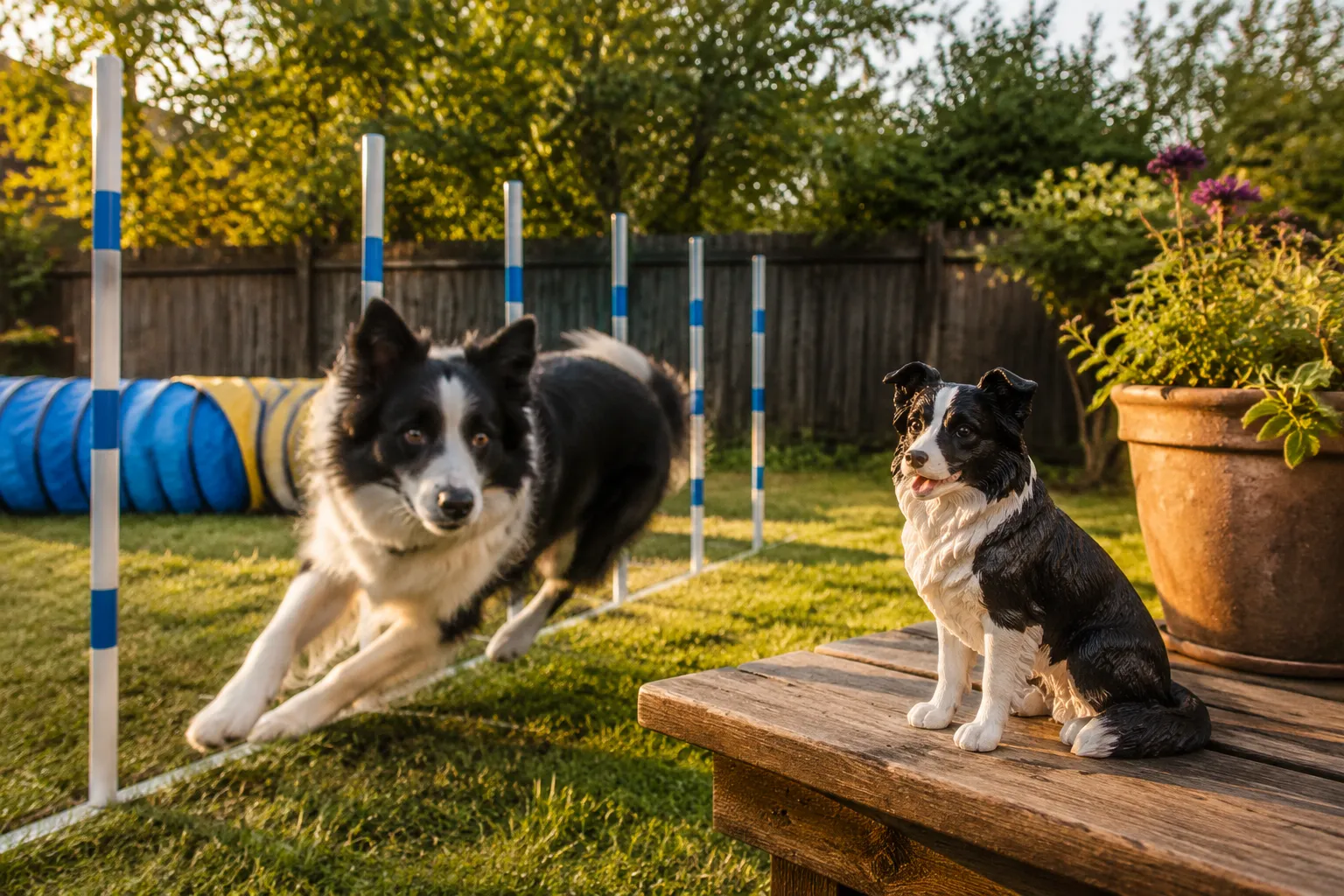
The basement used to thunder at midnight. Claws skittering across concrete, a tennis ball slamming the water heater again, again, again. These days it's calm down there. The turnaround came from a single border collie training checklist, built over one frantic week by a family we worked with last summer.
Quick Takeaways
- More exercise can backfire — a fitter border collie just builds stamina for more chaos.
- Mental work tires them faster — 15 minutes of problem-solving beats a two-hour march.
- Teach an "off switch" first — settling on cue is the skill that saves your sanity.
- Give the herding instinct a legal job — redirect the drive before it redirects your household.
- Celebrate the calmer dog you're building with a keepsake from custom pet figurines that captures who they became.
Why a Border Collie's Energy Feels Like a Force of Nature
Here's the thing nobody warns you about. A young border collie isn't hyper. That word is lazy. A young border collie is employed—bred for a century to read a flock, anticipate movement, and make split-second decisions on a Scottish hillside. You didn't adopt a pet. You adopted a mid-level manager with no assignments and a very loud opinion about it.
That distinction matters. Because most advice treats border collie energy like a fuel tank you just need to drain. Walk them more. Run them harder. Throw the ball until your arm gives out.
And it works, for about a week.
Then something strange happens. The dog gets fitter. The two-mile walk that used to wipe them out becomes a warm-up. You've accidentally trained a canine athlete, and now you're stuck in an arms race you cannot win.
"Energy isn't the enemy. Aimlessness is. A working dog without work will always invent its own."
We hear this story constantly from families who reach out about their dogs. The border collie who "won't settle down." The one who's herding the kids, nipping heels, spinning in circles, barking at shadows on the wall. Nine times out of ten, it's not a behavior problem. It's an unemployment problem.
According to the American Kennel Club's breed profile, border collies are among the most intelligent and energetic breeds—dogs that thrive on a job to do. That intelligence is the gift and the trap. A smart dog with nothing to think about will think about something. Usually your couch cushions.
So the goal of this checklist isn't to exhaust your dog. It's to give that beautiful, restless mind a place to point. To turn scattered energy into focused presence.
And National Dog Day, landing on August 26th, gives us a perfect finish line. Roughly three weeks from a standing start. Enough time to build real habits without rushing the sacred, slow work of trust.
Personal Aside: We'll be honest—the photos border collie owners send us are our favorite in the whole inbox. There's always this alert, slightly mischievous look in the eyes, like the dog is one step ahead of the camera. Capturing that spark in a figurine is a genuine joy. It's also a small nightmare, because they rarely hold still long enough for a good shot.
The Counterintuitive Truth: Calm Is a Skill, Not a Byproduct
Let's kill the biggest myth right now.
Most guides say: tire the dog out and calm will follow. Run them ragged, and peace arrives by default.
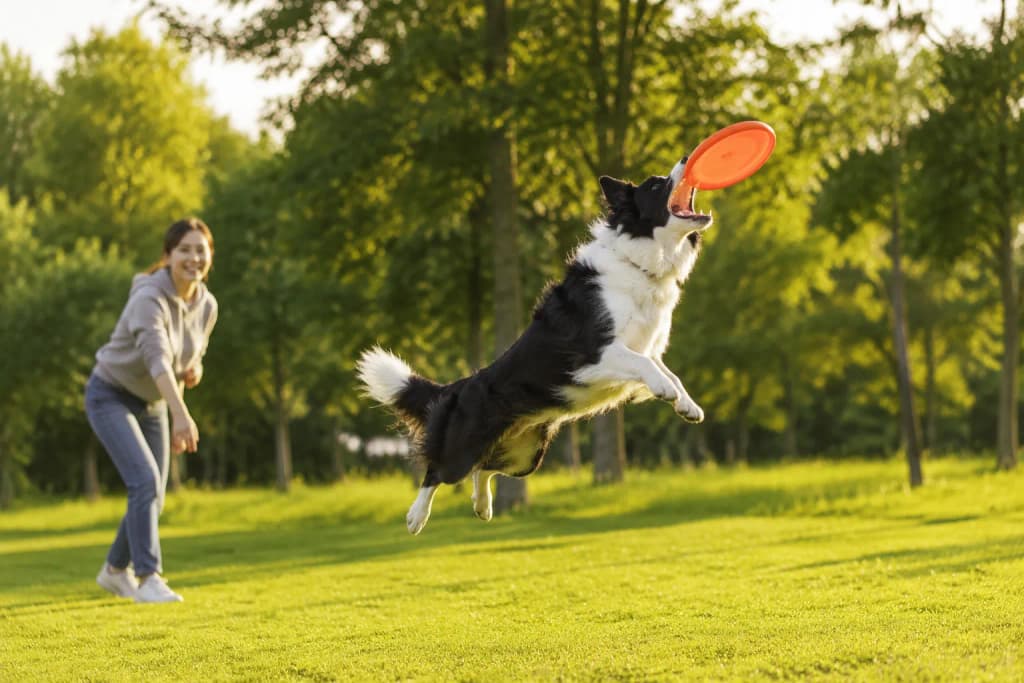
But calm isn't what's left over when the energy runs out. Calm is a trained behavior. A muscle. A skill you build on purpose, the same way you'd teach a sit.
Think about the difference. An exhausted dog collapses. A calm dog chooses to relax while still capable of springing up. Those are not the same animal. The first one is running on empty and will bounce back cranky. The second has learned an off switch—and can flip it even at full battery.
This is the piece the first five Google results almost always miss. They obsess over the outlet (walk, run, fetch) and ignore the recovery. But a dog who never practices settling never learns to settle. You have to teach the down-shift as deliberately as you teach the go.
"You can't drain a border collie. You can only teach one to rest with the engine still warm."
Here's a quick map of what actually moves the needle, and what just spins your wheels.
| Energy Outlet | Time Needed | Tires the Body | Tires the Mind | Best For |
|---|---|---|---|---|
| Long walk | 45–90 min | High | Low | Baseline health, sniffing |
| Fetch/ball chasing | 20–40 min | Very high | Low | Fast physical burn (use sparingly) |
| Puzzle feeders | 10–15 min | Low | High | Rainy days, quick reset |
| Scent games | 15–20 min | Medium | Very high | Deep satisfaction, focus |
| Trick training | 10 min | Low | High | Bonding, impulse control |
| Herding-style games | 20–30 min | High | Very high | Channeling the instinct |
Notice the pattern? The activities that burn mental fuel take a fraction of the time and leave a dog genuinely content, not just wiped. Fetch is the trap on that list—it's pure physical output with almost no thinking, and repeated obsessively it can actually crank arousal higher.
So what? So if your evenings feel like a losing battle, the fix probably isn't a longer walk. It's a smarter fifteen minutes.
The 7-Step Border Collie Training Checklist
This is the framework. Seven steps, sequenced on purpose—each one builds on the last. Work through them over about three weeks and you'll cross the National Dog Day finish line with a dog who's more focused, more settled, and honestly, more himself.
Don't skip ahead. The order is the strategy.
Step 1: Audit the Energy Before You Fight It
One family we worked with swore their dog was "impossible to tire out." So we asked them to do something simple first. For three days, write down every time the dog spun up—time of day, trigger, what happened right before.
The pattern jumped off the page. It wasn't random at all. It was 5 p.m., every day, the moment dinner prep started and the dog got ignored. The chaos had a schedule. They just hadn't been listening.
Before you train anything, spend 48 hours as a detective. Track the flare-ups:
- What time do they happen?
- What sound or movement sets them off? (A door? Kids running? The doorbell?)
- What's the dog not getting in that moment—attention, a job, an exit?
Why it matters: You can't focus energy you haven't mapped. Most people react to the explosion. Smart owners spot the fuse. Once you see the pattern, you can get ahead of it—slotting in a puzzle feeder at 4:45 instead of scrambling at 5:15.
This is also where you tune your ears. Border collie energy has a soundtrack. The click of nails picking up speed. The specific whine that means "give me a task." The huff before the zoomies. Learn the audio cues and you'll intervene before things escalate—when redirection is easy instead of impossible.
Step 2: Trade Miles for Minutes
This is the step that changes everything, so read it twice.
Cut one physical session and replace it with a mental one. Not forever—just as an experiment this week. Swap the second daily walk for fifteen minutes of nosework or trick training.
We watched this happen with a customer's eleven-month-old collie named in their notes as a "tornado with paws." They were doing three walks a day and losing their minds. We suggested dropping the midday walk and hiding kibble around the living room instead—ten little piles, tucked under cushions and behind chair legs.
The dog worked the room like a detective. Nose down, tail slow and thoughtful. And afterward? He slept for two hours. Two hours the walk never bought them.
The mechanism is real. Sniffing and problem-solving engage the brain in a way that produces genuine satisfaction and lowers arousal. The AKC notes that scent work is a natural, deeply fulfilling activity for dogs—it taps something ancient.
Here's your starter menu of mind-work:
- Scatter feeding — toss their kibble across the lawn or a snuffle mat. Breakfast becomes a treasure hunt.
- The muffin tin game — treats in a muffin tin, tennis balls on top. Let them figure it out.
- "Find it" — hide a toy in another room and send them searching.
- Shaping a new trick — teach "spin" or "back up" in tiny increments. Ten minutes, fully spent.
So what? Because a tired body wakes up cranky and ready for more. A satisfied mind rests deep. You're not just filling time. You're changing the quality of the calm.
Step 3: Build the Off Switch
Now the core skill. If you master only one thing on this list, make it this.
Teach a "place" or "settle" cue—a specific mat or bed where the dog goes to power down. This becomes their anchor. Their sacred space in the household. A spot that means the shift is over, you're off the clock.
Here's how, over about a week:
- Days 1–2: Toss a treat on the mat. The second all four paws land, mark it ("yes!") and reward. Repeat. You're just building the association: mat equals good things.
- Days 3–4: Add the word. Say "place," lure them on, reward. Now ask for a down once they're there. Reward the down generously.
- Days 5–7: Stretch the duration. Reward every few seconds at first, then every ten, then every thirty. Calmly walk away and return. Build up the time they can hold it.
The magic move most people miss: reward the calm, not just the arrival. Wait for the dog to sigh, to rest their chin, to soften. That's the moment to reinforce. You're literally paying them to relax, teaching their nervous system that stillness has value.
"An off switch isn't obedience. It's permission to stop working—and a working dog rarely gives that to themselves."
We can't overstate this. A collie who knows "place" can ride out a doorbell, a dinner party, a thunderstorm. Without it, every trigger is a fresh crisis. With it, you have a pause button for the whole house.
Step 4: Give the Herding Instinct a Legal Job
The heel-nipping. The circling. The intense stare at the neighbor's cat. That's not misbehavior—it's a herding dog doing exactly what a hundred generations built it to do, with no sheep in sight.
You can't delete the instinct. But you can give it a legal outlet so it stops leaking into your ankles and your kids.
A family in one of our old email threads had a collie herding their toddler around the backyard—gentle, but relentless. We suggested treibball, the "urban herding" sport where dogs push large exercise balls into a goal. Within two weeks the toddler-herding stopped. The dog finally had sheep. They just happened to be inflatable.
Legal jobs for the herding drive:
- Treibball — push oversized balls toward a target. Pure herding, zero livestock.
- Flirt pole — a lure on a rope you swing along the ground. Controlled chase with a clear start and stop.
- Structured fetch with rules — the dog must sit and wait before each throw, building impulse control into the chase.
- Agility basics — even a few backyard cones and a tunnel channel that drive into focus.
Why it works: Instinct doesn't respond to "no." It responds to redirection. Tell a collie to stop herding and you're fighting biology. Give it something to herd and the pressure releases. You're honoring the spirit of the animal instead of scolding it.
Step 5: Install a Daily Rhythm
Border collies are ritual creatures. They don't just tolerate routine—they crave it. Predictability is a nervous-system gift for a dog whose brain is always scanning for what's next.
So build a rhythm. Not a rigid military schedule—a reliable shape to the day. Morning work. Midday rest. Evening wind-down. The dog learns the sequence and stops asking "what now?" every ninety seconds, because they already know.
Here's a realistic weekday template:
| Time | Activity | Duration | Purpose |
|---|---|---|---|
| Morning | Walk + scatter breakfast | 30 min | Physical + mental start |
| Midday | Puzzle feeder, then place/settle | 15 min | Reset, practice the off switch |
| Late afternoon | Trick session or nosework | 15 min | Head off the 5 p.m. crazies |
| Evening | Flirt pole or structured play | 20 min | Burn peak-arousal energy |
| Night | Chew + settle on place | 20 min | Wind down, deep rest |
The insight here is that the transitions matter as much as the activities. Ending each block with a settle teaches the dog how to come down from arousal on their own. You're rehearsing the descent, over and over, until it's automatic.
Notice how little time this actually takes. Ninety minutes across a whole day, most of it low-effort. Focus beats duration every time.
Step 6: Teach Impulse Control Through Games
A focused dog isn't one who never wants things. It's one who's learned to wait for them. Impulse control is the quiet superpower underneath every well-mannered collie.
And you build it through play, not pressure.
"It's Your Choice" is our go-to. Hold a treat in a closed fist. The dog paws, licks, noses at it—ignore all of that. The instant they back off or look at you, open your hand. If they lunge, close it again. In minutes, a smart collie realizes: pushing gets nothing, patience gets everything.
That single lesson generalizes everywhere. The dog who waits at the food bowl. Who doesn't bolt the door. Who can watch a squirrel and choose you instead.
Other impulse-control builders:
- "Leave it" — starts with treats, scales up to real-world distractions.
- Wait at thresholds — the dog sits before every doorway until released.
- The pause in play — freeze fetch mid-game, ask for a sit, then resume. Teaches that arousal has an off ramp.
"Every whisker on a border collie points toward the next task. Our job—and yours—is teaching them where to aim it."
— The PawSculpt Team
So what? Because impulse control is the bridge between a dog who has skills and a dog who uses them when it counts. A perfect "place" in your quiet living room means nothing if it evaporates the moment a rabbit appears. Games under mild distraction bulletproof the training.
Step 7: Honor the Wind-Down as a Ritual
The last step is the most overlooked, and quietly the most important.
Dogs don't glide from full throttle to sleep. They need a descent. A closing ritual that signals the day's work is done. Skip it, and you get the classic evening problem—an overtired, over-aroused dog who's exhausted but can't stop.
Build a consistent nightly sequence. A long-lasting chew. Dim lights. A few minutes of slow, quiet stroking. The same soft phrase every night. This is your dog's version of a bedtime story—a predictable off-ramp from the highway of the day.
We're big believers in the power of a chew as a decompression tool. The repetitive motion of gnawing is genuinely soothing for dogs—it lowers the heart rate and floods the system with calm. A dog who chews for twenty minutes before bed sleeps differently than one who was just running.
And here's the emotional truth underneath all of it. This wind-down ritual isn't just management. It's connection. It's the sacred, ordinary presence of the two of you, closing another day in the shared story you're writing together. Those quiet nightly minutes become some of the deepest threads in the bond.
What Actually Changes Over Three Weeks
Let's set honest expectations, because that's where most checklists lie to you.
You will not have a transformed dog by day three. You might have a worse one—because you're changing routines and any smart dog tests new boundaries first. That's normal. That's the dip before the climb.
Here's the realistic arc:
| Timeframe | What You'll See | What to Do |
|---|---|---|
| Days 1–5 | Confusion, testing, maybe more chaos | Stay consistent, don't cave |
| Days 6–12 | First glimpses of the off switch | Reward every scrap of calm |
| Days 13–18 | Rhythm clicks, settling gets easier | Add mild distractions to games |
| Days 19–26 | Noticeably more focused, calmer defaults | Maintain, celebrate progress |
By National Dog Day, you're not looking for a finished dog. Dogs are never finished—they're living, growing beings, not projects. You're looking for a turned corner. A dog who can settle when asked. Who looks to you when overwhelmed instead of spinning out. Who's learning that the world has an off switch.
Personal Aside: The families who succeed aren't the ones with the most time. They're the ones who show up for fifteen focused minutes every single day. Consistency is unglamorous and it wins every time. We've seen it in the "before and after" stories people send us for years.
And when that corner turns, something worth marking has happened. You've helped a restless spirit find its footing. That's a milestone. Some families frame their National Dog Day progress photos. Others commemorate the calmer companion they've built with a lasting keepsake—and we've had pet parents order custom pet figurines specifically to capture that alert, intelligent border collie expression at the exact age their dog finally "found their brain," as one customer put it.
A Note on What We Do—and Don't—Know
We'll be straight with you. We're a figurine studio, not a veterinary clinic or a certified behaviorist's office. What we know comes from years of talking to thousands of pet families and seeing the patterns in their stories, plus the well-established consensus on how working breeds thrive.
But every dog is an individual. If your border collie's energy tips into something that looks like genuine anxiety—compulsive spinning, self-harm, panic that doesn't respond to structure—that's a conversation for a vet or a credentialed behaviorist, not a blog. The ASPCA's behavior resources are a solid starting point, and a good trainer is worth every penny.
Most young collie chaos is normal, healthy, unemployed energy. But trust your gut. You know your dog's baseline better than anyone. If something feels off beyond mere exuberance, get eyes on it.
The Photos That Capture a Border Collie's Spirit
Because we get asked this constantly by collie owners, a quick practical note.
Border collies are hard to photograph well. That laser focus, that ready-to-spring posture, the way the light catches their coat—it's magic in person and a blur on camera. If you ever want to preserve this era of your dog, whether in a photo book or as a full-color 3D printed figurine, a few tips help enormously:
- Shoot at their eye level. Get down on the floor. A dog photographed from above always looks smaller and flatter.
- Catch the alert expression. Squeak a toy right after the shutter. That ears-up, eyes-bright look is the border collie signature.
- Natural light, no flash. Near a window or outdoors in soft light. Flash flattens their gorgeous coat markings.
- Get the markings clearly. That distinctive black-and-white split, the tan points, the one blue eye—those details are the soul of the portrait.
When our master 3D artists work from a great photo, they can digitally sculpt every detail, then bring it to life through full-color 3D printing that captures those exact fur patterns and colors directly in the resin. The color is part of the material itself, protected with a clear coat for a natural sheen. You can see the full process and details over at pawsculpt.com—the craftsmanship on the intense-eyed breeds like collies is honestly some of our favorite work.
Frequently Asked Questions
How much exercise does a young border collie actually need?
Roughly one to two hours a day, but the real answer is about type, not just amount. Mental work counts enormously. Fifteen minutes of scent games or trick training can satisfy a collie more deeply than a long march, and leave them genuinely rested rather than just winded.
Why does more exercise seem to make my border collie worse?
Because you're building an athlete. Hard physical exercise, repeated daily, increases stamina—so your dog needs more and more to hit the same tired point. It's an arms race you'll lose. Shift some of that effort to mental enrichment and off-switch training instead, and you'll break the cycle.
Can I really improve my dog's focus in three weeks by National Dog Day?
You can turn a meaningful corner. Three weeks of consistent daily sessions is enough to install a settle cue, establish a rhythm, and see real changes in focus. Just don't expect perfection—dogs are never "done," and the first few days may feel harder before they get easier.
Is heel-nipping and herding normal for a young border collie?
Completely normal. It's a hardwired herding instinct with no sheep to point at. Suppressing it rarely works because you're fighting biology. Redirect the drive into a legal outlet like treibball, a flirt pole, or structured fetch, and the nipping usually fades on its own.
What's the one skill I should prioritize?
The off switch—a "place" or "settle" cue. A border collie who can power down on command can ride out doorbells, guests, and storms without spinning into chaos. It's the single most life-changing skill on the whole checklist, and everything else gets easier once it's in place.
Ready to Celebrate Your Pet?
Every pet has a story worth preserving. Whether you're honoring a beloved companion who's crossed the rainbow bridge or celebrating your furry friend's unique personality, a custom PawSculpt figurine captures those details that make your pet one-of-a-kind. There's something special about marking the moment your border collie finally found their focus—and when you finish your border collie training checklist by National Dog Day, that calmer, brighter-eyed companion deserves to be remembered exactly as they are.
Visit pawsculpt.com to learn more about our process, preview turnaround, revision options, and quality guarantee.