
5 Enrichment Myths Busy Chinchilla Owners Believe (and 3 Easy Fixes That Actually Work)
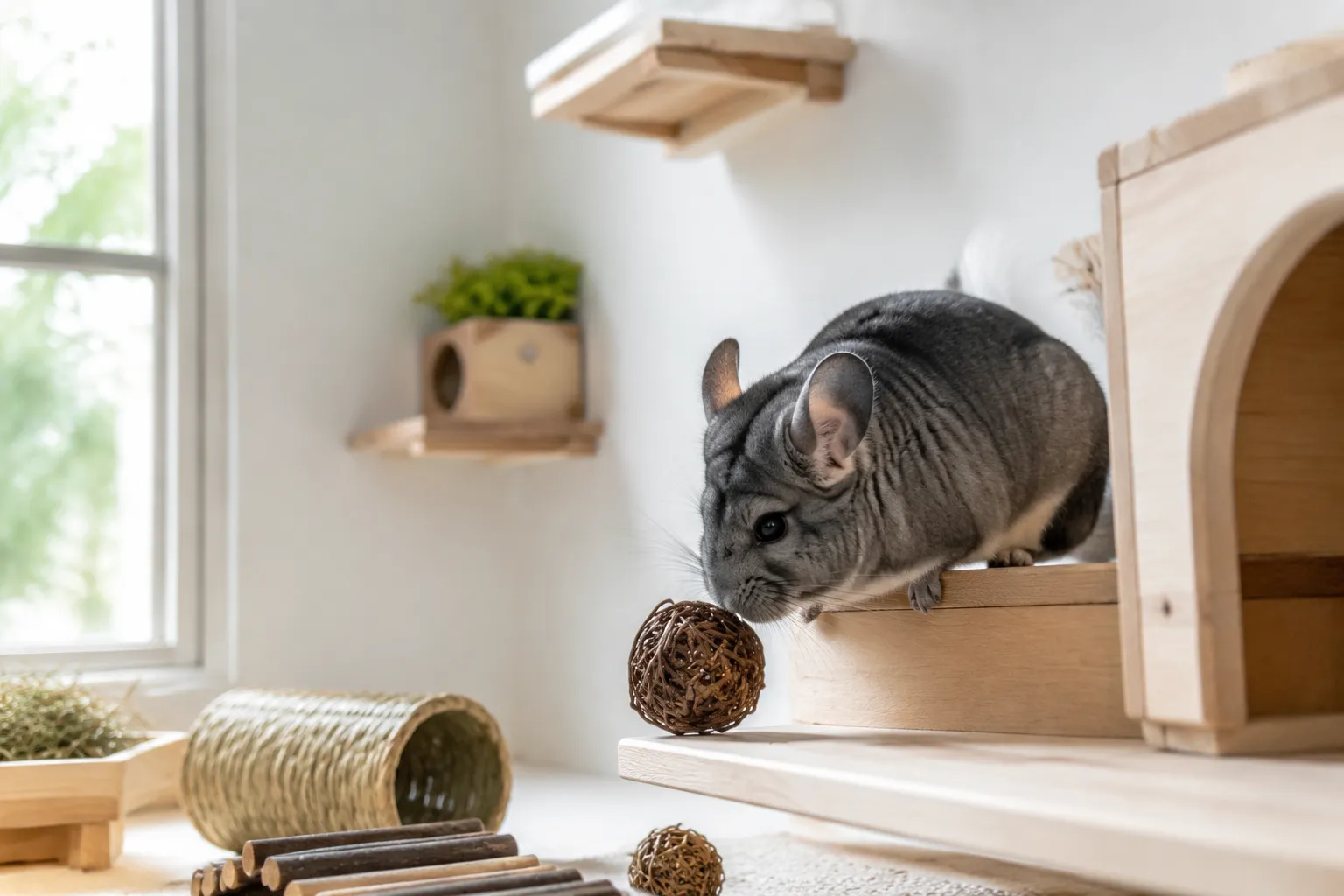
The dust bath leaves a fine gray powder on the kitchen counter at dusk, the same hour your chinchilla starts pacing the cage. That powder is a clue about chinchilla enrichment most owners miss. The restlessness isn't boredom. It's a small soul keeping an ancient appointment.
Quick Takeaways
- Enrichment isn't about more toys — it's about timing your interactions to your chinchilla's crepuscular energy peaks.
- Chewing is sacred, not destructive — it's a biological ritual that keeps ever-growing teeth from killing your pet.
- Five minutes of presence beats an hour of clutter — consistency and rhythm matter more than volume.
- A predictable daily ritual lowers stress hormones — chinchillas read your routine like a clock.
- Honor the bond beyond the cage — some families mark the relationship with custom pet figurines that hold a pet's likeness long after the dust settles.
The Hour Nobody Schedules For
Here's the thing about chinchillas. They live on a different clock than you do.
You come home, you want to connect, you reach into the cage at 6 p.m. with a fistful of hay and good intentions. And your chinchilla looks at you the way a teenager looks at a parent who walked in mid-nap. Polite. Tolerant. Not really present.
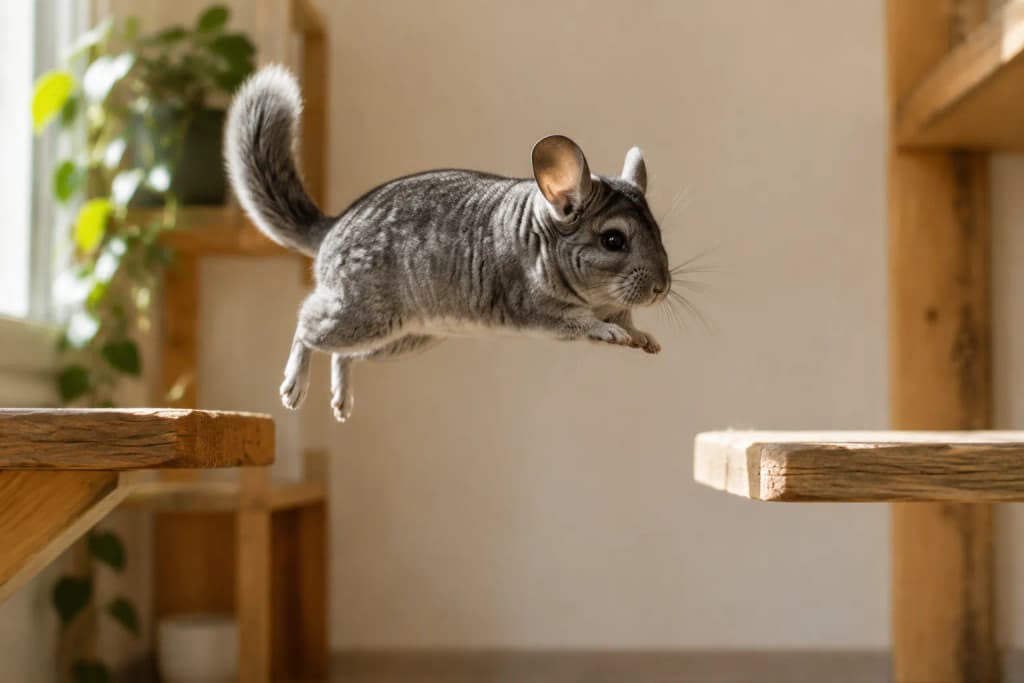
Then at 9 p.m., when you're brushing your teeth, the cage erupts. Wheel spinning. Popcorn jumps off the shelf. A sudden, electric aliveness that you keep missing because you're asleep by the time it arrives.
This is the first thing we want you to understand, and it reframes almost everything that follows. Chinchillas are crepuscular (most active at dawn and dusk, with a second wind deep into the night). Their enrichment problem is rarely a shortage of stuff. It's a mismatch of timing. You're offering your presence during their downtime and missing the window when their spirit is actually awake.
We've talked with thousands of pet families over the years, many of them small-pet owners who feel a quiet guilt that they can't give more. Busy people. Long shifts. Kids, commutes, the whole catalog of modern exhaustion. And almost every one of them is operating on a set of beliefs about chinchilla enrichment that sound reasonable and turn out to be wrong.
Let's walk through them together. Not as a lecture. As a map of a place we've both gotten lost in.
"Enrichment isn't a pile of toys. It's a relationship with a creature who keeps a different sun."
Myth 1: "More Toys Means a Happier Chinchilla"
Picture the cage of a guilty owner. We see photos of these all the time, sent in with questions. Three hanging bridges, a tunnel, two wooden hammocks, a chew castle, a forest of dangling apple-wood sticks. It looks like a tiny abandoned amusement park lit by the glow of a heat lamp.
And the chinchilla? Hunched in one corner. Ignoring all of it.
The mistake most people make is treating small pet enrichment like a shopping problem. Buy more, fill the space, prove your love through volume. But a crowded cage doesn't read as abundance to a prey animal. It reads as clutter. Hiding spots get blocked. Sight lines vanish. The shadows multiply, and to a creature wired to watch for hawks, too many shadows means too many places for danger to wait.
What actually helps more than a full cage is a rotated cage. Keep three or four items in at a time. Swap two of them every week. The novelty of an old toy returning after a fortnight away lights up a chinchilla's curiosity far more than a permanent wall of options that have all faded into background noise.
So what? Because novelty is the active ingredient in enrichment, not quantity. A toy your chinchilla has stared at for ninety straight days is, functionally, part of the furniture. The same toy, gone and returned, becomes new again. You're not buying engagement. You're rationing it.
The counterintuitive part: an emptier cage, refreshed on a rhythm, almost always produces a more active and curious chinchilla than a stuffed one left static. Less, moved often, beats more, left still.
What rotation actually looks like
You don't need a spreadsheet. You need two small bins.
- Bin A holds the items currently in the cage.
- Bin B holds the items resting.
- Every Sunday, while the dust bath powder is still hanging in the evening light, you trade two pieces between them.
That's it. Five minutes. The rhythm does the work, not your wallet.
Myth 2: "Chewing Is a Behavior Problem to Fix"
A customer once wrote to us, half-joking, that her chinchilla was "eating the house." Wooden ledges gnawed to splinters. The corner of a cabinet during free-roam time. She wanted to know how to make it stop.
We had to gently flip the question. The chewing isn't the malfunction. The chewing is the entire point.
A chinchilla's teeth never stop growing. Not as babies, not as elders. They grow continuously for the animal's whole life, and the only thing standing between your pet and a veterinary emergency called malocclusion (misaligned teeth that can prevent eating entirely) is the daily, grinding ritual of chewing. The American Veterinary Medical Association's guidance on exotic companion animals underscores how dental disease in small mammals is both common and preventable through proper diet and gnawing material.
So when you take away every chewable thing to "protect your furniture," you're not solving a behavior problem. You're interrupting a survival rite.
"The gnawing isn't your chinchilla destroying. It's your chinchilla staying alive."
What helps here is reframing the chew not as damage control but as sacred maintenance. Your job isn't to stop the chewing. It's to direct it. Give the instinct somewhere worthy to go.
Good options, and why they earn a place:
- Apple, pear, and willow wood — safe hardwoods that satisfy without splintering dangerously. The varied textures keep the ritual interesting.
- Pumice or lava stones — for the chinchilla who chews with real fervor, these wear teeth down efficiently without sugar.
- Loofah and seagrass — softer textures that work the front teeth and double as a foraging puzzle.
Avoid anything from stone fruit trees like cherry, plum, or apricot. The wood can contain compounds that are toxic to small mammals. When in doubt, PetMD's small-pet care library is a solid place to verify a wood's safety before it goes in the cage.
The deeper truth, the one that took us a while to really feel, is that a chinchilla's relationship with the world is largely a relationship through its teeth. Chewing is how it reads texture, claims space, and steadies its own nervous system. Denying that is denying the animal a primary language.
Myth 3: "My Chinchilla Needs Constant Hands-On Attention"
This one carries the most guilt, so let's sit with it for a second.
You read somewhere that chinchillas are social. You picture them craving cuddles, pining when you leave, withering without lap time. And because your life is full and your hours are short, you carry a low hum of failure into every interaction. You're never doing enough.
Here's what we'll be real about. Chinchillas are social, yes. But they are not dogs. Many of them find prolonged handling genuinely stressful, especially without the slow trust-building that comes from a creature deciding, on its own terms, to approach you.
The mistake here is measuring your bond in minutes of physical contact. That's a human metric projected onto an animal that experiences closeness differently.
What actually builds the relationship is predictable presence. A chinchilla learns your sounds, your shape, your schedule. When you sit beside the cage at the same hour each evening and simply exist there, talking low, hand resting open and still, you become a fixed star in its sky. Safe. Expected. Part of the architecture of its days.
"Trust isn't something you do to a prey animal. It's something you let them walk toward."
The counterintuitive fix: less grabbing, more sitting. The owner who reaches in constantly to hold and pet often reads, to the chinchilla, as a recurring small predator. The owner who shows up, stays calm, and lets the animal close the distance builds something sturdier. Within three to six weeks of this quiet ritual, most owners notice the chinchilla coming to the cage front when they arrive instead of bolting to a hide.
So what? Because forced closeness erodes trust, and patient presence compounds it. You're playing a long game with a creature that can live fifteen to twenty years. The relationship you're building isn't measured in tonight. It's measured in decades.
The five-minute floor of connection
For genuinely busy owners, here's the minimum that maintains the bond, not a guilt-driven maximum:
- Morning: Thirty seconds of voice. Say good morning while you refresh water. They learn your sound is tied to good things.
- Evening: Five minutes seated by the cage during their wake-up window, around dusk. Just be there.
- Twice weekly: Supervised out-of-cage time in a chinchilla-proofed room, scaled to their comfort.
That's a floor most schedules can hold. And it's enough.
A Quick Myth vs. Reality Reset
Before we go further, let's pin down the misconceptions side by side. We find this table helps owners recalibrate fast.
| Common Myth | The Surprising Reality |
|---|---|
| A full cage equals a happy chinchilla | Rotation and novelty matter more than sheer quantity of toys |
| Chewing is destructive misbehavior | Chewing is essential dental survival and a core form of expression |
| Bonding requires lots of handling | Predictable presence builds more trust than frequent holding |
| Dust baths are optional grooming | Dust baths are a non-negotiable physical and psychological ritual |
| Quiet means contentment | Quiet can signal stress, illness, or a mismatched activity schedule |
Myth 4: "Dust Baths Are Just Grooming"
The light catches it best in the early evening. That cloud of fine volcanic dust rising in the cage, your chinchilla rolling and flipping inside it like a small storm, fur turning from dull to luminous as the powder works through it.
Most owners file the dust bath under hygiene. A chore. Something on the maintenance list next to refilling pellets.
It's so much more than that.
A chinchilla's coat is among the densest of any land mammal, with fifty to eighty hairs growing from a single follicle (compare that to one or two on a human). That density is a marvel of high-altitude Andean evolution, and it cannot get wet. Water can't dry properly through fur that thick, which leads to fungal growth and chilling. The dust bath isn't a luxury version of grooming. It is the only grooming method their bodies can safely use.
But here's the part the hygiene framing misses entirely. The dust bath is also a ritual of regulation. Watch closely and you'll see a chinchilla that's anxious or overstimulated dive into the dust and emerge visibly calmer. The rolling discharges static, resets the coat, and seems to settle the animal's whole nervous system. It's physical and psychological at once.
So the practical guidance:
- Offer the bath two to four times a week, not daily. Constant access dries the skin and the eyes.
- Leave it in for ten to fifteen minutes, then remove it. Left in, it becomes a litter box.
- Use chinchilla-specific dust, never sand. Sand grains are sharp and abrasive; chinchilla dust is a fine, rounded volcanic ash.
"The dust bath is the one moment a chinchilla looks purely, weightlessly joyful. Don't reduce it to a chore."
When you start seeing the dust bath as a sacred reset rather than a hygiene task, you start protecting the quality of it. Fresh dust. Right timing. The proper depth, about two inches in a heavy, tip-proof container. You're not cleaning an animal. You're holding space for a daily ceremony its ancestors performed in the dry dust of the high Andes for millions of years.
Myth 5: "A Quiet Chinchilla Is a Content Chinchilla"
This is the one that worries us most, because it's the myth that hides emergencies.
We get it. After a fourteen-hour day, a silent, still chinchilla reads as a peaceful one. No noise, no problem. You exhale and call it a good night.
But prey animals are masters of concealment. In the wild, a chinchilla that visibly shows weakness becomes a target. So they hide pain, hide illness, hide distress, right up until they physically can't anymore. A sudden quiet, especially paired with reduced movement or appetite, can be the loudest alarm in the cage.
The behavioral language of a chinchilla is subtle, and learning to read it is the single highest-value enrichment skill you can develop. Not because it's a toy or a treat, but because attention itself is a form of care.
Signs that the quiet is the good kind:
- Relaxed posture, ears neutral, occasional grooming
- Normal eating and drinking, regular droppings
- Predictable wake-up activity at dusk
Signs the quiet needs a closer look:
- Hunching, fur looking rough or unkempt
- Reduced or absent droppings (a chinchilla not pooping is an emergency clock starting)
- Drooling or wet chin, which can signal dental trouble
- Sitting in unusual spots, especially low corners, away from normal perches
We're not vets, and we want to be clear about that. For anything in the second list, a call to an exotics veterinarian comes before anything else. The ASPCA's guidance on small-mammal care is a useful reference for baseline behavior, but it doesn't replace a professional who can see your animal.
The reframe that matters: silence is data, not reassurance. Reading it correctly is enrichment of the deepest kind, because it's the kind that keeps your companion alive long enough to enjoy everything else on this list.
"Every chinchilla we've ever helped a family capture had a signature gesture—a stretch, a head tilt, a way of holding stillness. Presence is paying attention long enough to learn it."
— The PawSculpt Team
The 3 Fixes That Actually Work for Busy Owners
Enough myth-busting. If you take nothing else from this, take these three fixes. They're built for real schedules, not idealized ones. Each one trades effort for rhythm, because rhythm is what a chinchilla actually responds to.
Here's how they stack up at a glance.
| The Fix | Time Cost | Frequency | Why It Works |
|---|---|---|---|
| The Two-Bin Toy Rotation | 5 min | Weekly | Novelty reignites curiosity without buying more |
| The Forage Scatter | 2 min | Daily | Turns feeding into natural foraging work |
| The Dusk Ritual | 5 min | Daily | Builds trust through predictable presence |
Fix 1: The Two-Bin Toy Rotation
We covered the mechanics above, but it earns its spot as a top fix because it solves the volume myth and the novelty problem in one stroke.
Who it's for: Anyone who feels guilty their chinchilla is bored but doesn't have time to engineer elaborate setups.
How to start:
- Take everything non-essential out of the cage (keep the hide, water, food, wheel).
- Split the toys into two bins.
- Put one bin's worth in. Store the other.
- Every Sunday evening, swap two items.
The aha here is that you already own enough enrichment. You don't have a shortage of toys. You have a shortage of rotation. The fix costs nothing and reactivates what's already on your shelf.
Fix 2: The Forage Scatter
A wild chinchilla spends most of its waking hours doing one thing: searching for food across rocky terrain. A bowl of pellets delivers nutrition but strips out the seeking, which is where a huge share of natural mental stimulation lives.
Who it's for: The owner who wants high enrichment value for almost zero added time.
Instead of dropping the daily ration in a bowl, scatter a portion of safe pellets and dried forage into a handful of paper, a cardboard tube stuffed with hay, or across a fleece liner. Now eating becomes hunting. The brain that evolved to search gets to search.
Pro tip: Tuck a few pellets inside a folded piece of plain paper or a toilet roll tube (no glue, no dye). The unwrapping is half the fun, and it doubles as a chew. Two needs, one cheap object.
So what? Because foraging behavior is one of the most studied forms of enrichment across species. Research into the human-animal bond and animal welfare, including work catalogued by the NIH, consistently links the opportunity to perform natural behaviors with lower stress markers. You're not just feeding. You're letting the animal be what it is.
Fix 3: The Dusk Ritual
The single highest-leverage thing a busy owner can do is align five minutes of calm presence with the chinchilla's natural wake-up window.
Who it's for: Every owner who's been connecting at the wrong time and feeling like the bond isn't growing.
Sit by the cage at dusk. No grabbing. No agenda. Talk low, keep a still open hand near the bars, and let the animal investigate on its own clock. Do it at roughly the same time daily and you become a predictable, safe presence woven into the most alive part of their day.
This is where the spiritual dimension of the bond lives, honestly. You're not performing a task. You're keeping a standing appointment with another being. Over weeks, that appointment becomes a kind of contract: I show up, you can trust me, we share this hour. That's the legacy you build with a long-lived animal, one quiet dusk at a time.
Honoring the Bond Beyond the Cage
There's a moment a lot of long-term chinchilla owners eventually describe to us. The animal does its little signature thing, the dusk stretch, the popcorn jump, the particular way it holds a chew stick in both paws, and the owner thinks: I never want to forget this exact shape of you.
Chinchillas live long, but not forever. Fifteen to twenty years is a gift and also a clock. And because they're small and undramatic compared to a big dog, their presence in a home can feel quiet in a way that makes people afraid the memory will fade just as quietly.
Families mark that bond in different ways. Some keep a jar of the soft dust as a strange, tender memento. Some photograph the dusk ritual for years. And increasingly, pet parents choose tangible keepsakes like custom pet figurines that hold a chinchilla's exact posture, coloring, and that one signature gesture in physical form.
We should be honest about how that's made, because it matters. At PawSculpt, a piece is digitally sculpted by master 3D artists, then precision 3D printed in full color. The color lives inside the resin itself, printed voxel by voxel, so a chinchilla's smoky gray gradient and pale belly come through in the material rather than sitting on the surface. The only manual step is a protective clear coat that gives it a gentle sheen and guards the detail.
What surprised us, working on small-pet pieces, is how much personality lives in tiny gestures. The set of the ears. The fullness of that famous fur. A good 3D pet sculpture captures the shape of the spirit, not just a generic rodent silhouette. If you're curious about the process, the details live over at pawsculpt.com, and we'd rather you explore there than have us quote specifics that change.
This isn't the point of caring for your chinchilla. The point is the daily ritual, the dust at dusk, the standing appointment. But when the clock eventually runs out, having something that holds the shape of that bond can be its own kind of comfort.
A Simple Weekly Rhythm to Pull It Together
To make all of this livable, here's a sample week. Adjust to your shifts. The goal isn't perfection. It's rhythm.
| Day | Core Ritual | Time |
|---|---|---|
| Daily | Dusk presence + forage scatter | 7 min |
| Mon / Wed / Fri | Dust bath (10-15 min, then remove) | 15 min |
| Sun | Two-bin toy rotation | 5 min |
| Tue / Thu | Supervised free-roam play | 20 min |
| Weekly | Quiet health check (droppings, fur, weight) | 5 min |
Notice what's not here. No hour-long handling sessions. No guilt-driven overbuying. No round-the-clock attention. Just a handful of small, consistent acts that honor what a chinchilla actually is.
That's the whole secret, if there is one. Enrichment for a busy owner isn't about doing more. It's about doing the right small things on a rhythm the animal can feel and rely on.
"You don't need more hours. You need the same five minutes, kept like a promise."
The Powder Settles
Go back to that kitchen counter at dusk. The fine gray powder, the pacing that you used to read as a problem to solve.
Now you know what it is. Not boredom. Not a complaint. It's the oldest part of your chinchilla waking up to keep its appointment with the dark, the same way its ancestors did on cold Andean slopes under a thinning light.
Your job was never to fill the cage or fix the chewing or force the closeness. Your job is smaller and far more sacred than that. Show up at dusk. Scatter the forage. Rotate the toys. Read the silence. Keep the promise.
Do those few things on a rhythm, and you'll have given your chinchilla the one thing no amount of toys can buy: a human who learned its clock and chose to live by it, even for five minutes a day.
Start tonight. When the powder rises and the cage comes alive, just sit down beside it. Say nothing. Be the fixed star. That's where good chinchilla care actually begins, and it's where the bond you'll carry for the next fifteen years quietly takes root.
Frequently Asked Questions
How much enrichment time does a chinchilla really need each day?
Less than most guilt-ridden owners assume. A consistent floor of about five to seven minutes of calm presence plus a quick forage scatter daily covers the essentials, with supervised free-roam time a few times a week. What your chinchilla responds to is the rhythm of those moments, not their length. Five minutes kept like a daily appointment beats an unpredictable hour.
How often should chinchillas have a dust bath?
Two to four times a week is the sweet spot for most chinchillas. Leave the bath in for only ten to fifteen minutes, then take it out so it doesn't become a litter box and dry out their skin. Always use proper chinchilla dust (a fine volcanic ash), never sand, which is too abrasive for that incredibly dense coat.
Is it normal for my chinchilla to be quiet during the day?
Daytime stillness is completely normal, since chinchillas are crepuscular and do their real living at dawn, dusk, and into the night. The quiet to watch for is the sudden kind, especially when it comes with less eating, fewer or no droppings, hunching, or a wet chin. Those signs warrant a prompt call to an exotics vet, since prey animals hide illness until late.
Why does my chinchilla chew everything?
Because it has to. A chinchilla's teeth grow continuously throughout its entire life, and chewing is the only thing that keeps them from overgrowing into a painful, eating-blocking condition called malocclusion. Don't try to stop it. Redirect it toward safe materials like apple wood, willow, and pumice stones, and avoid toxic stone-fruit woods like cherry.
Do chinchillas need constant handling to bond with me?
No, and forcing it often backfires. Many chinchillas find frequent grabbing stressful and read it as predatory. The stronger bond comes from predictable presence: sitting calmly nearby at dusk, talking low, and letting the animal choose to approach. Most owners see real trust develop over three to six weeks of this quiet, consistent ritual.
Ready to Celebrate Your Pet?
Every pet has a story worth preserving. Whether you're honoring a beloved companion who's crossed the rainbow bridge or celebrating your chinchilla's quirky dusk-hour personality, a custom PawSculpt figurine captures the details that make your pet one-of-a-kind, from that famously dense fur to its signature gesture. Good chinchilla care is about presence, and a keepsake lets that presence linger.
Visit pawsculpt.com to learn more about our full-color 3D printing process, preview turnaround, flexible revisions, and quality guarantee.