
The Second Year: How My Boxer's Medical Records Became a Ritual of Healing
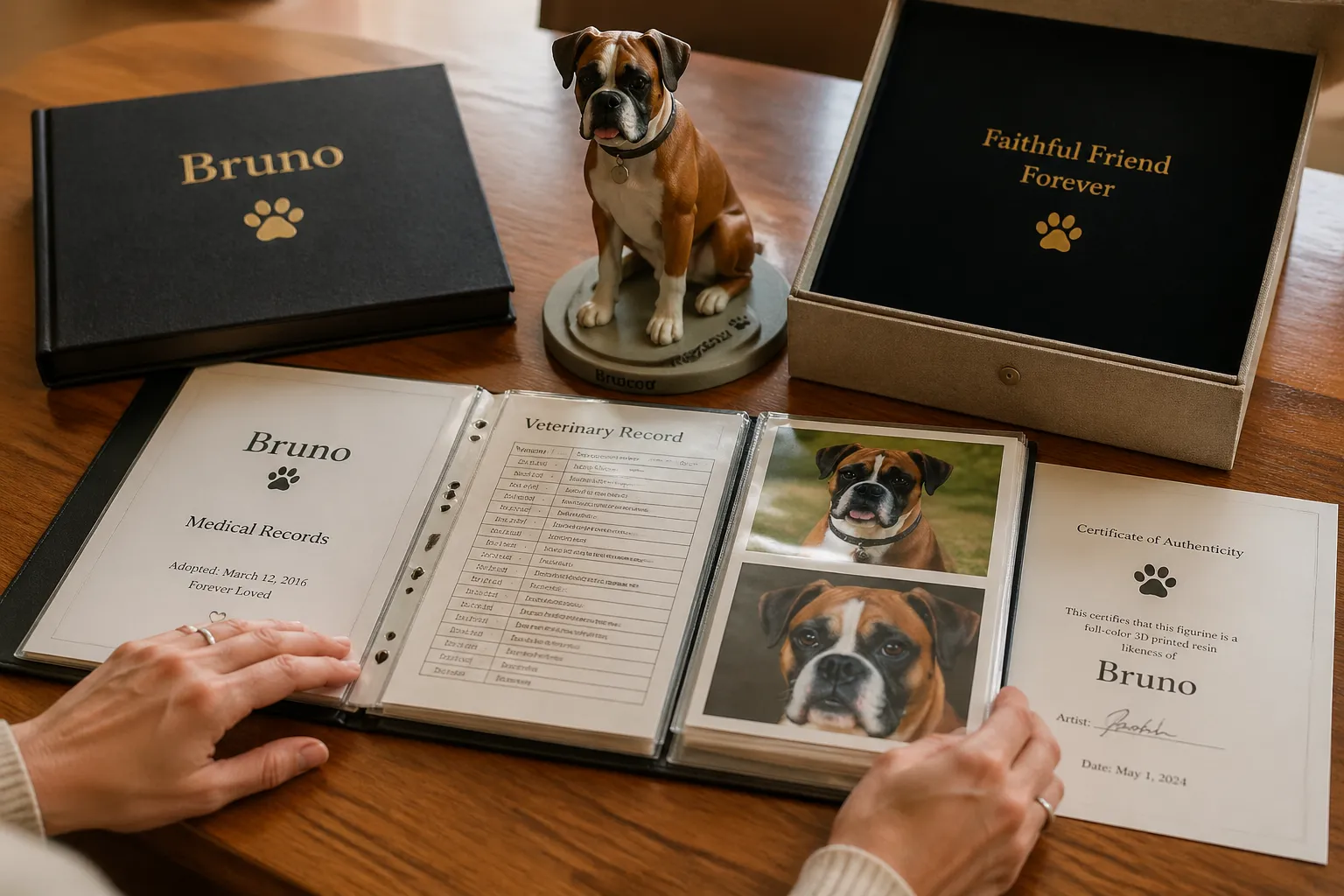
“Grief is praise, because it is the natural way love honors what it misses.” — Martín Prechtel. In the garage, pet loss grief sounded like one metal tag tapping the dryer once, then stopping.
Quick Takeaways
- Use records as ritual — sort one document weekly instead of forcing one overwhelming memorial project
- Name the hidden emotions — guilt, relief, and fear of forgetting often soften when spoken plainly
- Build a sound-based memory practice — list the household noises your dog changed, then honor them
- Choose one tactile anchor — a collar, file folder, or custom pet figurine can steady remembrance
- Treat year two differently — the grief second year often asks for structure, not distraction
Why the grief second year can feel stranger than the first
The first year after a dog's death has a rough architecture. There are immediate decisions. Ashes, sympathy texts, bowls to move or not move, medication bottles still lined up near the coffee maker. People expect your distress then. They know what they are looking at.
The second year is less legible.
And that is exactly why it can feel more destabilizing.
We've seen this pattern again and again while working with pet families. The first year is often governed by shock and logistics. The second year introduces a subtler task: integration. The mind begins asking a different question. Not “How did this happen?” but “Where does this bond live now?”
That shift catches people off guard.
A Boxer owner once described the first year as “sirens,” and the second as “a smoke alarm battery chirping at 3 a.m.” That is one of the best descriptions we've heard. Not constant catastrophe. Intermittent disruption. A sound that keeps insisting something still needs attention.
The overlooked problem: grief often gets stuck in paperwork
Most memorial advice centers on photos, urns, jewelry, gardens, or ceremonies. Some of that helps. Some of it doesn't. Our top editorial note here is simple: many grieving pet owners overlook administrative objects, even though those objects often hold the most unresolved emotion.
Medical records are a prime example.
Why? Because they contain the language of the ending:
- appointment dates
- weight changes
- diagnostic terms
- prescription instructions
- consent forms
- invoices tied to impossible choices
These papers are not sentimental in the usual sense. They are clinical. Thin. Often ugly. And yet they carry an enormous emotional charge because they record the stretch of time when love became decision-making.
That is the specific angle many articles miss. We don't just grieve the animal. We grieve the role we had to play near the end—caregiver, scheduler, interpreter, financier, advocate, witness.
A micro-story from year two
One family we worked with kept their Boxer's records in a cracked plastic accordion folder on a garage shelf beside extension cords and old tennis balls. They couldn't throw it out. They couldn't open it either. What finally helped was not “decluttering” or “moving on.” It was opening one tab every Sunday and reading only a single page.
That small physical ritual changed the folder from evidence into memory.
"Year two grief often needs a practice, not a pep talk."
The mistake most people make
The mistake most people make is trying to interact with painful objects only when they “feel strong enough.” Honestly, that day often doesn't arrive in a clean, cinematic way. What works better is a repeatable, low-intensity ritual with clear limits.
Ten minutes. One page. Same chair. Same time.
That matters because the nervous system responds well to predictability. Not because grief can be controlled—it can't—but because the body relaxes when it knows the container.
If you need additional support beyond personal rituals, organizations like the Association for Pet Loss and Bereavement offer grief resources and support options that many families find grounding.
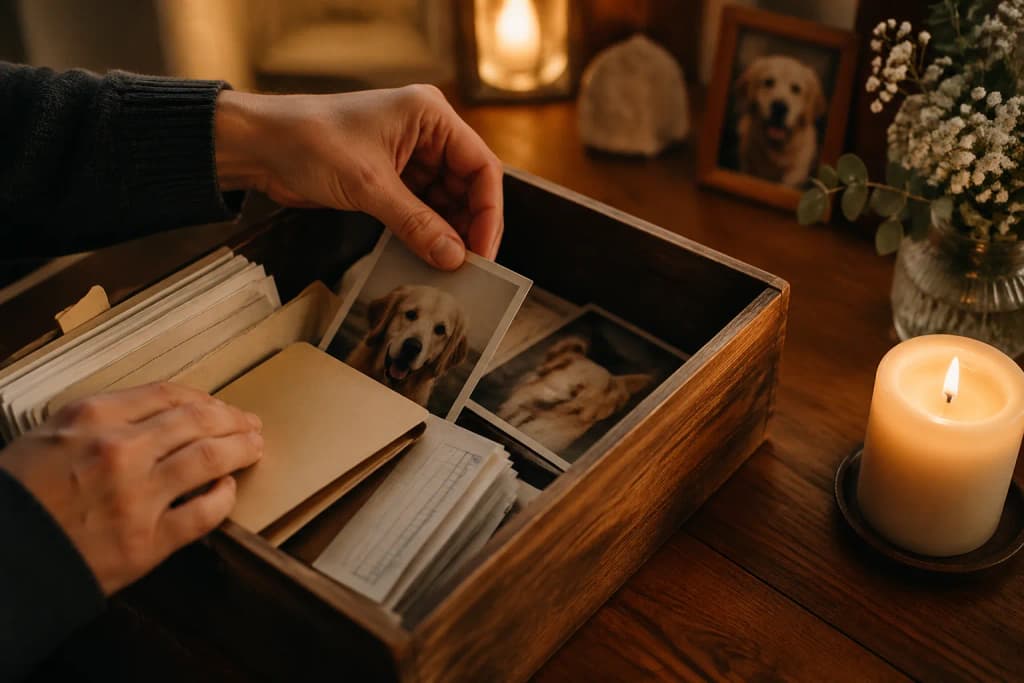
Medical records memorial: why paperwork can become a healing object
There is something almost unbearable about reading “declining appetite” in black ink when you can still hear the sound of your Boxer nudging the cabinet where treats were kept. Clinical language can feel cold. But cold language has an odd strength: it can hold emotion without collapsing under it.
That is why a medical records memorial can work surprisingly well.
Not for everyone. We're not huge fans of forcing one memorial format on every family. But for people who feel haunted by the end—especially by choices made under pressure—records can become a structured bridge between love and reality.
What records contain that photos do not
Photos capture identity. Records capture stewardship.
A photograph may show your Boxer asleep with one paw over his nose. A vet summary may show the dates you kept showing up, the tests you approved, the medications you tracked, the nights you were monitoring water intake at 2 a.m. together with the hum of the refrigerator and the soft thud of him resettling on the floor.
That difference matters.
If you struggle with guilt or second-guessing euthanasia timing, records can counter the mind's favorite distortion: selective memory. Grief often edits. It highlights one decision, one delay, one symptom you missed. But a complete file can reveal the fuller truth—you were engaged, attentive, and making decisions in real time, not with hindsight.
That doesn't erase regret. It corrects proportion.
A practical framework: the four-folder method
Our top pick for turning records into a ritual is what we call the four-folder method. It is simple enough to do in one weekend, but gentle enough to continue over months.
1. Care
Put here:- wellness exams
- vaccine history
- routine bloodwork
- weight notes
- dental reminders
This folder restores the long middle of the relationship. Not just the ending.
2. Change
Put here:- symptom logs
- specialist referrals
- medication adjustments
- lab trends
- mobility changes
This is where patterns become visible. Often, this folder reduces self-blame because it shows decline as a process, not one disastrous moment.
3. Decisions
Put here:- consent forms
- treatment estimates
- discharge instructions
- euthanasia paperwork if applicable
This is the emotionally hardest category. Handle it last.
4. Tribute
Put here:- sympathy cards from the clinic
- ink paw prints
- collar tag photocopy
- one favorite printed photo
- your own notes about personality
This folder is where the record becomes a memorial.
A table that helps families decide what to keep
Here is the simplest sorting guide we recommend.
| Record Type | Keep in Full? | Why It Matters Emotionally | Best Use in Ritual |
|---|---|---|---|
| Routine wellness notes | Yes | Restores everyday care, not just decline | Read one visit per month |
| Lab results and scans | Selectively | Helps with reality-testing if you feel regret | Keep summaries, not duplicates |
| Medication lists | Yes | Shows sustained caregiving labor | Pair with journal reflections |
| Invoices only | Selectively | Can trigger panic more than comfort | Keep major decision documents only |
| Euthanasia paperwork | Optional but often useful | Supports second-guessing relief through facts | Read only when emotionally resourced |
| Sympathy cards from vet staff | Yes | Confirms your dog's life was witnessed by others | Place in Tribute folder |
Counterintuitive insight: the goal is not “closure”
We’ll be real: closure is one of the least useful words in pet bereavement. It sounds tidy. Most real grief is not tidy. What families actually need is continuing orientation—a reliable way to return to the bond without being flattened by it.
Medical records can do that because they are chronological. They create sequence. And sequence is stabilizing.
When the mind is spiraling—Was it too soon? Too late? Did I miss something?—a dated record says: this happened, then this happened, then this happened. Not perfect. But real.
What to add if records feel too clinical
If the records alone feel sterile, combine them with sensory memory. Sound works especially well.
On the back of selected pages, write one remembered sound:
- nails ticking across concrete
- the snort before settling down
- collar tags hitting a metal water bowl
- the boxer “woo-woo” at the door
- the heavy exhale under a workbench in the garage
That pairing—fact plus sound—is unusually powerful. It links the medical timeline to lived life.
"Records tell you what happened. Sound reminds you who was there."
Boxer memorial rituals that honor the whole dog, not just the diagnosis
A good boxer memorial should capture the breed's contradictions. Dignified and ridiculous. Athletic and tender. Alert enough to hear a snack wrapper from two rooms away, dramatic enough to collapse as if auditioning for theater.
If your memorial contains only the illness, it will feel incomplete. The standout memorials we see don't sanitize the hard parts, but they also make room for the goofy, noisy, ordinary soundtrack of Boxer life.
Build a memorial around recurring household sounds
This is our favorite overlooked exercise because almost no one suggests it, and it works.
Take 15 minutes and make a list called “Sounds my Boxer changed in this house.”
For example:
- the hollow thump of a tail against a cabinet
- snoring loud enough to rival the TV
- paws scrambling on the garage floor when the car door opened
- one sharp bark at delivery trucks, then suspicious silence
- the jingle-jingle pause before dinner
Why does this help? Because grief often lives in pattern disruption. The absence that hurts is not abstract. It is rhythmic. Your dog was part of the home's acoustic design.
Naming those sounds turns vague ache into observable memory. And observable memory is easier to carry.
Create a ritual object from the record archive
Many people assume ritual has to be ceremonial—candles, poems, anniversaries. Sometimes it is much more practical. A folder. A binder. A labeled archival box. A weekly appointment on your calendar called “Boxer file.”
That may sound unromantic. It isn't. It is disciplined love.
One customer told us she slipped her dog's final specialist reports into a linen folio with his puppy class certificate and one photo of him asleep beside a leaf blower. The combination worked because it wasn't polished. It was true.
Memorial options, ranked by emotional function
We think memorial choices are easier when you rank them by what they actually do for you. Not by trend.
| Memorial Option | Best For | Emotional Function | Effort Level |
|---|---|---|---|
| Medical records binder | Owners replaying end-of-life decisions | Restores narrative and reduces distortion | Moderate |
| Sound memory list | Homes that feel acoustically wrong afterward | Names daily absence precisely | Low |
| Photo book | Families with lots of visual memories | Celebrates identity and chronology | Moderate |
| Memorial garden | People who need outdoor ritual | Gives grief a seasonal rhythm | Moderate to high |
| Custom figurine | Owners wanting a durable physical anchor | Makes memory tangible in shared space | Moderate |
A custom pet figurine can be especially meaningful if your challenge is not remembering, but locating where memory belongs. A shelf object, desk object, or mantle object can function as a visual home for attention. That's one reason some families explore memorial keepsakes for pets after the second year, not immediately after the loss.
Timing matters. Early grief often rejects permanence. Later grief often seeks it.
A note on figurines, because details matter
Not all keepsakes are made the same way, and we think readers deserve clarity.
At PawSculpt, figurines are digitally sculpted by master 3D artists, then precision 3D printed in full color. The color is printed directly into full-color resin, voxel by voxel, rather than applied as a surface layer. A protective clear coat is added afterward for sheen and durability. That means the result has vivid coloration, preserved markings, and a natural 3D print texture rather than a fake, overly smooth finish.
Why mention this in a grief article? Because memorial objects should be described honestly. In mourning, trust matters.
If a physical keepsake is on your shortlist, browse 3D pet sculptures that preserve markings and posture and compare them with other memorial forms. Our editorial advice: choose the object that helps you return, not the one that simply looks impressive.
Personal Aside
We’ve noticed something quietly moving in our work: the families who wait until year two or year three often know exactly what detail they want preserved. Not “make it cute.” More like “Please get the white blaze on his chest right, and the slightly crooked sit.” That specificity tells us healing has shifted from emergency to stewardship.
Physical ritual and pet loss grief: why the body needs a job
Here’s the thing many grief guides skip: thinking is not the only way we process loss. The body also needs participation.
That is where physical ritual comes in.
A ritual is not magic. It is repeated action with meaning. And repeated action helps when grief has become diffuse—spread across the day in tiny ambushes rather than one dramatic breakdown.
Why physical ritual works better than “staying busy”
People often say they are “keeping busy” after loss. We understand the impulse. But generic busyness can become avoidance with better branding. Physical ritual is different. It is specific, bounded, and relational.
Examples include:
- opening the medical folder every Sunday at 4 p.m.
- polishing a collar tag once a month
- writing one memory on one index card each Friday
- placing a flower near the leash hook on adoption day and goodbye day
- dusting a memorial object while saying the dog's name aloud
These actions may look small. They are not.
A Boxer owner we remember set a 7-minute timer every Wednesday evening, sat on an overturned bucket in the garage, and read one vet note while the washing machine clicked through its cycle. The sound became part of the ritual. Over time, the room stopped feeling like the place where medications were stored and started feeling like a place where care was witnessed.
That is healing in practical clothes.
"We’ve seen families heal faster when memory has a physical routine. Grief settles better when the body is invited to participate."
— The PawSculpt Team
If you feel guilty, start here
Many pet owners feel guilty about the ending, especially if euthanasia was involved. This is more common than people admit. So is the flash of relief mixed with grief when a pet's visible suffering ends.
That relief does not make you disloyal.
It means your nervous system had been bracing for distress—your dog's and your own. When the crisis ends, the body may register release before the heart catches up. Then guilt rushes in and mislabels that release as betrayal. It isn't.
- Take the final treatment or discharge note.
- Highlight only factual observations: pain level, mobility changes, appetite issues, breathing concerns.
- On a separate page, write: “I made decisions with the information available then, not the information I have now.”
- Read both pages together once a week for four weeks.
Why this works: it pairs compassion with documentation. It interrupts hindsight cruelty.
If this guilt becomes incapacitating or persistent, support groups or a grief-informed therapist can help. And if you are dealing with a living pet's medical decline, defer medical questions to your veterinarian or resources from the American Veterinary Medical Association, since we're not vets.
The role of repetition in year two
During the first months, even obvious tasks can feel impossible. By the second year, people often expect themselves to be “better,” which creates a second burden: performance.
Our view is firmer than that. Year two is not late grief. It is often deeper grief.
Deeper because your protective numbness has thinned.
Deeper because the world has resumed.
Deeper because your dog's absence has now shaped every season once.
That is why repetition matters more in year two than novelty. You do not need a dramatic new healing plan. You need one action that can survive ordinary weeks.
A simple monthly ritual schedule
If you're overwhelmed, start with this.
| Timeframe | Ritual Action | Why It Helps | Duration |
|---|---|---|---|
| Weekly | Read one page from the records folder | Creates manageable contact with the story | 5-10 minutes |
| Monthly | Add one sound memory or written anecdote | Expands memory beyond illness | 10 minutes |
| Quarterly | Review photos from one season only | Prevents emotional flooding | 15-20 minutes |
| Annually | Mark one meaningful date intentionally | Replaces dread with chosen structure | 20-30 minutes |
| As needed | Hold or clean one memorial object | Gives the body a calming task | 3-5 minutes |
This is not rigid doctrine. It is a scaffold. Adjust it.
A commonly overlooked aspect: grief and household acoustics
We want to stay with sound for a minute, because it is central and under-discussed.
Many people think they fear forgetting the image of their dog. But what they often fear more is forgetting the sound signature:
- the specific snore
- the sneeze
- the impatience whine
- the collar shake after a bath
- the double-hop on the stairs
Why is that so upsetting? Because sound is tied to anticipation. We don't just remember a noise; we remember what usually came next. The bark meant a visitor. The nails on concrete meant he heard your car. The sigh by the bed meant the day was done.
So when the sound disappears, the future it used to announce disappears too.
That is why preserving sound in writing can be as healing as preserving appearance in photographs.
Turning records into remembrance without getting stuck in the worst day
Some people avoid records because they fear becoming trapped in the medical chapter. Reasonable fear. We share it. A memorial practice should not turn your dog into a case file.
The better approach is curation.
Our writerly instinct—selective, not exhaustive—matters here. You do not need every scrap of paper. You need the papers that tell the truest story.
What to keep, what to archive, what to release
Our top editorial criteria are:
- Keep anything that documents long-term care, major decisions, or meaningful messages from clinicians.
- Archive technical duplicates, repeated billing pages, or low-value administrative copies.
- Release items that provoke only confusion and no clarity.
That third category surprises people. Some documents do not deepen remembrance. They simply re-trigger chaos. You are allowed to let those go.
A family once told us they were keeping six copies of the same lab packet because throwing any of them away felt like discarding devotion. But devotion is not measured in duplicate pages. Once they kept the physician summary and one complete report, the ritual became less punishing and more usable.
Build a “care chronology” in plain English
This is one of the most effective tools we recommend for a medical records memorial.
Create a one- to two-page timeline in plain language:
- “Spring: started slowing on walks”
- “June: appetite changed”
- “July: tried new medication”
- “August: more good days than bad until the final week”
- “Final appointment: chose comfort”
Do not write it like a chart. Write it like a witness.
The reason is simple: charts preserve data; narrative preserves meaning.
And meaning is what guilt attacks. A plain-English chronology can restore context, which is often what distressed minds have lost.
If you feel judged by others
This one deserves direct naming.
Many pet owners feel judged by others for the intensity of their grief, especially in the second year. People may tolerate acute mourning. They are less patient with recurring sorrow, anniversary reactions, or the need to keep records and memorial objects.
This is more common than you might think.
We hear versions of the same scenario often: someone sees a folder, an urn, a figurine, or a framed paw print and says some version of “Are you still doing that?” The shame that follows can be sharp.
Our advice is practical:
- Prepare one sentence in advance.
- Use it without apology.
- Then change the subject.
Good options:
- “Yes. This helps me remember him accurately.”
- “I’m not stuck. I’m honoring.”
- “This is part of how I care for the bond now.”
You do not owe anyone a simplified grief timeline.
"Honoring a pet after year one isn't indulgence. It's continuity."
Consider one tangible object that outlasts paper
Paper is intimate, but fragile. At some point, many families want one durable object that carries the memory into daily space. That might be a framed tag, a cast paw print, a collar shadow box, or a figurine.
For some, a custom pet memorial figurine becomes the right next step precisely because it does something records cannot: it restores posture, expression, and presence in three dimensions. Not as a replacement. As a complement.
One order that stuck with us came from a family whose Boxer had a very particular chest blaze and slightly forward-leaning sit. They had spent months in specialist visits and records review. The figurine mattered because it reintroduced the dog they knew before the treatment cycle overtook memory.
That is the standard we think matters most: does the memorial widen the story back out?
Fear of forgetting, guilt about moving on, and the strange mercy of tangible memory
Of all the difficult emotions in pet bereavement, fear of forgetting is one of the most under-acknowledged. It can hide inside other behaviors—over-saving photos, refusing to wash a blanket, keeping every email from the vet, panicking when a sound memory fades.
The fear is rarely about total erasure. It is usually about detail erosion.
You know the broad facts. You had a Boxer. You loved him. He died. What terrifies people is the loss of specificity: the exact forehead wrinkle before dinner, the groan while lowering into bed, the way the leash hardware clicked against the garage door frame.
That fear can become exhausting.
Why memory objects can reduce anxiety, not increase it
Some people worry that memorial objects will keep them “stuck.” Sometimes that is true if the object is emotionally chaotic or badly timed. But the opposite is often true: a well-chosen object can reduce vigilance.
If part of your brain is constantly trying not to forget, a tangible reminder tells the mind: you don't have to hold every detail alone anymore. Some of it is safely outside you now.
That is one reason memory books, organized records, and physical keepsakes help so many families.
A carefully made figurine can serve that role particularly well because it captures visible specifics—markings, ear set, stance, expression—in one place. PawSculpt's approach is worth noting here: pets are hand-modeled digitally with care, then brought to life through full-color 3D printing in resin, with color embedded directly in the material and a protective clear coat added after printing. If you're comparing memorial formats, that distinction is important because it affects longevity, accuracy, and visual honesty.
Again, don't choose quickly. Visit custom pet figurines designed from your photos only when the idea feels steady rather than urgent.
Guilt about moving on is often a scheduling problem
This may sound unusually practical, but stay with us.
Many people say they feel guilt about moving on when what they actually feel is uncertainty about where remembrance belongs now. Without a place or routine for grief, every happy moment can feel like an accidental abandonment.
Physical ritual solves part of this.
If you know you revisit the bond every Sunday evening or every first Saturday of the month, your nervous system stops demanding constant proof of loyalty. Joy becomes less threatening because remembrance has an appointment.
That is a counterintuitive insight, and we've seen it play out repeatedly. Structure does not cheapen love. It protects it from becoming ambient guilt.
A three-part ritual for the second year
If you want one reliable framework, this is our top pick.
Part 1: Read
Choose one page from the records folder.Part 2: Name
Write one sentence beginning with: “What this page cannot show is...”Examples:
- “What this page cannot show is the ridiculous snore after car rides.”
- “What this page cannot show is how he leaned against my leg when thunder started.”
- “What this page cannot show is the happy chuff at the sound of the treat jar.”
Part 3: Place
Return the page to the folder, then touch one memorial object—a tag, leash, photo, or figurine.This sequence matters:
- Read grounds you in reality.
- Name restores personhood.
- Place closes the ritual physically.
Do that once a week for eight weeks. Then evaluate. Most people don't feel “finished.” They feel less fragmented. Which is better.
What if your relationship with your pet was complicated?
This deserves space too.
Not every bond is simple. Some dogs had difficult medical histories, behavior challenges, financial strain, or years where caregiving became consuming. You may love your Boxer fiercely and still feel anger, exhaustion, or relief alongside grief.
That mixture is normal.
Complicated grief from a difficult pet relationship can carry extra shame because people think memorializing should look pure and uncomplicated. It rarely does. One family told us their dog had been reactive, expensive, and deeply beloved. Creating a record-based ritual helped because it honored the work as well as the affection.
Love that required labor is still love.
If another pet enters the home
Many families in the second or third year face anxiety about getting another pet. The fear is not just comparison. It is disloyalty. Or repeating a medical tragedy. Or upsetting the memorial atmosphere that has settled over the house.
Our opinion: don't make the new pet carry the old ritual.
Keep the Boxer memorial practice distinct. Separate shelf. Separate folder. Separate annual date. That boundary helps the new relationship breathe while preserving the old one intact.
The American Kennel Club's Boxer breed guide can also be helpful if you're thinking about breed traits again—whether for another Boxer or simply to revisit what made your dog so unmistakably himself.
How to start your own medical records memorial this week
If all of this resonates but you still feel frozen, here is the most usable starting plan we know. Not perfect. Just workable.
Your first 48 hours: gather, don't interpret
For the next two days, do only this:
- Collect all veterinary records into one location.
- Add related items: medication notes, sympathy cards, a tag copy, one printed photo.
- Choose a container: binder, archival box, folder, folio.
- Put it somewhere accessible but not intrusive.
Do not read everything yet.
This stage is logistical. The point is to stop the records from living in random drawers, glove compartments, and email folders where they ambush you.
Your first week: sort into broad categories
- Care
- Change
- Decisions
- Tribute
Set a timer for 20 minutes maximum. Stop when it rings even if you're mid-stack. That stop point is not failure. It is part of the ritual's safety.
A short session is better than an emotional flood that makes you avoid the material for three more months.
Your first month: establish the rhythm
Choose one recurring time and keep it. We like weekend late afternoon because the day has enough margin, but there is no sacred slot. The sound environment matters more than people realize. Pick a time when the house is relatively stable—dishwasher running, dryer humming, rain on the garage door, whatever feels containing rather than jarring.
Then follow this sequence:
- read one page
- write one sentence
- put one item back carefully
- end with one grounding action, such as making tea or stepping outside
The ritual should have an ending cue. Otherwise grief can leak into the rest of the evening.
What success actually looks like
Not crying less, necessarily.
Not thinking about your Boxer less.
Success looks more like:
- fewer intrusive spirals about “the exact right timing”
- less dread around paperwork
- more access to affectionate memories outside the illness period
- increased ability to speak your dog's name without bracing
- a stronger sense that remembrance has form
That last one matters most.
Because unstructured grief can feel endless even when love is clear. Structure gives love a place to land.
Frequently Asked Questions
Is it normal for pet loss grief to feel worse in the second year?
Yes. For many people, the grief second year feels stranger because the support around them has thinned while the bond remains vivid. The first year is full of firsts; the second year reveals what life actually sounds like without your dog in it. That can feel sharper, not smaller.
Can medical records really help with grieving a pet?
They can, especially if you're stuck in guilt or replaying decisions. Records create chronology, and chronology counters distortion. They won't remove sorrow, but they often reduce the mental chaos that keeps sorrow from becoming remembrance.
What is a physical ritual for pet loss grief?
A physical ritual is a repeated action that gives the body a role in memory—opening a folder weekly, touching a collar tag, writing one sentence after reading one page, cleaning a keepsake with intention. The key is repetition plus meaning, not complexity.
How do I make a boxer memorial that feels personal?
Start with specifics only your household would recognize: the chest blaze, the snore, the tail-thump against cabinets, the crooked sit, the dramatic sigh. A strong boxer memorial reflects lived habits and sounds, not just generic symbols of loss.
Is it normal to feel relief after euthanasia?
Yes. Relief and sorrow often arrive together, and that combination can be unsettling. Relief usually reflects the end of visible suffering and prolonged vigilance. It does not cancel love; in many cases, it confirms the depth of care.
What if I’m afraid a memorial object will keep me stuck?
Then choose carefully and later, not quickly. The best memorial objects reduce anxiety by holding details for you, so you don't have to grip every memory so tightly. If an object feels agitating rather than grounding, set it aside and return when you're more ready.
Ready to Celebrate Your Pet?
Every pet has a story worth preserving. Whether you're honoring a beloved companion who's crossed the rainbow bridge or celebrating your furry friend's unique personality, a custom PawSculpt figurine captures those details that make your pet one-of-a-kind. For many families navigating pet loss grief, a tangible keepsake becomes part of the ritual that carries love forward.
Visit pawsculpt.com to learn more about our process and guarantees