
A Phone Photo and a Small Ritual: Guiding Young Kids Through the Loss of a Golden Retriever
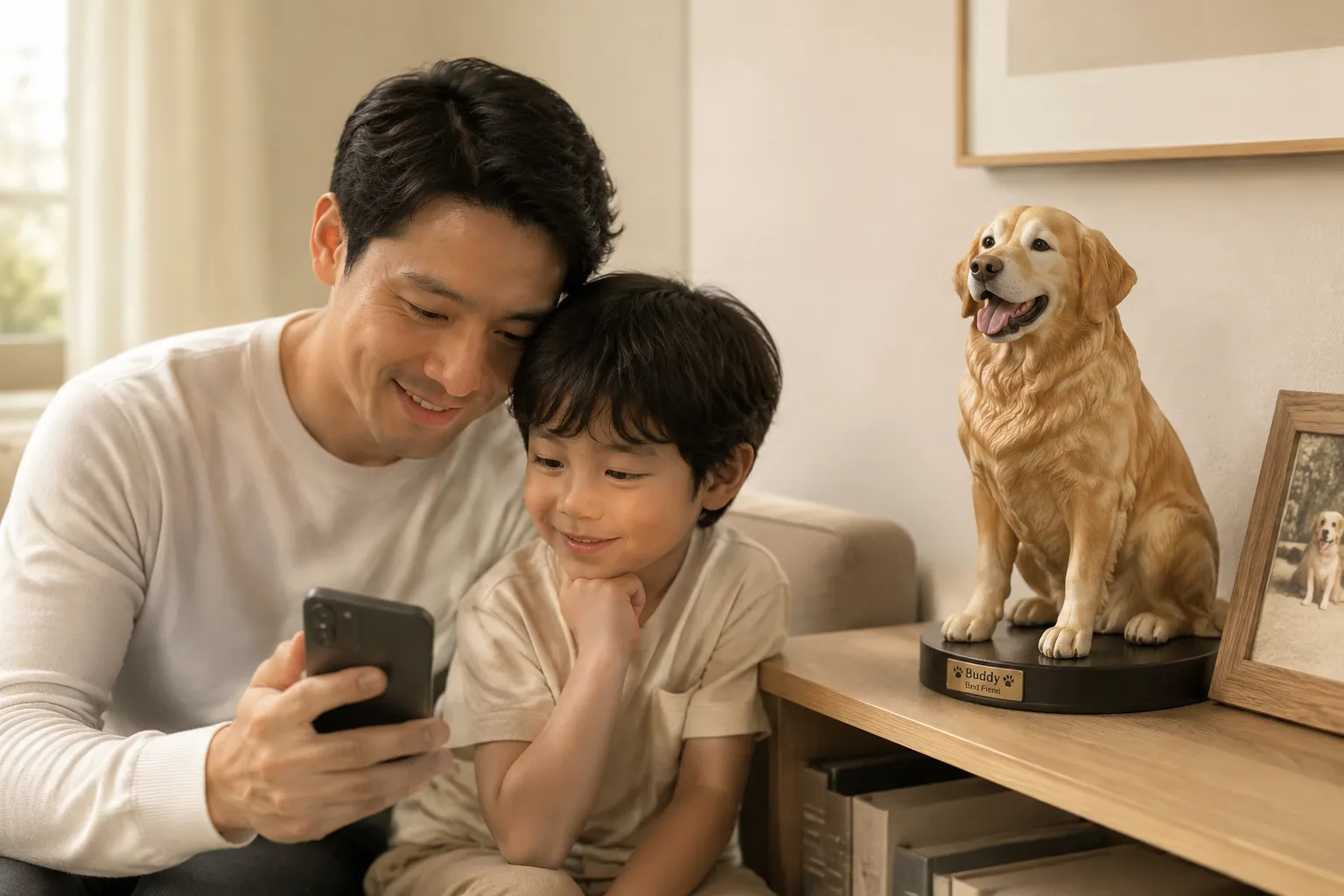
How do you explain pet loss to kids when the morning light still spills across that empty corner of the bedroom where your golden retriever used to sleep? Your six-year-old asks where he went. You open your mouth. Nothing comes.
Quick Takeaways
- Use plain, concrete words like "died" and "stopped working" — vague phrases confuse young kids more than they comfort them.
- Take one good phone photo before the goodbye — it becomes the anchor for every conversation that follows.
- Build a small daily ritual in the first week — repetition gives children's grief somewhere safe to land.
- Let kids help create a lasting tribute — many families turn a favorite photo into a custom pet figurine the child can actually hold.
- Expect grief to resurface for months — kids grieve in bursts, not straight lines, and that's normal.
Start With the Truth, Even When It Feels Too Heavy to Hand Them
Here's the thing nobody tells you in those first raw hours. The instinct to soften the blow is the very thing that makes it harder for kids.
You want to say he "went to sleep." You want to say he "ran off to a farm." You want to say "we lost him," because the real word feels like a brick in your throat.
But young children are concrete thinkers. A three-year-old who hears "went to sleep" may suddenly refuse to go to bed. A five-year-old who hears "we lost Buddy" might wonder, with genuine logic, why you aren't out looking for him.
Use the real words. "Buddy died. His body stopped working, and it can't be fixed. He won't be coming back, and that's why we're so sad."
We've talked with a lot of families over the years, and the ones who used direct language early almost always told us the same thing later: it was the hardest sentence they ever said, and also the one that saved them weeks of confusion.
"Children don't need the truth made smaller. They need it made safe."
So what does "safe" look like? It looks like the truth, delivered while you're holding them, in a calm voice, with permission to ask anything. The American Society for the Prevention of Cruelty to Animals offers thoughtful guidance on age-appropriate honesty through their pet loss resources, and the throughline is consistent: clarity protects kids, euphemism quietly destabilizes them.
Match Your Words to Their Age
A toddler and a ten-year-old are not grieving the same loss, and they can't hold the same explanation.
| Age | What They Understand | What to Say |
|---|---|---|
| 2–4 years | Death as temporary, reversible | "His body stopped. He can't eat, walk, or feel anymore." Repeat as they ask. |
| 5–7 years | Death is real but may feel "their fault" | Be clear it's permanent. Stress that nothing they did caused it. |
| 8–11 years | Death is permanent and universal | Invite questions about how and why. Welcome the hard ones. |
| 12+ years | Adult-level understanding | Treat them as a co-griever. Let them help with decisions. |
The micro-story we hear most often: a parent gives a careful, gentle explanation, and the four-year-old nods, wanders off to play, then asks twenty minutes later when the dog is coming home for dinner. That's not a failure of your explanation. That's a developing brain processing permanence in the only way it can — in loops.
You'll repeat yourself. Many times. Repetition isn't you doing it wrong. It's the work itself.
The Phone Photo: Why One Image Does the Heavy Lifting
Most grief advice for parents skips right past the single most useful tool you already have in your pocket. Your phone.
Before the goodbye — or in the hours right after, if you can bear it — take one deliberate photo. Not a frantic camera-roll dump. One good frame.
Here's why this matters more than people realize. Young kids anchor memory to images far more than to narrative. A child can't always reconstruct the story of a beloved golden retriever, but show them a photo of those amber eyes catching the late afternoon light, and the whole dog comes flooding back.
The photo becomes the conversation's anchor. When your kid asks about him in three weeks (and they will, usually at bedtime, usually when you're depleted), you don't have to summon words from nothing. You pull up the picture. You point. "Look at his big goofy grin. Remember how his fur went all golden when the sun hit it?"
"A photo gives small grief a place to point. And pointing is how children begin to understand loss."
What Makes a Good Anchor Photo
We work with full-color 3D printing every day, so we've developed strong opinions about which photos actually capture a dog's spirit — and which ones flatten it. The same rules that make a great keepsake photo make a great memory anchor for your child.
- Natural light, no flash. Window light or golden-hour sun reveals the true depth of a golden's coat — the cream at the chest, the deeper russet along the ears. Flash washes all of that out.
- Eye level, not looming over. Crouch down. A photo taken at your dog's eye level reads as connection. A photo shot from above reads as a pet looking up at a giant.
- Catch the eyes in focus. If the eyes are sharp, the soul is in the frame. Everything else can be a little soft.
- Include something for scale and story. The worn tennis ball. The favorite spot on the rug. The corner of the bed. Context turns a portrait into a memory.
Honestly, the best anchor photos are rarely the posed ones. They're the candids — head tilted at a sound only he could hear, tongue out after a sprint across the yard, that specific way goldens flop onto their backs and ask the whole world for a belly rub.
If you have older video clips, screenshot a frame or two. A still pulled from a video of him bounding through autumn leaves often carries more life than any portrait you ever staged.
The First Week: A Ritual Framework That Actually Holds
The pet loss first week is its own distinct terrain. The shock is wearing off just enough to let the ache through, and your kids are watching you to learn how grief is supposed to look.
Most advice here is uselessly vague. "Give them space." "Be there for them." Okay, but how, exactly, at 7 a.m. on a Tuesday when you have to get everyone out the door and your daughter is crying into her cereal?
You need structure. Children in crisis don't crave freedom — they crave predictability. So you build a small ritual, and you repeat it. The repetition is the medicine.
Here's a day-by-day framework families have told us actually helped, adapted to your own rhythm:
| Day | Ritual | Why It Works |
|---|---|---|
| Day 1 | Light a candle at dinner, say his name out loud | Names the loss, makes grief a shared family act |
| Day 2 | Each person shares one favorite memory | Shifts focus from absence to the life that was lived |
| Day 3 | Kids draw or "write a letter" to the dog | Gives nonverbal feelings a physical outlet |
| Day 4 | Walk his old route together (leash optional) | Reclaims a painful trigger as a gentle tribute |
| Day 5 | Create a small memory corner with the photo | Builds a permanent, comforting place to "visit" |
| Day 6 | Look at photos and videos together | Normalizes laughing and crying in the same breath |
| Day 7 | Plan a longer-term tribute as a family | Channels grief forward, gives kids agency |
You don't have to do all seven. Pick three. Repeat the ones that land. The structure matters more than the specifics.
Why the Candle on Day One Matters So Much
A micro-story from a family we worked with: the dad felt silly lighting a tea light at the dinner table the night after their golden passed. He almost skipped it. But his eight-year-old, who'd been stone silent all day, finally spoke. "Can I say goodnight to Maple now?" The candle gave the child permission that words hadn't.
A ritual tells a child: your feelings belong here, at this table, with this family. That permission is everything in week one.
"We've seen families heal by giving grief a shape they can hold. A photo, a candle, a small figure on the shelf — children need their love to have somewhere to go."
— The PawSculpt Team
The Feelings Kids Won't Name (And Neither Will You)
This is the section other articles won't write, and it's the one that matters most.
Your child may feel things they have no words for, and some of those feelings will scare you because you recognize them in yourself.
Let's talk about guilt. Many kids quietly believe they caused the death. The day before he died, your son got frustrated and yelled "I wish you'd go away" at the dog who chewed his homework. Then the dog died. In a child's magical-thinking brain, those two events are now welded together.
This is more common than most parents ever realize, because kids almost never say it out loud. They just carry it. Watch for the child who suddenly becomes "too good," overly anxious, or asks oddly specific questions about whether the dog was "mad" at them.
Say it before they have to: "Nothing you said or did or thought made Buddy die. His body got sick, and that is the only reason. It was never, ever your fault." Say it even if they haven't asked. Especially if they haven't asked.
When the Loss Was a Decision: Second-Guessing the Goodbye
If your golden was euthanized, you're carrying a particular weight — and so might your older kids.
That relief you felt when his suffering finally ended? The breath you let out in the vet's parking lot? It doesn't make you cold. It makes you someone who loved him enough to put his comfort above your own desperate wish to keep him one more day. The guilt that chases that relief is one of grief's cruelest tricks, and it lands on parents and perceptive older children alike.
If your twelve-year-old asks, "Did we do it too soon? Could we have waited?" — don't rush to reassure. Sit in it with them. "I've wondered that too. Here's how we decided." Honoring the question honors the dog. The Association for Pet Loss and Bereavement maintains compassionate grief support resources for exactly these moments, including the ones where the decision itself is the source of the pain.
"Relief and grief can share the same breath. Loving someone enough to let them go is not the same as wanting them gone."
The Association for Pet Loss and Bereavement is also a good place to gently point an older child who's processing the hardest questions — sometimes hearing that other families felt the same thing matters more than anything a parent can say.
The Anger Nobody Warns You About
Kids get angry. At the vet. At you. At the dog for leaving. At the universe.
A normally sweet seven-year-old might slam a door and scream that she hates everyone. That anger is grief wearing a different mask. Don't shut it down. Name it. "You're so mad that Buddy's gone. I'm mad too. It's not fair." Anger that gets named tends to soften. Anger that gets punished goes underground and stays there.
What We Wish We Knew Sooner
A candid sidebar from our team — the things we learned the hard way, from our own pets and from thousands of conversations with grieving families.
- We wish we'd taken more boring photos. Not the milestone shots. The ordinary Tuesday-afternoon ones. The dog asleep on the kitchen floor. Those are the images that bring kids the most comfort, and they're exactly the ones people forget to take.
- We wish we'd known kids grieve in bursts. They'll sob, then ask for ice cream four minutes later, then play normally for two days, then fall apart at a random commercial. This isn't them "being over it" or "not caring." It's how young nervous systems metabolize loss.
- We wish we'd let them see us cry sooner. A parent who hides all grief teaches a child that grief is shameful. A parent who cries openly — and recovers — teaches a child that feelings are survivable.
- We wish we hadn't rushed to replace anything. Clearing the bowls and beds within 24 hours, getting a new puppy within weeks. Sometimes it helps. Often, for kids especially, it short-circuits a grief they needed to finish.
- We wish we'd made something tangible. A drawing, a photo book, a small figure. Children process the abstract by holding the concrete. We'll come back to this.
Turning Grief Into Something You Can Hold
Around day six or seven, when the rawest edge has dulled slightly, kids often start asking a new kind of question. Not "where did he go" but "how will I remember him?" That shift is your cue.
Children grieve best when grief has a destination. A project. Something to make and keep. This is where you channel all that swirling feeling into a family grief ritual that produces something lasting.
Tangible Tribute Options, Ranked by What They Actually Do for Kids
Not every memorial works for a child. A donation to a shelter is beautiful and meaningful — but a six-year-old can't hold it, can't visit it, can't talk to it at bedtime. Here's how common options actually serve children specifically.
| Tribute | Effort | What It Gives a Child |
|---|---|---|
| Memory box | Low | A physical place to keep the collar, tags, a tuft of fur |
| Photo book | Medium | A story they can revisit and narrate themselves |
| Memorial garden / planted tree | Medium | A living thing to tend, tied to the seasons |
| Framed paw print | Low | A tactile, "this was really him" connection |
| Custom figurine | Medium | A holdable, 3D presence they can keep on the shelf |
That last one surprised us, honestly, when we first started hearing from parents about it. We expected adults to be our primary customers. Instead, we kept hearing about kids — kids who slept with the figurine, kids who carried it to school in a backpack, kids who finally stopped asking "where is he" because, in a small but real way, he was right there.
Why a Figurine Lands Differently for Children
Children relate to objects with a fierceness adults forget. The worn-soft stuffed animal. The specific blanket. Object permanence in a child's world isn't just a developmental stage — it's emotional architecture.
A two-dimensional photo is precious, but it stays behind glass. A figure they can pick up, turn over, set on the nightstand, and talk to occupies a different psychological space entirely. It moves the dog from "gone" to "still here, just different."
At PawSculpt, every piece is digitally sculpted by master 3D artists and then precision 3D printed in full color resin, which means a golden retriever's specific coat — the cream feathering on the legs, the deeper gold across the back, that exact russet on the ears — gets reproduced directly in the material itself. The color isn't a coating that can chip. It's printed voxel by voxel, part of the resin, then sealed with a protective clear coat for sheen and durability.
For a child, the realism matters in a way that's hard to overstate. When the markings are right — when it's unmistakably their dog and not a generic golden — the figure earns its place as a true keepsake rather than a toy. If you want to see how the full-color 3D printing process translates a single photo into something dimensional, the details are worth exploring when you're ready, not a moment before.
There's no rush. Some families order in the first week as part of the ritual. Many wait months, until they can look at photos without the wave. Both are right. Grief doesn't run on a deadline.
"A figure on a child's shelf says what they can't yet: he was real, he was mine, and I get to keep him."
A Quick Note on Choosing the Photo for a Keepsake
If you do decide to commission something dimensional — whether from us or anywhere — the photo guidance from earlier applies double. Sharp eyes, natural light, eye-level angle, and an expression that's authentically him. A clear, well-lit photo is the single biggest factor in a keepsake that makes a child gasp with recognition rather than shrug.
And let your kid help choose the photo. The act of selecting "the one" is itself part of the grieving — and the healing.
When Grief Resurfaces: The Months After Week One
Here's what blindsides most families. You get through the brutal first week. Things stabilize. And then, six weeks later, your kid melts down at a dog food commercial, or sobs at the school drop-off line for no visible reason.
This is normal. Children's grief is non-linear in a way that's almost dizzying for adults. A loss they seemed to "handle" resurfaces at developmental milestones, anniversaries, or random sensory triggers — the smell of wet fur, the jingle of another dog's tags.
Watch especially for these moments:
- The first time the season changes. The first snow without him. The first summer without the backyard sprints.
- The anniversary of the loss. Mark it gently, on your terms.
- When a new pet enters the home. Even a joyful addition can crack open old grief. The new puppy is wonderful and also not him.
- Big transitions. Starting school, moving houses. Grief piggybacks on other changes.
When it resurfaces, you don't start over. You return to the anchor. The photo. The ritual. The figure on the shelf. "I miss him too. Want to look at his pictures?" The tools you built in week one become the tools you use for years.
A Word on the Surviving Pet
If you have another dog or cat, they're grieving too — and your kids will notice. The remaining pet may search the house, eat less, sleep more, or vocalize at night. According to the American Kennel Club, dogs absolutely register the absence of a companion and can show real behavioral changes.
This is actually a gift for your child's grief. It gives them someone to comfort. "Daisy misses Buddy too. Let's give her some extra cuddles." Caregiving redirects a child's helplessness into purpose, and that's powerful medicine for a small grieving heart.
What Not to Do (The Well-Meaning Mistakes)
We'll be real about the missteps we see most, because avoiding them is half the battle.
- Don't say "he's in a better place" if it confuses your family's beliefs. Mixed metaphysical messages destabilize concrete thinkers. Keep it simple and consistent with what you actually believe.
- Don't hide the body conversation entirely. Kids handle "we buried him in the yard" or "his body was cremated" far better than a vague disappearance. Age-appropriate honesty, again.
- Don't force participation in rituals. Offer. Don't require. A child who refuses the candle tonight may light it tomorrow.
- Don't rush the replacement. A new pet is not a patch. When the time is right, the new pet deserves to be loved as themselves, not as a stand-in.
- Don't perform being "fine." Your authentic, regulated grief is the single best model your child will ever have.
The mistake most parents make is treating grief as a problem to fix fast, when it's really a process to move through together. The goal isn't to make the sadness disappear. It's to make sure your child never feels alone inside it.
Frequently Asked Questions
How do I explain pet loss to a young child?
Use direct, honest language. Say "died" and "his body stopped working and can't be fixed," rather than "went to sleep" or "we lost him," which confuse concrete-thinking children. Deliver it calmly, while holding them, and expect to repeat it several times as their developing brain processes permanence in loops.
Should I let my child see our pet's body to say goodbye?
For many children, a calm goodbye helps make the loss real and supports closure — but it depends on the child and the circumstances. Prepare them for what they'll see and how it will feel, follow their comfort level, and never force it. A photo taken beforehand can serve as a gentler anchor if seeing the body isn't right for your family.
Is it normal for my child to seem fine, then fall apart weeks later?
Completely normal. Children grieve in bursts rather than a steady line. A loss they seemed to handle often resurfaces at season changes, the anniversary, the arrival of a new pet, or a random sensory trigger like the jingle of dog tags. It's not a setback — it's how young nervous systems metabolize loss over time.
What's a good grief ritual for the first week?
Keep it small and repeatable. Light a candle at dinner and say your pet's name, take turns sharing one favorite memory, let kids draw or write a letter to the pet, and set up a memory corner with a favorite photo. The predictability of a daily ritual gives children's grief a safe place to land when words fail them.
How can I help my child hold onto the memory of our golden retriever?
Start with one clear, well-lit anchor photo — natural light, eye level, sharp eyes. From there, make a memory book your child can narrate, frame a paw print, or create a tangible keepsake like a custom figurine. Children connect deeply to objects they can physically hold, which moves the pet from "gone" to "still here, just different."
Should we get a new pet right away to help the kids cope?
Usually not immediately. A new pet isn't a replacement, and bringing one home too soon can short-circuit grief that kids genuinely need to move through. When the time feels right — and the whole family can welcome a new companion as their own self rather than a stand-in — that's the moment to consider it.
Ready to Celebrate Your Pet?
Every golden retriever leaves a golden-shaped space behind. When you're ready — not a day before — explaining pet loss to kids gets a little gentler when there's something real for small hands to hold. A custom PawSculpt figurine captures your dog's exact markings, that specific tilt of the head, the warmth in those amber eyes, turning a single photo into a keepsake your child can keep on the shelf for years.
Visit pawsculpt.com to explore our full-color 3D printing process, preview options, revisions, and quality guarantee.