The Boxer's Underbite: Why 'Perfect' Art Fails and 'Flawed' 3D Prints Succeed (A Guide to Realism)
"There is no excellent beauty that hath not some strangeness in the proportion." — Francis Bacon
The salt spray hits your face as you watch him run down the shoreline, sand flying, that characteristic underbite grinning against the wind—one of those distinct boxer dog features that makes him, him. It’s not the "perfect" show-dog posture that tugs at your heart; it’s the snaggletooth, the asymmetrical jowls, and the way his lip gets stuck on his gum when he’s excited.
Quick Takeaways
- Perfection is the enemy of realism — generic statues fail because they smooth out the "flaws" that define your specific pet.
- Digital sculpting captures anatomy — unlike clay, digital tools allow us to model the exact geometry of a Boxer’s underbite before a single layer is printed.
- Color is printed, not painted — we use full-color resin technology to embed pigment directly into the material, avoiding the loss of texture caused by paint layers.
- Preserve the gray — authentic custom figurines celebrate the aging process, capturing the dignity of a graying muzzle rather than hiding it.
The Uncanny Valley of "Perfect" Pet Art
We have a saying on the shop floor: "If it looks too perfect, it looks fake."
In our years of additive manufacturing, we’ve noticed a pattern among pet owners. You send us photos, but you don't just send the glamour shots. You send the close-ups of the scars, the cloudy eye, and the crooked tail. Why? Because the "perfect" version of a Boxer—the one you see in textbooks or generic garden statues—feels hollow. It lacks the history of your shared life.
When we look at traditional manufacturing or mass-produced figurines, we see idealization. The snout is perfectly straight. The ears are symmetrical. The coat is a uniform shade of fawn or brindle. But biology is rarely symmetrical.
Realism lives in the asymmetry. It lives in the "imperfections."
"True realism isn't about copying a breed standard. It's about capturing the specific history written on your dog's face."
When we utilize full-color 3D printing, we aren't trying to fix your dog. We are trying to translate the organic chaos of biology into a physical object. The technology we use—jetting millions of droplets of photopolymer resin that cure instantly under UV light—allows us to capture "flaws" that a human hand with a paintbrush would instinctively try to smooth over.
The Engineering of the Underbite: A Case Study in Geometry
Let’s get technical for a moment. As engineers and modelers, the Boxer presents a fascinating challenge in digital topology.
The Boxer head is brachycephalic (short-nosed). This creates a complex interplay of skin folds, bone structure, and dental alignment. In a traditional casting process (like bronze or porcelain), the artist often has to thicken delicate areas (like the lips or ears) to prevent breakage during the mold-making process.
In additive manufacturing (3D printing), we have different constraints, but also massive freedoms.
The Mandibular Prognathism (The Underbite)
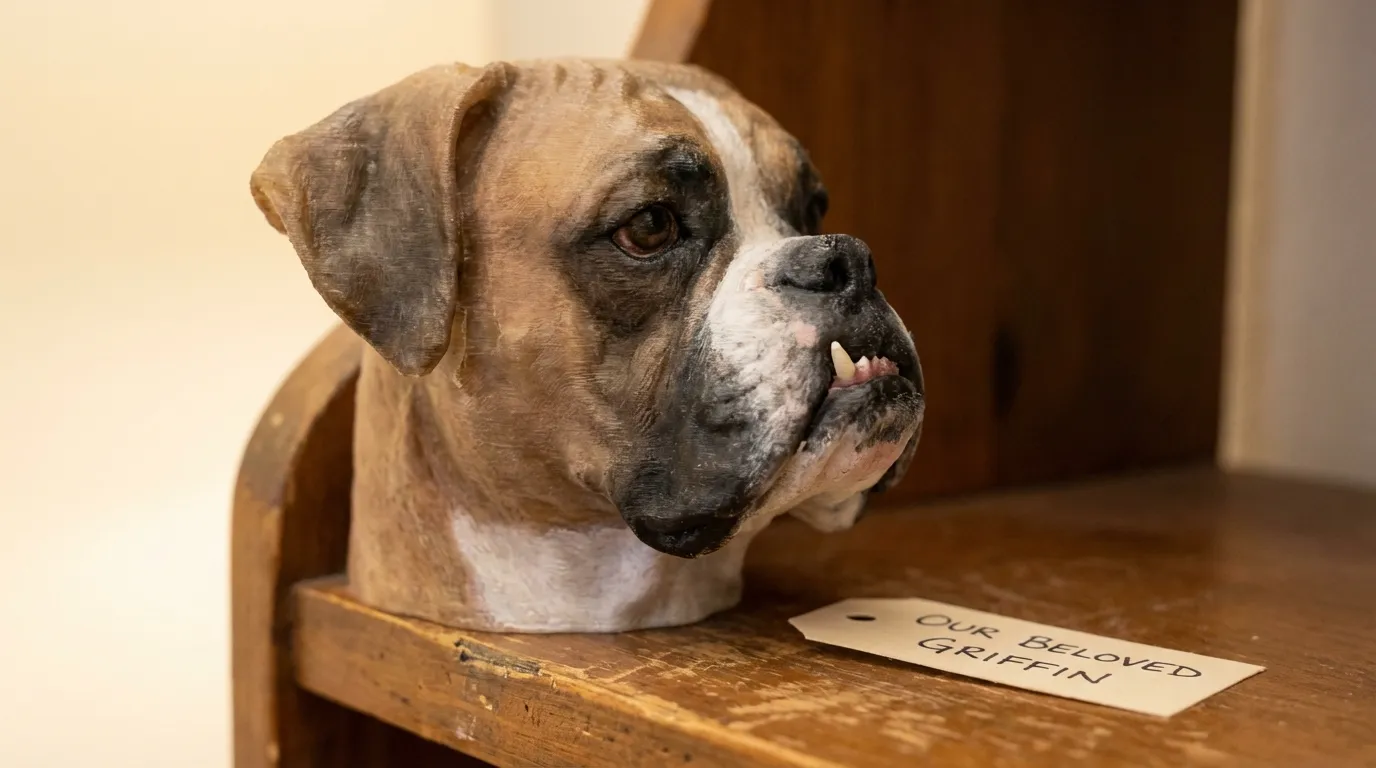
The hallmark of the Boxer is the underbite. Digitally, this isn't just "sticking the jaw out." It involves: 1. The Curve: The lower jaw often curves upward, creating that famous chin. 2. The Lip Tuck: The upper lips (flews) hang down but are pushed outward by the lower canines. 3. The Wetness: The gum line is constantly exposed to air and saliva.If you were to hand-paint a figurine, simulating the transition from dry fur to wet gum is incredibly difficult. Paint sits on top of the surface. It adds thickness. If you paint a small detail like a tooth, you lose the sharp definition of the gum line because the paint bridges the gap.
With full-color resin printing, we don't have that problem. We define the color voxel by voxel (a voxel is a 3D pixel). We can tell the printer: "This specific point in space is pink, shiny, and translucent (gum)," and "The point right next to it is black, matte, and opaque (lip)."
There is no layer of paint to obscure the detail. The color is intrinsic to the material. This allows us to capture that slight, wet sheen of the Boxer's exposed gums without it looking like a cartoon.
Why "Hand-Painted" Often Means "Detail Lost"
There is a romantic notion that "hand-painted" is always superior. In the world of high-fidelity miniatures, hand-painting is an incredible art form. But for photorealistic pet replicas, it has significant limitations that we, as engineers, try to solve with technology.
When an artist paints a model, they are applying a fluid that has surface tension.
- The Smoothing Effect: Paint tends to settle into the deepest cracks (crevices) and pull away from sharp edges. This can accidentally smooth out fine textures like the grain of a dog's nose or the direction of short fur.
- The Interpretation Bias: A painter interprets the color. They mix a "brindle" color and apply it. But brindle isn't one color; it's a complex layering of black hairs over a fawn base.
The 3D Printing Advantage
Our process utilizes PolyJet/MJF style technology. Think of it like a standard 2D inkjet printer, but instead of ink on paper, it jets liquid resin that hardens. It does this layer by layer, often in the 25–50 micron range (thinner than a human hair).- Fur Patterns: We can replicate the "salt and pepper" look of a graying muzzle by printing individual voxels of white amidst the black. We don't have to dry-brush it on.
- Subsurface Scattering: We can use semi-translucent resins for the ears or eyes. This mimics how light passes through thin skin, giving the figurine a fleshy, living look rather than a flat plastic appearance.
- No Brushstrokes: There are no brush marks to distract the eye. The texture you feel is the texture of the digital sculpt.
Embracing the "Bloom": Troubleshooting Resin Aesthetics
We want to be transparent about the realities of working with resin. While we avoid the pitfalls of painting, 3D printing has its own physics to manage.
One phenomenon we deal with is "bloom" or "matte patches." Sometimes, depending on how the support structures (the scaffolding that holds the print up while it's being made) are attached, the surface finish can vary.
We mitigate this through:
- Orientation Logic: We orient the model in the digital slicer software so that support structures touch the least visible areas (usually the belly or bottom of the paws).
- Clear Coat Application: This is the only manual step in our coloring process. We apply a UV-protective clear coat. This unifies the surface finish, making the eyes look wet and the nose look moist, while protecting the resin from yellowing over time.
"We've seen families heal by holding something tangible. Grief needs an anchor, and that anchor needs to feel real."
— The PawSculpt Team
The Workflow: From Your Phone to Physical Form
We often get asked, "How do you turn a 2D photo into a 3D object?" It’s a mix of artistic intuition and engineering precision. Here is the actual workflow we use at PawSculpt:
1. Digital Sculpting (The Art)
We don't scan your photos. A human artist uses software like ZBrush to "sculpt" with digital clay.- Anatomy First: We build the skeleton and muscle structure first. If the underlying anatomy is wrong, the surface will look "wobbly."
- The "Turnaround": We look at your photos to establish the unique silhouette. Does your Boxer have a deep chest? A high tuck? Cropped or natural ears?
2. Texture Mapping (The Skin)
Once the shape is approved, we project the colors from your photos onto the 3D model. We fix lighting shadows and glare digitally. This is where we paint—but we paint with pixels, not brushes.3. Slicing and Printing (The Engineering)
The file is sent to our industrial printers.- Layer Height: We typically slice at very fine intervals.
- Support Generation: We generate the scaffolding.
- Printing: The machine runs for hours, depositing resin and curing it with UV light instantly.
4. Post-Processing (The Finish)
- Support Removal: The scaffolding is dissolved or carefully clipped away.
- Cleaning: The model is washed in specialized solvents to remove uncured resin.
- Curing: A final blast of UV light creates the final material hardness.
- Clear Coat: The protective varnish is applied.
Visualizing the Difference: Generic vs. Custom
| Feature | Generic "Store Bought" Statue | Custom 3D Printed Figurine |
|---|---|---|
| The Underbite | Usually closed mouth or generic smile | Modeled to specific tooth alignment & lip tuck |
| The Eyes | Solid black or painted on | Printed with depth, color variation, and "wet" look |
| The Coat | Single color wash (e.g., "Brown") | Complex gradients, brindle patterns, white flashes |
| Scarring | None (perfect skin) | Can include scars, nicks in ears, or lumps |
| Posture | Standard "Show Stack" | Your pet's specific sit (e.g., the "lazy sit") |
A Note on Durability (Managing Expectations)
As engineers, we have to talk about material properties.
Full-color 3D printed resin is a composite photopolymer. It is heavy, solid, and feels substantial in the hand—much like ceramic or stone. However, it has different failure modes than plastic toys.
- Brittleness: Resin is harder than standard plastic, which means it holds detail better, but it is also more brittle. If you drop it on a tile floor, it can shatter like porcelain. It is a display piece, not a toy.
- UV Sensitivity: While we use UV-resistant clear coats, all photopolymers can shift color if left in direct, baking sunlight for years. We recommend displaying them indoors, away from direct window sills, to preserve that vibrant brindle color for decades.
Why We Do This: The Community Connection
We have been in this industry long enough to know that we aren't just manufacturing objects; we are manufacturing memories.
We remember a specific order for a Boxer named Duke. Duke had a large, benign fatty lump on his flank. The owner hesitated to mention it, asking if we could "Photoshop it out." We told her what we tell everyone: We can remove it, but are you sure you want to?
She decided to keep it. When she received the figurine, she wrote to us saying that her thumb automatically went to that spot on the figurine, just like it used to when she petted him. That tactile memory—the "flaw"—was the connection point.
You are not alone in wanting to remember the reality of your pet, not the idealized version. The gray hairs mean they lived a long life. The scars mean they played hard. The underbite means they smiled at you.
"Grief isn't a problem to be solved. It's a love story that continues after the last chapter."
Frequently Asked Questions
Why do you use 3D printing instead of hand-painting?
We use full-color 3D printing because it allows for higher fidelity in texture. Paint adds thickness that fills in fine details. By printing the color directly into the material (voxel-level color), we can maintain the texture of nose leather, fur grain, and dental details without masking them.Can you capture my Boxer's specific underbite?
Absolutely. This is the primary advantage of digital sculpting. Unlike a mold that produces the same dog every time, our artists build your dog's jaw structure on the computer first. We can adjust the degree of the underbite, the specific teeth that show, and the asymmetry of the jowls to match your photos exactly.Is the figurine fragile?
It is best to think of these as fine art collectibles, similar to porcelain or ceramic figures. The resin is solid and heavy, giving it a premium feel, but it is brittle. If dropped on a hardwood or tile floor, ears or tails can snap. They are designed for display, not play.How many photos do I need to send?
The more, the better, but quality matters more than quantity. We typically need: 1. Front face (eye level) 2. Side profiles (left and right head) 3. Full body (left and right side) 4. Rear view (tail and markings) 5. Top down (back markings) Lighting is key—try to avoid harsh shadows or flash photography that washes out white markings.Ready to Celebrate Your Pet?
Every pet has a story worth preserving. Whether you're honoring a beloved companion who's crossed the rainbow bridge or celebrating your furry friend's unique personality, a custom PawSculpt figurine captures those details that make your pet one-of-a-kind.
Free instant AI preview • 3D artist preview within 7 days • 5 free revisions