
6 Ways to Display a Sphynx Cat Figurine in a Modern Home (Without Being Creepy)
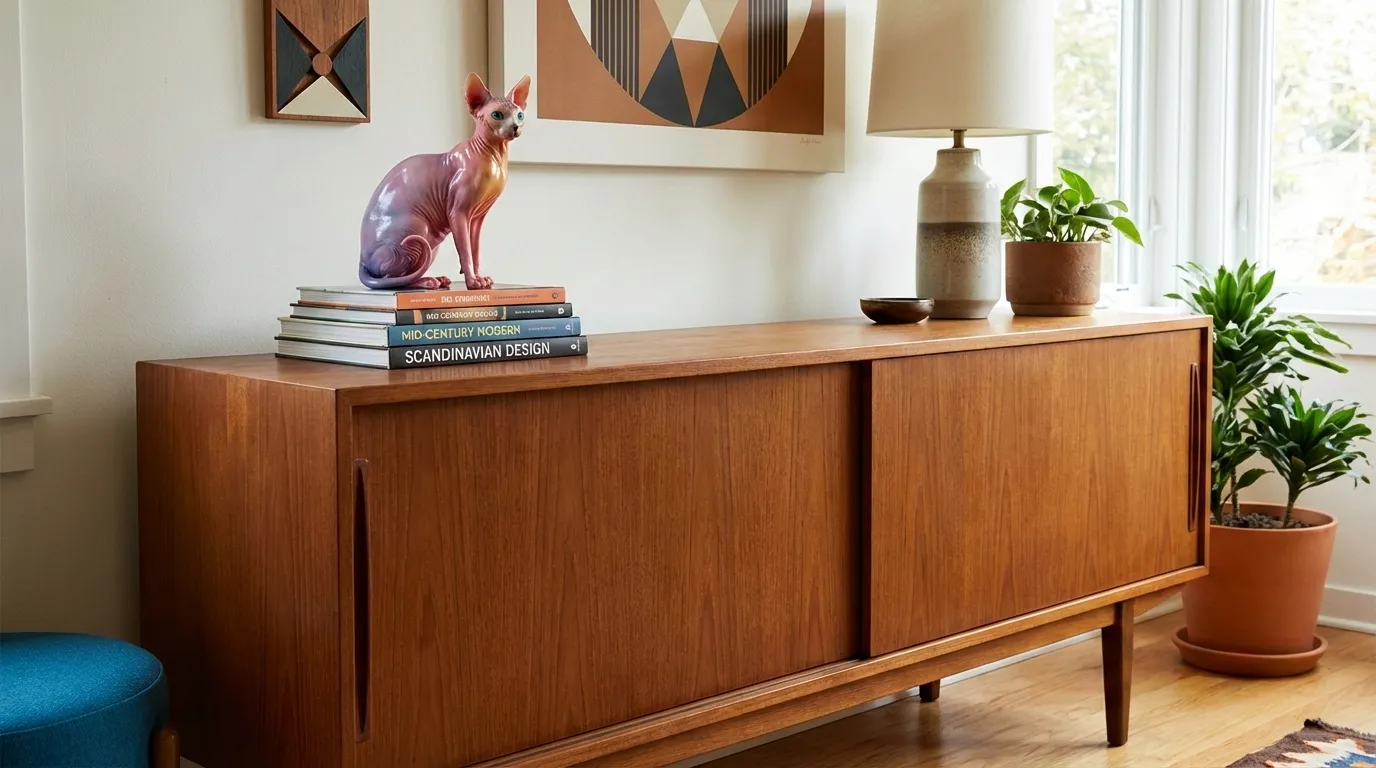
Does the shadow of those oversized ears on your hallway wall sometimes startle you, looking more like a gargoyle than a house cat?
Quick Takeaways
- Scale matters — Avoid the "uncanny valley" by choosing 1:4 or 1:6 scale rather than life-size replicas.
- Lighting is key — Use diffused, warm lighting to mimic the "subsurface scattering" effect of real skin.
- Contrast materials — Pair the smooth resin of custom figurines with rough concrete or soft velvet to engage the brain's tactile processing.
- Embrace geometry — Sphynx cats are naturally angular; align them with mid-century modern lines for visual harmony.
Let’s be honest about the biology of it. The Sphynx is a polarizing animal. To the uninitiated, they are alien, startling, and—yes—sometimes a little creepy. To those of us who love them, they are architectural marvels of warmth and personality. But displaying a figurine of a hairless animal presents a unique interior design challenge that doesn't exist with a fluffy Golden Retriever.
When you display a statue of a furry dog, the brain registers "texture" and "softness" immediately. The fur breaks up the light. But a Sphynx? That is pure geometry and skin.
As someone who has spent over a decade in additive manufacturing, specifically working with high-fidelity full-color 3D printing, I view the Sphynx not just as a pet, but as a complex surface topology problem. The wrinkles, the musculature, the visible vein structure—capturing this requires a different engineering approach than printing fur. And displaying it requires a different psychological approach to avoid triggering the "uncanny valley" response in your guests.
Here is the science—both manufacturing and psychological—behind displaying these unique creatures in a modern home.
1. The "Uncanny Valley" and the Science of Scale
The "Uncanny Valley" is a concept in aesthetics and robotics which suggests that humanoid objects which appear almost, but not exactly, like real human beings elicit feelings of eeriness and revulsion. While usually applied to robots, this psychological phenomenon applies to hairless pets too. Because a Sphynx has skin that closely resembles human skin in tone and texture, a life-sized, motionless replica can inadvertently trigger a biological "corpse" warning in the human brain.
To circumvent this cognitive dissonance, we manipulate scale.
The 1:6 Ratio Rule
In the world of high-end collectibles, scale is everything. For a Sphynx figurine, I almost always recommend stepping away from 1:1 (life-size). By reducing the scale to 1:4 or 1:6 (roughly 4-6 inches tall), you force the brain to categorize the object as "art" or "icon" rather than "potential biological anomaly."At a smaller scale, the wrinkles and prominent eyes becomes stylized features rather than biological starkness. It allows the viewer to appreciate the form of the cat—the triangular head, the bat-like ears, the pot-bellied elegance—without the brain expecting the chest to heave with breath.
"Art isn't about replicating reality until it hurts. It's about capturing the truth of the subject in a way the mind can accept."
2. Lighting and "Subsurface Scattering"
This is where my background in engineering comes into play. Real skin (and the skin of a Sphynx) has a property called subsurface scattering. When light hits skin, it doesn't just bounce off the surface; it penetrates the upper layers, scatters around, and exits at a different point. This is what gives living things their "glow."
Standard opaque plastic figurines look dead because they reflect light directly. However, the full-color resin we use at PawSculpt acts differently. Because the color is embedded into the voxel (the 3D pixel) of the resin during the printing process, rather than painted on top, the material has a depth that mimics organic matter.
The Lighting Setup
To display a Sphynx figurine effectively, you must avoid harsh, direct overhead lighting. Direct down-lighting washes out the subtle ridges of the 3D print and flattens the musculature.Instead, aim for raking light.
- What it is: Light that hits the object from a side angle (usually 30–45 degrees).
- Why it works: It creates micro-shadows in the digitally sculpted wrinkles and muscle definitions. It highlights the texture that our digital artists spend hours modeling.
Lighting Temperature Guide for Skin Tones:
| Sphynx Coloration | Recommended Light Temp | Why? |
|---|---|---|
| Pink / Flesh Tone | 2700K - 3000K (Warm White) | Enhances the natural warmth; prevents the "medical specimen" look. |
| Blue / Grey | 4000K (Neutral White) | Preserves the slate tones without making them look muddy or brown. |
| Black / Dark | 3000K - 3500K (Soft White) | Needs slightly brighter intensity to define the silhouette against shadows. |
| Calico / Patterned | 3500K (Balanced) | Ensures the full-color print pattern remains color-accurate. |
3. Material Contrast: Hard Resin vs. Soft Surroundings
In cognitive science, we talk about sensory processing. A Sphynx is visually "soft" (skin) but a 3D printed figurine is physically hard (cured resin). This creates a tactile mismatch. To ground the figurine in a modern home, you need to surround it with materials that explain this contrast to the brain.
The Concrete & Velvet Approach
Place your figurine on a material that is distinctly inorganic. Polished concrete, matte steel, or dark walnut wood works exceptionally well. The harshness of the base highlights the organic curves of the cat.Alternatively, use the "nesting" technique. Placing the figurine on a small swatch of velvet or wool creates a "biophilic" response—it signals comfort and safety. Since Sphynx cats are heat-seeking missiles in real life, displaying them on a "warm" texture feels psychologically accurate to the viewer.
The Engineering Reality of the Surface:
It is important to understand that our process does not involve hand-painting. We use PolyJet-style technology where droplets of colored resin are jet-sprayed and instantly UV-cured. The result is a surface that is incredibly detailed but has a very fine, matte texture naturally. We apply a clear coat to protect it, which gives it a sheen similar to well-moisturized skin. This natural resin sheen looks fantastic against matte materials like unglazed ceramic or slate.
4. Architectural Alignment (The Bauhaus Cat)
Look at a Persian cat. It is a circle. A fluff ball.
Now look at a Sphynx. It is a series of triangles. Ears, face, chest—it is pure geometry.
This makes the Sphynx the perfect companion for Mid-Century Modern or Bauhaus decor. These design movements privilege function and geometric form.
The Shelf Placement Strategy
Don't just sit the figurine in the center of a shelf. Use the Rule of Thirds. 1. Divide your shelf length into three sections. 2. Place the figurine on the left or right third line. 3. Balance the negative space with a tall, rectangular object (like a book spine or a vase) on the opposing third.This asymmetry creates "visual tension," which keeps the eye moving. Because the Sphynx is so angular, aligning it with the sharp edges of books or modern art prints reinforces the sculpture as an intentional design choice, not just a sentimental keepsake.
"We often tell clients that a Sphynx isn't just a pet, it's living architecture. The figurine should be treated the same way—give it space to breathe."
— The PawSculpt Team
5. The "Cabinet of Curiosities" Aesthetic
If you want to lean into the unique, slightly eccentric nature of the Sphynx, embrace the Victorian "Cabinet of Curiosities" (Wunderkammer) vibe, but modernize it.
In the 19th century, collectors would display coral, skulls, and botanical specimens. A Sphynx fits this biological fascination perfectly.
The Glass Dome (Cloche) Method
Placing your custom figurine under a glass cloche (bell jar) does three things: 1. Elevates Value: It instantly signals "this is precious." 2. Dust Protection: From an engineering standpoint, dust is the enemy of high-fidelity 3D prints. Dust settles in the micro-crevices of the sculpted wrinkles, killing the contrast. A dome keeps the print pristine. 3. Scientific Framing: It frames the cat as a specimen of beauty.Pro-Tip: If you use a glass dome, ensure the base has a small hole for airflow or use a moisture-absorbing packet hidden underneath. While UV-cured resin is stable, trapped humidity in a sunlit dome can cause condensation that obscures the view.
6. Digital Sculpting: Capturing the "Grumble"
Why do generic store-bought statues of Sphynx cats look so wrong? usually, it's because they smooth them out. They treat them like Greyhounds.
But a Sphynx is defined by its looseness. The skin folds around the shoulders, the wrinkles on the forehead that give them that perpetual "grumpy old man" expression—these are the details that trigger emotional recognition.
The Photo-to-Mesh Workflow
When we create a custom figurine, our digital artists don't just trace a silhouette. They are looking for the "landmarks" of the anatomy.- The Zygomatic Arch: The cheekbones on a Sphynx are prominent.
- The Scapula: Without fur, the shoulder blades are visible and change position based on the pose.
- The Tail Whip: Sphynx tails are rat-like and expressive.
When you are submitting photos for a custom print, don't just send face shots. Send photos of the back and the neck. We need to see how the skin flows over the muscle. That "flow" is what makes the final 3D print look alive rather than like a plastic toy.
"True affection is knowing every wrinkle, every spot, every scar. A custom figurine is a map of that love."
The Engineering Behind the Art: Why We Don't Paint
I need to clear up a common misconception about high-end pet figurines. Many people assume "custom" means an artist sits there with a tiny brush painting spots on a white model.
That is the old way. That is the fragile way.
At PawSculpt, we utilize full-color additive manufacturing.
Imagine a standard inkjet printer that prints on paper. Now, imagine that printer head passes over the same spot thousands of times, depositing microscopic droplets of liquid resin that are instantly hardened by UV light. We are building the object and the color simultaneously, layer by microscopic layer (often in the 25–30 micron range).
Why this matters for a Sphynx owner:
- Gradient Control: A Sphynx's skin often has pink undertones that fade into grey or black spots. Hand-painting struggles to achieve that smooth, organic gradient without looking streaky. Digital printing achieves perfect, atomized gradients.
Durability: The color isn't a skin that can chip off. The color is* the object.
- Pattern Accuracy: If your cat has a specific cluster of freckles on its nose, we map that digitally onto the 3D model. The printer reproduces it exactly. There is no "interpretation" error from a painter's hand.
Frequently Asked Questions
Will the figurine break if it falls?
Our full-color resin is cured to be tough, but it shares properties with ceramic or stone. It is not a soft plastic toy. Thin extremities—which are common on Sphynx cats (ears, tails, long toes)—can be vulnerable to impact. We strongly recommend using a small dab of museum wax or putty on the base if you are displaying it on a high shelf.Can I put the figurine in direct sunlight?
We apply a high-grade UV-protective clear coat to every piece. However, in the world of photopolymers, UV light is the catalyst for curing, and excessive long-term exposure can eventually shift colors. It is best to display your keepsake out of direct, scorching window light. A bookshelf or hallway niche is ideal.How do I clean the dust off the wrinkles?
This is a great question specifically for Sphynx figurines. Because the digital sculpt includes deep wrinkle crevices, dust can accumulate there. Do not use water or solvents. Solvents can dull the clear coat. Simply use a soft, clean makeup brush or a blast of compressed air (from a distance) to dislodge dust from the textured areas.My Sphynx has peach fuzz. Can you print that?
We cannot print individual hairs that are microscopic—the technology is incredible, but not magic. However, we simulate the appearance of peach fuzz through digital texture mapping. By adding a subtle "noise" to the surface texture of the 3D model and using a matte finish, the light interacts with the surface in a way that suggests velvet softness rather than slick plastic.Ready to Celebrate Your Pet?
Every pet has a story worth preserving, but the unique geometry of a Sphynx deserves a medium that can capture every wrinkle and curve. Whether you're honoring a beloved companion who's crossed the rainbow bridge or celebrating your furry (or hairless) friend's unique personality, a custom PawSculpt figurine captures those details that make your pet one-of-a-kind.
Free instant AI preview • 3D artist preview within 7 days • 5 free revisions