
The 'Bridge' Concept: Using a Turtle Figurine to Explain Pet Loss to Children (A 3-Step Script)
The hallway used to be a percussion instrument, a rhythmic click-click-slide of claws on hardwood every time the refrigerator opened. Now, the floorboards are just smooth, cold timber, and the quiet has a physical weight that presses against your chest, heavier than the dog ever was.
Quick Takeaways
- The "Turtle Method" — uses a shell analogy to separate the physical body from the spirit.
- Tangible anchors — children process abstract loss better when holding physical objects.
- Avoid euphemisms — phrases like "put to sleep" cause anxiety; use biological truths instead.
- Create a focal point — a custom memorial figurine gives grief a physical place to land.
The Architecture of Explanation
Explaining death to a child is like trying to describe the color blue to someone who has never seen light. It is abstract, terrifying, and vast. As adults, we often try to soften the edges with metaphors that unintentionally confuse. We say "we lost him," and the child wonders why we aren't searching. We say "he went to sleep," and the child becomes terrified of bedtime.
From our perspective as creators of physical memories, we understand that humans—especially small ones—crave texture. We need something to hold when the world feels vaporous.
This is where the "Bridge" concept comes in. It is a method of explanation that relies on a prop to bridge the gap between the biological reality of death and the emotional reality of love. While we specialize in capturing the precise geometry of a pet’s snout or the unique constellation of spots on a coat, the most powerful tool for this specific conversation isn't a replica of your pet (yet)—it’s a simple turtle.
The Turtle Analogy: A Script for Parents
The core difficulty for children is understanding how a body can be here, but the "pet" is gone. The Turtle Method uses the concept of a shell to make this distinction clear.
The Setup:
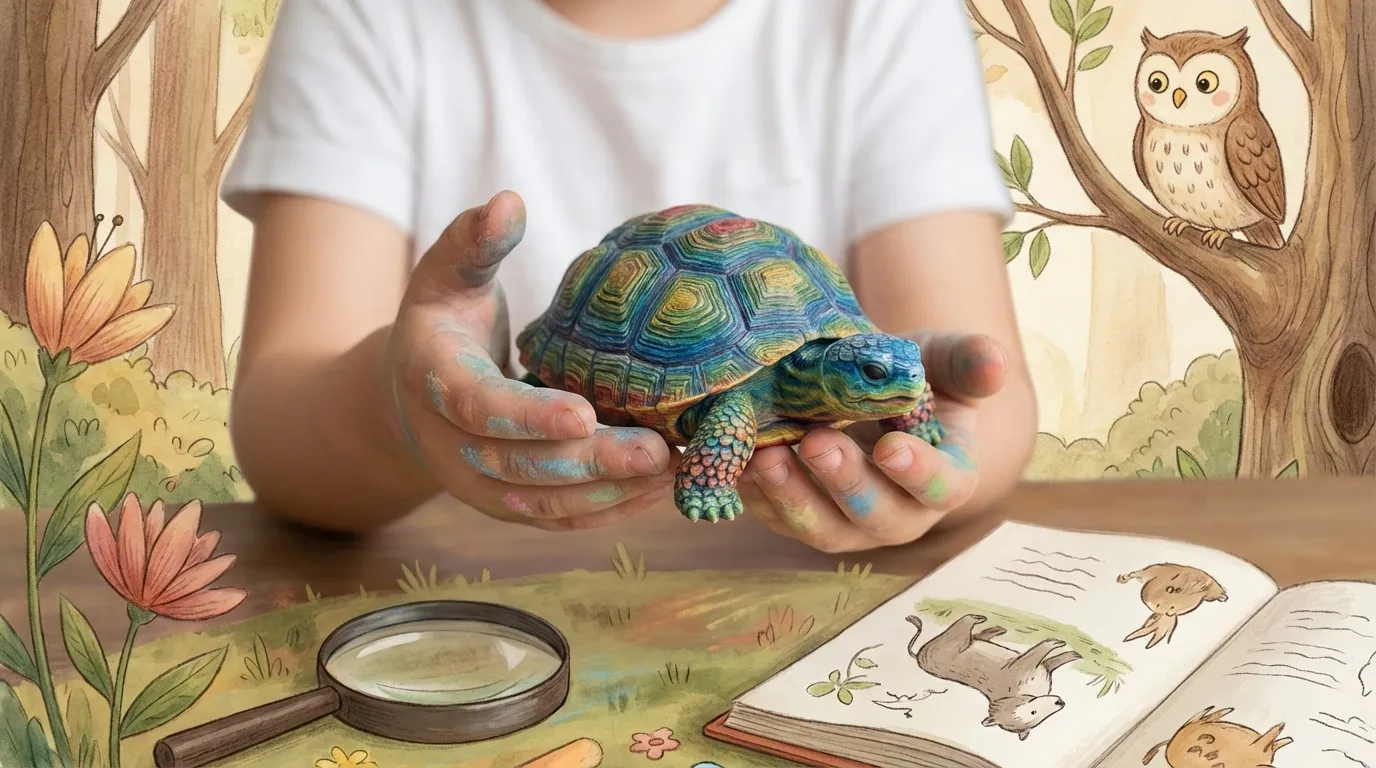
Sit on the floor. Eye level is crucial. Have a toy turtle (or a picture of one) and, if you have it, a photo of your pet.
The Script:
"You know how a turtle has a shell? The shell is hard and strong. It protects the turtle. It’s the house the turtle carries around."
(Let the child touch the turtle/image).
"Our bodies, and [Pet's Name]'s body, are just like that shell. They are the house where we live. When [Pet's Name] was a puppy/kitten, his shell was brand new and strong. But just like a toy can break or batteries can run out, living shells can stop working."
"[Pet's Name] had to leave his shell because it was broken and couldn't be fixed. His body is here, like an empty shell, but the part of him that barked, played, and loved us—the turtle inside—is free now."
"Children process grief through their fingertips. They need to touch the reality to understand the absence."
The Emotional Nuance: The Relief We Don't Discuss
Before we go further, we need to address the feeling you might be hiding from your children, and perhaps even from yourself.
There is a specific, sharp texture to the guilt that comes with relief.
When a pet has been terminally ill, incontinent, or suffering from dementia, their care becomes a heavy, 24-hour job. When they pass, alongside the crushing sadness, there is often an exhale. You might sleep through the night for the first time in months. You might walk through the living room without scanning for accidents.
Then, immediately, the guilt strikes. How can I feel relieved? Does this mean I didn't love them?
We see this constantly in the stories families share with us. Please know: Relief is not the absence of love; it is the absence of suffering. You are relieved that their pain is over, and you are relieved that the caregiver burnout has lifted. This is a biological response, not a moral failing. Acknowledging this to yourself allows you to be more present for your grieving child, rather than being consumed by secret shame.
Age-Appropriate Grief Concepts
Children are not miniature adults; their cognitive architecture changes rapidly. What comforts a seven-year-old might terrify a three-year-old.
| Age Group | Concept of Death | Recommended Approach |
|---|---|---|
| Toddlers (2-4) | See death as reversible/temporary. May ask "When is he coming back?" repeatedly. | Keep answers short and biological. "He died. That means he doesn't eat or breathe anymore." |
| Early School (5-8) | Beginning to understand finality, but may personify death (fear of "the boogeyman"). | Use the Turtle/Shell analogy. Focus on the body stopping. Avoid "sleep" metaphors. |
| Pre-Teen (9-12) | Understands biological finality. May experience "delayed grief" or anger. | Allow them to participate in rituals. Let them choose the memorial object or photos. |
| Teenagers | Adult understanding, but may withdraw. Might feel embarrassed by public grief. | Respect their privacy. Offer tangible keepsakes they can keep in their room without forced discussion. |
The Physics of Memory: Why Tangibility Matters
In our studio, we work with the concept of "voxel-level detail." This is a technical term in 3D printing that essentially means building an object pixel by pixel, but in three dimensions. When we recreate a pet, we aren't just making a statue; we are trying to capture the way light hit their fur.
Why does this matter for a grieving child?
Because memory is slippery. A child's memory is impressionable and fades faster than an adult's. They fear forgetting.
The Fear of Forgetting
A common source of anxiety for children (and adults) is the terror that they will forget what their pet looked like. Not the general idea of the pet, but the specific details—the crooked ear, the white patch on the paw.
Providing a tangible object—whether it's a collar, a favorite toy, or a precise replica—acts as a memory anchor. It offloads the cognitive work of "remembering" to a physical object, allowing the child to relax.
The Difference Between Photos and Objects
Photos are flat. They are windows we look through. Objects are things we exist with.- Tactile feedback: A child can pet a figurine or hold a collar.
- Spatial presence: An object takes up space in the room, acknowledging that the pet used to take up space too.
- Permanence: In a digital world where images swipe away, a solid object made of resin or stone says, "This happened. This love was real."
"We've seen families heal by holding something tangible. Grief needs an anchor, otherwise, it just drifts."
— The PawSculpt Team
Moving From the "Shell" to the Memorial
Once the child understands the "Turtle Shell" concept—that the body is just a vessel—you can introduce the idea of a memorial. This is where the transition from "creepy" to "comforting" happens.
If a child sees a cremation urn or a box of ashes, it can be scary. It's abstract. But if you frame a memorial as a "statue of the shell" to honor the friend who lived in it, it becomes a tribute.
Rituals for Closure
1. The Shadow Box: Let the child pick the collar, a tag, and a photo to put in a box. 2. The Garden Stone: Painting a rock to place in the yard where the pet liked to sunbathe. 3. The New Vessel: This is where many families choose to create a custom figurine. Unlike a taxidermy (which preserves the actual "shell" and can be traumatic for children), a 3D printed replica is artwork. It is a celebration of the life, not a preservation of the death.A Note on Our Process:
We often get asked if our pieces are hand-painted. The answer is no, and here is why that matters for realism. Hand-painting is an interpretation; it relies on the artist's brushstrokes. We use full-color 3D printing technology. The color is built directly into the resin, layer by microscopic layer. This captures the organic, chaotic patterns of fur that a human hand struggles to replicate. For a child who memorized every spot on their dog's back, this accuracy is comforting, not uncanny.
Common Language Pitfalls (And What to Say Instead)
We often use soft language to protect ourselves, but it leaves children confused. Here is a breakdown of the vocabulary of loss.
| The Euphemism (Avoid) | Why It Fails | The Better Phrasing |
|---|---|---|
| "He went to sleep." | Causes fear of bedtime/naps. Implies waking up is possible. | "His body stopped working." |
| "We lost him." | Implies he is lost and needs finding. Creates anxiety. | "He died." (It sounds harsh to us, but clear to them). |
| "He went to a farm." | Creates a false hope of visitation. Erosion of trust later. | "He couldn't live in his body anymore." |
| "God took him." | Can create resentment toward God/religion. | "He was very sick/old and his body couldn't stay alive." |
When the Grief Comes Later
You might have the "Turtle" conversation, and the child seems fine. They might ask, "Can I watch cartoons?" and run off.
Do not mistake this for a lack of caring. Children puddle-jump in grief. They jump into the sad puddle, splash around, get overwhelmed, and jump out into the "happy" dry land immediately. Adults tend to wade in the river of grief and stay there.
Watch for these delayed signs:
- Regression: Bedwetting or baby talk.
- Aggression: Acting out at school.
- Somatic complaints: Tummy aches or headaches with no medical cause.
These are signs that the "shell" explanation needs revisiting. They need to know that the sadness is safe to feel.
"Grief isn't a problem to be solved. It's a love story that continues after the last chapter."
Creating a Permanent "Hello" Spot
One of the most effective ways to help a child process the loss over time is to establish a specific location in the home where "hello" happens.
When a pet is alive, they are everywhere—the couch, the kitchen, the foot of the bed. When they die, their absence is everywhere. By creating a small memorial shelf or corner, you contain the grief in a manageable space.
The "Hello" Spot Strategy:
- Choose a location: A mantelpiece or a special shelf.
- Place the anchor: This could be the urn, a framed photo, or a figurine.
The Ritual: Tell the child, "Whenever you miss [Pet's Name], you can come here and say hello, or touch his statue, or tell him about your day."*
This gives the child agency. They don't have to carry the sadness around; they can put it down on the shelf and pick it up only when they want to visit.
Frequently Asked Questions
Should I let my child see the pet's body after death?
For children generally over the age of 5, seeing the body can provide necessary closure, provided the pet looks peaceful. It confirms the "shell" analogy—they can see the stillness. However, prepare them in advance: "He will feel cold and he won't move." If the pet suffered trauma, it is better to use photos or a memorial object instead.How long does a child's grief for a pet usually last?
Children grieve in cycles. Intense sadness may last only a few days, but expect waves of grief to return during milestones or holidays for months. This "puddle-jumping" style of grief—moving in and out of sadness rapidly—is normal and healthy.Is it okay to get a new pet immediately?
It is generally recommended to wait. Getting a "replacement" too soon can teach children that living things are disposable or interchangeable. Allow the family to mourn the specific individual before introducing a new relationship.Why is my child acting angry instead of sad?
Anger is a common expression of grief in children who lack the verbal skills to articulate deep sadness. They may feel abandoned by the pet or frustrated that they couldn't "fix" the problem. Validate the anger: "It makes me mad that he had to leave, too."Ready to Celebrate Your Pet?
Every pet has a story worth preserving. Whether you're honoring a beloved companion who's crossed the rainbow bridge or celebrating your furry friend's unique personality, a custom PawSculpt figurine captures those details that make your pet one-of-a-kind.
Free instant AI preview • 3D artist preview within 7 days • 5 free revisions