
The Bucket List Your Senior Cat Deserves: 12 Gentle Adventures for an Aging Ragdoll
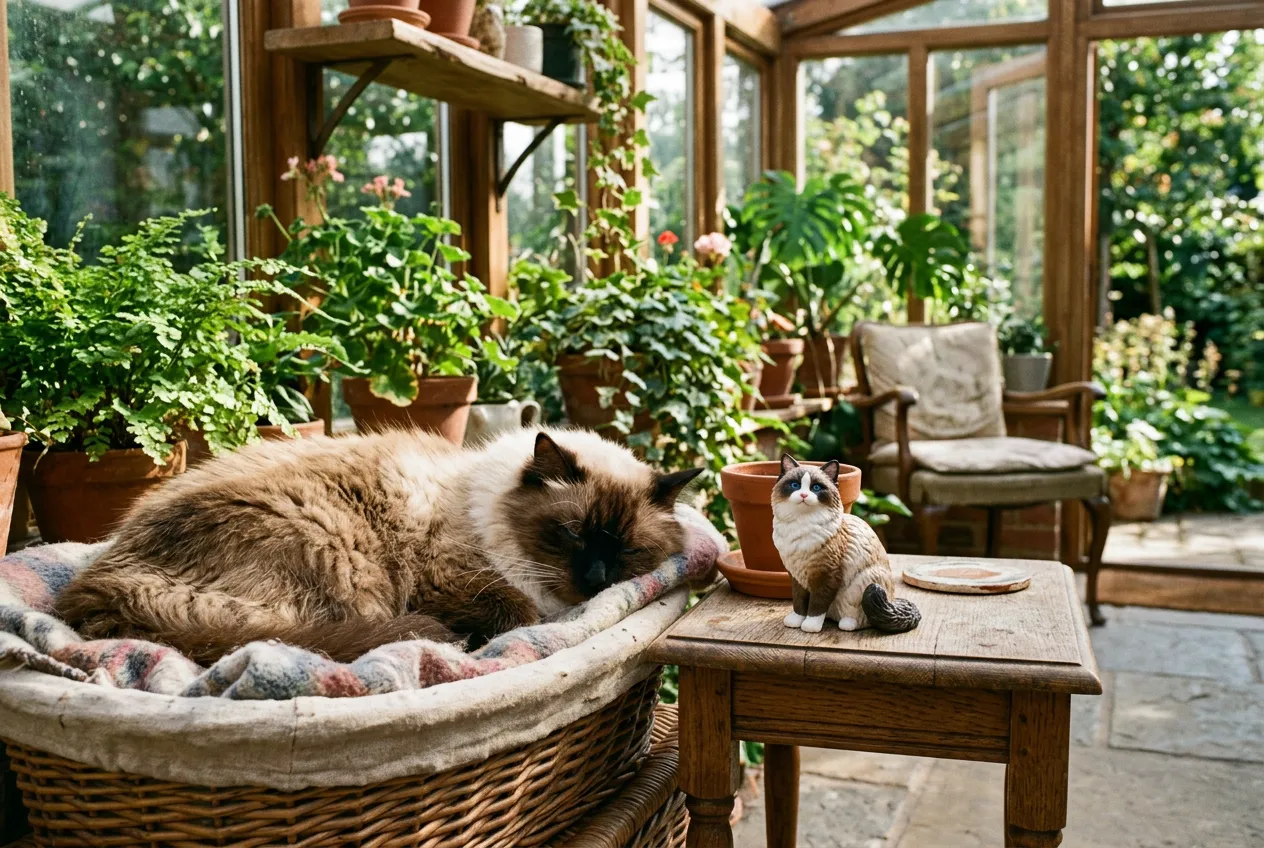
Her paw landed on your bare ankle—warm, deliberate, impossibly light—and your sixteen-year-old Ragdoll settled against the front porch railing like she'd chosen this exact square of afternoon sun on purpose. That small, weighted touch is where every senior cat bucket list actually begins: not with grand gestures, but with paying closer attention to what she's already telling you.
Quick Takeaways
- Aging Ragdolls communicate preferences through texture-seeking and resting postures — learn to read those signals before planning any adventure
- A bucket list for senior cats should prioritize sensory richness over physical exertion — gentle stimulation matters more than novelty
- The 12 adventures below are sequenced by energy demand — start low and calibrate to your cat's daily rhythm
- Preserving your Ragdoll's likeness through a custom 3D-printed figurine creates a lasting sacred object — capture her while her spirit still animates every whisker position
- Veterinary clearance comes first for any activity involving temperature change, travel, or new foods — check with your vet before adventure #1
Why Most Senior Cat Bucket Lists Get It Wrong
Here's the counterintuitive part that most guides skip entirely: a bucket list for an aging cat is not about checking boxes. It's about constructing a series of rituals—small, sacred, repeatable—that deepen the energetic contract between you and your Ragdoll in her final season. The typical listicle you'll find on Google suggests things like "take your cat to the beach" or "let them try whipped cream." Those aren't adventures. They're Instagram moments designed for humans, not cats.
A Ragdoll in her senior years (generally age 10 and above, though breed-specific aging patterns vary) experiences the world primarily through three channels: thermal comfort, tactile input, and olfactory landscape. Her vision may be dimming. Her hearing may have narrowed to lower frequencies. But the pads of her paws still register the difference between sun-warmed wood and cool tile with extraordinary precision, and her nose still catalogs the world in layers you can't perceive.
One of our customers—we'll call her Diane—reached out to us last spring with a photo of her 14-year-old blue bicolor Ragdoll, Maren. Diane's message was brief: "I know we don't have much time left. I want to give her the best last months I can, and I want something to hold onto after." That dual impulse—to honor the living and prepare for the absence—is what drives the best kind of bucket list. Not a frantic rush to "do everything," but a deliberate slowing down.
"The most meaningful adventures for a senior cat happen in a three-foot radius. The magic is in the intention, not the distance."
What follows is a framework rooted in feline behavioral science, organized by energy expenditure level (low to moderate), and designed specifically for the Ragdoll breed's temperament—docile, people-oriented, texture-responsive, and deeply bonded to routine. We're not vets, so for any medical concerns or before introducing new foods or environments, consult your veterinarian. But we are a team that's worked with thousands of pet families navigating their animal's later years, and we've learned a few things about what actually matters during that window.
The 12 Gentle Adventures: A Senior Ragdoll's Bucket List, Sequenced by Energy
Adventure #1: The Warm Surface Rotation
Energy level: Minimal
What it is: Systematically introduce your Ragdoll to 4–6 different warm surfaces throughout your home over the course of a week.
This sounds almost too simple. It's not. Senior Ragdolls develop thermoregulatory preferences that shift as their metabolism slows, and most owners default to whatever bed or blanket the cat has always used. But aging joints crave variety in thermal texture the way a sommelier craves variety in wine.
Try these surfaces in sequence:
- A heated pet pad set to its lowest setting, covered with a cotton pillowcase
- A sun-warmed wooden cutting board placed near a window (the dense wood retains heat differently than fabric)
- A fleece-lined heating disc (microwavable, available at most pet stores)
- Your own body heat—specifically, your lap with a thin cotton layer between you
Watch which surface she returns to. That preference is data. It tells you something about her pain points, her circulation, and her sense of safety. Diane told us Maren rejected the heating pad entirely but spent 40 minutes on the warm cutting board. "I'd never have guessed," she said. "She liked the firmness under her."
Why it matters: You're not just providing comfort. You're conducting a gentle experiment that reveals her current physical state and lets you calibrate everything that follows.
Adventure #2: The Scent Garden (Indoor Edition)
Energy level: Minimal
What it is: Create a rotating collection of 3–5 safe, aromatic items and place them within your cat's resting zone.
Ragdolls, despite their famously placid demeanor, have an olfactory world that's roughly 14 times more complex than yours. A senior cat whose mobility has decreased is essentially living in a smaller and smaller olfactory territory. This adventure expands it without requiring her to move.
Safe options include:
- Valerian root (dried, in a cloth sachet—many cats respond more strongly to this than catnip)
- Silver vine powder sprinkled on a felt square
- Fresh basil or rosemary sprigs in a small vase she can sniff but not chew
- A worn cotton t-shirt from someone she loves but doesn't see often
- Tatami mat or dried grass—the smell of outdoors, translated
Rotate one item per day. Place it 6–12 inches from her primary resting spot. Don't force interaction. Just observe.
The counterintuitive insight: Research from the ASPCA's guide on feline enrichment suggests that novel scents can actually reduce stress-related behaviors in senior cats—the opposite of what most owners assume. We tend to think aging cats want everything exactly the same. They want safety to stay the same. Novelty in the olfactory channel, delivered gently, is stimulating without being threatening.
Adventure #3: The Texture Walk
Energy level: Low
What it is: Lay out a path of 5–7 different textures across a room and let your Ragdoll traverse them at her own pace.
This is where the tactile emphasis becomes central. Gather materials with genuinely different surface qualities:
| Material | Texture Quality | Temperature Feel | Best Placement |
|---|---|---|---|
| Cork mat | Warm, slightly yielding | Room temperature | Start of path |
| Silk pillowcase | Cool, slippery-smooth | Below room temp | Mid-path |
| Sisal doormat (small) | Rough, fibrous | Neutral | Mid-path |
| Memory foam sample | Deep, sinking | Warm | Near the end |
| Smooth river stones (flat) | Hard, cool, irregular | Cool | End of path |
| Sherpa fleece | Dense, plush | Very warm | Final resting point |
Arrange them in a loose line with small gaps between each. Don't coax. Place a few treats on the sherpa at the far end if she needs motivation, but ideally, let curiosity drive her.
Why this works for Ragdolls specifically: The breed's characteristically silky, semi-long coat means they experience ground textures differently than shorthaired cats. Their paw tufts—those tufts of fur between the toe pads—act as additional sensory receptors. A Ragdoll walking across cork registers a fundamentally different sensation than a Siamese on the same surface. You're giving her paws a story to tell.
"A senior cat's world shrinks by the month. Your job isn't to fight that—it's to make every remaining square foot extraordinary."
Adventure #4: The Golden Hour Portrait Session
Energy level: Low
What it is: Spend 20–30 minutes photographing your Ragdoll during the warmest natural light of the day (typically 30–60 minutes before sunset).
This adventure serves a dual purpose: it's a meditative practice for you, and the focused, quiet attention actually registers with your cat as a form of communion. Ragdolls are among the most human-attentive breeds; they notice when you're fully present.
Practical photography notes for senior Ragdolls:
- Get on her level. Lie on the floor. Senior cats don't jump to dramatic vantage points anymore—meet her where she is.
- Use natural light only. Flash startles aging cats and washes out the subtlety of a Ragdoll's colorpoint pattern.
- Capture the details that change. The slight frosting of white around her muzzle. The way her coat has softened (or thinned) at the temples. The exact pattern of her mittens or her blaze.
- Shoot in burst mode. Her eyes will close. A lot. You need volume to catch the frames where her gaze is clear.
These photos serve a sacred function beyond memory. They become the raw material for any future memorial you might choose to create—whether that's a framed print, an album, or a three-dimensional keepsake. Diane's photos of Maren from this period, shot on an iPhone in late-afternoon light, ended up being the reference images she later submitted for a custom pet figurine—and the warmth in those images translated directly into the presence of the finished piece.
Adventure #5: The Lap Liturgy
Energy level: Minimal
What it is: A structured, 15-minute daily ritual of holding your senior Ragdoll with full attention—no phone, no television, no conversation.
We're calling it a liturgy deliberately. This is a spiritual practice. The word comes from the Greek leitourgia—a public service, a communal act. Here, the community is two: you and her.
The protocol:
- Sit in a consistent location at a consistent time
- Place a specific blanket or cloth on your lap (always the same one—this becomes the ritual object)
- Lift her gently, supporting her hindquarters (senior Ragdolls often develop hip sensitivity)
- Place one hand flat against her ribs. Feel her breathing. Count the rhythm.
- Stay for exactly 15 minutes. Not 10. Not "until she gets restless." Fifteen.
Why fifteen? Because it takes roughly 7–9 minutes for a cat's cortisol levels to begin dropping in a secure hold, according to veterinary behavioral research. Most owners put their cat down before the calming window even opens. Fifteen minutes gets you into the territory where both your nervous system and hers begin to synchronize.
The texture detail that matters here: Pay attention to the feel of her coat under your palm. A healthy senior Ragdoll's fur has a specific quality—less silky than it was at age 5, slightly coarser near the spine, still extraordinarily soft at the cheeks and belly. That tactile fingerprint is as unique as a voice. Learn it with your hands so thoroughly that you could identify her blindfolded.
Adventure #6: The Window Theater
Energy level: Minimal
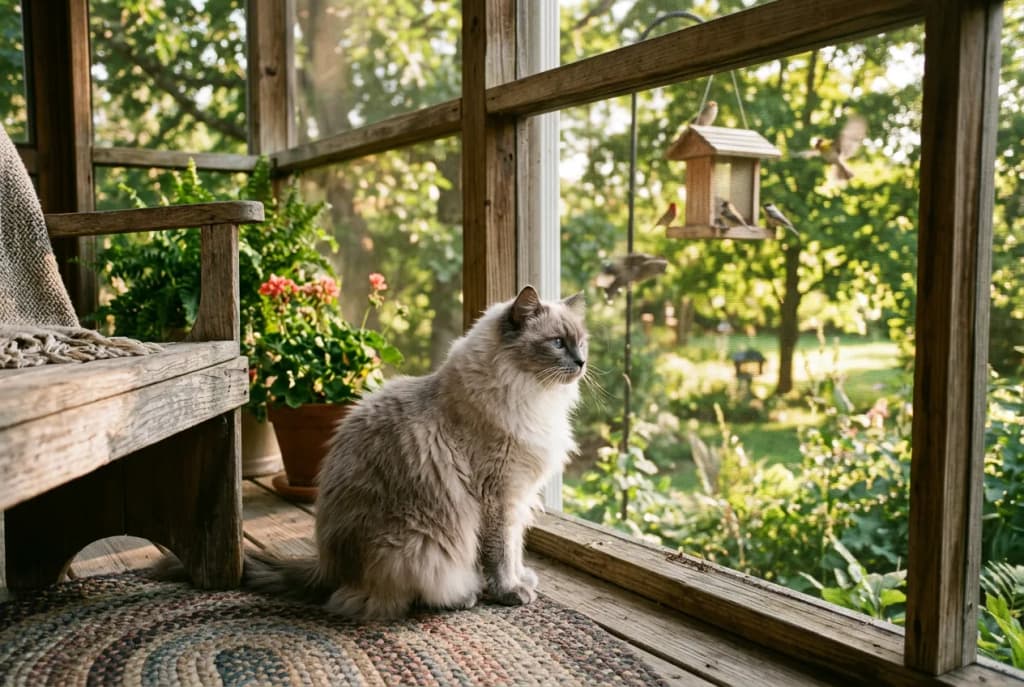
What it is: Install or reposition a bird feeder within 6 feet of your cat's favorite window and add a padded, heated perch at sill height.
This adventure requires almost nothing from your cat and delivers an enormous cognitive reward. Senior cats who've lost the ability (or desire) to hunt still retain the prey observation circuitry in their brains. Watching birds activates neural pathways that keep her mind sharp without taxing her body.
Optimization details:
- Choose a feeder that attracts small, fast-moving birds (finches, chickadees) rather than large, slow ones. The rapid movement triggers more engagement.
- Position the perch so she doesn't have to jump. If the windowsill is above 18 inches, build a ramp or stack firm cushions as steps.
- Add a thermal pad beneath the perch cover. Warmth plus visual stimulation is the senior cat equivalent of a spa day.
Adventure #7: The Familiar Stranger Visit
Energy level: Low to moderate
What it is: Invite one calm, cat-experienced friend to visit specifically and exclusively to meet your Ragdoll.
This sounds contradictory to the "keep things calm" advice. But Ragdolls are a socially oriented breed—more so than most cats—and a senior Ragdoll who sees only her one or two household humans may actually be under-stimulated socially. The key word is familiar stranger: someone your cat has met before but doesn't see regularly.
The rules:
- One visitor only. Never two.
- The visitor sits on the floor, at cat level
- No reaching for the cat. Let her approach.
- The visitor brings one novel scent item (a scarf, a glove) and sets it on the floor
- Visit lasts 30 minutes maximum
You're looking for a specific behavioral response: the slow blink and approach sequence. If Maren slow-blinks at the visitor within the first 10 minutes, the social channel is open and this is enriching. If she retreats to another room and stays there, this particular adventure isn't for her—and that's perfectly fine. Not every item on the list applies to every cat.
| Adventure # | Energy Required | Primary Sense Engaged | Best Time of Day | Ragdoll-Specific Benefit |
|---|---|---|---|---|
| 1. Warm Surface Rotation | Minimal | Touch/thermal | Morning | Reveals joint comfort preferences |
| 2. Scent Garden | Minimal | Olfactory | Midday | Expands shrinking territory |
| 3. Texture Walk | Low | Touch/tactile | Afternoon | Engages unique paw-tuft sensitivity |
| 4. Golden Hour Portraits | Low | Visual/bond | Evening | Creates memorial-quality images |
| 5. Lap Liturgy | Minimal | Touch/bond | Consistent daily | Synchronizes nervous systems |
| 6. Window Theater | Minimal | Visual/cognitive | Daylight hours | Activates prey observation circuits |
| 7. Familiar Stranger | Low-moderate | Social | Afternoon | Fulfills breed-specific social need |
Adventure #8: The Meal Ceremony
Energy level: Minimal
What it is: Elevate one meal per week into a multi-sensory feeding ritual with upgraded food, warmed to body temperature, served on a novel surface.
Senior Ragdolls often experience declining appetite. Before assuming it's purely medical (and do consult your vet if appetite drops suddenly), consider that mealtime boredom is a real and underrecognized factor. Cats who've eaten the same kibble from the same bowl in the same corner for 14 years aren't just losing hunger—they're losing interest.
The ceremony:
- Choose one meal per week—always the same day, always the same meal (consistency creates anticipation)
- Select a high-quality wet food, ideally one with a pâté texture (easier on aging teeth and more aromatic)
- Warm it to exactly 100–101°F (body temperature—this releases maximum scent compounds)
- Serve it on a flat ceramic plate, not a bowl (reduces whisker fatigue, which worsens with age)
- Place the plate on a different surface than usual—a woven placemat, a wooden tray, a piece of slate
The temperature detail is critical. Most owners serve wet food straight from the refrigerator at 38°F, which suppresses aroma by roughly 60%. Warming it to body temperature transforms the olfactory experience entirely. Your cat will notice.
Adventure #9: The Grooming Meditation
Energy level: Minimal
What it is: A 10-minute brushing session using two or three different grooming tools, performed as a deliberate mindfulness practice.
Ragdolls require regular grooming anyway due to their semi-long, low-matting coat. But there's a difference between maintenance brushing and intentional grooming as connection. The distinction is in your attention.
Tool sequence that works:
- Start with a wide-toothed metal comb through the ruff and chest (where mats are most likely in seniors)
- Transition to a soft bristle brush along the spine and flanks
- Finish with a grooming glove—the kind with silicone nubs on the palm
The grooming glove is the key. It bridges the gap between tool and touch. Your cat feels your hand's warmth and pressure through the glove while the nubs provide gentle stimulation. For many senior Ragdolls, this is the most pleasurable tactile experience available to them.
What to notice: As you groom, pay attention to where she leans into the tool versus where she pulls away. This map of preference and avoidance is a real-time health assessment. New areas of avoidance—especially along the lower spine or hindquarters—can signal pain that she's not otherwise showing. Cats are stoic. Their fur tells the truth their behavior hides.
"Every senior cat we see immortalized in a figurine was loved fiercely in the details—the daily brushing, the warmed food, the quiet sitting together. That's what real devotion looks like."
— The PawSculpt Team
Adventure #10: The Sunbeam Chase
Energy level: Low
What it is: On a sunny day, place your Ragdoll in the path of a moving sunbeam and let her follow its migration across the floor.
This is the gentlest possible version of "play." No wand toys, no laser pointers (which can frustrate aging cats who can no longer catch the dot), no demands on her musculoskeletal system. Just warmth that moves, and a cat who follows it at her own pace.
The specific magic of this for Ragdolls: The breed's colorpoint coat pattern means their extremities (ears, face, paws, tail) are darker than their body. These darker areas absorb more solar radiation. When a Ragdoll lies in a sunbeam, she's receiving differential heating across her body—more warmth at the points, less at the trunk. This creates a complex thermal sensation that's genuinely pleasurable and unique to pointed breeds.
Time this for a window where the sunbeam travels across 3–4 feet of floor over about 45 minutes. Place her at the warm end. Watch her adjust position as the light moves. She may not "chase" it in any dramatic sense—she may simply shift, inch by inch, a paw at a time. That's enough. That's the adventure.
Adventure #11: The Legacy Recording
Energy level: Minimal (for the cat)
What it is: Spend one hour recording audio and video of your Ragdoll's specific sounds, movements, and habits.
This is the adventure most owners wish they'd done and almost none actually do until it's too late. Record everything:
- Her purr. Hold your phone against her ribs while she purrs. Capture the specific frequency and rhythm—every cat's purr is acoustically unique, like a fingerprint.
- Her chirp or trill. Ragdolls are known for their soft vocalizations. Prompt these by calling her name from another room.
- The sound of her eating. Strange? Maybe. But six months from now, you'll want to hear it.
- Her walk. The specific cadence and pad-fall sound on your particular flooring.
- Her kneading rhythm. If she still kneads, capture the visual and the sound of her claws on fabric.
This recording becomes a spiritual artifact—a container for presence that outlasts physical form. Combine it with the photographs from Adventure #4, and you've built a multi-sensory archive of her specific, unrepeatable existence.
Some families take this archive a step further and use the best photographs as the basis for a physical memorial. The team at PawSculpt, for instance, works from owner-submitted photos to digitally sculpt and then 3D print full-color resin figurines that capture specific details like coat pattern, eye color, and even characteristic postures. The color is embedded directly in the resin material itself—voxel by voxel—so the subtle gradations in a Ragdoll's points and the pale cream of her body read as continuous and authentic, finished with a protective clear coat. It's one way to translate a two-dimensional archive into a three-dimensional legacy object you can hold.
Adventure #12: The Porch Vigil
Energy level: Low
What it is: On a mild day (60–75°F, low wind), carry your Ragdoll to a secure porch or enclosed patio and sit with her for 20–30 minutes.
We end where we began.
The front porch—or any transitional space between inside and outside—holds a particular energy for indoor cats. It's liminal territory: not quite her domain, not quite the wild. The sounds are richer (birdsong, distant traffic, wind through leaves). The smells are exponentially more complex. The air moves against her fur in a way climate-controlled indoor air never does.
Safety requirements are non-negotiable:
- Enclosed or screened porch only. No open decks, no unfenced areas.
- Harness and leash if the space isn't fully enclosed, though many senior Ragdolls won't tolerate a harness they haven't worn before—don't introduce new restraints to an aging cat.
- Your lap or a carrier with the door open as her base of operations
- Maximum 30 minutes. Monitor for signs of overstimulation: flattened ears, dilated pupils, panting, or attempts to flee.
Diane brought Maren to her screened back porch on a Tuesday afternoon last May. "She just sat on my lap and stared at everything," Diane told us. "Her ears were rotating like satellite dishes. She looked... awake. More awake than she'd been in months." Maren passed away seven weeks later. Diane said the porch afternoon was one of the memories she returns to most often.
The adventure isn't the porch. The adventure is witnessing your cat experience the world with renewed attention—and matching that attention with your own.
Building the Bucket List Into a Sustainable Practice
The mistake most guides make is framing these activities as a one-time event. "Do these 12 things and you're done." That misses the point entirely. A senior cat bucket list works best when it becomes a rotating practice—a set of rituals you cycle through based on her energy level on any given day.
Here's a practical weekly framework:
| Day | Primary Adventure | Backup (Low-Energy Day) | Time Required |
|---|---|---|---|
| Monday | #2 Scent Garden | #5 Lap Liturgy | 15–20 min |
| Tuesday | #3 Texture Walk | #1 Warm Surface Rotation | 20–30 min |
| Wednesday | #9 Grooming Meditation | #5 Lap Liturgy | 10–15 min |
| Thursday | #8 Meal Ceremony | #6 Window Theater | 15–20 min |
| Friday | #7 Familiar Stranger | #10 Sunbeam Chase | 30 min |
| Saturday | #12 Porch Vigil (weather permitting) | #4 Golden Hour Portraits | 20–30 min |
| Sunday | #11 Legacy Recording | #5 Lap Liturgy | 15–60 min |
Notice that the Lap Liturgy appears three times as a backup. That's intentional. On her worst days—the days when she barely moves from her heated pad, when her eyes are cloudy and her appetite is thin—the most profound adventure available is simply the warm weight of her body against yours, your hand rising and falling with her breath.
What Ragdoll Owners Specifically Need to Know About End-of-Life Activities
Ragdolls age differently from most breeds, and those differences matter when you're designing gentle adventures. According to breed health data compiled by PetMD's breed profiles, Ragdolls are predisposed to hypertrophic cardiomyopathy (HCM) and kidney disease, both of which influence energy levels, temperature tolerance, and sensory engagement in the senior years.
Three Ragdoll-specific considerations:
- Their pain tolerance is unusually high. Ragdolls are famously relaxed—but this means they also mask discomfort more effectively than most breeds. Don't interpret willingness to participate as absence of pain. A cat who walks the texture path without complaint may still be experiencing joint discomfort. Watch for subtle changes: slightly shortened stride length, favoring one side, reluctance to knead.
- Their social dependency increases with age. Most cat breeds become more solitary as they age. Ragdolls often go the opposite direction—becoming more clingy, more vocal when left alone, more insistent about proximity. This isn't regression. It's the breed's inherent bonding instinct intensifying as her world contracts. Honor it. If she wants to be in the same room as you at all times, rearrange your life to make that possible.
- Their coat changes communicate health status. A Ragdoll's coat is a diagnostic instrument. Dullness or excessive oiliness along the spine often precedes visible symptoms of kidney decline by 2–4 weeks. During the Grooming Meditation (Adventure #9), you're not just bonding—you're conducting an early-warning assessment.
The Spiritual Dimension: Why a Bucket List Is Really a Goodbye Ritual
We'll be real with you: there's a reason you're reading an article about Ragdoll cat end-of-life activities. You're preparing. Maybe not for tomorrow, maybe not for next month, but you're holding the awareness that this particular presence—this specific fur-texture, this purr-frequency, this weight on your chest at 3 a.m.—is temporary.
That awareness isn't morbid. It's sacred.
Every major spiritual tradition has a concept for the practice of intentional presence during a season of ending. Buddhism calls it sati—mindfulness of impermanence. The Stoics called it memento mori. What you're doing when you warm a plate for her Tuesday meal ceremony, when you lay out the texture path, when you sit on the porch and let her ears rotate through the soundscape—you're performing a version of these practices. You're saying, with your actions: I know this is finite, and I choose to be fully here for it.
"Ritual transforms routine into remembrance. The food you warm, the fur you brush—these aren't chores. They're acts of witness."
The legacy objects you create during this period—the recordings, the photographs, the figurines—aren't replacements for her presence. They're vessels that hold the shape of the bond after the living warmth has gone. They serve a specific psychological function: giving grief a physical anchor. Something to touch when the phantom weight on your lap becomes unbearable.
Diane keeps Maren's figurine on the windowsill where the bird feeder still hangs. "I don't pretend it's her," she told us. "But when I touch it—the surface has this specific feel, smooth and solid, with just enough texture that it doesn't feel like plastic—it brings me back to the porch afternoon. Every time."
The Commonly Overlooked Element: Documenting for Your Future Self
Here's what no other senior cat guide will tell you: the bucket list isn't just for your cat. It's for the version of you who exists six months after she's gone.
That future version of you will have a specific, aching need: to remember the details. Not the broad strokes—you'll remember those. But the micro-details. The exact spot behind her left ear where she liked to be scratched. The way she always tucked her front paws under, left over right, never the reverse. The precise sound of her claws on the sisal mat during the texture walk.
Those details evaporate with terrifying speed. Grief researchers have documented that specific sensory memories begin fading within 8–12 weeks of a loss, replaced by generalized emotional impressions. You shift from remembering the feel of her fur to remembering that her fur was "soft." The granularity dissolves.
The twelve adventures above—when documented through photos, videos, audio recordings, and written notes—create a sensory archive that slows this dissolution. They give your future self access to specificity that grief would otherwise erode.
Write things down. After each adventure, spend two minutes noting:
- What texture or surface she preferred
- How long she engaged before losing interest
- Any sound she made
- Where on her body she seemed most responsive to touch
- The exact time of day
This isn't journaling for its own sake. It's building a map of her final preferences—a document that captures who she was at the end, not just who she was at the beginning when everything was easy and obvious.
Knowing When to Stop: The Ethics of the Senior Cat Bucket List
One more thing that needs saying, because responsible guidance demands it: not every adventure is appropriate for every stage of decline. The Texture Walk that delighted her in September may exhaust her by November. The Porch Vigil that brought her alive in spring may overwhelm her in autumn.
Signs that a specific adventure should be retired:
- She doesn't engage within the first 5 minutes (where she previously did)
- She vocalizes in distress (as distinct from her normal chirps)
- She seeks escape or hiding rather than exploration
- She pants, trembles, or shows rapid breathing afterward
- She refuses food within 2 hours of the activity
When an adventure drops off the list, let it go without guilt. The list was never about completion. It was about presence. And sometimes the most present thing you can do is sit beside her heated pad with your hand resting on her flank, feeling the architecture of her ribs, and doing absolutely nothing at all.
That's not the absence of adventure. That's the deepest one.
Frequently Asked Questions
What should be on a senior cat bucket list?
A thoughtful senior cat bucket list should prioritize gentle sensory experiences over physically demanding activities. Focus on thermal comfort (warm surface rotation), olfactory enrichment (safe scent gardens), tactile stimulation (texture walks and intentional grooming), and deepened social bonding (the Lap Liturgy). The best bucket list items are repeatable rituals, not one-time stunts. Tailor everything to your specific cat's energy level on any given day.
How do I know when my Ragdoll cat is near end of life?
The signs are often subtle in Ragdolls because the breed's naturally calm temperament masks distress. Watch for sustained appetite loss (not just a skipped meal but a pattern over 3–5 days), withdrawal from social contact (unusual in this highly bonded breed), visible coat deterioration, and difficulty rising from rest. Increased vocalization at night can also signal pain or cognitive decline. Your veterinarian is the only person qualified to assess where your cat is in this process—don't rely on internet checklists alone.
What activities are safe for an aging Ragdoll cat?
The safest activities involve minimal physical exertion and maximum sensory engagement: lap time with intentional presence, window bird-watching from a heated perch, gentle brushing with soft tools, scent enrichment using cat-safe herbs, and supervised time in an enclosed outdoor space. Avoid introducing new harnesses, loud environments, unfamiliar animals, or any activity that requires jumping or sustained movement.
How can I memorialize my senior cat while she's still alive?
Start by creating a thorough sensory archive: high-quality photographs in natural light, audio recordings of her purr and vocalizations, and video of her characteristic movements. Write down specific physical details—coat texture, favorite resting posture, preferred scratch spots. Some families also commission lasting keepsakes like custom 3D-printed figurines from current photos, capturing her likeness while every detail is still vivid and present.
Do Ragdoll cats need special end-of-life care?
Ragdolls have breed-specific vulnerabilities that influence end-of-life care. Their predisposition to hypertrophic cardiomyopathy and kidney disease means regular veterinary monitoring is essential. Their high pain tolerance means they often appear comfortable when they aren't. And their intense social bonding means isolation—even brief—can cause significant distress in their final months. Adjust your schedule to maximize proximity.
How long do Ragdoll cats typically live?
Ragdolls generally live 12 to 17 years, with some individuals reaching their late teens. Indoor-only Ragdolls with regular veterinary care and appropriate nutrition tend toward the higher end of that range. Genetics play a significant role, particularly regarding HCM prevalence, so knowing your cat's lineage and health history helps set realistic expectations.
Ready to Celebrate Your Senior Ragdoll?
Every cat has a spirit that deserves to be preserved in more than memory alone. Whether you're in the middle of your senior cat bucket list or looking for a way to honor a Ragdoll who filled your home with warmth, a custom PawSculpt figurine captures the exact markings, posture, and presence that made her irreplaceable—digitally sculpted from your photos and 3D printed in full-color resin, detail by detail.
Visit pawsculpt.com to explore the full process, preview options, and service details