
The Lizard's Gaze: How to Capture the Eyes of a Blue Tongue Skink for a Realistic Replica
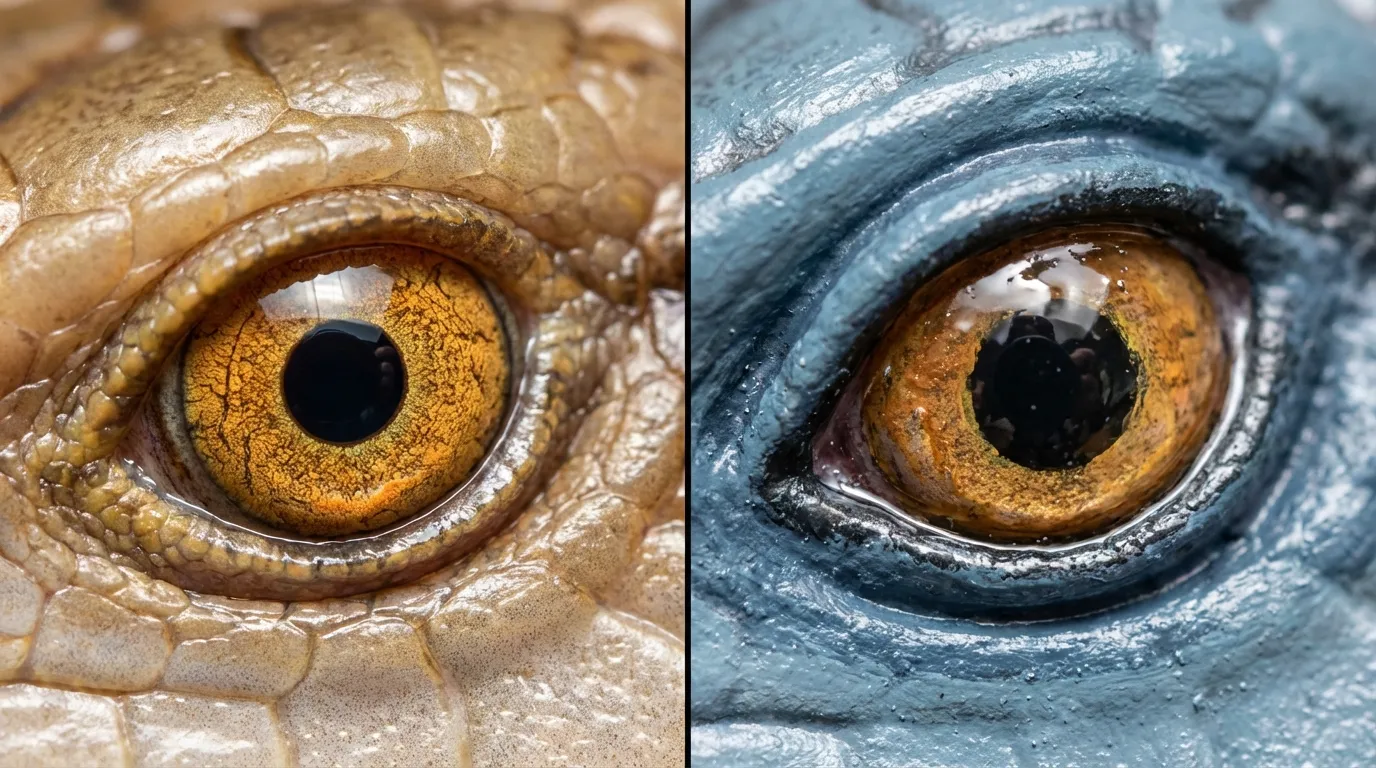
Adjusting the macro lens, I held my breath as the morning sun hit the terrarium glass, illuminating the copper flecks in my Blue Tongue Skink’s iris. In that split second of focus, the flat black bead transformed into a galaxy of depth—exactly the detail needed for realistic reptile eyes.
Quick Takeaways
- The "Catchlight" is Vital — Without a single white reflection point, the eye looks dead; aim for one crisp highlight.
- Level Up, Not Down — Always photograph from the substrate level to capture the "orbital ridge" that gives skinks their grumpy expression.
- Avoid Direct Flash — On-camera flash flattens the iris texture; use diffused natural sunlight for accurate color mapping.
- Reference Quality Matters — High-resolution close-ups are essential for creating lifelike custom figurines that capture your pet’s specific gaze.
The Art of the Reptile Eye
To the untrained observer, a reptile's eye might seem like a simple, glossy button. But as someone who has spent years studying the geometry of pets to translate them into physical form, I can tell you that the eye of a Blue Tongue Skink (BTS) is a masterpiece of biological engineering. It is not merely an organ of sight; it is the primary vessel of their personality.
When we look at a dog, we look at the eyebrows and the mouth. When we look at a skink, the emotion is entirely in the tilt of the head and the depth of the eye.
Capturing this for a replica—whether it's a digital model or a physical keepsake—requires a shift in perspective. You have to stop looking at the lizard as a whole and start looking at the architecture of the face. The heavy brow, the specific scale pattern surrounding the orbit, and the way light refracts through the cornea.
"To capture a skink's eye is to capture their attitude. The difference between a generic lizard and your lizard is usually found in the asymmetry of their gaze."
Beyond the "Black Bead"
The biggest mistake in reptile photography and replication is assuming the eye is a solid color. In Northern Blue Tongue Skinks, for example, the iris often contains complex striations of orange, amber, and deep mahogany. In Meraukes or Indonesians, you might find lighter, more olive tones mixed with brown.
If you take a photo where the eye appears as a solid black dot, you have lost the data needed to recreate the animal. You’ve captured the silhouette, but missed the soul.
Lighting: The Brush of the Photographer
In the world of 3D modeling and full-color printing, we often talk about "specular highlights." This is the reflection of the light source on a shiny surface. For a Blue Tongue Skink, the wetness of the eye is what makes it look alive.
The Problem with Flash
If you blast a skink with a direct camera flash, two things happen: 1. The Corneal Washout: The reflection becomes a giant white blind spot, obscuring the color of the iris underneath. 2. The Flatness: Direct light eliminates the tiny shadows cast by the eyelid scales. Without those shadows, the texture disappears.The Natural Light Solution
The most "sculptural" photos—the ones that give us the best data for modeling—are taken with diffused side lighting.Ideally, place your skink near a window (but not in direct, baking sun) during the "golden hour" or on a slightly overcast day. The clouds act as a giant softbox. This light wraps around the curve of the eye, revealing the sphere shape rather than flattening it into a disk.
| Lighting Source | Effect on Texture | Effect on Eye Detail | Best Use Case |
|---|---|---|---|
| Direct Flash | Flattens scales; looks plastic | Washes out iris color | Avoid (unless emergency) |
| Midday Sun | Harsh shadows; high contrast | Causes squinting/closing | Showing scale iridescence |
| Window (Overcast) | Soft, wrapping shadows | Reveals iris depth & color | Ideal for Portraits |
| Ring Light | Artificial circular highlight | Good clarity, unnatural reflection | Macro photography |
Anatomy of a Grump: The Orbital Structure
When we analyze a Blue Tongue Skink for a custom project, we aren't just looking at the eyeball. We are looking at the housing.
Unlike geckos, which often have bulging eyes, skinks have somewhat deep-set eyes protected by a heavy brow ridge. This ridge is what gives them that signature "judgmental" look that owners adore.
The Scale Rosette
Look closely at your skink. Surrounding the eye is a specific arrangement of smaller scales. These are not random. They form a protective ring. When photographing for a replica, you need to ensure these scales are in focus.If the camera focuses only on the nose (which is long), the eyes will blur. If you focus on the ear, the eye blurs. You must manually select your focus point directly on the intersection of the pupil and the eyelid.
"We often tell pet parents that the 'grumpiness' of a Blue Tongue Skink isn't in the mouth—it's in the heavy brow ridge casting a shadow over the eye. That shadow is the secret ingredient to realism."
— The PawSculpt Team
The Technical Approach: Macro Photography Tips
You do not need a $3,000 camera rig to get the shot we need. Most modern smartphones have incredible "macro" modes or telephoto lenses that work beautifully if used with patience.
The "Sniper" Technique
Reptiles move in bursts. They are still for ten minutes, then gone in a second. 1. Get Low: Lie on the floor. If you are shooting from above, you are a predator. If you are shooting from eye level, you are a peer. 2. Stabilize: Use a stack of books or a small beanbag to rest your phone or camera on. Hand-shake is the enemy of macro detail. 3. The Lure: Blueys are food-motivated. A smear of banana or a piece of high-quality dog food placed just out of frame can fix their gaze in one direction long enough for the camera to lock focus.Checking Your Results
Zoom in on your photo. Can you see the texture of the individual scales on the lower eyelid? Can you distinguish the pupil from the iris? If the answer is yes, you have captured data that can be translated into a tangible object.From Pixels to Polymer: How We Use the Data
At PawSculpt, we operate at the intersection of digital artistry and manufacturing technology. We don't paint on top of a model; we create the color inside the model.
The Voxel Difference
Our full-color 3D printing technology builds the figurine layer by layer—or more accurately, voxel by voxel (a 3D pixel). This means we can replicate the gradient of your skink's eye—that shift from dark brown to amber—directly in the resin.When you provide a photo where the light hits the eye just right, our digital sculptors can map that exact texture onto the 3D model. We can mimic the way the scales overlap the edge of the eye. We can reproduce the slight asymmetry where one eyelid might droop lower than the other.
This is why no hand-painting is involved. A brush can rarely achieve the gradient transparency of a reptile eye. But voxel-level printing, sealed with a high-gloss varnish to mimic the wetness of the cornea, captures that organic look perfectly.
Troubleshooting Common Photo Issues
Even with the best intentions, reptile photography is tricky. Here are the hurdles we see most often when owners submit photos for their custom figurines.
| Issue | Visual Symptom | The Fix |
|---|---|---|
| Glass Glare | A hazy reflection of the room covers the skink | Shoot with the lens flush against the glass, or open the enclosure door. |
| Motion Blur | The eye looks smeared | Increase shutter speed or add more light (lamps) to the room. |
| Wrong Focus | Nose is sharp, eye is soft | Tap the screen specifically on the eye; use "Portrait Mode" carefully. |
| Shedding Skin | Eye looks blue/cloudy ("in blue") | Wait until after the shed for the photo session. |
The "Blue" Phase
A quick note on physiology: If your skink is "in blue" (preparing to shed), their eyes will turn a milky, opaque blue. While this is a natural part of their life cycle, it masks the true color and personality of the eye. Unless you specifically want a figurine depicting a shedding skink, it is best to wait a week until they have fresh, glossy scales.The Emotional Weight of the Gaze
Why do we obsess over these details? Why does it matter if the iris is amber or mahogany?
Because for reptile owners, the bond is different. A dog wags its tail; a cat purrs. A Blue Tongue Skink communicates trust by simply existing calmly in your presence, by closing its eyes while you stroke its head, or by watching you with that keen, intelligent interest.
When you lose a reptile, or when you simply want to celebrate one, you aren't looking for a generic lizard statue. You are looking for Bluey, or Godzilla, or Potato. You want to see that specific skeptical look they gave you when you offered them greens instead of bugs.
Capturing the eye is capturing the witness to your life together. It is the anchor point of the memory.
"Grief isn't a problem to be solved. It's a love story that continues after the last chapter."
Preserving the Details
In the end, a photograph is a flat memory. It lives on a screen or in a frame. But a three-dimensional replica occupies space in your world. It casts a shadow. It has weight.
By taking the time to photograph your Blue Tongue Skink with the eye of an artist—focusing on the light, the texture, and the anatomy—you are doing more than taking a picture. You are archiving a personality. You are ensuring that the unique spark of life that makes your pet who they are is preserved, sharp and clear, against the blurring of time.
So, get down on the floor. Wait for the sun. Watch for the glint in the eye. And capture the gaze that has watched you with such quiet, prehistoric wisdom.
Frequently Asked Questions
How close do I need to get for a good reference photo?
You don't need to be touching the lizard—in fact, that often causes them to close their eyes. Stay about 6 to 10 inches away and use your camera's telephoto lens or macro mode. If you get too close with a wide-angle lens, you risk the "fisheye effect," which distorts the nose and makes the head look misshapen.Can you fix red-eye or flash reflection in the figurine?
Yes, we can. While a clean photo is best, our digital sculptors are experts at "cleaning up" the data. If your favorite photo has a flash reflection blocking the pupil, we can reconstruct that area digitally, provided you send us at least one other photo (even a blurry one) that shows the true eye color for reference.My skink has different colored eyes. Can you replicate that?
Absolutely. This is one of the major advantages of our technology. Because we use full-color 3D printing rather than hand-painting, we don't rely on stock colors. We map the specific color data to the model. If your skink has one amber eye and one brown eye, or unique pigmentation spots (heterochromia), the figurine will match that reality exactly.Do I need a professional camera for these photos?
No. A modern smartphone (iPhone or Android) produced in the last 3-4 years is sufficient. The secret isn't the sensor size; it's the lighting. A smartphone photo taken in good natural window light is infinitely better for modeling than a professional DSLR photo taken in a dark room.Ready to Celebrate Your Pet?
Every pet has a story worth preserving. Whether you're honoring a beloved companion who's crossed the rainbow bridge or celebrating your furry (or scaly) friend's unique personality, a custom PawSculpt figurine captures those details that make your pet one-of-a-kind. By using your photos to create realistic reptile eyes in full-color resin, we ensure the spark of their personality remains.
Free instant AI preview • 3D artist preview within 7 days • 5 free revisions