
Stop Taking Boring Photos: How to Capture Your Boston Terrier's 'Soul' for 3D Modeling
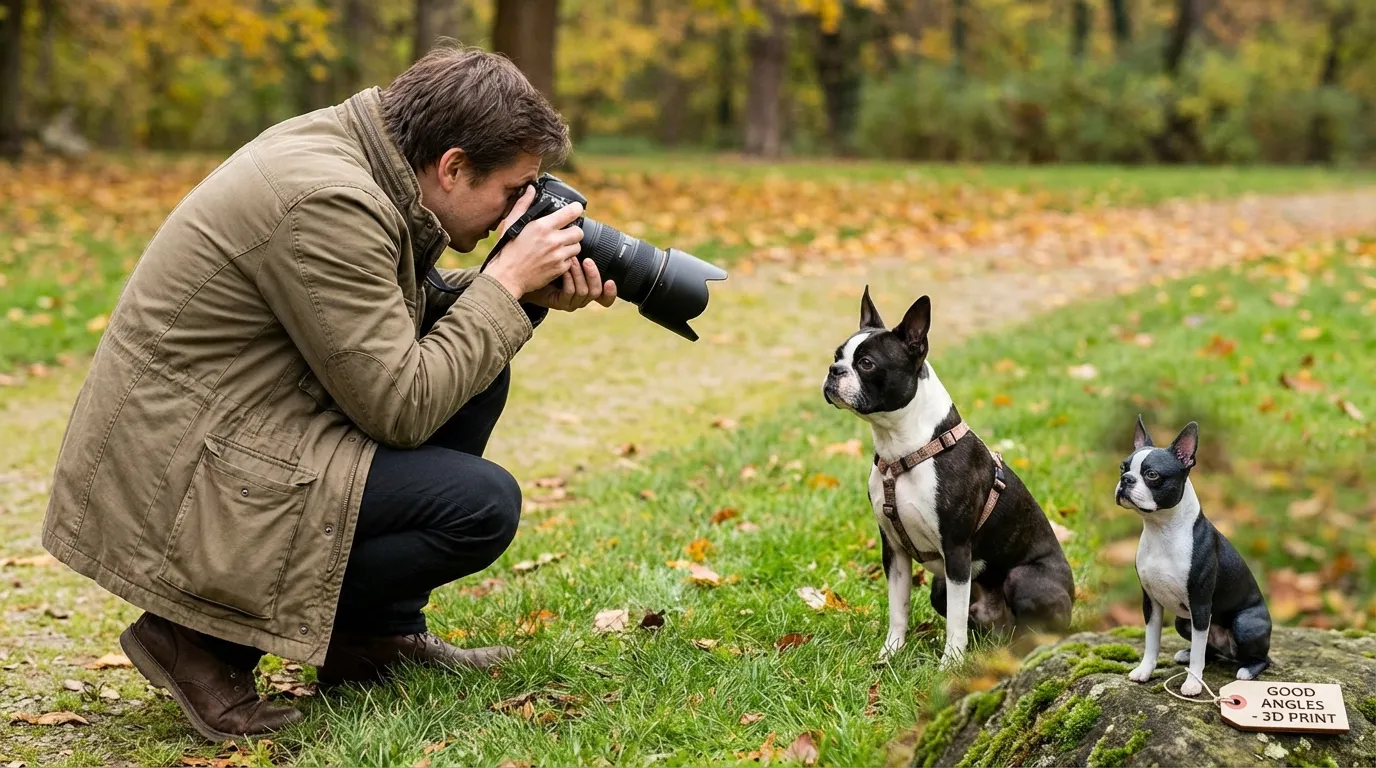
"The soul is placed in the body like a rough diamond, and must be polished, or the luster of it will never appear." — Daniel Defoe
Dust motes danced in the single beam of sunlight cutting across the attic, illuminating the worn leather of an old steamer trunk. Inside, tucked between moth-eaten blankets, I found it—a faded Polaroid of a dog I hadn't seen in twenty years, yet whose wet nose I could almost feel against my palm. That singular image triggered a cascade of neural pathways, flooding my brain with the specific weight and warmth of a friend long gone. This is the power of Boston Terrier photography: not just to document a pet's existence, but to encode their spirit into visual data that can be translated into a tangible, three-dimensional reality.
Quick Takeaways
- Capture "Micro-Tension" — A photo of a resting dog is biologically "flat"; photograph the split-second of anticipation before a treat to capture personality.
- Diffuse Light is Critical — Harsh sunlight creates high-contrast shadows that confuse 3D modeling software; aim for overcast days or soft, window light.
- Eye Level = Emotional Connection — Shooting from above triggers a "dominance" perspective; get on your stomach to engage the viewer's limbic system.
- The "Tuxedo" Challenge — Boston Terriers have high-contrast coats; ensure your camera exposure balances the white chest and black back without losing detail.
- Turn Photos into Touch — Use your best reference shots to create a custom 3D pet figurine that permanently preserves your dog's unique geometry.
The Psychology of the "Soul" Shot
Here is the uncomfortable truth about most pet photography: it fails to capture the "soul" because it ignores the biology of recognition. When you look at your Boston Terrier, your brain isn't just processing shape and color. It is processing micro-expressions and muscular tension.
In the world of 3D modeling and cognitive science, we talk about the "Uncanny Valley"—that eerie feeling when a replica looks almost real but something is off. Usually, what's missing is the evidence of life: the slight flare of a nostril, the asymmetrical cock of an ear, or the tension in the masseter muscle when they spot a squirrel.
If you send us a photo of your Boston Terrier fast asleep, we can create a beautiful model of a sleeping dog. But if you want a figurine that makes you say, "That’s him," you need to capture the biological markers of his personality. We need to see the intent behind the eyes.
"A photograph captures a moment. A reference photo captures the anatomy of a personality."
The Boston Terrier Paradox: Brachycephalic Geometry
Boston Terriers present a unique challenge for both photographers and 3D artists due to their brachycephalic (flat-faced) skull structure. From a psychological standpoint, their faces mimic the "baby schema" (large eyes, round forehead), which triggers a massive release of oxytocin in human brains. This is why you love them.
However, from a technical modeling standpoint, their faces are a landscape of extreme geometry.
The "Bug Eye" Factor
The prominent, exophthalmic eyes of a Boston are their most expressive feature. But they are also highly reflective.- The Mistake: Using a flash. The flash reflects off the retina (tapetum lucidum), creating "laser eyes" or harsh white glare spots that obscure the iris color.
- The Fix: Use natural side-lighting. You want to capture the "catchlight"—the small white reflection of the sky or window—which gives the eye depth and life without washing out the brown or blue pigment.
The Black-and-White Dynamic Range
Camera sensors struggle with high contrast. This is known as dynamic range limitation.- The Science: If you expose for the white chest, the black fur becomes a black void with no texture. If you expose for the black fur, the white chest becomes a "blown out" white blob.
The Consequence: When we convert this to a full-color 3D print, the machine needs color data for every voxel (3D pixel). If the photo is pure white or pure black, the printer just prints flat plastic. We need to see the grain* of the fur.
- The Solution: Shoot on cloudy days. Clouds act as a giant soft-box, diffusing the light and lowering the contrast, allowing the camera to see texture in both the tuxedo black and the bright white markings.
The Neurobiology of the "Head Tilt"
You know the look. You make a weird noise, and your Boston’s head snaps to the side. It’s adorable. But scientifically, it’s also the perfect modeling pose.
Why? Because it engages the vestibular system and creates asymmetry.
Symmetry in nature often indicates a resting state or death. Asymmetry indicates life, thought, and processing. A 3D model with a slight head tilt or a lifted paw feels alive because our brains interpret that imbalance as potential energy—movement about to happen.
How to Trigger the "Alert State"
Don't just wait for it. Manipulate the environment to trigger a dopamine response.- The High-Value Lure: Do not use their regular kibble. You need a stimulus that overrides their background processing. Cheese, liver, or a brand new squeaky toy.
- The "Novelty Sound": Dogs habituate to their names. Instead, make a sound they haven't heard before (a high-pitched lip trill or a crumbling paper bag) right as you snap the photo.
- The Result: This triggers the Orientation Reflex. Their ears perk up (showing the ear leather shape), their eyes widen (showing color), and their neck muscles tense (showing anatomy). This is the data a digital sculptor dreams of.
The Orthographic Requirement: Thinking in 360 Degrees
When you look at a photo, your brain fills in the missing information. You see a face, and you assume the back of the head exists. But our 3D artists, despite their decade of experience in digital sculpting, cannot guess. They need hard data.
We use a process rooted in photogrammetry principles. We aren't just painting a surface; we are building a volume.
The Essential Shot List for 3D Modeling
| Angle | Biological Purpose | What We Look For |
|---|---|---|
| The "Mugshot" (Front) | Facial recognition & symmetry check | The specific pattern of the "haggerty spot" (if present), the width of the blaze, eye spacing. |
| The Profile (Side) | Cranial structure analysis | The exact slope of the nose (stop), the curvature of the skull, the neck arch. |
| The Top-Down (Dorsal) | Body mass index & markings | The "saddle" markings, the tail set (screw tail vs. straight), waist taper. |
| The "Soul" Shot (3/4 View) | Personality & emotional resonance | The typical expression. Is the mouth open in a "Boston grin"? Are the ears back? |
Counterintuitive Insight: Most people obsess over the face and forget the tail. Boston Terriers have highly unique "screw tails" or "nubs." Without a photo of the rear, we have to guess the torque and twist of the tail, which is often as unique as a fingerprint.
Lighting: The Science of Shadows
Here is where cognitive science meets physics. Our brains perceive 3D shape primarily through shadow gradients. A sphere looks like a circle until you add a shadow; then it becomes a ball.
If you take a photo with a flash directly from the front, you flatten the image. You eliminate the shadows that tell our artists how deep the wrinkles are between your Boston's eyes.
The "Rembrandt" Technique:
Position your dog so the light hits them from a 45-degree angle. This creates soft shadows on one side of the face. These shadows act as topographic maps for our sculptors. They reveal the depth of the jowls and the muscular structure of the shoulder.
"Shadows are not the absence of light; they are the presence of form."
The "Haggerty Spot" and Unique Markings
Many Boston Terriers have the "Haggerty Spot"—a small dot of color on top of the head. In genetics, this is a specific expression of the piebald gene. In 3D printing, this is a critical detail.
Because PawSculpt uses full-color resin technology—where the color is physically printed into the material voxel-by-voxel rather than painted on top—we can replicate these markings with incredible precision. But we can only print what we can see.
The Blur Problem:
If your photo is blurry, the "edges" of the markings become fuzzy data. Our artists have to interpret where the black ends and the white begins.
Pro Tip: Tap your phone screen on your dog's face to lock focus before* you shoot. Don't rely on auto-focus, which often grabs the background or the collar.
Capturing the "Boston Grin" (Respiratory Anatomy)
The famous Boston "smile" is actually a function of their respiratory anatomy. When they pant, the wide jaw and loose flews create a grimace that looks like pure joy.
Capturing this requires timing.
The Physiological Window: Photograph them after* 5 minutes of play.
- Why: Their endorphins are high, their tongue is likely out (showing the unique tongue spotting many Bostons have), and their eyes are bright with adrenaline. A dog that has just played is a dog that looks "happy" because their entire sympathetic nervous system is activated.
From Pixels to Polymer: The PawSculpt Difference
It is important to understand the transition from your screen to the figurine. We are not taking a generic dog mold and painting it to look like yours. We are digitally sculpting a unique mesh based on your photos.
- Cognitive Dissonance in Art: If an artist hand-paints a figurine, you can see the brushstrokes. Your brain registers it as "art," not "reality."
- The 3D Print Advantage: Our full-color 3D printing technology fuses color into the resin itself. This creates a natural, matte texture that mimics the way light absorbs into organic material. It feels more "real" because the color is integral to the object, not a shell on top of it.
Common Mistakes (And Why They Happen)
1. The "Phone Angle"
You stand up, point your phone down, and snap.- The Result: A dog with a giant head and tiny feet. This is called foreshortening.
- The Fix: Squat. Lay on the grass. The lens must be parallel to the dog's chest.
2. The "Digital Zoom"
You pinch the screen to zoom in.- The Result: Pixelation and noise.
- The Fix: Move your feet. Get physically closer to the dog. Digital zoom destroys the fine details of fur texture that our printers are capable of reproducing.
3. The "Cluttered Background"
A photo of your dog on a messy plaid blanket.- The Result: The complex pattern of the blanket confuses the eye and makes it hard to see the silhouette of the dog's fur.
- The Fix: Use a plain background. A concrete wall, a wooden floor, or green grass. High contrast between the subject and the background helps outline the form.
PawSculpt Expert Insight
"The most valuable photos aren't the perfect portraits. They're the ones showing the quirky asymmetry—the crooked ear or the snaggletooth—that makes your dog yours."
— The PawSculpt Team
Frequently Asked Questions
Can I use photos from my phone for 3D modeling?
Absolutely. The camera in your pocket is likely more powerful than the DSLRs of ten years ago. The most important factor isn't the megapixel count, but the lighting. A phone photo taken in soft, window light is infinitely better for modeling than a professional camera used in a dark room.My Boston Terrier is black and white; will the details show up?
This is the most common concern. Because we use full-color resin printing, we can capture the subtle gradients of the coat if the photo shows them. Avoid using the flash. Flash turns black fur into a flat black hole. Natural light reveals the brown or blue sheen in the black coat, which helps us model the muscle definition underneath.Do I need a professional photographer?
Honestly? usually, no. Professional photographers focus on "composition" and "art." We need "information." You know your dog's "soul" look better than a stranger does. A candid photo of your dog giving you "the look" while you eat a sandwich often captures more personality than a staged studio portrait.How many photos should I upload for a custom figurine?
Quality beats quantity, but coverage is key. Aim for 5 to 8 photos. We essentially need to map your dog. 1. Front face (eye level) 2. Left profile (full body) 3. Right profile (full body) 4. Rear view (crucial for tail and markings) 5. Top down (shows body shape) 6. Close-ups of unique features (scars, specific spots, collar)Ready to Celebrate Your Pet?
Every pet has a story worth preserving. Whether you're honoring a beloved companion who's crossed the rainbow bridge or celebrating your furry friend's unique personality, a custom PawSculpt figurine captures those details that make your pet one-of-a-kind. Don't let those Boston Terrier photography files sit forgotten in the cloud—turn them into something you can hold.
Free instant AI preview • 3D artist preview within 7 days • 5 free revisions