
The Resin Aging Process: What to Expect from Your Hamster Figurine Over 10 Years
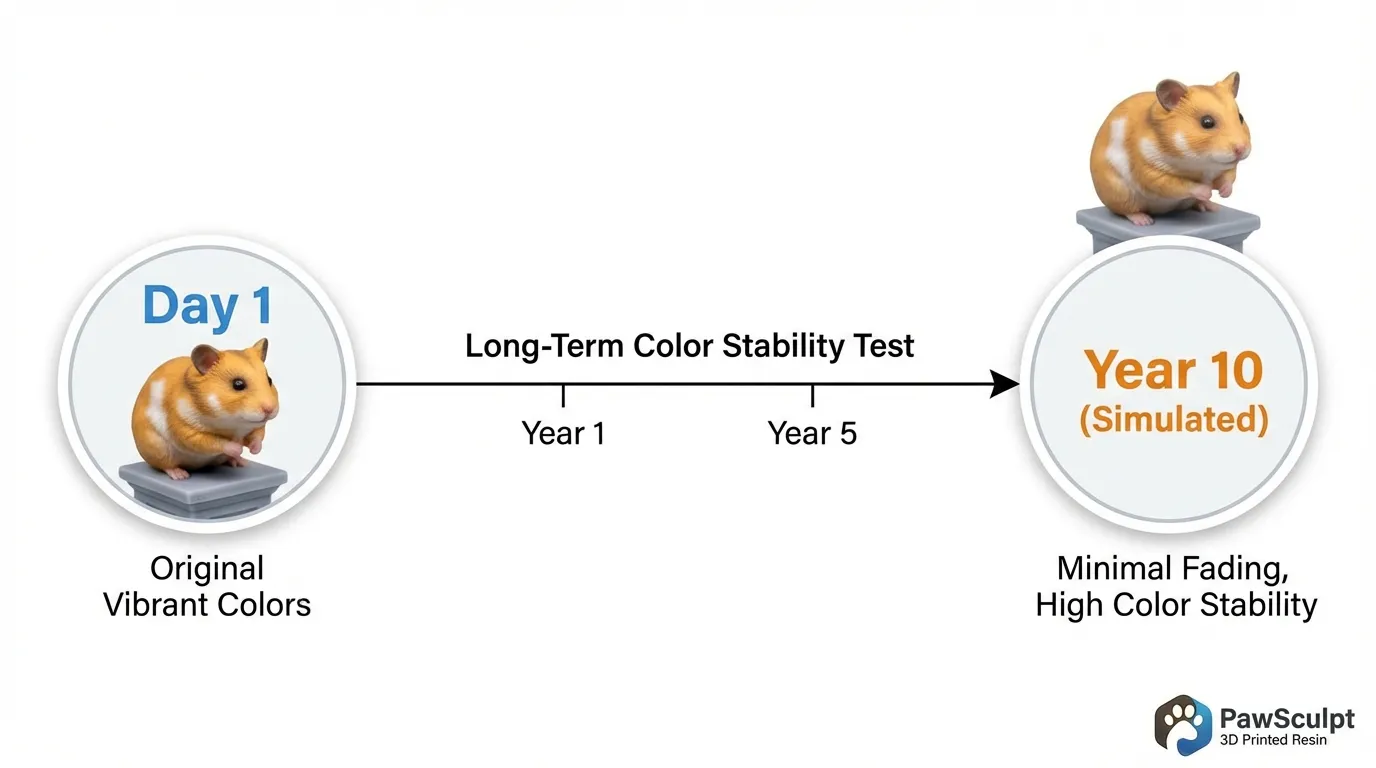
The shelf in my workshop used to hold a row of fading, yellowed prototypes from the early days of 3D printing—a stark reminder of how brittle and unstable those early resins were. Today, looking at a ten-year-old full-color test print of a Syrian hamster next to a brand new one, the difference is negligible, proving just how far archival-quality resins have come.
Quick Takeaways
- UV light is the enemy — Direct sunlight will degrade even the highest quality resin over a decade.
- Micro-climate matters — Stable humidity prevents the microscopic swelling and contracting that causes cracks.
- Handling oils accumulate — The natural oils on your fingers are acidic; handle your custom hamster figurine by the base.
- Cleaning is a dry process — Never use water or solvents; a soft microfiber brush is your best tool.
The Science of "Settling": What Happens in the First 12 Months
When we talk about a hamster figurine aging, we aren't talking about it getting wrinkles. We are talking about polymer cross-linking and UV stability. In the additive manufacturing world, we often say a print isn't "done" when it leaves the printer; it’s merely stable.
The first year is the most critical period for your figurine. This is when the photopolymer resin—the material we use to capture the tiny, intricate details of your hamster's fur texture—fully acclimates to your home environment.
The "Dark Cure" Phenomenon
Most people think curing stops the moment the UV light in the printer turns off. That’s incorrect. There is a process known as "dark curing" where the chemical reaction continues at a microscopic level for weeks.During this phase, the resin achieves its final hardness. For a small subject like a hamster, where we are printing tiny ears and delicate feet, this hardening is beneficial. It makes the extremities less pliable and more durable. However, it also means the material becomes slightly more brittle. A drop that might have bounced in week one could cause a fracture in month six.
"A figurine is a captured moment, but the material itself is living a long, slow chemical life."
The Color Lock
Because PawSculpt uses full-color 3D printing technology—where the pigment is embedded inside the voxel (a 3D pixel) rather than painted on top—the color is incredibly resilient. However, the clear coat we apply is the primary shield. In that first year, that clear coat hardens into a protective shell. If you keep the figurine out of direct sunlight during this window, you essentially "lock in" the vibrancy for the next decade.The 5-Year Mark: The Battle Against UV and Oxidation
Fast forward to year five. If you’ve followed basic care instructions, your hamster figurine should look 99% identical to the day you unboxed it. But if you look under a microscope—as we often do in the shop—you might see the subtle signs of time.
The "Yellowing" Myth vs. Reality
In the early days of 3D printing (think 2010-2015), resins would turn the color of old parchment within two years. It was heartbreaking for collectors.Modern archival resins, like the ones we use, have UV inhibitors chemically bonded into the matrix. However, no polymer is completely immune to the sun. Over five years, if a figurine sits on a windowsill, you might notice a phenomenon called "warming."
White patches—like the belly of a Roborovski hamster—might take on a very faint creamy hue. It’s not the ugly yellowing of cheap plastic; it’s a subtle warming of the tone. Interestingly, many collectors actually prefer this "patina," feeling it gives the object a sense of permanence and history, much like an old oil painting.
Surface Bloom
One thing we occasionally see around the five-year mark in humid climates is "bloom." This looks like a faint, dusty haze on the surface. It’s not dust. It’s actually a microscopic reaction of the clear coat to moisture in the air.The Fix: This is why we tell people never to use water to clean their figurines. If you see bloom, a gentle buffing with a dry, high-grit polishing cloth (like those used for eyeglasses) usually removes it instantly, restoring the sheen.
| Environmental Factor | Impact on Resin (5 Years) | Prevention Strategy |
|---|---|---|
| Direct Sunlight | "Warming" of whites, fading of blacks | Display in indirect light or behind UV glass |
| High Humidity | Surface "bloom" (haze), potential warping | Keep away from bathrooms/kitchens; silica packets |
| Skin Oils | Glossy spots, potential acidity damage | Handle by base only; wipe after touching |
| Heat Fluctuations | Micro-cracking in thin areas (ears) | Avoid placing near radiators or AC vents |
The 10-Year Horizon: Structural Integrity and Material Memory
Reaching the decade mark is a milestone. At this point, the resin has reached its absolute maximum hardness. It is geologically stable.
Brittleness and the "Glass State"
By year ten, the resin has cross-linked as much as it ever will. We call this the "glass state." The material is incredibly strong in compression (you could stack books on it), but it has low shear strength.For a hamster figurine, the risk areas are the ears and the tiny paws. If you are dusting a 10-year-old figurine, you must be gentle. Snapping a resin ear at this stage is more like snapping a dry twig than bending a piece of plastic. It happens instantly and cleanly.
Color Deepening
Here is the counterintuitive insight that surprises most people: heavily pigmented areas often look better after a decade.Because the pigments we use in full-color printing are suspended in the resin, they don't flake off like paint does. Paint sits on top and eventually separates from the surface. Our color is the surface. Over ten years, as the clear coat settles and the resin fully cures, dark colors (like the stripes on a Russian Dwarf hamster) often appear deeper and richer.
"We don't just print a shape; we engineer a memory to withstand the chemistry of time."
— The PawSculpt Team
The Micro-Climate Factor: Where You Display Matters
We have analyzed returns and repairs for years, and we have found a pattern. The longevity of a figurine has less to do with the print quality (which is standardized) and everything to do with the "micro-climate" of the shelf it lives on.
The Radiator Effect
We had a customer whose hamster figurine developed a hairline crack along the base after three years. We were baffled until we asked for a photo of the room. The figurine was on a shelf directly above a radiator.Resin expands and contracts with heat. It does this on a microscopic scale. If you cycle that temperature up and down every day for three winters, the material eventually fatigues.
The Engineer’s Advice: Place your figurine on an interior wall, away from vents, radiators, and windows. The most stable temperature in your house is usually a bookshelf in a hallway or living room, away from the exterior walls.
The Bathroom Mistake
Never, ever display resin art in a bathroom. The humidity cycling—steamy shower, dry air, steamy shower—is torture for additive manufacturing materials. It forces moisture into the microscopic layers of the print (hygroscopy), which can cause delamination over a decade.Cleaning and Maintenance for the Long Haul
If you want your custom figurine to look museum-quality in 2035, you need to rethink how you clean it.
Most people clean things by wiping them. For resin collectibles, wiping is actually abrasive. Over ten years, wiping with a paper towel is equivalent to taking sandpaper to the clear coat. You create millions of micro-scratches that dull the finish and make the fur texture look flat.
The "Air First" Method
1. Blast it: Use a manual air blower (like the ones for camera lenses). This removes 90% of dust without touching the surface. 2. Brush it: Use a high-quality makeup brush or a model-making brush with extremely soft synthetic bristles. Agitate the dust in the fur texture gently. 3. No Liquids: I cannot stress this enough. Do not use Windex. Do not use water. Do not use "plastic safe" cleaners. A dry polish is all you need.Why Full-Color Printing Ages Differently Than Hand-Painting
It is important to understand the distinction in our process because it dictates the aging profile.
In traditional hand-painted miniatures, you have a primer layer, a paint layer, and a varnish layer. These three layers have different thermal expansion rates. Over 10 years, they expand and contract at different speeds, which leads to cracking or peeling paint.
With PawSculpt’s full-color 3D printing, the "paint" and the "canvas" are the same material. The color is defined by the mixture of resins jetted at that specific coordinate. There are no layers to delaminate. This is why we can confidently say our figurines are archival. There is no paint to chip off because the object is solid color through and through.
Frequently Asked Questions
Will my hamster figurine fade if I keep it on my desk?
If your desk is out of direct sunlight, fading will be minimal over 10 years. Indirect ambient light is fine, but direct UV rays (sunbeams hitting the object) will cause gradual lightening of pigments and warming of white areas. We recommend rotating the figurine every few months so any light exposure is even.Can I repair a broken ear on a 10-year-old resin figurine?
Yes, but use cyanoacrylate (super glue) gel, not liquid. Because aged resin is brittle and glass-like, you need a gel that fills the microscopic gaps in the fracture. Apply a tiny dot with a toothpick, hold for 30 seconds, and let it cure for a full 24 hours before moving it again.Why does my figurine feel sticky after a few years?
Stickiness is rare but usually indicates a reaction with cleaning chemicals (like furniture polish) or extreme humidity that has softened the clear coat. Do not wash it. Place it in a dry, cool area with good airflow for a week. If it remains sticky, the clear coat may have been compromised—contact us for advice.Is the resin toxic as it degrades?
No. Once fully cured, the resin is chemically inert. Even as it ages and becomes brittle, it does not off-gas or release toxins. It is perfectly safe to handle, though we always recommend keeping it out of reach of pets who might mistake it for a chew toy.Ready to Celebrate Your Pet?
Every pet has a story worth preserving. Whether you're honoring a beloved companion who's crossed the rainbow bridge or celebrating your furry friend's unique personality, a custom PawSculpt figurine captures those details that make your pet one-of-a-kind.
Free instant AI preview • 3D artist preview within 7 days • 5 free revisions