Why Size Deceives: The Engineering Behind a Stable Greyhound Figurine
You hold your breath as you lift the support structure away from the ankles, the resin still smelling faintly sharp and chemical in the basement air. One wrong move with the flush cutters, just a millimeter of excessive torque, and the delicate front leg of the Greyhound figurine snaps with a heartbreaking tink.
Quick Takeaways
- Physics fights anatomy — Greyhounds have a massive chest-to-ankle ratio that makes standard 3D printing supports risky without engineering adjustments.
- Scale doesn't equal strength — Due to the Square-Cube Law, making a figurine larger actually increases the stress on the legs faster than it increases their strength.
- Digital thickening is invisible — Our artists subtly increase ankle diameter by microns to ensure stability without altering the visual likeness of your pet.
- Orientation matters — We often print long-legged breeds at specific angles to ensure the layer lines don't create weak points across the custom figurine's thinnest areas.
The "Spaghetti Leg" Paradox
We have been in the additive manufacturing trenches for over a decade, and if there is one breed that keeps shop managers awake at night, it is the Sighthound family—Greyhounds, Whippets, Salukis, and Italian Greyhounds.
Most people assume that to make a model stronger, you simply make it bigger. It seems intuitive: a bigger dog means thicker legs, which means a sturdier statue. But in the world of full-color resin 3D printing, this assumption is the enemy of structural integrity.
Here is the counterintuitive insight that most generic printing guides miss: The Square-Cube Law.
When we double the height of a Greyhound figurine, we don't just double its weight—we multiply it by eight (volume increases by the cube of the multiplier). However, the cross-sectional strength of those spindly legs only increases by a factor of four (area increases by the square).
The result? A larger Greyhound print is often structurally weaker relative to its own weight than a smaller one. The torso becomes a massive, solid block of photopolymer resin, all supported by four columns that, while thicker, are now bearing a disproportionately heavier load.
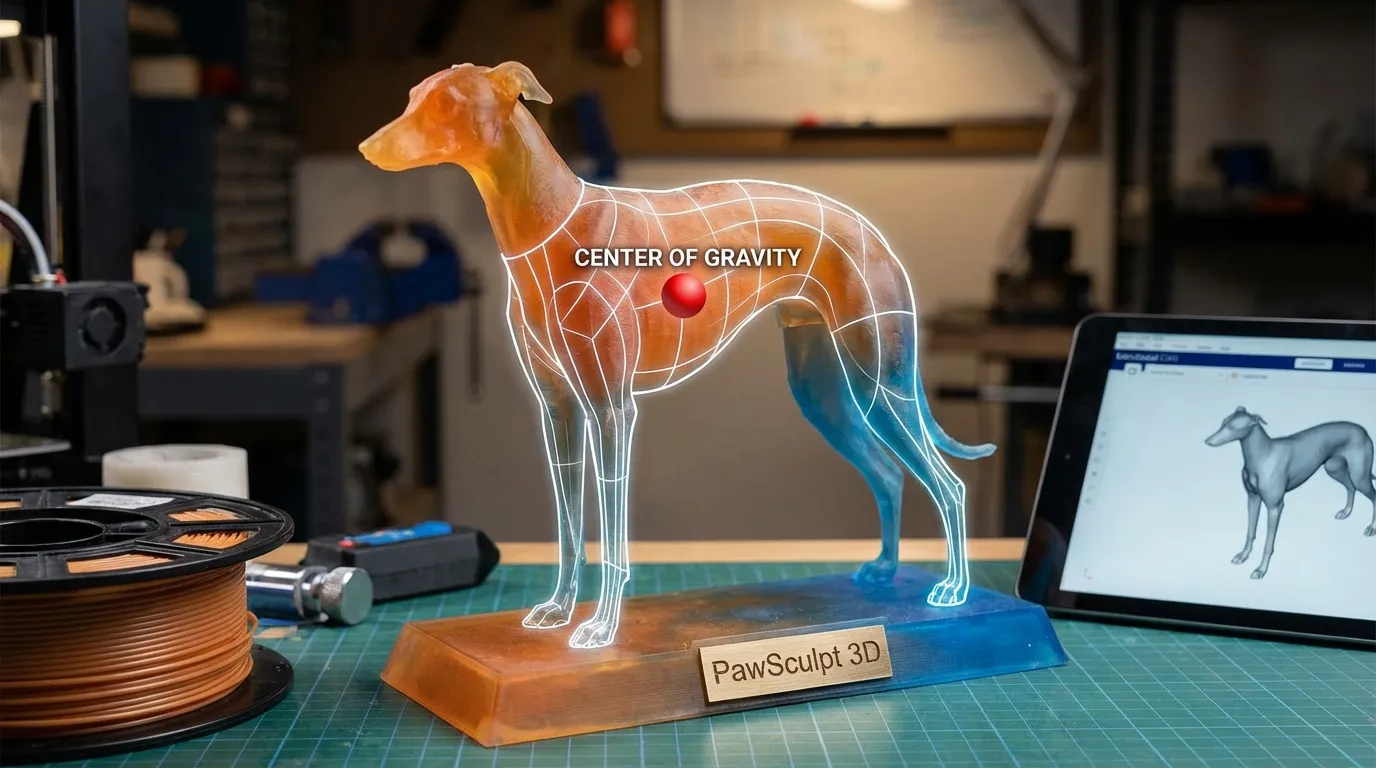
In our shop, we don't look at a Greyhound photo and see just a beautiful dog. We see a cantilevered beam (the neck and head) and a heavy central mass (the deep chest) balancing on high-stress stilts.
Digital Sculpting: The Art of Invisible Engineering
This is where the "custom" in custom figurines becomes a matter of engineering, not just art. When you send us photos of your Greyhound, we don't just run them through an automated scanner. That would result in a print that collapses under its own weight or warps over time.
Our digital artists, working in software like ZBrush, perform a process we call "structural translation."
The 20-Micron Threshold
We have to respect the material properties of the UV-cured resin. While the full-color technology captures the brindle coat or the specific white chest patch perfectly, the resin itself behaves somewhat like a ceramic-plastic hybrid. It is rigid, which is great for detail, but it lacks the flexibility of injection-molded plastic toys.To combat this, we often apply a subtle localized thickening to the ankles and pasterns. We are talking about adjustments often in the 25–50 micron range.
"To the naked eye, the leg looks exactly like your dog's leg. But to the laws of physics, that 5% increase in diameter provides a 20% increase in shear strength."
The "Webbing" Technique
Another trick of the trade involves "webbing." If your Greyhound is sculpted in a running pose, or with one paw raised, the remaining three legs take extreme stress. We often sculpt tiny, almost invisible blades of grass or terrain features that touch the raised heel or the underside of the tail.This isn't just aesthetic; it creates a triangulated support structure. It transfers the load from the heavy chest directly to the base, bypassing the weakest point of the legs.
The Printing Process: Why We Don't Use Brushes
It is vital to correct a common misconception right now. We do not print a white model and then hire an artist to paint it with brushes.
We use full-color additive manufacturing.
Imagine an inkjet printer, but instead of printing on paper, it jets millions of tiny droplets of liquid colored resin that are instantly cured by UV light. It builds the object layer by layer, voxel by voxel (a voxel is a 3D pixel).
Why this matters for Greyhounds:
Because the color is impregnated into the material, we don't have to worry about paint chipping off those thin legs. The black of the nails, the pink of the tongue, and the fawn color of the coat are chemically bonded.However, this process introduces a challenge called "Green State" fragility.
When a print first finishes, it hasn't reached its maximum hardness yet. It is slightly soft. If we print a Greyhound standing perfectly upright, the weight of the wet resin torso can actually cause the legs to bow slightly before they fully cure.
Orientation Strategy
To solve this, we rarely print Sighthounds standing vertically "feet down." We often orient them at a 45-degree angle in the build volume.| Orientation | Pros | Cons (The Trade-off) |
|---|---|---|
| Vertical (Feet Down) | Cleanest surface finish on the back. | High risk of leg warping; heavy support scarring on belly. |
| Horizontal (Side) | Strongest legs (layer lines run length-wise). | One side of the dog requires heavy support removal/sanding. |
| 45-Degree Tilt | The Sweet Spot. Good balance of strength and surface quality. | Requires complex digital support planning. |
Post-Processing: The Danger Zone
This is the part of the process that requires the steadiest hands in the industry. Once the print is done, it is encased in a gel-like support material (or surrounded by powder, depending on the specific machine used that day).
Cleaning a Bulldog is easy; you can blast it with the water jet. Cleaning a Greyhound is surgery.
We cannot use high-pressure water jets on the legs. We have to manually dissolve the support material in chemical baths, often taking twice as long as other breeds. If the resin absorbs too much fluid during this bath, it can swell, leading to cracks later. It is a delicate dance of chemistry and timing.
The Clear Coat Armor
Since we do not paint, the final step is a UV-protective clear coat. For Greyhounds, this isn't just about sheen—it's structural.We use a specialized clear coat that adds a microscopic "shell" to the print. This seals the resin, preventing humidity changes from affecting the thin legs. Resin is hygroscopic (it absorbs moisture from the air). Without this seal, a humid summer day could make those thin ankles soft enough to droop.
"We don't just build these to look like your pet on day one. We engineer them to stand tall on your mantle for decades."
— The PawSculpt Team
Displaying Your Greyhound Figurine: A Safety Guide
We have seen too many heartbreaks where a perfectly engineered print survives shipping only to fail on a bookshelf. Because of the high center of gravity in Greyhound figurines, they are uniquely prone to "toppling vibration."
The "Walking" Phenomenon
If you place the figurine on a shelf that gets walked past frequently, the micro-vibrations can cause the lightweight, hard resin feet to "walk" or slide toward the edge over months.Our Recommendation: Use a tiny dab of museum wax or quake putty under each paw. This anchors the lightweight legs and prevents the "tink" of a fall.
Sunlight and Brittleness
While our clear coat is UV resistant, no resin is UV proof. Direct sunlight is the enemy of thin resin structures. UV rays continue the "curing" process, making the resin harder and harder until it becomes brittle like glass. For a thick object, this doesn't matter much. For a 3mm Greyhound leg, it means a slight bump could cause a clean snap years down the road.Why We Go Through This Trouble
You might wonder why we don't just refuse to print Sighthounds, or why we don't just make them out of solid blocks.
We do it because the silhouette of a Greyhound is one of the most elegant forms in nature. The curve of the spine, the deep tuck of the abdomen, the intelligent, aerodynamic head—capturing that in 3D is a triumph of both art and engineering.
When we see a finished Greyhound figurine, standing proud and stable, showcasing that unique brindle pattern that only full-color 3D printing can achieve, we know we have preserved a memory in a way that defies the fragility of the medium.
"Physics tries to pull them down. Love (and good engineering) keeps them standing."
Frequently Asked Questions
Are Greyhound figurines more fragile than other breeds?
Yes, simply due to physics. A Bulldog has a low center of gravity and thick legs; a Greyhound is top-heavy with thin supports. While we engineer them to be stable, they are "display pieces," not toys. We recommend placing them in a spot where they won't be bumped.Do you hand-paint the brindle patterns?
No. We use advanced full-color 3D printing. The complex brindle stripes or ticking on your dog's coat are printed directly into the resin voxel by voxel. This allows for soft gradients and fur textures that are nearly impossible to achieve with hand-painting.Can I order a life-size Greyhound statue?
We generally advise against massive scales for this specific breed in resin. As mentioned regarding the Square-Cube Law, the weight increases faster than the leg strength. Our standard desktop sizes (4 inches to 8 inches) are the "Goldilocks zone" for structural integrity and detail.How do I clean my figurine safely?
Never use water or liquid cleaners on the thin legs of a Greyhound figurine. Use a soft, dry microfiber cloth or a soft makeup brush (like a blush brush) to gently dust it. Liquids can seep into micro-pores and cause swelling over time.Ready to Celebrate Your Pet?
Every pet has a story worth preserving. Whether you're honoring a beloved companion who's crossed the rainbow bridge or celebrating your furry friend's unique personality, a custom PawSculpt figurine captures those details that make your pet one-of-a-kind.
Free instant AI preview • 3D artist preview within 7 days • 5 free revisions