The Busy Owner's 6-Step Plan to Gently Retrain an Aging Mini Pig
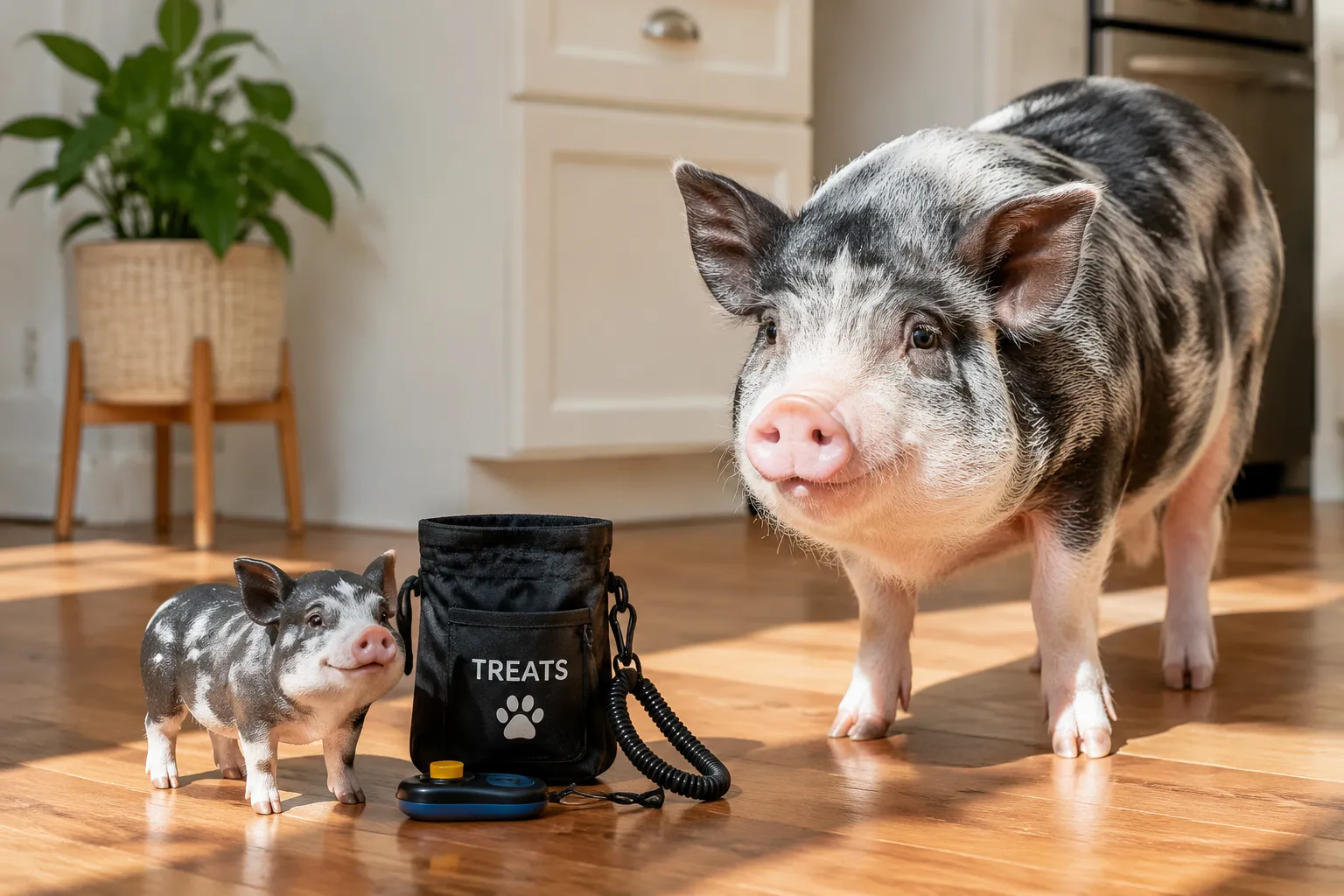
You find her at the bottom of the basement stairs at dawn, gray muzzle pressed to cold concrete, ignoring the bowl she used to charge. This is where mini pig training gets real—not with a piglet, but an aging pig who's decided the old rules no longer apply.
Quick Takeaways
- Most "stubbornness" in older pigs is pain or sensory loss — check the body before blaming the brain.
- Short beats long — five focused minutes twice a day outperforms a weekend marathon for senior pet retraining.
- Swap visual cues for scent and touch — aging eyes fail first, so retrain through the nose.
- Consistency across your whole household decides whether retraining sticks or quietly unravels.
- Capturing your pig's personality now matters — many families preserve it with custom pet figurines before age changes their shape entirely.
What Nobody Tells You About Retraining an Older Mini Pig
Here's the thing most articles skip: an aging mini pig who "won't listen" is rarely being defiant. We've talked with enough pig families through our studio to spot the pattern. The pig isn't ignoring you. The pig literally can't read the cues that used to work.
Mini pigs are smart—genuinely smart, somewhere in the range of a toddler or a clever dog. That intelligence is exactly why retraining a senior pig feels so personal. When a smart animal stops cooperating, we assume attitude. We assume the relationship soured. We start using the word "stubborn" like a diagnosis.
It usually isn't attitude. It's biology.
Around age 7 to 12, mini pigs slide into their geriatric years, and their sensory world quietly shrinks. Vision dims. Hearing dulls. Joints stiffen. The hand signal you spent two years perfecting? She may not see it clearly anymore. The verbal "come" you trained from across the yard? Half the consonants don't land.
So the real work of mini pig training in old age isn't teaching new tricks. It's re-translating the language you already share into channels that still work.
That's the angle we want you to sit with. You're not starting over. You're updating the firmware.
"An old pig who won't obey isn't broken. The signal just stopped reaching her—so change the signal."
Why this hits busy owners hardest
Let's be honest about your reality. You've got a job, maybe kids, a commute, a phone that won't stop. The original training happened when you had a piglet and, presumably, more patience and bandwidth. Now you're squeezing pet care into the cracks of a packed life.
The good news—and we mean this—busy owners often retrain seniors faster than they expect. Not despite the time crunch, but because the time crunch forces the right habits: short sessions, clear goals, no overtraining. Pigs hate long drills. So do tired humans. Your constraints and her preferences actually line up.
The trap is guilt. We hear it constantly from the families we work with—the sense that they "let things slide" and now the pig is paying for it. Drop that. Aging changes behavior in every species. You didn't cause it. You just get to respond to it.
The Hidden Cause Behind Most Geriatric Pet Behavior Changes
Before we hand you the six steps, you need the frame that makes them work. Because if you skip this part, you'll train the wrong problem.
A family reached out to us about a 9-year-old pig who'd started "refusing" to climb onto her favorite couch—the one she'd launched herself onto for years. They assumed she was sulking after a vet visit. Turns out she had early arthritis in her hind legs. The couch wasn't a behavior issue. It was a ramp issue.
This is the core of geriatric pet behavior: what looks like a choice is often a limitation. And mini pigs, being prey animals, are masters at hiding pain. They evolved to look fine right up until they can't. So by the time you notice a behavior shift, the underlying cause has usually been building for weeks.
The three sensory shifts that rewrite the rules
Three changes do most of the damage to your old cues. Understanding them turns confusing behavior into a solvable puzzle.
Vision goes first, and it goes subtly. Cataracts and general decline mean hand signals, pointing, and anything at a distance lose their punch. A pig who "ignores" you from across the room may simply see a fuzzy shape making fuzzy movements.
Hearing fades next. Your pig might still respond to low, rumbly tones while missing higher-pitched words entirely. The classic sign: she reacts to the fridge door but not to her name.
Joints and gut slow down. Arthritis makes "sit," "spin," and stairs genuinely uncomfortable. Slower digestion changes appetite, which changes how much your food rewards even matter.
Here's the part worth a screenshot:
"Aging doesn't make a pig forget the lesson. It changes the classroom she's sitting in."
The American Veterinary Medical Association has solid general guidance on senior pet care and what to watch for, and it's worth a read before you assume any behavior shift is "just personality." We're not vets—so anything sudden, painful-looking, or paired with appetite or bathroom changes deserves a real exam, not a training plan.
Myth vs. Reality
Let's bust the three misconceptions we hear most from pig families.
Myth: "Old pigs can't learn new things."
Reality: They learn beautifully—often faster than piglets because they're calmer and more food-motivated. What changes is the channel, not the capacity.
Myth: "If she stopped doing it, she's testing my authority."
Reality: Pigs don't run dominance campaigns the way myths suggest. A dropped behavior almost always traces back to discomfort, confusion, or a cue she can no longer perceive.
Myth: "Retraining means long, daily training sessions."
Reality: For seniors, less is more. Two five-minute sessions beat one thirty-minute slog every single time, and they fit a busy life better anyway.
The Busy Owner's 6-Step Plan for Senior Pet Retraining
Now the plan. Six steps, built for someone with a full calendar and a pig who needs a gentler approach. Work them in order the first time through—each one sets up the next.
We've organized this so you can run the whole thing in under fifteen minutes a day. That's the promise. No weekend bootcamps, no guilt about the hours you don't have.
Step 1: Audit the Body Before You Touch the Behavior
Start here or everything downstream breaks. Within the first 48 hours of noticing a behavior change, do a slow, hands-on body check and book a vet conversation if anything seems off.
Run your hands down her spine, hips, and legs. Watch how she rises from lying down—does she favor a side, hesitate, or grunt? Note whether she's eating with her usual gusto. Check her eyes in good light for cloudiness.
The micro-story that sticks with us: one family spent three frustrated weeks "retraining" their pig to use a litter area again, convinced she'd regressed. A vet visit found a urinary infection. Two weeks of treatment and the "training problem" vanished on its own.
So what? Because training a pig through pain doesn't just fail—it teaches her that your cues now mean discomfort. You can poison years of good association in a few bad sessions. Rule out the body first. Always.
Step 2: Shrink the Session, Not the Standard
This is where busy owners win. Your busy owner training plan isn't a compromise—it's the optimal approach for an aging pig.
Aim for two sessions of three to five minutes, ideally tied to existing routines: one before breakfast, one before dinner. Pigs are sharpest when slightly hungry and motivated by food. Keep your standards high but your duration tiny.
End every session while she's still winning. The moment she nails a cue twice in a row, stop. Walk away on a high note. Pigs remember how a session ended far more than how long it lasted.
What actually helps more than adding time? Adding clarity. A blurry five-minute session does nothing. A crisp three-minute session with one clear goal—"today we only work on the touch cue"—moves mountains.
"You don't need more time with an old pig. You need smaller, sharper moments."
So what? Long sessions exhaust her joints and her attention, and they sour the whole exercise. Short and frequent builds the habit loop without the burnout—for both of you.
Step 3: Trade Vision Cues for Scent and Touch
Here's the counterintuitive move that changes everything, and almost no standard guide mentions it. Stop relying on your eyes-based cues and rebuild around the nose.
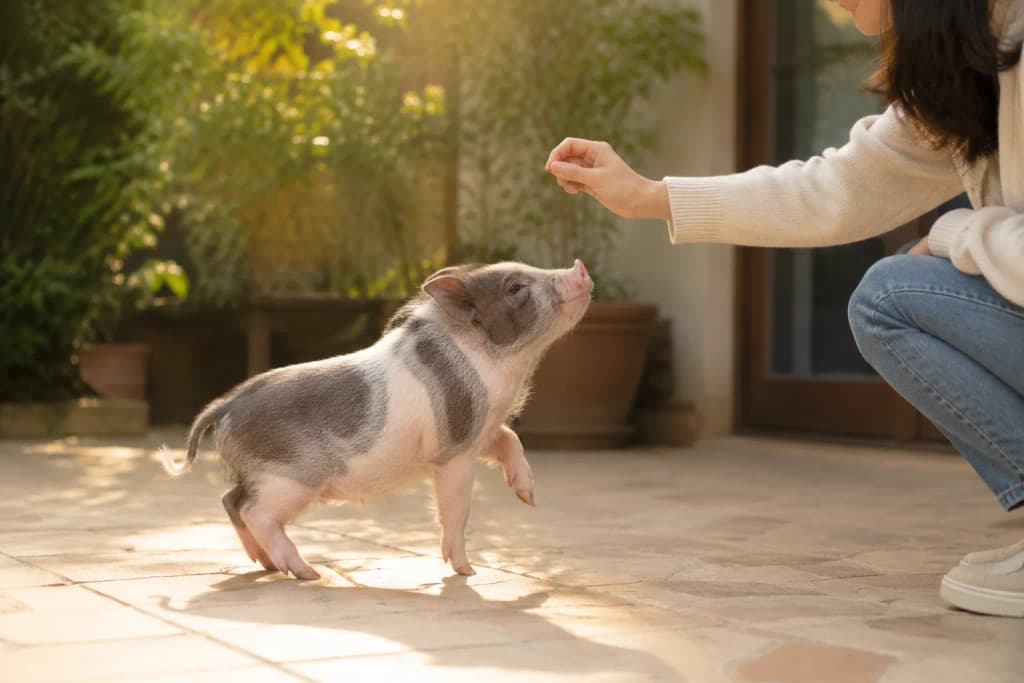
A mini pig's sense of smell is extraordinary—it's how they're famously used to find truffles underground. While her vision and hearing fade, her nose stays remarkably sharp deep into old age. So make scent and touch the new foundation of your communication.
Practical translations:
- Replace a distant hand signal with a target stick she can smell and nose-touch. Rub a tiny bit of a favorite food on the tip.
- Replace calling her name across the room with walking close and using a gentle, consistent touch on the same spot—say, two taps on the shoulder—paired with a low verbal cue.
- Use scent trails for movement cues: a small treat path guiding her up a ramp instead of pointing at it.
One family we worked with had a nearly blind 11-year-old pig who seemed "lost" and anxious. They switched her entire cue set to touch-based signals and scent markers on her favorite spots. Within about three weeks, the anxiety faded. She wasn't disobedient. She'd just been navigating a world she could no longer see.
So what? When you train through the channel that still works, "stubborn" disappears. You stop fighting her biology and start working with it.
Step 4: Rebuild One Routine Anchor at a Time
Resist the urge to fix everything at once. Pick the single most important routine and rebuild only that until it's solid—usually one to two weeks per anchor.
For most families, the priority anchors are, in rough order: bathroom routine, coming when cued, settling calmly, and safe movement around stairs or furniture. Choose the one whose breakdown causes the most daily friction.
Say bathroom habits slipped. You'd rebuild only that: consistent timing, a scent-marked spot, immediate reward, zero focus on anything else for two weeks. Once it's reliable, add the next anchor.
Why one at a time? An aging brain—pig or otherwise—handles change better in small doses. Pile on three retraining goals and you'll confuse her and frustrate yourself. Sequential beats simultaneous for seniors, every time.
Here's a rough sequencing guide we share with families:
| Routine Anchor | Typical Rebuild Time | Best Cue Channel | Busy-Owner Tip |
|---|---|---|---|
| Bathroom/litter habits | 1–2 weeks | Scent + timing | Tie to your own bathroom trips |
| Coming when called | 2–3 weeks | Touch + low voice | Practice during meal prep |
| Settling/calm on cue | 1–2 weeks | Touch + mat scent | Use during your evening wind-down |
| Safe stair/furniture use | 2–4 weeks | Scent trail + ramp | Add a ramp before retraining |
So what? Focus compounds. One rock-solid anchor gives her confidence that spills into the next, and gives you a visible win that keeps you going.
Step 5: Reward the Try, Not Just the Result
Old pigs need a new reward bar. If you only pay out for perfect execution, you'll rarely pay out—and she'll quit trying.
Start rewarding effort and approximations. She shuffles two steps toward you instead of coming all the way? Reward it. She lifts her head toward the touch cue? Reward it. You're not lowering standards permanently. You're rebuilding momentum from where her body actually is today.
We saw this with a family whose senior pig had stopped responding to "come" entirely. They'd been holding out for the full crossing of the room. Once they started rewarding the first step, she rebuilt the whole behavior in about ten days. The reward was the missing fuel.
Watch your reward value, too. Slower digestion means she may need smaller, higher-value treats—a sliver of something special rather than a handful of kibble. A pig who's not hungry won't work, no matter how smart she is.
"Reward the effort and the behavior will follow. Pay only for perfection and you'll wait forever."
So what? Effort-based rewards rebuild a pig's belief that participating is worth it. That belief, not the treat itself, is what you're actually training.
Step 6: Protect the Wins Across the Whole Household
This is the step that quietly decides everything—and the one busy households blow most often. Everyone who interacts with your pig has to use the same cues.
If you've switched "come" to two shoulder taps plus a low "here," but your partner still calls her name from across the kitchen and your teenager points, you've handed your pig three different languages. She'll default to confusion, and you'll wonder why retraining "stopped working."
Write the new cue set on a sticky note on the fridge. Seriously. Three lines, plain words: what the cue is, how to deliver it, what to reward. Everyone follows it. No freelancing.
This is also where the community piece matters. You are genuinely not alone in this—pig forums and senior-pet groups are full of families navigating the exact same shift. Many owners report that the household-consistency step was the real unlock, not any single training trick.
So what? A pig can't relearn a cue that keeps changing. Consistency is the soil everything else grows in. Get the whole house aligned and the previous five steps finally hold.
A Realistic Weekly Rhythm for the Busy Owner Training Plan
Plans fail when they don't fit real life. So here's what a doable week actually looks like—the kind we've seen families stick with for months, not days.
| Time Slot | Duration | Focus | Why It Works |
|---|---|---|---|
| Before breakfast | 3–5 min | Current anchor cue | Pig is hungry and sharp |
| Midday (optional) | 2 min | Quick touch-cue refresh | Keeps the channel warm |
| Before dinner | 3–5 min | Same anchor, slight progression | Reinforces morning's work |
| Evening wind-down | 5 min | Settling + bonding, no pressure | Builds calm association |
Notice the total: roughly fifteen minutes a day, broken into pieces you barely feel. That's the whole point. Senior pet retraining isn't about heroic effort. It's about small, repeated, well-aimed moments stacked over weeks.
And honestly? The evening wind-down session is our favorite. It's less training and more just being together—the part of pet ownership that got you a pig in the first place.
"We've watched hundreds of pigs age, and the ones who adapt best aren't the smartest—they're the ones whose people slowed down with them."
— The PawSculpt Team
What Changes Emotionally When You Retrain an Aging Pig
We'd be doing you a disservice if we made this purely tactical. Because something else happens when you start retraining a senior pig, and the families we work with rarely see it coming.
You start noticing the clock.
Watching her hesitate at stairs she used to vault, seeing the gray spread across a snout that used to be solid black, adjusting cues for ears that don't catch your voice anymore—it lands. This animal is getting old. The retraining process forces a kind of tenderness that day-to-day busy life usually buries.
Many owners describe a strange mix of emotions here. Patience and grief, sitting side by side. Frustration on the hard days, then guilt for the frustration. A fierce, sudden urge to hold onto this somehow. If that's you, you're in good company. It's one of the most common things we hear.
This is the moment a lot of families start thinking about preservation—not in a morbid way, but a loving one. They photograph more. Some keep a journal of her quirks. And increasingly, pet parents choose tangible keepsakes like custom 3D pet figurines that capture a pig's exact markings and posture while she's still here to enjoy the attention.
We're a figurine studio, so yes, we have a stake in this. But we say it because it's true: the families who commission a piece during their pig's senior years almost never regret it. The ones who wait sometimes do.
"The right time to preserve your pet's personality is while it's still filling the room."
How we capture an aging pet's likeness
If you do go this route, a quick honest explainer on how it works, since the technology gets misrepresented a lot.
We don't paint figurines. There's no brush involved. Your pig is digitally sculpted by master 3D artists from your photos, then precision 3D printed in full color—the color is part of the resin itself, printed voxel by voxel, not layered on top afterward. The only manual step is a protective clear coat for sheen and durability.
What that means for you: the full-color resin 3D print captures your pet's unique markings, the specific gray creeping across her muzzle, the exact set of her ears, with a natural print texture that reads as authentic rather than glossy-plastic-perfect. For an aging pig whose appearance is changing month to month, that accuracy matters.
The practical tip: good photos make or break the result. Natural daylight, several angles, eye-level shots, and at least one clear view of her distinctive markings. You can see how the whole process works and what to send over on the PawSculpt site—we'd rather you understand it than take our word for it.
The Visual Story of an Aging Pig (And Why It's Worth Recording)
Let's slow down on the visual for a second, because it's where the emotion actually lives.
Watch the light change on an old pig. Morning sun catches the silvered bristles along her spine in a way it never did when her coat was uniform and dark. The cloudiness in her eyes has a soft, opaline quality—not sad, exactly, just different. The way her shadow pools differently now that she moves slower, lower to the ground.
These are the details that fade from memory first. Not the big moments—the texture. The specific weight of her against your leg. The particular tilt of her head when she's working out a cue through scent instead of sight.
This is why we keep nudging families toward recording it somehow, whether that's video, a flood of phone photos, or a physical keepsake that freezes one moment in full dimension. The American Kennel Club's broader writing on the human-animal bond gets at why this matters so much—these relationships rewire us, and we grieve the loss of their physical presence in surprisingly bodily ways.
You don't have to commission anything. But do record it. Future-you will be grateful in ways present-you can't quite imagine yet.
Common Mistakes That Quietly Sabotage Senior Pig Retraining
A few traps we see over and over. Skim these even if you skim nothing else.
- Training through undiagnosed pain. The number one error. Body audit first, always.
- Marathon sessions out of guilt. Long drills exhaust aging joints and attention. Short wins.
- Clinging to visual cues. If her eyes are failing, your hand signals are noise. Switch channels.
- Inconsistent household cues. Three people, three languages, zero progress.
- Rewarding only perfection. You'll wait forever and she'll stop trying.
- Comparing her to her younger self. You're training the pig in front of you, not the one in your memory.
That last one is more emotional than tactical, we know. But it's real. The grief of watching capability fade can make you train at the pig you miss instead of with the pig you have. Meet her where she is. That's the whole game.
When to Call in Help
We're a figurine company, not a veterinary clinic, so here's our honest boundary: some situations need a professional, and pretending otherwise would be irresponsible.
Loop in your vet if you see sudden behavior changes, signs of pain, appetite or bathroom shifts, or disorientation that seems neurological. Cognitive decline is real in older pigs, and it looks a lot like "training problems" but needs a completely different approach. The ASPCA and your local exotic-pet vet are better first calls than any blog—ours included—when something seems medically off.
For pure behavior and retraining, a certified animal behaviorist who has worked with pigs (not just dogs) can be worth every penny if you're stuck after a few weeks of honest effort. Pigs are specialized. Generic obedience advice often misses.
Frequently Asked Questions
Why is my older mini pig suddenly not listening to me?
In most cases, it's not defiance. Aging mini pigs lose vision and hearing before anything else, so the hand signals and verbal cues you've always used simply aren't landing anymore. Arthritis pain is another frequent culprit. Audit her body, then shift your cues to scent and touch before you ever conclude it's a behavior issue.
Can you really retrain a senior mini pig?
Absolutely. Pigs stay sharp and food-motivated deep into their senior years, so the ability to learn barely fades. What changes is the channel you communicate through. Rebuild your cues around her nose and a gentle, consistent touch, keep sessions short, and most older pigs adapt within a few weeks.
How long should each training session be for an aging pig?
Three to five minutes, twice a day, is the sweet spot. Tie them to mealtimes when she's hungry and motivated, and always stop while she's still succeeding. Long sessions tax aging joints and attention, and they sour the whole experience. Short and frequent wins for senior pet retraining.
Is it normal for my mini pig's behavior to change as she ages?
Yes. Dulling senses, stiffening joints, and slower digestion all shift behavior, and that's a normal part of geriatric pet behavior. That said, anything sudden—sharp appetite drops, bathroom changes, apparent pain, or disorientation—deserves a vet visit, because pigs are experts at masking discomfort until it's serious.
What if I'm too busy for a full training routine?
You're actually better positioned than you think. A busy owner training plan of about fifteen minutes a day, broken into a few short sessions around your existing schedule, outperforms long weekend drills. Constraints force the clarity and brevity that aging pigs respond to best.
Ready to Celebrate Your Pet?
Every pet has a story worth preserving. Whether you're navigating the gentle work of mini pig training in her senior years or simply celebrating the quirks that make her unmistakably her, a custom PawSculpt figurine captures the exact markings, posture, and personality that age will eventually change.
Visit pawsculpt.com to explore our full-color 3D printing process, flexible revisions, and quality guarantee.