
7 First-Aid Truths Vets Wish Multi-Cat Homes Knew About Their Geriatric Sphynx
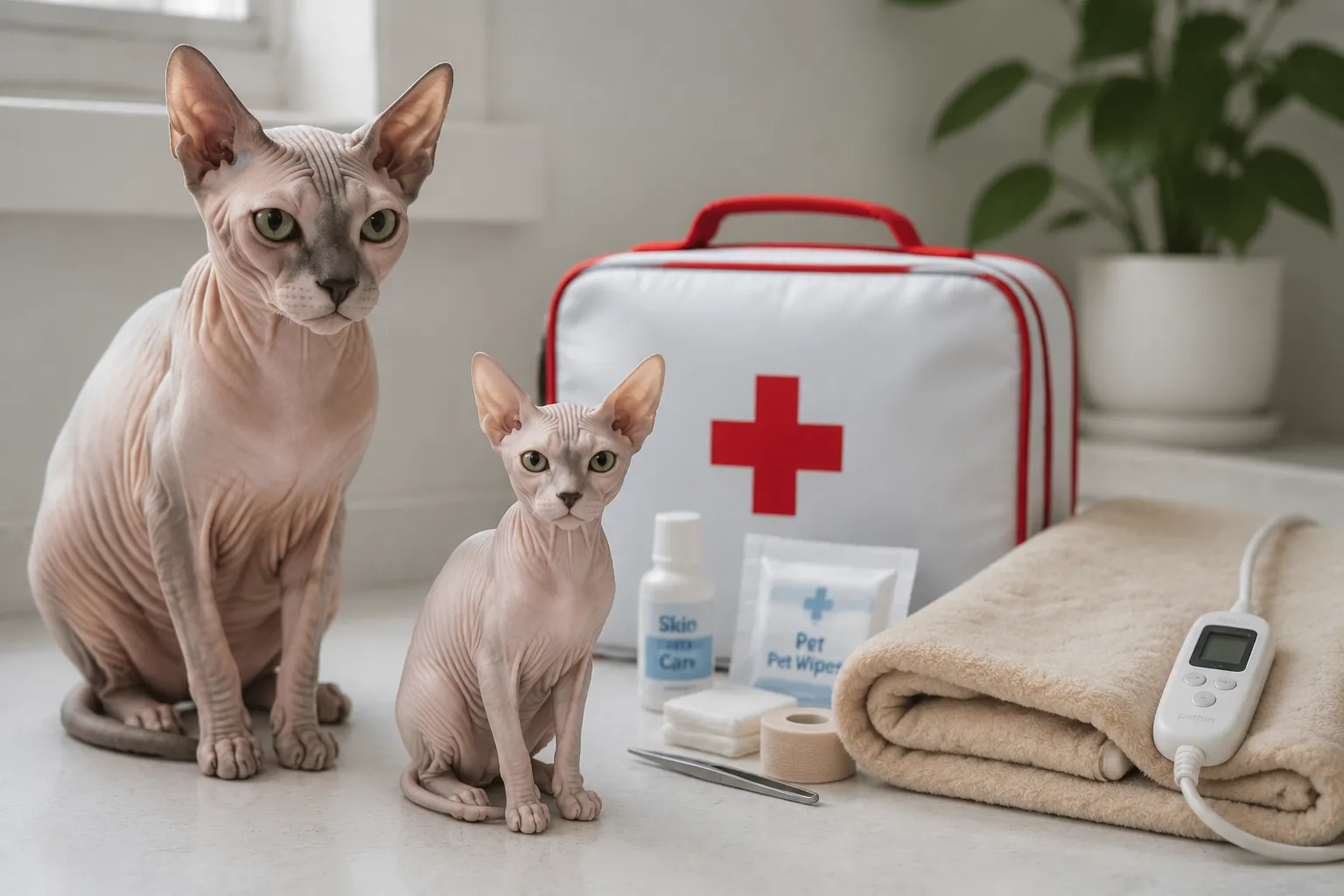
The exam room clock ticked while a fourteen-year-old Sphynx named Pixel pressed her bare, warm body against the steel table, and her owner realized she'd never learned the basics of sphynx first aid until that moment. Two years earlier, that same cat had vaulted onto countertops. Now she trembled at a draft.
Quick Takeaways
- Naked skin changes the rules — temperature swings and wounds show faster on a Sphynx than coated breeds.
- Geriatric Sphynx need a warm "first-aid baseline" — know their resting body heat before a crisis hits.
- Multi-cat homes hide illness — a sick senior masks symptoms harder when competing for resources.
- Build a Sphynx-specific kit and keep records of your pet's quirks — the kind of detail captured in custom pet figurines is the same detail vets beg you to notice while your cat is still here.
- Sound is your earliest warning — a change in breathing or grooming noise often beats visible symptoms.
Why a Geriatric Sphynx Breaks Every First-Aid Rule You Learned
Here's the thing nobody warns you about when you bring home a Sphynx. The advice that works for a tabby or a Maine Coon can actively hurt your hairless cat, especially once they cross into their senior years around age eight to ten.
We've talked with thousands of pet families over the years, and the Sphynx owners always tell the same story. They read the general cat first-aid guides. They bought the standard kit. Then a real emergency hit and half of what they'd prepared was useless.
A coated cat carries its own insulation, its own first layer of wound protection, its own buffer against the world. A Sphynx walks through life with none of that. Their skin is the front line, exposed to everything, all the time.
So what? So a scratch that would vanish under a Persian's fur becomes a visible, infection-prone wound on a Sphynx within hours. A cold snap that a Bengal shrugs off can drop a geriatric Sphynx into dangerous hypothermia overnight.
"A Sphynx tells you everything its body is feeling. You just have to learn to read skin the way other owners read fur."
The aging part makes it sharper still. Older Sphynx lose the little fat padding they had. Their skin gets thinner, more papery. They feel cold faster and heal slower. And in a house with other cats, all of this happens while your senior is busy pretending nothing's wrong.
That pretending is survival instinct. In the wild, the sick animal gets pushed out. Your living room is not the wild, but your cat's nervous system never got that memo. In a multi-cat household, the geriatric Sphynx works overtime to look fine, because looking fine is how you keep your spot near the food bowl and the warm blanket.
This is the angle most articles miss entirely. They treat Sphynx first aid like generic cat first aid with a note about sunburn tacked on. The reality is that the hairless, aging, socially-competing cat is a completely different patient, and the seven truths below come straight from what veterinarians wish every multi-cat home understood before the emergency, not during it.
Truth #1: That "Cold" Cat Might Be in Real Trouble
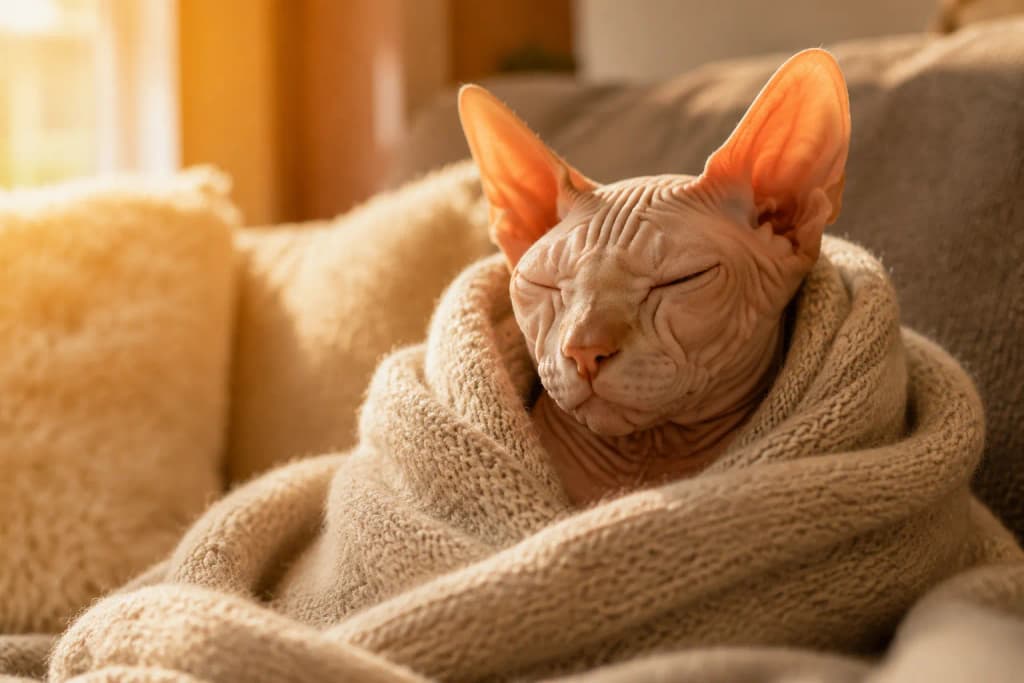
Picture this. It's 2 a.m. in February. Your Sphynx, who normally burrows under the duvet, is sitting alone in the middle of the kitchen floor, hunched, still. No blanket. No heat vent. Just sitting.
Most owners see this and think the cat is being weird. Cats are weird, after all. But for a geriatric Sphynx, a cat who stops seeking warmth is a cat who may be too weak or too sick to thermoregulate.
A healthy Sphynx is a heat-seeking missile. They pile into laundry baskets, steal the sunny spot, sleep on your neck. When that behavior changes, the change itself is the symptom.
Know Your Cat's Normal Number
Here's a piece of insider knowledge that almost no first-aid guide mentions. You should know your cat's resting body temperature when they're healthy, ideally written down somewhere you can find at 2 a.m.
A cat's normal range runs roughly 100.5°F to 102.5°F. But individual cats live at their own set point within that band. If your Sphynx normally runs at 101.8 and you measure 99.5 during an emergency, that drop tells you something is wrong even though the number is technically "in range."
We're not vets, so for anything involving an actual temperature reading and what to do about it, your veterinarian is the authority. But knowing the baseline gives you and the vet a real data point instead of a guess.
The Warming Mistake That Backfires
Most people's instinct with a cold cat is to crank the heat fast. A heating pad on high. A hot water bottle straight against the skin.
For a Sphynx with thin, fragile senior skin, that's how you trade hypothermia for a burn. What actually helps more is gentle, gradual warming: a towel-wrapped warm (not hot) water bottle, body heat, a warm room. Slow and steady.
The "So what?" here is brutal in its simplicity. Get the warming wrong and you've added a second injury to a cat who was already in distress.
"With a hairless cat, your hands are the thermometer you always have with you. Learn what warm feels like before you need to know what cold means."
Truth #2: Skin Wounds Are Louder and Faster Than You Think
A family we worked with told us about the morning they found a streak of dried blood on their white couch cushion. No yowling in the night. No drama. Just evidence. Their two cats had a brief disagreement and the Sphynx came away with a scratch that, on any furred cat, would've been invisible.
This is the double edge of hairless skin. You see wounds immediately, which is good. But the same exposed skin means wounds get contaminated, irritated, and infected faster because there's no fur barrier holding the first line.
Multi-Cat Math Makes It Worse
In a single-cat home, you'd probably notice a scuffle. In a multi-cat household, especially with three or more, micro-conflicts happen constantly and quietly. A swat near the food bowl. A territorial nip on the cat tree. Your senior Sphynx, slower now, loses these exchanges more often than they used to.
The geriatric cat that once dominated the household hierarchy may be slipping down the ranks. Younger cats sense weakness. And your Sphynx, being naked, wears every consequence on their skin.
What vets wish you knew: examine your Sphynx's skin daily, the way you'd brush a long-haired cat daily. Run your hands over them during your evening cuddle. You're feeling for warmth, swelling, scabs, and the small wet spots that signal a wound you can't see in dim light.
A Simple Wound Triage You Can Actually Remember
When you find a wound, the question isn't "is this an emergency or not." It's more useful to sort it like this:
| Wound Type | What You See | First Move | Vet Urgency |
|---|---|---|---|
| Surface scratch | Thin red line, no depth | Gentle clean, monitor | Watch 24-48 hrs |
| Puncture (bite) | Small hole, may close over | Do not seal it; keep open to drain | Call vet promptly |
| Abscess forming | Warm, swollen, painful lump | Warm compress, no squeezing | Vet within a day |
| Deep/gaping | Visible tissue, heavy bleeding | Pressure, then transport | Emergency now |
The counterintuitive one is the puncture. People want to clean a bite wound and watch it close up neatly. But a bite that seals over traps bacteria underneath and becomes an abscess, which is far worse than the original puncture. Cat-bite punctures are notorious for this. When in doubt, that's a call to your vet, not a wait-and-see.
Truth #3: The Soundtrack of Your House Tells You When Something's Wrong
Close your eyes and think about the sounds your cat makes in a normal day. The specific thump when they land off the windowsill. The wet rhythm of grooming. The particular pitch of the meow that means "feed me" versus the one that means "I'm bored."
You know this soundtrack by heart even if you've never thought about it consciously. And changes in that soundtrack are often your earliest first-aid warning, earlier than anything you'd see.
What the Absence of Sound Means
A Sphynx grooms. Not as dramatically as a furred cat, but they lick, they clean, they make that small rhythmic sound. When a senior cat stops grooming, the quiet that replaces it is information. Pain, nausea, weakness, and dental disease all show up first as a cat who simply goes silent in their self-care.
One pattern we hear constantly from senior-cat owners: "I didn't realize how much noise she made until she stopped." The missing landing-thump because the cat no longer jumps. The missing chirp at the window. Geriatric decline announces itself through subtraction, the sounds that fade out one by one.
The Breathing Sounds That Mean Move Now
Some sounds demand immediate action. Learn these, because they cut across breed and age:
- Open-mouth breathing — cats almost never pant; this is a red flag
- Wheezing or whistling on the inhale or exhale
- A new "click" or rattle in the chest
- Rapid, shallow belly-breathing at rest
A geriatric cat at rest should breathe roughly 15 to 30 times per minute. Count it during a calm moment so you know the normal. If you ever count significantly higher while your cat is resting (not after play), that's a same-day vet conversation.
The "So what?" is that respiratory distress in cats escalates fast and hides well. By the time a cat looks obviously distressed, they've often been compensating quietly for a while. The sound changes come first.
"Cats don't get louder when they're dying. They get quieter. Learn the silence as carefully as you learned the purr."
Truth #4: In a Multi-Cat Home, Your Senior Is an Expert at Lying
Let's talk about the thing that catches even attentive owners off guard.
A solo cat that feels lousy will often just feel lousy in the open. A cat in a competitive household does the opposite. They mask. They show up at the food bowl on schedule even when nauseated, because skipping a meal in a multi-cat home can mean losing access to that bowl. They keep using the high perch even when their joints scream, because surrendering territory has social costs.
This means the multi-cat environment actively delays your detection of illness. The very thing that makes your home rich and full for your cats also makes your sick senior harder to read.
Resource Mapping: The Trick Vets Use
Here's something borrowed from feline behavior medicine that almost no first-aid article covers. Map your resources and watch who uses what.
The rule of thumb is one of each key resource per cat, plus one extra, spread across the home:
| Resource | Multi-Cat Rule | Why It Matters for a Sick Senior |
|---|---|---|
| Litter boxes | One per cat + 1 | A monitored box reveals urinary/GI problems early |
| Food stations | Separated, not clustered | Lets you see who's actually eating |
| Water sources | Multiple, away from food | Senior kidney issues = increased thirst |
| Resting spots | Warm, low-access options | Arthritic Sphynx can't reach high perches |
When resources are scarce or clustered, your senior competes and masks. When resources are abundant and separated, the sick cat can finally afford to act sick, which is exactly when you get to catch the problem.
Add one more layer: low, warm, easy-access resting spots specifically for your arthritic Sphynx. A senior who can no longer reach the cat tree but won't lie on a cold floor will sometimes just stop resting well, and exhaustion compounds everything.
The American Society for the Prevention of Cruelty to Animals offers solid general guidance on senior cat care worth reading alongside this; see the ASPCA's pet care resources for foundational background.
Feeding-Time Surveillance
The most practical multi-cat tool you have is feeding time. Feed in separate, visible spots and actually watch. Who approaches eagerly? Who hesitates? Who chews on one side? Who walks away after two bites?
We've heard from countless families that the first real sign of their senior's illness was "she stopped racing to the bowl." In a multi-cat home, that race is the diagnostic. Lose the race, suspect a reason.
Truth #5: Your First-Aid Kit Needs Sphynx-Specific Gear
Walk into any pet store, grab the standard cat first-aid kit, and you'll have a kit built for a furred, younger, single cat. For a geriatric Sphynx in a busy home, it's about 60% right.
What the Standard Kit Gets Wrong
The generic kit assumes fur. It often skips warmth entirely. It rarely accounts for fragile senior skin or the reality that you're managing multiple cats who might all need attention.
So build a better one. Here's what actually belongs in a geriatric-Sphynx kit, organized by purpose:
Warmth and temperature
- Digital rectal thermometer plus a written record of your cat's normal baseline
- Microwavable warming pad (the kind that warms gently, not a high-heat heating pad)
- A soft towel reserved for wrapping
Skin and wounds
- Sterile saline (for flushing wounds without harsh chemicals)
- Non-stick gauze pads and a soft cohesive wrap that won't stick to bare skin
- Blunt-tip scissors and clean tweezers
- A pet-safe antiseptic your vet has approved in advance
Senior-specific
- A current list of medications and doses, photographed on your phone too
- Your vet's number AND the nearest 24-hour emergency clinic's number, posted physically
- A soft-sided carrier that opens from the top (easier on stiff joints than a front-loader)
Multi-cat extras
- A way to isolate one cat calmly (a spare room prepped in advance)
- A second carrier, because emergencies don't politely involve only one cat
The Item Everyone Forgets
A pet-specific first-aid manual or a saved offline reference. When your hands are shaking at 2 a.m., you don't want to be searching the internet through tears. Keep a physical reference in the kit. The American Veterinary Medical Association publishes accessible first-aid basics; bookmark the AVMA's pet first aid information and print the parts that matter to you.
The "So what?" on the whole kit: preparation isn't about anxiety. It's about buying yourself calm in the one moment you'll need calm most.
Truth #6: Sunburn, Skin Care, and the Daily Ritual That Doubles as an Exam
People think of sunburn as a beach problem. For a Sphynx, the sunny windowsill is the beach.
A geriatric Sphynx with thinning skin and years of sun exposure faces real risk from that favorite sunbeam. Hairless cats can sunburn through windows, and chronic sun damage raises long-term skin concerns. This isn't fear-mongering, it's just the cost of having no fur and loving the warm spot.
The Bathing Question Nobody Answers Straight
Sphynx skin produces oils that, with no fur to wick them away, build up. So they need bathing in a way furred cats don't. But here's the nuance for seniors that gets glossed over.
An aging Sphynx with fragile skin and arthritis may find baths increasingly stressful and physically hard. The vigorous weekly bath that suited them at three years old can become a source of real distress at thirteen.
What works better for many seniors: gentler, more frequent spot-cleaning with a soft, damp cloth or pet-safe wipes, rather than full submersion baths. Less stress on the joints, less stress on the heart, same skin-health goal. Talk to your vet about the right rhythm for your specific cat.
Turn the Ritual Into a Health Scan
This is the reframe that changes everything. Your skin-care routine is also your daily physical exam.
Every time you wipe down your Sphynx, you're running your hands over their entire body. Use it. Feel for:
- New lumps or bumps that weren't there last week
- Warm spots that might signal infection
- Scabs or wounds from a multi-cat scuffle
- Changes in skin elasticity (a rough dehydration check)
- Reactions to touch that might reveal a sore, arthritic joint
Do this nightly and you'll catch things days or weeks earlier than an owner who only notices when something's obvious. The ritual is the early-warning system. That's the insight: care and surveillance are the same fifteen minutes, if you let them be.
"Every wrinkle and freckle on a Sphynx is a map of who they are. The owners who know that map catch trouble first."
— The PawSculpt Team
This intimate knowledge of your cat's body, the exact pattern of their skin folds, the freckle by their left ear, the particular set of their ears when content, is something we think about a lot in our work. When families come to us wanting to capture a beloved companion, it's those specific details that matter. The generic doesn't move anyone. The exact does.
Truth #7: Knowing When It's an Emergency (and the Calm to Act on It)
The hardest first-aid skill isn't technique. It's judgment under fear. Knowing the difference between "watch tonight" and "drive now" is what separates a good outcome from a tragic one.
A customer once described the worst part of her Sphynx's collapse not as the event itself, but as the paralysis. The not-knowing. The wasted minutes wondering if she was overreacting. Those minutes are the enemy.
The Drive-Now List
Memorize these. For a geriatric Sphynx, treat any of the following as a real emergency:
- Difficulty breathing — open-mouth, gasping, or blue-tinged gums
- Collapse or inability to stand
- Suspected hypothermia — cold to the touch, unresponsive, very low temp
- A male cat straining in the litter box producing little or nothing (possible urinary blockage, deadly fast)
- Repeated vomiting with lethargy, or any vomiting in a known-ill senior
- A wound with heavy or non-stop bleeding
- Sudden inability to use the hind legs (a known feline emergency)
- Seizure activity
The Myth vs. Reality You Need Before the Crisis
Three beliefs that quietly cost cats their lives. Let's bust them.
Myth: "Cats hide pain, so if mine is hiding, it can't be that bad yet."
Reality: The hiding IS the bad part. By the time a cat lets you see suffering, especially in a multi-cat home where masking is constant, the problem is usually well advanced. Hiding is the warning, not the reassurance.
Myth: "He's straining in the litter box, so he's just constipated."
Reality: In male cats, straining with little output can mean a urinary blockage, one of the fastest-killing emergencies in feline medicine. This is a drive-now, not a wait-and-see. Hours matter.
Myth: "She skipped one meal, she's just being picky."
Reality: A cat who stops eating, particularly a senior, can develop serious liver complications from the fasting itself within a few days. Appetite loss in an older cat is never "just picky" until a vet says so.
Practice the Calm
Here's the part vets rarely say out loud. You should physically rehearse your emergency response before you need it. Where's the carrier? Where are the keys? What's the 24-hour clinic's address? Can you load a frightened, painful senior cat without making it worse?
Run the drill once on a calm afternoon. Time yourself. The families who handle emergencies best aren't the calmest people. They're the most rehearsed.
| Situation | Watch at Home | Call Vet Today | Emergency Now |
|---|---|---|---|
| Minor surface scratch | ✓ | ||
| Slight appetite dip, otherwise normal | ✓ (24 hrs) | ||
| Two missed meals, lethargy | ✓ | ||
| Straining in litter box (male) | ✓ | ||
| Open-mouth breathing | ✓ | ||
| Limping, still eating/active | ✓ |
The "So what?" of this entire truth: fear makes us freeze, and freezing wastes the time your cat doesn't have. A plan dissolves the freeze.
Holding On to Who They Are
There's a quiet shift that happens with a geriatric cat. You stop taking the ordinary for granted. The way they wedge into the warm spot. The particular squint of contentment. The freckled skin you've mapped with your fingertips a thousand times.
Some families keep a journal of their senior's quirks. Some take hundreds of photos in good light, knowing future-them will treasure every angle. And increasingly, pet parents are choosing to preserve those specifics in physical form, like 3D-printed pet sculptures that capture the exact set of the ears, the real markings, the personality in the posture.
We mention this not as a sales pitch but because the same attention serves both purposes. The owner who notices every detail of their Sphynx's body for first-aid reasons is the owner who, later, can describe that cat completely. The noticing is the gift, whether it saves a life tonight or preserves a memory someday.
"The details you memorize out of love are the same ones that keep them safe."
What to Expect When Capturing Your Pet's Likeness
If you do decide to preserve your companion's likeness, a few things help. Clear, well-lit photos from multiple angles work best, and for a Sphynx, lighting that shows their true skin tone and markings matters more than for a furred cat. Natural daylight, several angles, and a calm subject go a long way.
Our process begins with master 3D artists who model your pet digitally with real care, working from your photos to capture the proportions and the particular details that make your cat unmistakably theirs. That digital model is then precision 3D printed in full color, where the color lives inside the resin itself rather than sitting on the surface. The only hands-on finishing step is a protective clear coat that adds durability and a gentle sheen.
The result has an authentic, full-color quality with a fine natural texture, not a glossy plastic uniformity. For exact details on turnaround, revisions, and guarantees, those evolve, so it's best to check pawsculpt.com directly for the current specifics.
Frequently Asked Questions
How do I know if my geriatric Sphynx is too cold?
Watch their behavior more than the thermostat. A Sphynx that suddenly stops seeking warmth, sits hunched away from heat, or feels cold when you touch their belly and ears may be struggling to thermoregulate. Knowing their normal resting temperature in advance gives you and your vet a real comparison point. When in doubt, warm them gradually and call your veterinarian.
Why is Sphynx first aid different from regular cat first aid?
Because the fur changes everything, and a Sphynx doesn't have it. No insulation means faster heat loss and easier sunburn. No fur barrier means wounds appear instantly but also contaminate quickly. And senior Sphynx have especially thin, papery skin that can burn from the same heating pad that would comfort a furred cat. Generic kits and advice miss these realities.
How can I tell if a cat is sick when I have several cats?
Sick cats are skilled at hiding it, especially in competitive multi-cat homes where looking weak has social costs. The most practical tool is separated, supervised feeding so you can see exactly who eats well and who hesitates. Changes like a senior no longer rushing to the bowl, or slipping down the household hierarchy, often signal a problem before visible symptoms appear.
Is a cat straining in the litter box an emergency?
For male cats, yes, treat it as one. Straining with little or no urine produced can indicate a urinary blockage, which is among the fastest-killing feline emergencies and can turn deadly within hours. Don't assume it's constipation. Get to a vet or emergency clinic immediately.
My senior cat skipped a meal. Should I worry?
One skipped meal in an otherwise normal cat may be nothing, but appetite loss in a senior is never something to dismiss for long. Cats who stop eating can develop serious liver complications from the fasting itself within a few days. If your older cat refuses food for more than a day or shows other symptoms, call your vet.
How do I keep a daily check on my Sphynx without stressing them?
Fold it into your existing skin-care routine. The nightly wipe-down or cuddle is the perfect time to run your hands over their whole body, feeling for new lumps, warm spots, scabs, or sore joints. Done consistently, this fifteen-minute ritual becomes an early-warning system that catches trouble days before it would otherwise show.
Ready to Celebrate Your Pet?
Every pet has a story worth preserving. Whether you're honoring a beloved companion who's crossed the rainbow bridge or celebrating the cat who taught you everything you now know about sphynx first aid and geriatric cat care, a custom PawSculpt figurine captures those details that make your pet one-of-a-kind, the freckles, the ears, the exact posture you'd know anywhere.
Visit pawsculpt.com to learn more about our process, preview turnaround, flexible revisions, and quality guarantee.