
5 Enrichment Myths Busy Owners Still Believe About Their Mid-Life Bengal
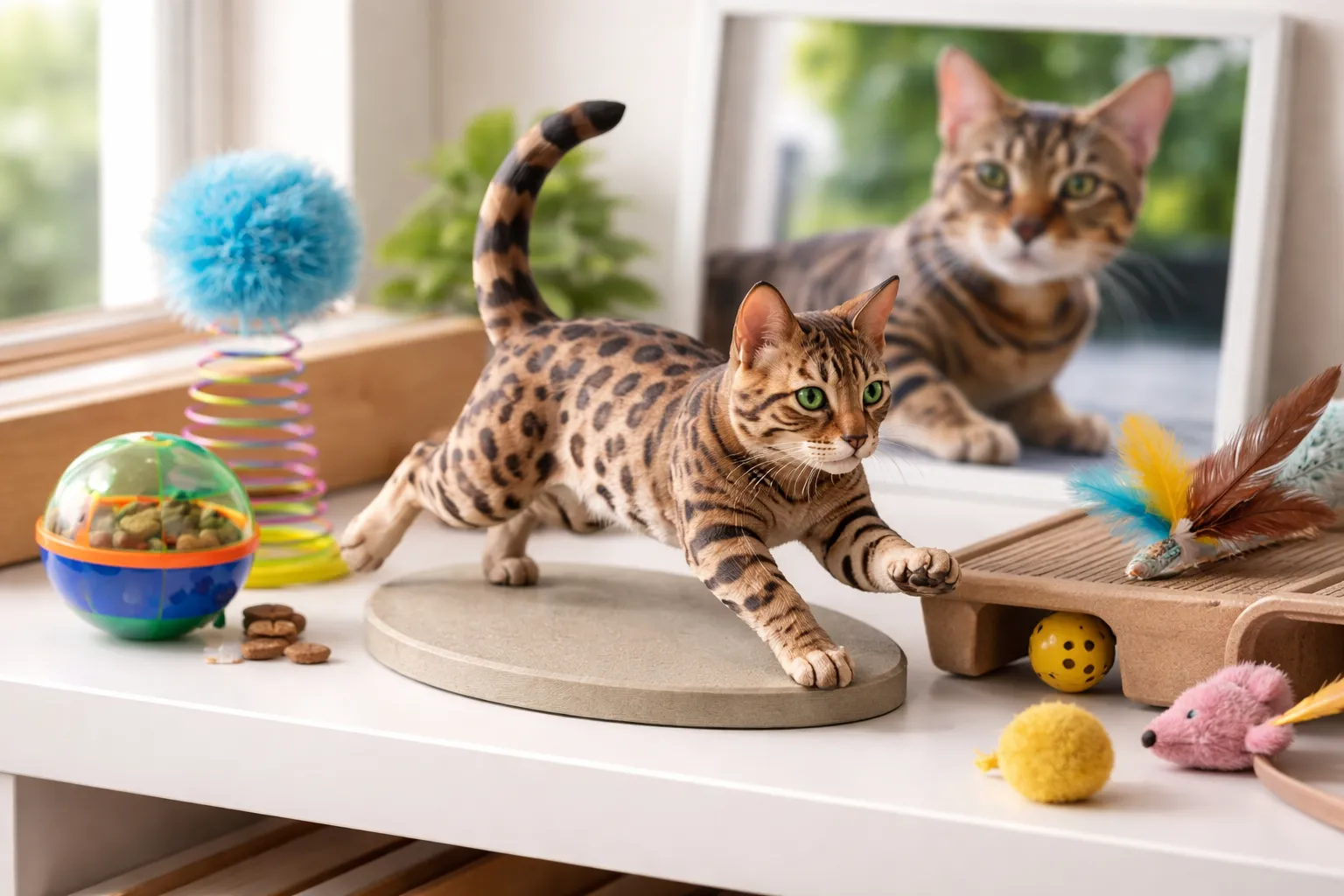
Salt wind through the screen door, and your seven-year-old Bengal freezes mid-stretch on the sun-warmed floorboards, ears swiveling toward gulls she'll never chase. That coiled tension in her shoulders is the entire case for bengal enrichment, and most busy owners read it backwards.
Quick Takeaways
- Mid-life is peak enrichment demand, not a wind-down — your 6-10 year old Bengal needs more structure, not less.
- Rotation beats abundance — five toys cycled weekly out-stimulate twenty toys left out permanently.
- Environmental design does the heavy lifting — change the room, not just the schedule, when time is short.
- Capture your cat's prime years now — many families preserve this exact stage with custom 3D pet figurines before the gray whiskers arrive.
- Mental work tires a Bengal faster than physical play — a five-minute puzzle beats a frantic laser session.
The Mid-Life Bengal Problem Nobody Warned You About
Here's what the breeder didn't tell you. The Bengal who shredded your couch at eighteen months doesn't suddenly become a lap cat at seven. She becomes something trickier — quieter, but not satisfied.
You walk past her in the afternoon and she's lying in the exact center of the rug, eyes half-closed, watching the ceiling fan turn. Looks peaceful. Looks like she's finally mellowing.
She isn't. That stillness is often a Bengal who has run out of legal things to do.
Mid-life Bengals (roughly ages 6 through 10) sit in a strange gap. They no longer have the chaotic kitten energy that forced you to engage them. But they retain the dense, hard-wired drive of a breed only a few generations removed from the Asian leopard cat. The drive doesn't fade. It just goes underground.
And that's where the myths live. Busy owners — and we mean genuinely busy, two jobs and a commute and a dishwasher that won't drain — build a mental model of their aging Bengal that's comforting and wrong. We've talked with thousands of pet families over the years, and the same five misconceptions surface again and again.
Let's take them apart one at a time. Not with theory. With things you can actually do tonight.
Myth 1: "She Has a Whole Basket of Toys, So She's Covered"
Picture the basket. It lives in the corner by the bookshelf, the one nobody walks past. Inside: a deflated foil ball, three mice with the catnip long since dead, a feather wand missing its feather. Your Bengal hasn't touched it in months.
You bought every one of those with love. And every one of them is now furniture.
The counterintuitive truth: object permanence works against you. A toy left in the open stops registering as prey. To your Bengal's hunting brain, a stationary item that's been in the same spot for weeks isn't a target — it's part of the wall. Abundance creates invisibility.
"A toy that never disappears stops being a toy. Novelty is the whole game."
What actually works is rotation, and it's almost embarrassingly simple. Take everything out of that basket. Keep five items in active use and hide the rest in a closed drawer. Once a week, swap two or three. The "new" toys are the same old toys — but after a week in the dark, they read as fresh to a cat who relies on change to flag opportunity.
So what? A Bengal who re-encounters a "lost" toy gets a small hit of the discovery response — the same alertness she'd have spotting movement in tall grass. You're not buying more. You're managing scarcity.
The hunting sequence most owners skip
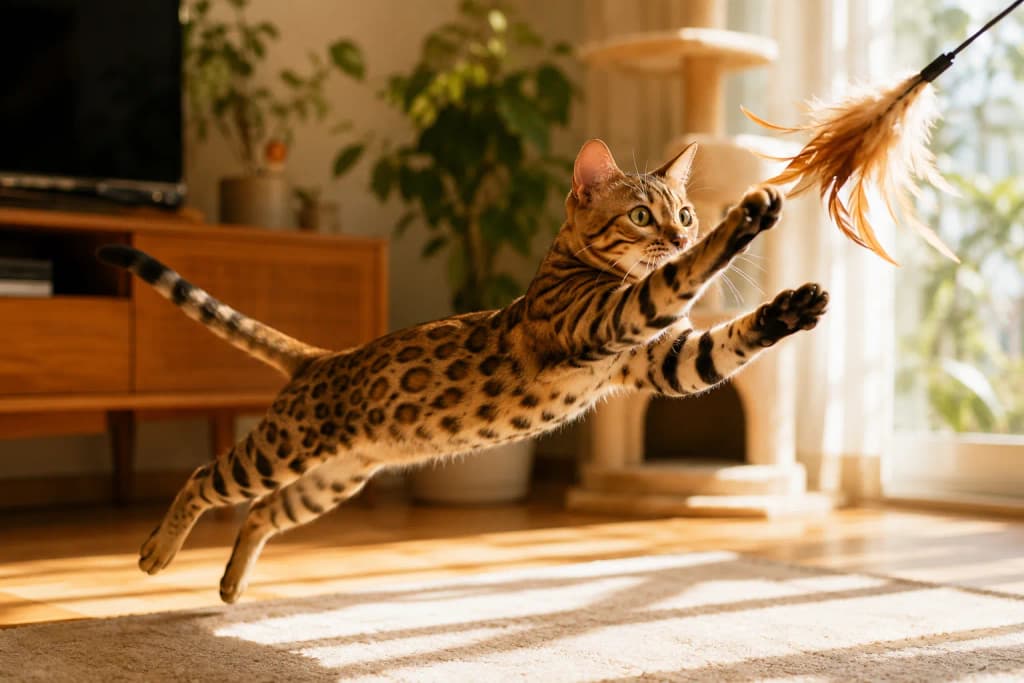
There's a deeper layer here. Cats don't want toys. They want the predatory sequence: stare, stalk, chase, pounce, grab, bite, and then — this is the part everyone forgets — a "kill" they can actually catch and possess.
A laser pointer gives them stare, stalk, and chase. Then the dot vanishes into nothing. No capture. No resolution. Some Bengals find that genuinely frustrating over time, like a song that cuts off before the last chord.
Fix it with one move: end every wand or laser session by landing the "prey" on a physical toy she can grab and bite. Flick the laser onto a small plush, then turn it off as she pounces. Let her win. The sequence completes, and the satisfaction is visible — she'll often groom afterward, the classic post-hunt behavior.
That single adjustment, costing zero dollars and ten seconds, does more than the entire basket.
Myth 2: "When She's Restless, She Just Needs to Burn Energy"
The 9 p.m. zoomies. You know them. She tears down the hallway, banks off the armchair nobody sits in, knocks a pen off the desk, and stares at you like you did something.
Your instinct is physical: grab the wand, run her until she pants, exhaust the battery in her. Reasonable. Often wrong.
Here's the thing about mid-life Bengals — they're frequently under-stimulated mentally long before they're under-exercised physically. A Bengal can be physically tired and mentally starving at the same time. The restlessness you read as "needs to run" is often "needs to think."
Consider the math of it. Fifteen minutes of hard chase play raises her heart rate and burns calories. But a food puzzle that takes her eleven minutes to solve engages problem-solving, patience, paw dexterity, and scent-tracking — and Bengals, who are unusually intelligent and dexterous, find that work deeply absorbing. Mental effort fatigues the brain in a way sprinting doesn't.
"A puzzle exhausts a Bengal in ways a sprint never can. Tired paws aren't a tired mind."
The practical swap looks like this:
- Foraging feeders instead of a bowl. Scatter feeders, snuffle mats, or treat balls turn a thirty-second meal into a ten-minute task.
- Cardboard puzzle boxes. Cut paw-sized holes in a shoebox, drop kibble inside, tape it shut. She has to fish. Free, and most Bengals love it more than store-bought versions.
- Frozen treats. A few pieces of her wet food frozen in an ice cube tray makes her work — licking, melting, problem-solving — on a hot afternoon.
So what? When you address the mental side, the physical restlessness often drops on its own. You stop treating the symptom (zoomies) and start feeding the actual need (cognitive load).
A quick word on what "tired" should look like
A well-enriched Bengal doesn't collapse. She settles. After a good evening of varied stimulation, you'll notice her choosing a perch, doing a long slow blink, and sleeping deeply rather than the twitchy, surface-level dozing of a bored cat. The PetMD overview of feline behavioral enrichment is a solid starting point if you want to understand the why behind this settling response.
Myth 3: "She's Calmer Now, So She Needs Less Than She Used To"
This is the most dangerous myth, because it feels like wisdom. Older cat, lower needs. It maps onto how we think about aging in general.
But mid-life is often when a Bengal needs the most deliberate enrichment of her entire life — and gets the least.
Think about the trajectory. As a kitten, she demanded attention so loudly you had no choice. By mid-life, she's learned which demands you ignore. So she stops demanding. The need didn't shrink. Her communication did. You interpret the silence as contentment.
Meanwhile, your life filled up. Kids, promotion, aging parents, the thousand small obligations of the middle years. Right when she stopped insisting, you had less to give. The two curves cross at exactly the wrong moment.
"Mid-life cats don't ask for less. They just stop asking. That gap is where boredom grows."
— The PawSculpt Team
Here's the spatial detail that gives it away. Watch where your Bengal spends her day. Is she increasingly drawn to the windows — pressed against the glass, tail flicking, watching the street with an intensity that looks almost desperate? That window-watching can be enrichment. It can also be a cat with nothing else, staring at a world she can't reach.
A genuinely fulfilled mid-life Bengal moves through her territory. A under-stimulated one parks at the only available stimulus and consumes it like a screen addict.
Why this stage is worth marking
There's an emotional truth tucked inside this myth. Mid-life is the prime of your Bengal — the period when her markings are richest, her musculature most defined, her personality fully formed but not yet softened by age. It passes quietly.
We've worked with families who came to us after their Bengal had aged, wishing they'd captured those middle years — the precise rosette pattern, the alert posture, the specific way she sat. Some families photograph obsessively. Others commission custom pet figurines that hold a pet's exact markings in three dimensions. It's worth thinking about now, while the prime is in front of you, not after.
But that's a side note. The core action here: audit your enrichment as if she were three, not seven. Her brain hasn't retired. Don't let yours decide it has.
Myth 4: "Real Enrichment Takes Time I Don't Have"
Let's be real about the constraint. You're not avoiding enrichment because you're lazy. You're avoiding it because the guides all seem to assume you have a free hour and a craft budget. You don't. You have eleven minutes between the dishwasher and bed.
So here's the reframe that changes everything: the best enrichment for a busy owner isn't something you do. It's something you build once and let run.
Active enrichment (wand play, training) requires your presence. Passive enrichment (the environment itself) works while you're at the office, asleep, or stuck on a call. For a time-poor owner, the leverage is overwhelmingly on the passive side.
Compare the two honestly:
| Enrichment Type | Your Time Cost | Works While You're Away? | Best For |
|---|---|---|---|
| Wand/interactive play | 10-15 min, daily | No | Bonding, hunt completion |
| Food puzzles | 2 min to set up | Yes | Mental fatigue, slow feeding |
| Window/bird-feeder view | One-time setup | Yes | All-day visual stimulation |
| Toy rotation | 5 min weekly | Yes | Restoring novelty |
| Vertical territory | One-time install | Yes | Confidence, surveillance |
Look at that right-hand column. The things that work while you're gone are the things that cost you almost no ongoing time. That's the busy owner's cheat code.
The day-in-the-life version
It's 6:40 a.m. You're making coffee, half-awake. Instead of dumping kibble in a bowl, you tip it into the snuffle mat by the patio door — twenty seconds — and she spends the next quarter hour nosing it out while you shower. On your way out, you crack the blinds so the morning light hits the cat tree where she'll track sparrows till noon. Total added effort: under a minute. The enrichment runs for hours without you.
That's the whole philosophy. Stop thinking about enrichment as an event on your calendar. Start thinking about it as systems embedded in your home that do the work autonomously.
A bird feeder is the single highest-leverage move
If you do one thing from this entire article, do this: mount a bird feeder outside the window your Bengal already favors. "Cat TV" is not a joke. It's arguably the most cost-effective enrichment that exists for an indoor cat.
So what? You're outsourcing stimulation to the local sparrow population, for free, for the life of the cat. The American Kennel Club's general guidance on companion-animal mental stimulation applies across species — engaged senses, varied input, agency over environment — and a window full of birds delivers all three without a single minute of your day.
Myth 5: "I Got Her a Cat Tree, So Vertical Space Is Handled"
The cat tree stands in the corner. Tall, carpeted, probably more expensive than you'd like to admit. And she sits on the top tier sometimes, so — handled, right?
Not quite. The myth here isn't that vertical space matters. It's that one structure equals a vertical environment. A single tree is an island. What a Bengal actually wants is an archipelago — a connected network of routes through the upper third of your rooms.
Bengals are arboreal-minded. In the wild, the leopard-cat lineage moves through trees, surveying from height. A lone cat tree gives her one vantage point. A vertical pathway — a route from sofa to shelf to cabinet to window perch that she can travel without touching the floor — gives her territory.
Think about it spatially. Right now, most of your Bengal's world is the bottom eighteen inches of every room — the same plane where you walk, vacuum, and drop things. Move her routes upward and you triple her usable territory without adding a square foot to your home.
Here's how to build a real vertical environment in tiers, cheapest first:
- Free first. Clear the top of a bookshelf or wardrobe she can already reach. Instant high perch. Cost: moving some clutter.
- Cheap next. Add one or two floating wall shelves to bridge a gap — sofa-back to windowsill, say. Now two perches become a route.
- Connective. A window hammock that suctions to the glass turns the bird-feeder view into a throne.
- Optional splurge. Wall-mounted cat shelving systems if you want the full highway.
"Cats don't live in rooms. They live in routes. Give her a path through the air."
So what? Vertical routes do something no toy can — they let your Bengal choose where to be and survey her domain from safety. Agency over her environment is itself enrichment. A cat who can decide to retreat upward when the doorbell rings is a more confident, less reactive cat. That's not fluff; it's basic feline territorial psychology.
The corner that tells the truth
There's one diagnostic worth running. Find the chair nobody sits in — every home has one, the armchair that collects mail. If your Bengal has claimed it as her only resting spot, she may be choosing the path of least resistance because better options don't exist. When you build genuine vertical territory, watch her abandon that default corner for the perches she'd actually prefer. The shift is quick, often within forty-eight hours, and it tells you the new setup is working.
Putting It Together: A Realistic Weekly Rhythm
You don't need to do all of this every day. That's the trap that makes busy owners give up entirely. Enrichment isn't all-or-nothing. It's a rhythm, and most of it is passive.
Here's a sustainable weekly framework that respects your actual schedule:
| When | Action | Time Cost |
|---|---|---|
| Each morning | Feed via puzzle/snuffle mat instead of bowl | 30 seconds |
| Each evening | 10-min wand play, ending with a "caught" toy | 10 minutes |
| 2-3 times weekly | Rotate 2-3 toys in and out of hiding | 2 minutes |
| Weekly | Move one piece of furniture or perch slightly | 5 minutes |
| One-time setup | Bird feeder + vertical route + window perch | An afternoon |
Notice the totals. After the one-time setup, you're looking at roughly ten to twelve minutes a day — most of it the evening play you probably enjoy anyway. Everything else runs on its own.
That's the reframe this whole article hinges on. A mid-life Bengal isn't a problem of insufficient time. She's a problem of insufficient design. Build the environment once, and it carries the load.
A small honesty note here: we make custom figurines, not veterinary diagnoses. If your Bengal's behavior changes suddenly — new aggression, hiding, appetite shifts, over-grooming — that's a vet conversation, not an enrichment problem. Boredom is real, but so is pain that masquerades as it. When in doubt, rule out medical causes first.
The Bigger Picture on Your Bengal's Prime Years
Step back from the tactics for a second. Why does any of this matter beyond a quieter house?
Because mid-life is the longest, fullest chapter of your cat's life, and it's the one we tend to sleepwalk through. The kitten photos fill three albums. The senior years get documented out of bittersweet awareness. But the rich middle — the years she's most herself — slips by undocumented and, too often, under-stimulated.
Enrichment is how you stay in relationship with who she actually is. A Bengal who's mentally engaged shows you her personality: the way she "talks" back, the specific games she invents, the route through the room she's decided is hers. That personality is the thing worth preserving.
It's why so many of the families we work with reach out during these middle years rather than waiting. They want to capture the Bengal at her peak — the bold rosettes, the muscular set of her shoulders, the alert tilt of her head mid-hunt. A figurine produced through full-color resin 3D printing holds those markings in dimension in a way a flat photo can't, the pattern reproduced directly in the material rather than added on top. If that resonates, you can explore the process at pawsculpt.com — but honestly, even a phone full of good photos beats the regret of having documented nothing.
The point isn't the keepsake. The point is paying attention. Enrichment and remembrance turn out to be the same instinct pointed at different ends of the same love.
Frequently Asked Questions
How much enrichment does a mid-life Bengal really need?
Aim for roughly 10-15 minutes of interactive play each day, plus passive enrichment that runs without you. The daily play handles bonding and the hunt sequence; puzzle feeders, toy rotation, and a good window view cover the rest of her waking hours. Most busy owners can hit this with about twelve minutes of daily effort once the environment is set up.
Why does my older Bengal seem restless or do zoomies at night?
Often it's mental under-stimulation rather than too much pent-up physical energy. A Bengal can be physically tired and cognitively bored at the same time. Try a food puzzle or a short, satisfying hunting game (one that ends with her catching something) in the evening, and you'll frequently see the late-night restlessness drop.
Do Bengals really need more enrichment than other cats?
In our experience and across breed behavior consensus, yes. Bengals are only a handful of generations from a wild ancestor, and they retain unusually strong predatory drive, intelligence, and athleticism. That doesn't fade in mid-life. They tend to need more mental challenge and more vertical territory than a typical domestic shorthair.
What's the single most cost-effective enrichment I can set up?
A bird feeder mounted outside the window your cat already favors. It delivers hours of daily visual stimulation, costs almost nothing after setup, and requires zero ongoing time from you. Pair it with a window perch and you've built one of the highest-leverage enrichment systems available to an indoor Bengal.
Is my single cat tree enough vertical space?
Probably not on its own. A lone tree is one vantage point; Bengals want connected routes they can travel without touching the floor. Cleared shelf tops, a couple of floating wall shelves, and a window hammock turn isolated perches into a network that effectively triples her usable territory.
Ready to Celebrate Your Pet?
Every pet has a story worth preserving. Whether you're honoring a beloved companion who's crossed the rainbow bridge or celebrating your Bengal in the prime of her mid-life years, a custom PawSculpt figurine captures the rosettes, posture, and personality that make her one-of-a-kind. Good bengal enrichment keeps her thriving today — and a figurine made through full-color 3D printing keeps this exact chapter long after the gray whiskers arrive.
Visit pawsculpt.com to learn more about our process, preview turnaround, revisions, and quality guarantee