
The Fourth of July First-Aid Checklist Every Multi-Dog Home With a Dachshund Needs
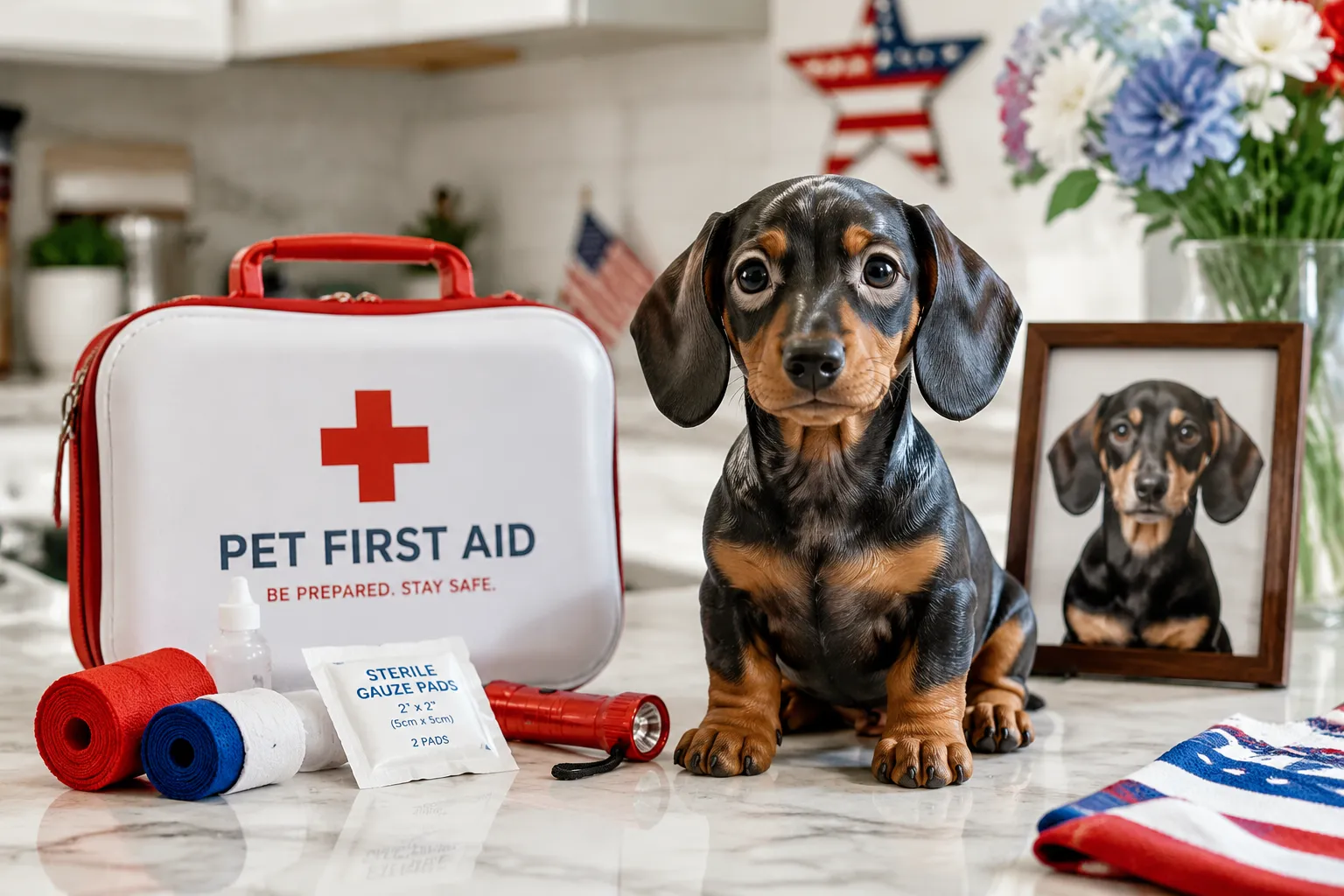
"Dogs are not our whole life, but they make our lives whole." — Roger Caras
It's 9:47 PM. Your dachshund has burrowed so far under the bed he's just a quivering shape in the dark, and the first mortar shell cracks against the window glass. This is the exact moment a fourth of july pet first aid plan stops being a someday idea.
Quick Takeaways
- Fear spreads dog-to-dog — calm your steadiest dog first and panic stays contained.
- Dachshunds risk spinal injury during panic — frantic jumping and bolting can herniate a disc.
- Build your kit before July 1 — a scrambling 9 PM search is how small problems become emergencies.
- Microchip and ID every dog now — the Fourth is the single biggest day for lost pets in the U.S.
- Celebrate the dog you're protecting — a custom pet figurine preserves the personality you fight so hard to keep safe.
Why One Dachshund Rewrites Your Entire Fourth of July Plan
Here's the thing most checklists won't tell you. You don't have "a few dogs who get scared of fireworks." You have a system. And in that system, the dachshund is almost always the loose wire.
We've talked with thousands of pet families over the years, and a pattern shows up again and again. The household with three dogs assumes the Fourth of July is just three times the noise management. It isn't. It's one anxious dog setting off a chain reaction in the other two, and one low-slung body built in a way that turns ordinary panic into a vet visit.
Let's start with the part nobody connects.
A dachshund's spine is the whole reason the breed is adorable and the exact reason fireworks night is dangerous in a way a Lab's never will be. That long back, those short legs—it's a beautiful design flaw. The breed is genetically prone to intervertebral disc disease (IVDD), where the cushioning discs between the vertebrae bulge or rupture. According to the American Kennel Club's breed information, the dachshund's distinctive shape comes with a well-documented predisposition to back problems.
Now picture that body in full panic.
A terrified dachshund doesn't sit quietly and shake. He launches off the couch. He claws at a closed door. He twists midair trying to escape a sound that's coming from everywhere. Every one of those movements—the jump, the hard landing, the violent spin—is a moment where a disc can give way. So the fireworks themselves aren't the only injury risk. The reaction to the fireworks is.
That reframes everything. Your job on the Fourth isn't only to soothe a scared dog. It's to keep a structurally vulnerable little body from hurting itself while it's flooded with stress hormones and acting on pure instinct.
"The danger on the Fourth often isn't the noise. It's a small dog moving fast in a body that can't afford it."
The cortisol cascade, explained simply
When fireworks start, your dog's brain doesn't pause to evaluate the threat. The amygdala—the brain's alarm system—fires before any thinking happens. Stress hormones flood the body. Cortisol and adrenaline spike, the heart rate climbs, muscles prime for escape.
This is the same fight-or-flight response you feel when a car swerves toward you. The difference is your dog can't tell himself "it's just the neighbors." There's no off switch he can reach. His body is genuinely convinced it needs to run, and it will keep him in that state for hours if the booms keep coming.
Why does this matter for your plan? Because a dog in a cortisol surge isn't being stubborn or dramatic. He physically cannot calm down through willpower, and trying to "correct" the fear makes it worse. You're not managing a behavior. You're managing a chemical event happening inside a body that's already at a structural disadvantage.
When One Dog's Fear Becomes Everyone's: The Multi-Dog Contagion Problem
A family we worked with last summer described it perfectly. Their two older dogs had weathered years of Fourth of Julys just fine. Then they adopted a dachshund puppy. The next July, all three dogs were a wreck. The owners couldn't figure out what changed.
What changed was emotional contagion.
Dogs read each other's stress with startling precision—body posture, breathing, the whites of the eyes, scent. Research on canine social behavior suggests dogs can essentially "catch" emotional states from one another, much the way one yawning person sets off a room. When your most anxious dog (often the smallest, often the youngest, often the dachshund) tips into panic, he's broadcasting a signal the others are wired to take seriously.
So your steady senior Lab smells the fear, sees the trembling, and his own threat-assessment system starts asking: should I be scared too?
Here's the counterintuitive part. Most multi-dog guides tell you to comfort the scariest dog first. In our experience that's backwards. If you pour all your attention onto the panicking dachshund while your other dogs watch, you can accidentally confirm that something is genuinely wrong. The smart move is to anchor your calmest dog first—keep him relaxed, keep him near you, let his settled body language do some of the work. A grounded dog in the room is a stabilizing signal for the whole pack.
"In a panicking pack, your calmest dog is the medicine. Steady him, and you steady the room."
Why scent matters more than you'd think
This is the part of the plan people overlook entirely. A dog's world is built on smell, and fear has a smell.
When dogs are frightened, they release stress-related odors through their paw pads and skin. The other dogs in your home pick this up instantly. It's part of why panic can ripple through a household even when one dog is in another room.
You can use this same principle in reverse. Familiar, comforting scents lower stress. The blanket that smells like your dog's normal sleeping spot. A worn t-shirt that carries your scent. The faint, particular smell of home—coffee, the laundry detergent on the dog beds, that warm dusty smell of the closet they like to hide in. Building a "scent sanctuary" before the noise starts gives every dog in the house an olfactory anchor that says you are home and home is safe.
Lay out the beds early. Don't wash the favorite blanket the week of the Fourth. That funky, lived-in dog smell you barely notice? To your pack, it's a security signal.
The First-Aid Kit Every Multi-Dog Home Should Build Before July 1
Now to the actual checklist. The mistake we see most often isn't having the wrong supplies. It's assembling them at 9 PM while a dog is already in distress, hunting through three drawers for a styptic stick you bought two years ago.
Build this in the daylight. Put it in one container. Label it. Keep it in the bedroom or wherever your dogs naturally retreat, because that's where you'll be when you need it.
Here's the core fireworks anxiety checklist for a household with multiple dogs and at least one dachshund:
| Item | Why It's In the Kit | Multi-Dog / Dachshund Note |
|---|---|---|
| Digital pet thermometer | Stress and overheating both spike body temp | Check the smallest dog first; little bodies overheat faster |
| Styptic powder or gel | Stops bleeding from a torn nail (common when dogs claw at doors) | Dachshunds dig and scratch frantically—nail injuries are frequent |
| Gauze, vet wrap, blunt scissors | Wound coverage for scrapes from escape attempts | Keep two sets; you may treat more than one dog |
| Saline flush | Cleans cuts and irritated eyes | Useful after a dog bolts through brush or a fence gap |
| Tick remover + flashlight | Outdoor potty breaks happen in the dark | Check long-haired dogs thoroughly; ticks hide in dachshund ears |
| Vet + emergency clinic numbers (printed) | Phones die or get misplaced in chaos | Tape it inside the lid—don't rely on memory at 10 PM |
| Recent photo of each dog | For lost-dog flyers, fast | One clear photo per dog, printed and saved to phone |
| Slip leads (one per dog) | Fast, secure restraint without fumbling clips | A panicked dachshund slips a loose collar in seconds |
A few things that surprise people about this list.
The thermometer isn't optional. A dog locked in a prolonged stress state, especially a small one in a warm, closed room, can climb toward dangerous body temperatures. Knowing the difference between "scared and panting" and "overheating and in trouble" can change your whole night. Normal canine temperature runs roughly 101 to 102.5°F. We're not vets—if you're seeing a reading at or above 104°F along with heavy distress, that's a call-your-emergency-clinic situation, not a wait-and-see one.
Slip leads beat collars on the Fourth. A frightened dog flattens and reverses, and a standard collar slides right over the head. The number one way dogs get lost on July 4th isn't open gates—it's slipping a leash during a quick potty break gone wrong.
The supplies for the dachshund specifically
Beyond the shared kit, a dachshund household needs a small additional set focused on the spine and the body's particular weak points.
- A firm, flat carry surface (a sturdy cookie sheet, a board, even a stiff cutting board works). If your dachshund shows any sign of back injury, you want to move him without bending his spine. You transport a possible IVDD dog flat and supported, never scooped under the belly like a football.
- A properly fitted harness, never a collar, for leashed trips outside. A collar yanks the neck and spine; a Y-front harness distributes pressure across the chest. For a breed this back-sensitive, it matters every day, and doubly so on a night when he might lunge.
- Pre-placed ramps or steps at the couch and bed, set out before the Fourth. A scared dachshund will try to get up to you or down to hide. Give him a safe path so he's not flinging himself off furniture.
So what? Because the most common dachshund injury on a fireworks night isn't a burn or a cut. It's a back. And back injuries are the ones where what you do in the first ten minutes—keeping him still, keeping him flat—shapes how the next ten weeks go.
The Dachshund Emergencies Nobody Warns You About
Let's get specific about what can actually go wrong, because "keep your dog calm" is useless advice when you're staring at a dog who suddenly can't use his back legs.
Sudden hind-end weakness or paralysis
This is the big one. If your dachshund yelps, then seems reluctant to move, hunches his back, or drags his rear legs, you may be looking at an acute disc event. It can happen fast—one bad landing during a panic spiral.
- Stop all movement. Don't let him walk it off. Don't let the other dogs jostle him.
- Confine him to a small space or crate so he can't worsen it.
- Transport flat and supported on your firm surface if you need to get to a vet.
- Call your emergency clinic immediately. With disc injuries, the window for the best outcomes can be narrow—often the first 24 to 48 hours. This is genuinely time-sensitive.
We want to be honest about our limits here: we make figurines, not diagnoses. But this is the one scenario where knowing the signs ahead of time changes everything, because owners who don't recognize it often wait, and waiting is the enemy with spinal cases.
Torn nails and split pads
A dog who claws at a door or crate for an hour will damage his nails and feet. It bleeds dramatically and looks scarier than it usually is. Apply pressure with gauze, use styptic powder to stop the bleeding, and keep him from licking it raw. The so what here: a nail injury treated calmly is a five-minute fix; ignored, it can abscess over the long weekend when your regular vet is closed.
Stress-related GI upset
A flood of cortisol can hit the gut. Vomiting or diarrhea after a fireworks night is common and usually settles. Watch for blood, repeated vomiting, or a dog who won't drink—those cross into call-the-vet territory.
The escape and the road
A panicked dog who gets loose doesn't think. He runs from the sound, which often means toward a road. This is why the ASPCA's disaster and safety guidance consistently emphasizes secure ID. Microchip every dog, make sure the registration is current, and put a tag on the collar with your phone number. Do it this week, not on July 3rd.
Here's a triage table to keep your head clear when adrenaline is running in you, too:
| What You See | Likely Cause | Your First Move | Urgency |
|---|---|---|---|
| Hunched back, yelping, won't move | Possible disc injury | Confine, keep flat, call clinic | Emergency — minutes matter |
| Dragging back legs | Acute IVDD event | Immobilize, transport flat | Emergency — minutes matter |
| Bleeding nail or paw | Frantic clawing/digging | Pressure + styptic powder | Monitor; vet if it won't stop |
| Vomiting, loose stool | Stress GI upset | Withhold food briefly, offer water | Watch; vet if blood or it persists |
| Heavy panting, hot to touch | Overheating + stress | Cool room, water, take temp | Urgent if temp ≥104°F |
| Dog escaped/loose | Panic flight | Call name calmly, alert neighbors | Act immediately |
Print this. Tape it inside the lid of your kit. In a real moment of fear, you don't want to be reading prose—you want a glance that tells you go or watch.
"Every dog we sculpt has a story. The families who plan for the scary nights are the ones who get more of the joyful ones."
— The PawSculpt Team
Building Your Night-Of Triage Plan for the Whole Pack
A kit is gear. A plan is what turns that gear into calm. In a multi-dog home, the plan has to account for the fact that your dogs will not all respond the same way—and they'll feed off each other if you let them.
Assign each dog a role and a place
Before sundown, decide where each dog rides out the night. Not all together by default. Think about who calms whom.
- The anchor dog (your steadiest): stays with you in the main retreat room. His calm is a tool.
- The dachshund (your most vulnerable): gets the most controlled environment—a crate or small room, ramps in place, no furniture to launch from.
- The wild card (the one who paces or barks): may do better with a barrier between him and the others so his agitation doesn't ripple outward.
This sounds clinical, but it's really just acknowledging that personalities differ and that proximity changes outcomes. A reactive dog and an anxious dog in the same small space can escalate each other into a feedback loop.
Set the environment two hours early
Don't wait for the first boom. By the time fireworks start, you want the stage already set, because anticipatory calm beats reactive calm every time.
- Close windows and curtains to muffle sound and block the flashes.
- Turn on white noise, a fan, or steady music to blunt the sudden cracks.
- Set out the unwashed favorite blankets—remember the scent sanctuary.
- Feed dinner a little earlier so nobody's digesting during peak panic.
- Do a final potty break in daylight, on a harness and slip lead, before the neighborhood gets loud.
That last potty trip is more important than it sounds. Once the booms start, a frightened dachshund may refuse to go outside at all, or bolt if you force it. Beat the noise.
The thing you should NOT do
Don't punish the fear. Don't drag a hiding dog out to "show him it's fine." And here's the one that surprises people: don't over-fuss in a frantic, high-pitched way. Your dogs read your energy. If you're swooping around saying "it's okay it's okay it's OKAY" in a tight, worried voice, you're not transmitting calm—you're transmitting alarm in a different accent.
Quiet, boring, low presence is the goal. Sit on the floor. Breathe slow. Let the hiding dog hide if hiding is what soothes him. A dog under the bed isn't being difficult; he found his den. Sometimes the most loving thing is to simply be nearby and unbothered.
What We Wish We Knew Sooner
We talk to pet families constantly, and the same regrets surface every July. Consider this the sidebar we'd hand our younger selves.
We wish we'd known that calm is contagious too. Everyone focuses on fear spreading. Almost nobody realizes the same channel runs in reverse—a genuinely relaxed human and a settled anchor dog can pull a wobbling pack back toward steadiness. Your nervous system is part of the toolkit.
We wish we'd treated the harness as non-negotiable years earlier. So many dachshund owners use a collar out of habit. For a breed built like this one, a Y-front harness isn't an upgrade. It's basic spine insurance, every single walk.
We wish we'd practiced the "safe space" months before July. A crate or room only feels safe if it already feels safe on an ordinary Tuesday. A den introduced for the first time on the Fourth is just a strange box during the scariest night of the year.
We wish we'd taken better photos of our dogs when they were calm and themselves. Not the panic. The good days. The way the light hit the fur on the porch. Because the dogs we love don't stay long enough, and the ordinary moments are the ones we'd give anything to hold again.
That last one is why so many of the families we work with come to us. They want something that holds the real dog—the personality, the particular tilt of the head—not a blurry phone photo buried in a camera roll.
After the Smoke Clears: Recovery and What Lasts
The fireworks end. The smell of sulfur drifts in from outside, and the house exhales. But the night isn't fully over for your dogs.
Stress hormones take time to clear. A dog can stay jittery, clingy, or off his food for a day or two after a hard fireworks night. That's normal. Give it space. Let the dachshund rest his body. Watch the whole pack for the slower-burning signs—a back that seems sore the next morning, an appetite that doesn't bounce back, a dog who's suddenly afraid of the room where it all happened.
Here's where the science gets hopeful. Because of neuroplasticity—the brain's lifelong ability to rewire—repeated bad experiences can deepen a fear, but repeated good experiences can soften it. How you handle recovery and how you prepare for next year genuinely shapes your dog's brain over time. Counter-conditioning, desensitization with recorded sounds at low volume, working with a certified behaviorist for the severe cases—these aren't just coping tricks. They're literally reshaping the neural pathways.
The American Veterinary Medical Association offers solid guidance on noise aversion, and for dogs whose panic is genuinely dangerous, there are veterinary anti-anxiety medications that can make the Fourth survivable rather than traumatic. That's a conversation to have with your vet in June, not a prescription to scramble for on the third.
Holding onto the dog you fought to protect
When you spend a night like this—body between your dachshund and his fear, hand resting on a back you're praying he didn't hurt—you understand something about how much these animals occupy. They're not background. They're the warm weight at the foot of the bed, the smell of grass and dog on the blanket, the reason the house feels full.
A lot of the families we work with reach out after exactly this kind of night. Something about a near-miss, or simply a year survived together, makes them want to make the love tangible. Some keep a paw-print in clay. Some fill a wall with photos. And some choose a custom resin keepsake of their dog, digitally sculpted by our 3D artists and then precision 3D printed in full color, so the markings and the particular shape of the face come through the way they actually are.
We do this with advanced full-color 3D printing—the color is printed right into the resin, voxel by voxel, then finished with a protective clear coat. It means the freckled belly, the one ear that folds wrong, the brindle along the spine all show up true. Not a generic dog. Your dog. If you're curious how that process turns your photos into a figurine, you can explore the details and see examples at pawsculpt.com.
We mention it not to sell you something tonight. We mention it because the whole reason you're reading a first-aid checklist is love, and love wants something to hold.
"We don't fear the noise for ourselves. We fear it for the small, brave bodies that trust us to handle it."
Frequently Asked Questions
Why are dachshunds more at risk during fireworks than other dogs?
It comes down to anatomy. Dachshunds are genetically prone to intervertebral disc disease, and the panic response—jumping, bolting, twisting midair—puts dangerous force on that long spine. So the real risk isn't only the noise. It's the violent way a frightened dachshund moves his body. Keeping him still and confined during the chaos protects the part of him most likely to get hurt.
How do I keep several dogs calm when one starts to panic?
Start with your calmest dog, not your most anxious one. Fear travels between dogs through scent and body language, so a settled anchor dog helps hold the whole group steady. Set up a quiet room with familiar-smelling blankets before the fireworks begin, and consider giving a reactive dog his own space so his agitation doesn't ripple to the others.
What's the most overlooked item in a Fourth of July first-aid kit?
A digital thermometer and a firm flat surface for transport. Most people stock bandages and forget that a stressed dog can overheat, and that a dachshund with a suspected back injury must be moved flat and supported, never scooped under the belly. Slip leads also beat collars, since a panicked dog easily slips a loose collar and bolts.
Is it normal for my dog to be off for a day or two afterward?
Yes. Stress hormones like cortisol take time to clear, so a clingy, jumpy, or off-his-food dog the next day is common and usually settles within 48 hours. Watch for slower signs of trouble, though—a sore back the morning after, repeated vomiting, or a refusal to drink. Those warrant a call to your vet.
Should I medicate my dog for fireworks anxiety?
For dogs whose panic is severe or dangerous, veterinary anti-anxiety options can turn a traumatic night into a manageable one. We're not vets, so this is a conversation to have in June rather than a scramble on July 3rd. Pairing medication with long-term desensitization gives the best results, because the brain can genuinely rewire over time.
Ready to Celebrate Your Pet?
Every pet has a story worth preserving. After a night spent shielding your dachshund from the noise, hand resting on that brave little back, you understand exactly how much these companions mean—and why so many families want to hold onto that bond in something lasting. A custom PawSculpt figurine captures the markings, the expression, and the personality that make your dog one of a kind.
The same care you put into your fourth of july pet first aid plan is the care we put into recreating your pet in vivid, full-color resin—so the dog you fight to keep safe is celebrated for years to come.
Visit pawsculpt.com to learn more about our process, preview options, and quality guarantee.