
Calm Vet Visits by Design: Prepping a Bengal Kitten in a Busy Multi-Pet Home
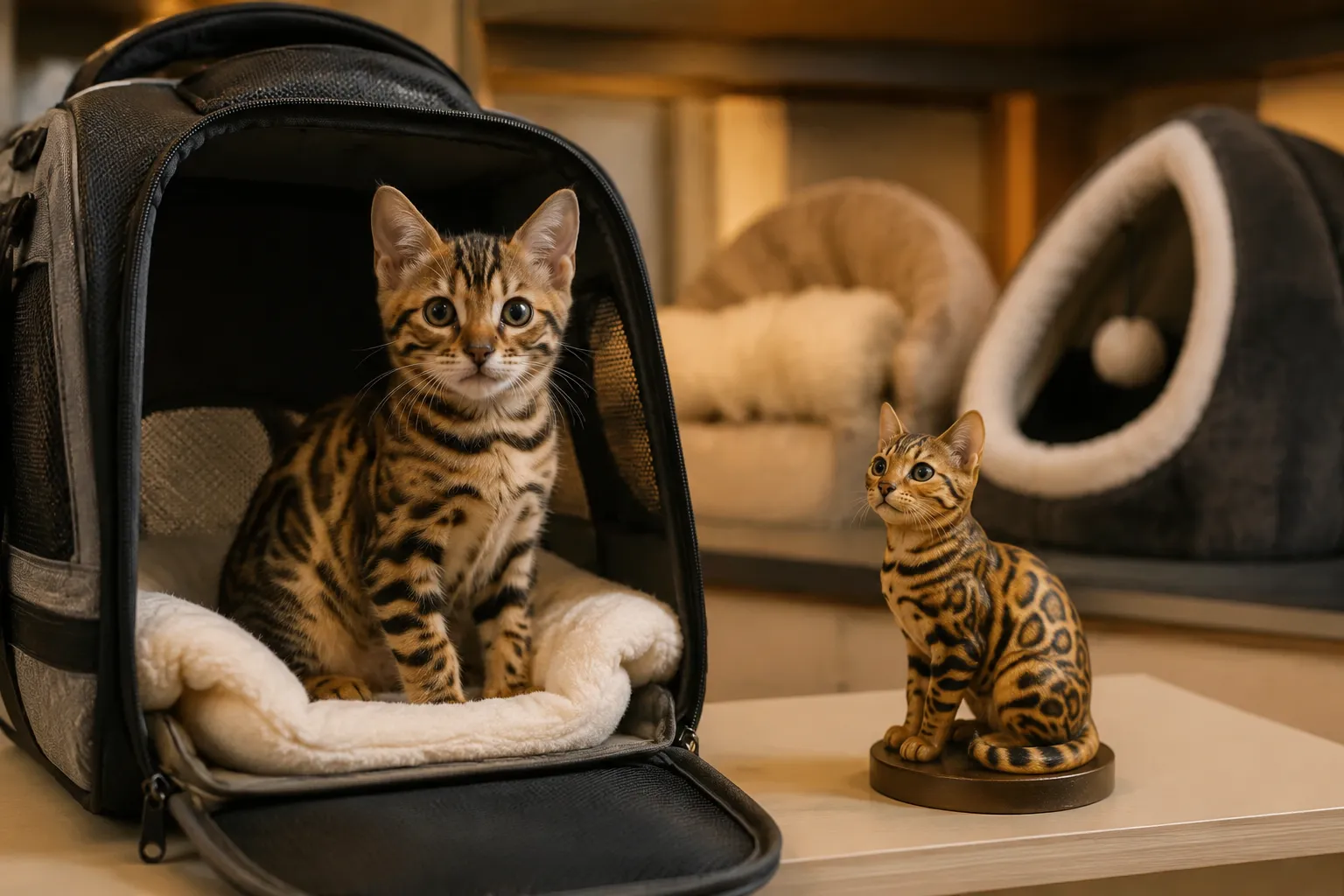
Roughly two-thirds of cats show measurable stress before they ever reach an exam table—and Bengal kittens, wired for motion and sound, spike faster than most. That's why smart bengal kitten vet visit prep starts in your hallway, weeks before the appointment, right where the carrier waits by the coat hooks.
Quick Takeaways
- Leave the carrier out permanently — a hallway fixture, not a scary object that appears only on vet day.
- Prep the household, not just the kitten — a calm resident dog and cat lower your Bengal's baseline stress fast.
- Run a full carrier rehearsal 72 hours out — car idle, engine on, back in the door, treats the whole way.
- Capture the "before" while they're healthy — many families turn a favorite photo into custom pet figurines that freeze this bright, springy stage of kittenhood.
- Recovery matters as much as the visit — a quiet decompression room resets a Bengal within hours, not days.
Why Bengal Kittens Break the Standard Vet-Prep Playbook
Here's the thing most generic "cat vet tips" articles get wrong: they treat all cats as one anxious species with one nervous system. Bengals aren't that.
We've packed and shipped figurines for thousands of pet families, and Bengal owners tell us the same story on repeat. Their kitten isn't scared of the vet in the way a shy domestic shorthair is. Their kitten is over-aroused. Big difference.
A timid tabby shuts down. A Bengal winds up. The same clinic that bores one cat into a loaf will send a Bengal into full parkour mode—climbing the blood-pressure machine, batting at the otoscope, vocalizing in that loud, chirpy, almost-dog way the breed is famous for.
So the standard advice ("keep it calm, use a towel, bring treats") isn't wrong. It's just incomplete. Bengals need a prep plan built around drainage—burning energy and lowering arousal—not just soothing.
"Calm isn't the absence of energy. For a Bengal, calm is energy that's already been spent before the car door closes."
That's the counterintuitive core of this whole guide. You don't relax a Bengal kitten into a good vet visit. You exhaust the sharp edges off first, then keep the environment predictable enough that the leftover energy has nowhere to spike.
And in a multi-pet household, you've got a second layer to manage: your Bengal reads the other animals like a mood ring. More on that shortly.
The arousal-vs-anxiety distinction that changes everything
Watch your kitten's tail and ears when the carrier comes out. Anxiety looks like flattening—low body, tucked tail, hiding. Arousal looks like the opposite—up on the toes, tail flicking, pupils wide, that chattering meow.
Most Bengal kittens run hot on arousal. Which means your job is regulation, not just reassurance. Reassuring an over-aroused kitten with high-pitched "it's okaaay" baby talk actually pours gas on the fire. We'll be real: your voice matters more than you think, and we'll get to exactly how to use it.
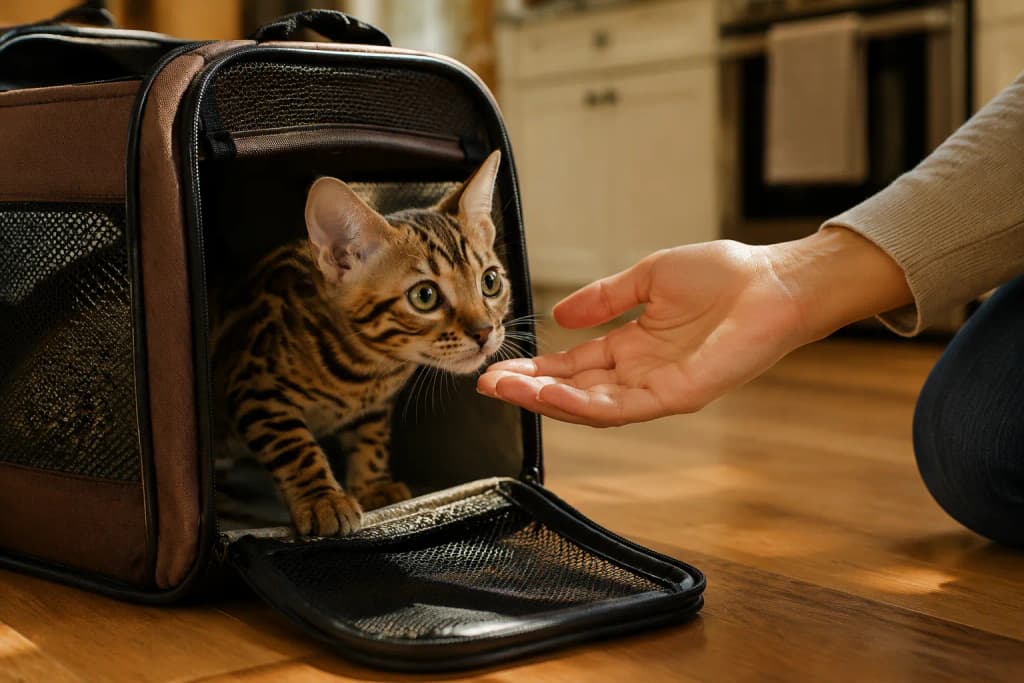
Bengal Kitten Vet Visit Prep Starts With the Carrier (and It's a Hallway Job)
The single biggest lever you have is the carrier. Not the treats, not the calming spray, not the vet's bedside manner. The carrier.
Our top pick for placement surprises people: the hallway. Not a closet, not the garage, not tucked under a bed. A high-traffic hallway where your kitten walks past it forty times a day.
Why? Familiarity kills fear through sheer repetition. An object your kitten brushes against every single day becomes furniture. An object that only materializes on the morning of a needle appointment becomes a trap. Bengals are smart enough to make that association in exactly one bad trip.
The carrier reset: a two-to-three week schedule
Don't rush this. If your appointment is next week and the carrier's been in storage, you're playing catch-up—do the compressed version at the end of this section. But if you've got time, run the full desensitization.
Here's the schedule we recommend to owners who ask us how to make carrier day a non-event:
| Days | Action | What You're Building |
|---|---|---|
| Days 1-3 | Carrier open in hallway, door removed, blanket inside | "This is just a cave" |
| Days 4-7 | Feed 2-3 meals near, then inside the open carrier | "Good things happen here" |
| Days 8-12 | Kitten naps inside voluntarily; add a worn t-shirt | "This smells like safety" |
| Days 13-16 | Close door for 30-60 seconds during a treat, then open | "Closed isn't forever" |
| Days 17-21 | Carry closed carrier around the house, then set down | "Movement is normal" |
The worn t-shirt trick is underrated. Scent is the fastest calming channel a cat has, faster than sight or sound. A shirt you slept in tells your kitten my human is nearby even when you're driving and can't reach back to reassure them.
"The carrier shouldn't be a place your kitten goes. It should be a place your kitten already lives."
If you're short on time (the 4-day compressed version)
Life happens. Vet visit's Friday, it's Tuesday. Fine. Do this:
- Tuesday: Carrier open in the hallway, all meals served inside or right beside it.
- Wednesday: Meals inside, door closed for 90 seconds mid-meal, calm exit.
- Thursday: Closed carrier carried through the house twice, plus one sit in a parked car (engine off, five minutes, treats).
- Friday morning: Engine-on idle in the driveway for three minutes before you actually leave.
It's not as bulletproof as the three-week version. But it beats the grab-and-shove that 90% of owners default to.
Multi-Pet Household Vet Tips: Your Bengal Reads the Room
This is the section the first five Google results skip entirely, and it's the one that matters most if you've got a full house.
A Bengal kitten in a multi-pet household doesn't experience the vet trip in isolation. They experience it through the emotional broadcast of every other animal in the home. Dogs especially. Your Golden Retriever's low, worried whine as you wrestle the carrier out? Your kitten logs that. Files it under "something bad is coming."
One family we worked with had a Bengal who was perfect for vet visits—until they adopted a reactive rescue dog who barked at the carrier every time. Within a month, the kitten started hiding at the first jingle of car keys. The dog taught the cat to be afraid.
The pre-visit household protocol
You want the resident pets neutral or absent during carrier loading. Not curious, not anxious, not underfoot.
- Dogs: Crate them or send them to another room with a chew before the carrier comes out. A barking, circling dog turns a two-minute load into a five-alarm event.
- Resident cats: Feed them in a separate room. A resident cat watching the kitten get "taken" can trigger territorial weirdness on return (we'll cover reintegration below).
- The soundscape: Kill the chaos. TV off, no vacuum, no doorbell deliveries scheduled. Silence the triggers your kitten has learned to associate with disruption.
Here's a comparison of how different housemates affect your Bengal's vet-day stress, and what to do about each:
| Housemate | Stress Impact on Bengal | Best Move |
|---|---|---|
| Anxious dog | High — vocal cues transfer fast | Separate room + chew toy |
| Calm senior cat | Low to neutral | Leave be, feed separately |
| Another kitten | Medium — play energy spikes arousal | Separate 30 min before loading |
| Vocal bird | Medium — alarm calls read as danger | Cover cage or relocate |
| Kids under 10 | High — excitement raises the pitch | Assign them a quiet "job" elsewhere |
The overlooked win: bring a calm co-pilot's scent, not the pet
Do NOT bring a second animal to the clinic thinking it'll comfort your Bengal. It almost never does—it doubles your handling problem and often amplifies stress in the waiting room.
Instead, bring the scent of a calm housemate. If your Bengal is bonded with a mellow older cat, tuck that cat's blanket into the carrier. You get the comfort of the companion without the chaos of transporting two animals. That's the kind of tip you only learn from families who've tried the messy alternative.
Reduce Cat Vet Stress by Managing Sound (The Sense Everyone Ignores)
Owners obsess over sight—covering the carrier, dimming lights. Smart. But sound is the sense that actually runs a Bengal's nervous system, and it's the one nobody preps for.
Think about the auditory gauntlet of a vet trip. The metallic click of the carrier latch. The garage door groaning up. Tires on gravel. Then the waiting room: a dog's nails skittering on tile, another cat yowling behind a plastic wall, the phone ringing, the hiss-clunk of the automatic door. For a breed with the hearing sensitivity Bengals have, that's an assault.
Build a "sound bridge" from home to clinic
The trick is to make the clinic soundscape less novel by rehearsing pieces of it at home.
- Record it: Ask your vet if you can get a two-minute audio clip of the lobby, or find generic clinic ambience online. Play it low during meals for a week. Novelty is what spikes cats; familiarity defuses it.
- The carrier click: Practice the latch sound during treat time so it predicts chicken, not needle.
- Car sounds staged early: Engine, blinker, radio at low volume—layer these in during your carrier car-sits.
"A Bengal doesn't fear the vet. It fears the sounds it can't predict on the way there."
The counterintuitive sound tip: don't go silent, go steady
Most guides say keep it quiet. Half right. Dead silence in the car actually makes some Bengals hypervigilant—every small road noise becomes a startle. What works better is a steady, boring audio floor: soft classical, a white-noise app, or a specific calming playlist you always use for car rides.
Consistency is the magic word. The same track, every trip, becomes a cue: we're doing the car thing, it's fine, it ends with home. You're building a Pavlovian off-switch through repetition.
And your own voice? Keep it low, slow, and quiet. That chirpy "aww are you okaaay baby" register reads as alarm to a cat. Talk to your kitten the way you'd talk to someone falling asleep. Low frequency, flat affect, steady rhythm.
Myth vs. Reality: Bengal Vet Prep Edition
Let's bust the stuff we hear most from new Bengal owners. Some of this "common knowledge" is actively making things worse.
Myth #1: "Skip breakfast so my kitten is hungry for treats at the vet."
Reality: A stressed cat won't eat anyway, and an empty stomach makes some kittens nauseous in the car—now you've got motion sickness on top of fear. Feed a small meal 3-4 hours before, not zero. Save high-value treats for the calm moments, not as a bribe during the exam.
Myth #2: "My kitten will 'get used to it' if I just keep going."
Reality: Repeated bad experiences don't build tolerance—they build sensitization. Each bad visit can make the next one worse. Getting used to it only happens if the experiences are neutral or positive. Flooding a Bengal with stress does the opposite of what you'd hope.
Myth #3: "A bigger carrier gives my kitten room to feel comfortable."
Reality: Cats feel safest in small, enclosed spaces. A cavernous carrier leaves a kitten sliding around with nothing to brace against. Snug beats spacious. Top-loading, hard-sided, and just big enough to turn around is the sweet spot.
The 72-Hour Countdown: A No-Nonsense Timeline
You've done the desensitization. Now here's the final stretch, hour by hour, because the last three days are where good prep gets undone by rushing.
- Confirm the appointment and ask for the first slot of the day or right after lunch—the lobby's quietest then, fewer barking dogs.
- Do one full carrier-in-car rehearsal. Engine on, drive around the block, come home, treats.
- Freeze a favorite treat or squeeze-tube snack. A frozen lick treat gives a long, calming activity for the drive.
- Wash and dry the carrier blanket, then let your kitten sleep on it—reloading it with home scent.
- Trim nails if your kitten tolerates it (calmer for everyone, safer for the vet techs).
- Start the resident-pet separation routine so it's familiar, not sudden.
- Small meal 3-4 hours out.
- Fifteen minutes of hard play before loading—wand toy, laser, whatever drains the tank. This is the Bengal-specific step. Spend the energy so it can't spike at the clinic.
- Load calmly into the pre-warmed, blanket-lined carrier. Cover with a light towel. Steady playlist on.
That pre-visit play session is the move almost nobody makes, and it's the difference between a kitten who's coiled and one who's pleasantly tired. A drained Bengal is a manageable Bengal.
"A tired Bengal is a calm Bengal. Spend the energy before the appointment, and the appointment spends itself."
— The PawSculpt Team
At the Clinic: Reading the Room in Real Time
You've done the work. Now it's about not blowing it in the final ten minutes.
Keep the carrier off the floor. Floor level is where the scary dogs are, where the smells pool. Hold it on your lap or set it on the chair beside you, facing the wall, not the room. A small shift that meaningfully drops the sensory load.
Ask to wait in the car. Most clinics will text you when the room's ready. Your car, with its familiar steady playlist, beats a chaotic lobby every time. This one tip alone can halve your kitten's pre-exam stress.
Let the kitten come out on their own if the vet allows it. Top-loading carriers shine here—unclip the top, and many cats will stay put in their "cave" while the vet works around them. Dragging a braced cat out through a front door is where scratches and trauma happen.
For the medical specifics—vaccine schedules, what a healthy kitten exam covers, when to worry about symptoms—we always point owners to real veterinary sources. We're figurine people, not veterinarians. The American Veterinary Medical Association has solid, non-alarmist guidance on kitten wellness visits worth bookmarking.
The recovery room nobody sets up
Here's the last piece, and it's where the reduce cat vet stress goal actually gets locked in: what happens after you get home.
In a multi-pet home, don't just dump the carrier in the living room and open it. The resident animals will swarm the returning kitten, who now smells like clinic—alien, alarming. Cats have been known to attack a bonded housemate who comes home "smelling wrong." It's called non-recognition aggression, and it's heartbreaking to watch.
Set up a decompression room. One quiet room, door closed, with the kitten's own things, for two to four hours. Let them settle, groom, and shed the clinic smell before reintroducing them to the household. According to PetMD's guidance on feline stress, giving a cat control over their own recovery pace is one of the most effective ways to prevent a single bad experience from compounding.
Capturing the Bright, Springy Stage Before It's Gone
Kittenhood is loud in the best way—the thunder of a 3 a.m. zoomie down the hallway, the chirp-trill when they spot a moth, the ridiculous chittering at the window birds. And then, quietly, it's over. Bengals mature fast. That leggy, wide-eyed, spring-loaded kitten becomes a sleek adult in what feels like a season.
A lot of the families we work with realize this too late—they've got a phone full of blurry action shots and not one crisp portrait of the kitten stage. So while you're doing all this careful prep, snap a few good photos on a calm day. Clear light, eye level, no motion blur. You'll want them.
Some families frame those photos. Some make a little album. And a growing number turn their favorite shot into a keepsake—we create full-color 3D printed pet figurines where the color is printed directly into the resin, capturing those signature Bengal rosettes and that glitter-coat sheen in three dimensions. The markings that make your Bengal your Bengal, held in your hand.
It's not about the vet visit, exactly. It's about the same instinct: paying attention to this fleeting stage while it's here. You prep for the vet because you want more calm years with this animal. You capture the moment for the same reason—because the springy kitten in your hallway won't be springy forever.
If you're curious how a photo becomes a dimensional keepsake, our blog walks through what makes a great reference shot.
What Actually Makes a Vet-Confident Bengal (The Long Game)
One visit prepped well is a win. But the real goal is a cat who, over a lifetime, treats the vet as a mildly annoying non-event rather than a trauma.
That comes from stacking neutral-to-positive experiences. Do "fake vet" handling at home weekly—peek in ears, hold paws, run hands down the spine, look at teeth, always paired with a treat. A kitten who's used to being handled by you is dramatically easier for a stranger in a white coat to examine.
Book a "happy visit" if your clinic offers them—walk in, get a treat from the front desk, walk out. No exam. It rewrites the clinic's meaning from needle place to snack place. Cheap insurance against a lifetime of vet dread.
And keep the household calm skills sharp. The multi-pet household dynamics you manage on vet day are the same ones that keep your whole home peaceful the other 364. A Bengal who feels secure in their territory carries that security into the carrier.
"You're not prepping for one appointment. You're teaching your kitten that scary things end with home, and home is safe."
Frequently Asked Questions
How do I prepare a Bengal kitten for its first vet visit?
Start with the carrier weeks ahead. Leave it out in a hallway or busy spot so it becomes ordinary furniture, feed meals inside it, and rehearse short car trips. On the morning of the appointment, run a fifteen-minute play session to drain energy, feed a small meal a few hours prior, and use a steady, familiar playlist in the car. Keep your own voice low and slow.
Why are Bengal kittens harder to take to the vet than other cats?
Most cats respond to stress by shutting down—hiding, going still. Bengals more often wind up. They're an over-arousal breed, so a stressful clinic sends them climbing and vocalizing rather than freezing. That means your prep should focus on burning energy and keeping the soundscape predictable, not just gently reassuring them, which can actually raise their arousal.
How can I reduce vet stress for my cat in a multi-pet household?
Manage the other animals first. Separate anxious dogs and resident cats before you bring the carrier out, since their stress broadcasts straight to your kitten. Don't transport a second pet for "comfort"—instead tuck a bonded housemate's scented blanket into the carrier. When you get home, use a quiet decompression room for a few hours so the clinic smell fades before reintroduction, preventing non-recognition aggression.
Should I feed my Bengal kitten before the appointment?
Generally yes—a small meal three to four hours before helps prevent car sickness. The old "skip breakfast" advice backfires for many kittens, causing nausea on top of nerves. A truly stressed cat rarely eats treats at the clinic anyway, so save the high-value snacks for calm moments during prep and recovery.
What carrier works best for an anxious Bengal?
Go snug, hard-sided, and top-loading. Bengals feel safest braced against enclosed walls, so a cavernous carrier actually increases stress. Top-loading models are the standout because the vet can examine your kitten while it stays tucked in its "cave," avoiding the trauma of being dragged out a front door.
Is it normal for my Bengal kitten to hide or vocalize after a vet visit?
Yes, some post-visit hiding or loud chatter is completely normal as your kitten decompresses. Give them a quiet space and a few hours to reset. If unusual behavior, refusal to eat, or lethargy lasts beyond a day, check with your veterinarian—we're figurine specialists, not medical professionals, so anything health-related belongs with your vet.
Ready to Celebrate Your Pet?
Every pet has a story worth preserving. The leggy, spring-loaded stage of a Bengal kitten passes fast—so while you're mastering your bengal kitten vet visit prep and building years of calm, healthy checkups ahead, consider freezing this bright chapter in something you can hold. A custom PawSculpt figurine captures your Bengal's exact rosettes, coat, and personality in vibrant full-color 3D printed resin.
Visit pawsculpt.com to learn more about our process, preview turnaround, and quality guarantee