
National Dog Day First-Aid Check: 5 Multi-Pet Myths That Put Your Chihuahua at Risk
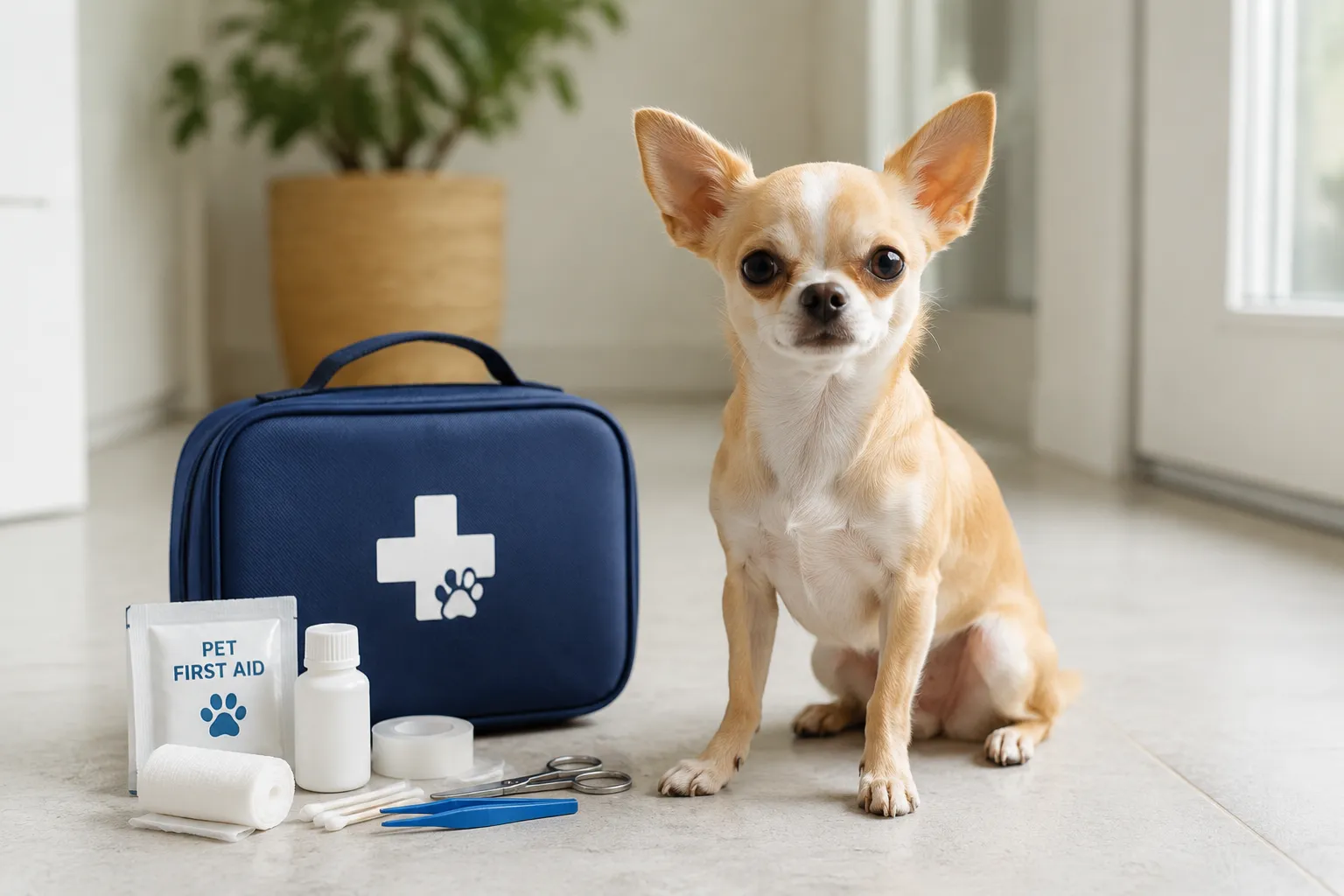
"It's not the size of the dog in the fight, it's the size of the fight in the dog." — Mark Twain
Down the hallway, the click of tiny nails, then a yelp swallowed by a bigger dog's happy bark. That sound is why, this National Dog Day, the smallest member of your pack deserves a first-aid plan built for her—not one borrowed from the retriever.
Quick Takeaways
- A single family first-aid kit fails your Chihuahua — dosing, tools, and technique all scale with body weight.
- No blood doesn't mean no injury — blunt trauma from a playful big dog can be internal and invisible.
- "Let them work it out" is the riskiest advice in a size-mismatched home; seconds matter for a 5-pound dog.
- CPR and choking response differ by size — get certified before you ever need it.
- Celebrate the survivor, not just the loss — some families mark milestones with custom pet figurines that capture a tiny dog's outsized personality.
The Multi-Pet First-Aid Blind Spot Nobody Talks About
We've reviewed a lot of pet first-aid content over the years. Blog posts, printable checklists, laminated fridge cards, the works. And here's the standout problem with almost all of it: it's written for a dog that doesn't exist in your house.
The "default dog" in most guides weighs somewhere between 40 and 70 pounds. A Lab. A shepherd mix. A golden. The advice assumes that dog's metabolism, that dog's airway, that dog's pain tolerance. Then you go home to a 6-pound Chihuahua and quietly apply instructions calibrated for an animal ten times her size.
That's the blind spot. Not the other pets themselves. The assumption of sameness.
Worth noting: this problem gets worse, not better, in a multi-pet home. When you have two or three dogs, you naturally build one system. One kit under the sink. One vet's number on the fridge. One mental script for "what do I do if something happens." Efficient. Also dangerous, because that single system defaults to the bigger animal almost every time.
The commonly overlooked truth is this—your Chihuahua lives in a different physical world than your big dog. She occupies the floor. The space under the coffee table. The narrow lane between the couch and the wall. She moves through the low corners of the room where a bigger dog's shoulder swings without warning. Her emergencies happen at a scale, and at a speed, that a large-breed plan simply wasn't designed to catch.
So let's do what a good editor does. Let's throw out the five most common pet first aid myths that put small dogs at risk, and replace each one with what actually protects them.
"In a mixed-size home, the danger isn't the big dog's temper. It's your one-size-fits-all plan."

Myth 1: One Family First-Aid Kit Covers Every Pet
Picture the kit most people own. A zippered pouch with gauze, some vet wrap, a pair of blunt scissors, maybe a tick key and a bottle of something for wounds. It sits in a hallway closet or a kitchen drawer, and it's genuinely useful.
For your big dog.
Here's the thing about a Chihuahua-ready kit: the contents don't just shrink, they change. A muzzle sized for a Lab won't seat on a Chihuahua's face, and a panicked small dog can slip it and bite—or worse, can't breathe well in it if it's forced on. Gauze meant to wrap a large paw becomes a bulky, circulation-cutting mess on a leg the width of your thumb.
Our top recommendation is to stop thinking "family kit" and start thinking layered kit. Keep your shared supplies, absolutely. But add a small, clearly labeled pouch that belongs to the little dog and no one else.
What goes in the Chihuahua layer that people forget:
- A properly sized soft muzzle or a strip of soft gauze for improvised muzzling (a scared small dog bites first, thinks later).
- A digital thermometer and the note that normal runs 101–102.5°F—small dogs chill and overheat fast.
- Corn syrup or a glucose gel, because hypoglycemia is a real, fast emergency in toy breeds and tiny puppies.
- A small towel to swaddle and restrain without crushing.
- Your dog's current weight written on the lid. Sounds silly. It's the single most important number in a poisoning call.
The "so what" here is blunt: in an emergency, you will not do math or measurement well. You'll be shaking. A kit that already accounts for a 5-pound body removes decisions from the worst possible moment to be making them.
The American Kennel Club's overview of building a canine first-aid kit is a solid baseline—just read it with the mental filter that your smallest dog needs her own supplement to it.
Myth 2: No Blood Means No Real Injury
This one costs small dogs their lives, and it's the most invisible risk in the whole list.
A family we worked with told us about their morning. Two dogs, a 70-pound rescue and a 4-pound Chihuahua, playing in the kitchen. The big dog spun, his hip caught the little one, and she rolled, popped back up, shook it off, and trotted to her water bowl. No cut. No limp. No yelp after the first surprised one. They exhaled and went about their day. By afternoon she was quiet in her corner, breathing wrong.
Blunt-force trauma is the danger you can't see. When a large dog's body—even in pure play, no aggression at all—collides with a toy breed, the force transfers into a body that has almost no protective mass. Vets call the severe version "big dog–little dog" syndrome, or BDLD, and it's a recognized emergency category. The wounds that matter are often internal: bruised lungs, a cracked rib driven inward, bleeding you'll never spot from the outside.
Here's the counterintuitive part most owners miss. A small dog acting "fine" right after an impact tells you almost nothing. Dogs are hardwired to hide vulnerability, and internal bleeding or shock can take 30 minutes to several hours to show. The calm hour after a collision is not the all-clear. It's the window.
What to actually watch for in the hours after any big-dog impact:
- Gums that go pale, gray, or muddy instead of healthy pink (press gently—color should return in under 2 seconds).
- Breathing that's fast, shallow, or has an odd catch to it.
- A dog who "goes to her corner"—that retreat to a low, tucked, out-of-the-way spot is a classic pain and shock signal.
- A tucked belly, a hunched back, or reluctance to be picked up.
So what? If your Chihuahua takes a real hit from a bigger dog, the smart move isn't to watch and wait at home. It's to call your vet and describe the mechanism—"she was body-slammed by a dog fifteen times her size." That single sentence changes how a vet triages the call, because they know what that force does to a small frame.
We're not vets, and this isn't medical advice—it's pattern recognition from too many stories that ended the same way. When in doubt with a toy breed, the downside of an unnecessary vet visit is a copay. The downside of waiting is not.
Here's a quick reference for how the same incident reads completely differently depending on which dog it happens to:
| Incident | For a 70-lb Dog | For a 5-lb Chihuahua |
|---|---|---|
| Playful body-check | Barely noticed | Possible internal trauma, rib fracture |
| Short fall from couch | Minor jolt | Risk of fracture or head injury |
| Stepped on by owner | Startle, quick recovery | Potential crush injury |
| Missed meal | Mild hunger | Hypoglycemia risk within hours |
| Swallowed a grape | Low-dose exposure | Proportionally far higher toxin load |
Myth 3: Let the Dogs Work It Out Themselves
Solid advice for two evenly matched dogs sorting out furniture rights. Genuinely bad advice when one dog could fit inside the other's mouth.
The phrase "let them work it out" comes from a real place—breaking up every minor squabble can create anxious, dependent dogs, and a lot of same-size scuffles resolve fine on their own. But it assumes both dogs are playing the same game with the same stakes. In a size-mismatched home, the stakes aren't symmetrical. For your Chihuahua, a single hard grab—not even a true fight, just overexcited play—can end in a puncture, a spinal injury, or a shaken-baby-level whiplash.
The mistake most people make is watching for aggression. They figure they'll intervene if things "turn mean." But BDLD injuries overwhelmingly happen during friendly play, prey-drive chasing, or a big dog getting overstimulated by a small one darting and squeaking. There's no snarl to warn you.
A practical, no-nonsense reframe: your job in a mixed-size home isn't to referee fights. It's to manage arousal and geography.
- Interrupt before the peak, not after. When play gets faster and the small dog starts high-pitched squeaking, that's your cue—not the moment teeth appear.
- Control the vertical. Give your Chihuahua elevated safe zones (a couch corner, a cat tree, a raised bed) where the big dog's momentum can't reach.
- Create escape lanes. Small dogs get hurt when they're cornered against a wall or under furniture with no exit. Arrange the room so she always has an out.
- Feed and give high-value chews separately. Resource moments are where size mismatch turns dangerous fastest.
The "day-in-the-life" version looks like this. It's 6 p.m., you're making dinner, and the pack gets zoomies in the narrow galley kitchen. Instead of half-watching, you toss the big dog's ball down the hallway—away from the little one—and drop a lick mat on the Chihuahua's raised bed. Two dogs, two zones, thirty feet of separation, no confrontation. That's not overparenting. That's the whole ballgame.
"You don't referee a mismatched pack. You design a room where nobody has to fight."
So what's the payoff? Studies and veterinary consensus consistently point to the same thing: the vast majority of serious small-dog injuries in multi-pet homes are preventable through management, not treatment. The best first aid is the emergency that never starts.
Myth 4: First-Aid Techniques Are the Same for Every Dog
If you've taken a pet CPR course, good—you're ahead of most owners. But a lot of what floats around online quietly assumes a medium-to-large dog, and applying it to a Chihuahua can do harm.
Consider chest compressions. On a big, deep-chested dog, you compress over the widest part of the chest with the dog on its side, using the heel of your hand or both hands. On a small dog under about 15 pounds, the recommended approach is different—often a one-handed, wrap-around technique compressing directly over the heart, with far less force and a shallower depth. Use big-dog force on a Chihuahua's chest and you can crack ribs into the very organs you're trying to save.
Choking response scales too. The sweeping, forceful abdominal thrusts you might picture are calibrated for size. On a tiny dog, the same motion delivered with the same power can rupture something. Positioning, hand size, and pressure all change.
We're not going to teach you CPR in a blog post, and you shouldn't learn it from one. That's the honest limitation. What we'll say with full confidence is this: the standout action item in this entire article is to take a hands-on pet first-aid and CPR class that lets you practice on a small-dog manikin. The Red Cross and many local vet clinics offer them. Reading about compressions and doing them under stress are different universes.
Worth noting: normal vital signs differ by size, and knowing your Chihuahua's baseline is its own kind of first aid.
| Vital Sign | Large Dog (typical) | Chihuahua (typical) |
|---|---|---|
| Heart rate (resting) | 60–100 bpm | 100–140+ bpm |
| Respiratory rate | 10–30 breaths/min | Often higher end |
| Normal temperature | 101–102.5°F | 101–102.5°F (chills faster) |
| Capillary refill | Under 2 seconds | Under 2 seconds |
Check these numbers on a calm, healthy day and write them down. When something's wrong, "her heart rate is 200" only means something if you know it usually runs 120.
The AVMA's pet first-aid resources are a reliable, non-commercial place to start reading—pair that reading with a live class and you've got the real thing.
Myth 5: If It's Safe for the Big Dog, It's Safe for the Little One
This is the myth that turns a shared home into a shared risk. And it shows up in two sneaky ways.
First, medication. Nearly every dose that matters is weight-based. A quantity of a medication—or a toxin—that a 70-pound dog barely registers can be catastrophic for a 5-pound body. Never split the big dog's prescription for the little one. Never estimate. If your vet says a dose, that dose is tied to a specific weight on a specific day.
Second, and more insidious: proximity. In a multi-pet home, whatever the big dog can safely nibble, the little dog can reach too. A chew, a supplement, a dropped pill, half a chocolate bar the kids left on the low shelf. Your Chihuahua lives at floor level and counter-surfs the coffee table. The spatial reality of a small dog is that the dangerous stuff lives right at her eye line.
One order that stuck with us came from a family who'd lost their Chihuahua to a sugar-free gum incident—xylitol, which is dramatically more toxic to a tiny dog than most people grasp. The gum wasn't even hers. It fell out of a backpack in the entryway. She found it in the hallway before anyone noticed the bag had tipped.
So the practical rule for mixed-size households: you don't childproof for the big dog, you childproof for the smallest one. Grapes, raisins, xylitol, chocolate, onions, xylitol-containing peanut butter, human NSAIDs like ibuprofen—all scale their danger down to body weight, which means your Chihuahua is always the most vulnerable animal in the room.
Keep the ASPCA Animal Poison Control number saved in your phone right now, before you finish this article. Google it, add the contact. When you're staring at an empty gum wrapper on the hallway tile, you will not want to be searching. The ASPCA maintains a widely used list of toxic and non-toxic substances worth bookmarking too.
"We build figurines of dogs who survived a hundred close calls. The little ones always have the biggest stories."
— The PawSculpt Team
Building a Chihuahua-Ready First-Aid System That Actually Works
Enough myth-busting. Let's get organized, because a plan you can't find at 2 a.m. isn't a plan.
Our approach is a three-zone system, and it's built around the reality that emergencies with small dogs move fast and you'll be flustered.
Zone 1: The Grab Bag. One small, brightly colored pouch, stored somewhere you pass daily—not buried in a closet. This is the Chihuahua layer we talked about: soft muzzle, thermometer, glucose gel, a small towel, self-adhesive wrap sized for tiny limbs, and a laminated card with her weight, your vet's number, the nearest 24-hour ER, and Animal Poison Control.
Zone 2: The Fridge Sheet. A single printed page on the fridge with the same emergency numbers plus a two-line "what to do while we drive" note for the three scenarios most likely in your home—big-dog impact, choking, and suspected poisoning. In a crisis, reading beats remembering.
Zone 3: Your Phone. Contacts saved. A recent photo of your dog. A note with her exact weight and any medications. The photo matters more than you'd think—if someone else has to take her in, a clear image and her stats save minutes.
Here's how those pieces map to the emergencies you're actually preparing for:
| Scenario | First Move | Kit Item Needed | Then |
|---|---|---|---|
| Big-dog impact | Check gums + breathing | Note weight, phone | Call vet, describe mechanism |
| Suspected poisoning | Identify substance | Weight card, poison # | Call before inducing anything |
| Choking | Assess, don't blind-sweep | Trained technique | ER if not resolved fast |
| Low blood sugar | Rub glucose on gums | Corn syrup/glucose gel | Vet if no rebound |
| Bleeding wound | Direct pressure | Gauze, small wrap | Vet for anything deep |
The counterintuitive insight buried in that table: for a Chihuahua, your first move is almost never a medical procedure. It's information gathering and a phone call. Big-dog first aid often means "stabilize, then transport." Small-dog first aid, given how fast toy breeds decline and how little margin they have, usually means transport is the treatment. Your job is to observe accurately and get her to someone who can help—not to become the doctor.
One more overlooked detail. In a multi-pet home, an emergency with one dog means a loose, stressed second dog underfoot while you're trying to help the first. Decide now who grabs the big dog and where he goes. A crate command, a baby gate, a designated "go to your room" spot. Chaos costs seconds, and for a 5-pound dog, seconds are the currency.
Marking National Dog Day: Celebrate the One Who Made It
Here's something we've learned from thousands of orders. People reach for keepsakes after loss, sure. But the families who surprise us are the ones who commission a piece to celebrate a survivor—the little dog who took the hit, recovered, and is currently snoring in a sunbeam.
National Dog Day is, at its heart, a celebration. And there's something worth honoring in the dog who's small enough to be fragile but stubborn enough to have made it through every close call your careful management prevented—and the one or two it didn't.
Some families mark the day with a long hike. Others do a "yes day" of every forbidden treat (vet-approved, we'd add). And increasingly, pet parents choose something they can hold onto—a full-color resin figurine that's digitally sculpted by 3D artists, then precision 3D printed to capture the exact tilt of those oversized ears, the specific pattern of her coat, the attitude that never fit her body size.
What makes the technology work for tiny dogs specifically: because the color is printed directly into the resin voxel by voxel—not layered on afterward—the fine markings that make a Chihuahua hers come through faithfully. The brindle, the tan points, the white blaze. If you're curious how the process handles a small dog's detail, the team at PawSculpt's custom figurine service walks through it on their site.
"The dog who fit in your palm leaves the biggest empty space on the couch."
We'll be real about the tradeoff: a figurine isn't for everyone, and it isn't the point of keeping your dog safe. The point is the snoring sunbeam. But for families who want to mark the milestone—a recovery, a birthday, a National Dog Day where everyone's still here—a tangible piece has a way of holding the story that photos on a phone don't. You can browse examples and the full process on the PawSculpt blog if that's a road you want to explore.
Frequently Asked Questions
Why is multi-pet first aid different for a Chihuahua?
Almost every first-aid instruction—medication dosing, wrap sizing, CPR force, choking response—scales with body weight. Guidance written for a 60-pound dog can be ineffective or actively harmful on a 5-pound one. In a multi-pet home, the natural tendency to build one shared system means your smallest dog inherits a plan designed for someone much bigger. She needs her own supplies and her own protocol.
Should I break up play between my big dog and my Chihuahua?
Don't referee every squabble, but do manage the environment. Serious small-dog injuries usually happen during friendly play, not fights, so watching for aggression is the wrong signal. Interrupt when play speeds up and the small dog starts squeaking, give her elevated safe spots and clear escape routes, and separate the dogs for meals and high-value chews.
My Chihuahua seemed fine after a big dog bumped her. Is she okay?
Maybe, but "fine" right after impact isn't reassuring on its own. Blunt trauma can cause internal bleeding or bruised lungs that take 30 minutes to several hours to show. Watch her gum color, breathing, and whether she retreats to a tucked corner. When a small dog takes a hit from a much larger one, calling your vet and describing the mechanism is the safe call.
What everyday foods are most dangerous for small dogs?
Xylitol (in sugar-free gum and some peanut butters), chocolate, grapes, raisins, onions, garlic, and human pain relievers like ibuprofen. Because toxicity is weight-based, the same amount that barely affects a big dog can seriously harm a Chihuahua. Save the ASPCA Animal Poison Control number in your phone now, and childproof your home for the smallest dog, not the biggest.
How do I do CPR on such a small dog?
Differently than on a large dog—gentler, shallower, often one-handed over the heart. Using big-dog compression force on a Chihuahua can drive ribs into her organs. This is genuinely a skill you should practice in person, so take a hands-on pet first-aid and CPR class through the Red Cross or a local clinic that uses a small-dog manikin.
How often should I check my Chihuahua's vitals?
Do a baseline check on a calm, healthy day—heart rate, breathing, gum color, temperature—and write the numbers down. You don't need to monitor daily, but knowing what's normal for your specific dog turns a vague worry into a clear signal when something's off. Recheck the baseline a couple of times a year and after any big change in weight or age.
Ready to Celebrate Your Pet?
Every pet has a story worth preserving, and a Chihuahua's is usually bigger than she is. Whether you're honoring a companion who's crossed the rainbow bridge or celebrating a survivor who made it through every close call this National Dog Day, a custom PawSculpt figurine captures the details that make your dog one-of-a-kind—the ears, the markings, the attitude that never matched her size.
Visit pawsculpt.com to learn more about our full-color 3D printing process, preview turnaround, and quality guarantee.