
Stuffed Replica vs3D Resin Print: Which One Survives a Toddler, a Move, and 10 Years? (Material Data Inside)
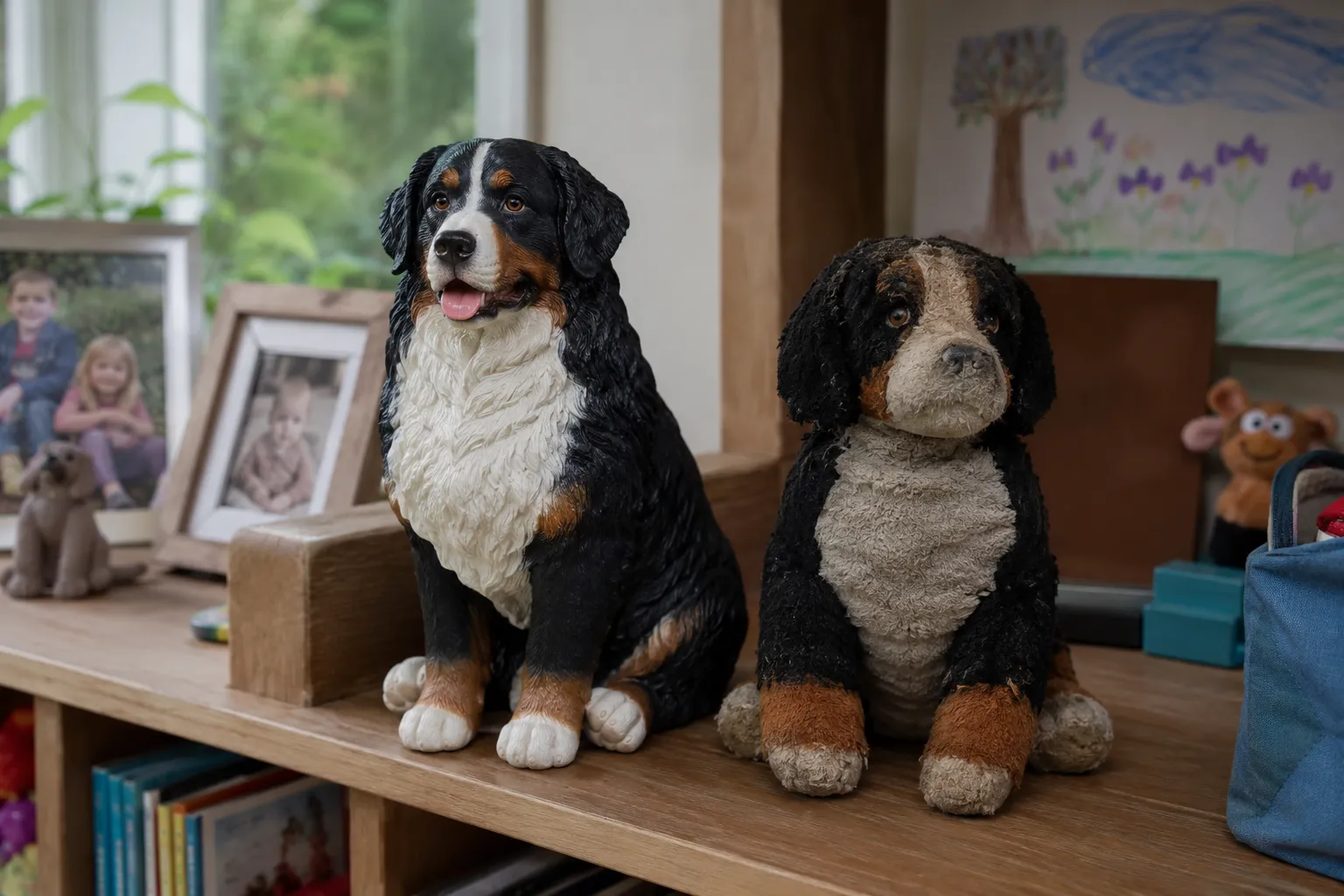
Which keepsake survives the salt-crusted beach towel, the sandy backseat, and the decade that follows — the plush replica your kid drags everywhere, or the shelf piece? That single question sits at the heart of the stuffed animal vs figurine durability debate, and most pet parents never ask it until something is already fading.
Quick Takeaways
- Plush fades fast — sun, saliva, and washing machines break down fabric pets within a few years.
- Full-color resin holds its color because the pigment is baked into the material, not layered on top.
- The toddler test favors washable plush short-term, but resin wins the decade-long memory game.
- For a piece meant to outlive the grief and the moves, explore custom pet figurines built to be handled, not hidden.
- Match the keepsake to the ritual — daily cuddle versus permanent altar shapes which material is right.
The Real Question Nobody Asks Before They Buy
Here's what we've learned from working with thousands of pet families: people choose a memorial keepsake with their heart in the checkout cart and their grief running the show. They pick what feels comforting in week one. They almost never picture week 520.
And that's the mistake.
A keepsake isn't really for this month. It's for the version of you a decade from now, standing in a different kitchen, in a different city, who reaches for something solid when the memory of your dog's weight on the bed comes back uninvited.
So the question isn't "which one is cuter right now." The question is which one becomes a permanent part of your sacred space — the corner of the house where your pet's presence still lives.
We've tested both. We've shipped both. We've heard back from families three, five, eight years later. Let's get into what actually holds up.
"A keepsake's real job starts the day the grief gets quiet. That's when you find out what was built to last."
Why "Durability" Is the Wrong Word to Start With
Most articles on this topic measure durability like it's a phone case. Drop test. Scratch test. Done.
We think that misses the point entirely.
Durability for a pet memorial is emotional first, physical second. A keepsake "fails" not when it cracks, but when it stops looking like your pet. A plush dog can survive a move intact and still betray you — matted, grayed, missing the exact russet of your golden's ears.
That's the part the spec sheets skip. So we're going to talk about both: the material science and the soul of the thing.
Pet Figurine Material Science: What You're Actually Buying
Let's pull back the curtain. When you compare a stuffed replica to a 3D resin piece, you're comparing two completely different physics problems.
A plush replica is textile plus polyester fill plus printed or stitched detailing. Soft. Light. Made to be squeezed.
A modern figurine from advanced full-color 3D printing is full-color resin — and here's the part most people get wrong. The color isn't paint sitting on the surface. The pigment is printed into the material itself, voxel by voxel, so the russet of those ears is part of the resin's body, not a coat that can chip away.
That single difference drives almost everything that follows.
Here's how the core materials stack up across the things that actually matter over a lifetime.
| Factor | Stuffed Plush Replica | Full-Color Resin Figurine |
|---|---|---|
| Color permanence | Surface dye, fades with light and washing | Pigment embedded in resin, far more stable |
| Shape retention | Compresses, mats, sags over years | Holds form indefinitely |
| Cleaning | Absorbs odor, needs washing | Wipe with a damp cloth |
| Allergen behavior | Traps dust, dander, mites | Non-porous, doesn't harbor allergens |
| Repairability | Hard to restore once matted | Stable; clear coat protects surface |
| Emotional accuracy over time | Drifts as fabric ages | Stays true to the original markings |
The takeaway isn't that plush is bad. It's that the two materials are built for different jobs. One is built to be loved loudly. The other is built to be kept.
The Pigment Problem Nobody Warns You About
Here's an aha moment that surprises almost everyone.
Fabric dye and embedded resin pigment age in opposite directions. Fabric dye is a guest on the surface — UV light, body oils, and detergent slowly evict it. You don't notice day to day. Then one afternoon you pull the plush out of a box after a move and the white patches have gone the color of weak tea.
With full-color resin, the color is structural. There's nothing on the surface to wash off because the surface is the color. PawSculpt then seals the piece with a clear protective coat — the only manual step in the whole process — which adds sheen and shields against everyday wear.
So what? So the figurine you photograph on day one looks like the figurine your kid inherits. That's the whole promise of a memorial: that the likeness doesn't quietly leave you while you're not watching.
The Toddler Test: Survival in a House That Throws Things
Let's be real about the chaos test. A toddler is a force of nature with sticky hands and zero respect for your grief timeline.
Here's where honesty matters, because we won't pretend resin wins every round.
For a toddler who wants to hug, drag, and sleep with the keepsake, plush wins the daily battle. It's soft. It survives being thrown across a room. It can go in the wash when it gets covered in applesauce. If your goal is a comfort object a small child carries everywhere, a washable plush replica is genuinely the smarter pick. We'll always tell you that.
But.
There's a version of the toddler test people forget — the display version. A figurine placed on a high shelf, part of the family's daily ritual of "say goodnight to Max," survives a toddler perfectly well, because it lives above the chaos. It becomes a fixed point. The empty chair in the corner gets a guardian.
A Morning in a Real House
Picture it. 7:14 a.m. The kitchen smells like burnt toast and the coffee maker is gurgling. Your two-year-old is demanding the plush dog that's currently soaked because it went through the wash again last night and isn't dry. Meanwhile, on the shelf above the light switch, the resin figurine of the same dog sits exactly where it sat yesterday, catching the morning light, untouched by the cereal disaster below.
Two keepsakes. Two completely different jobs. One gets loved into early retirement. One becomes the household's quiet north star.
That's the insight: the toddler test isn't pass/fail. It's about placement. Soft things for small hands. Solid things for the sacred corner.
"Soft keepsakes get loved to pieces. Solid ones get loved into legacy. You may need both."
The Hidden Cost of the Washing Machine
One thing we wish more people knew before they buy plush: the washing machine is where memorial plush goes to age in dog years.
Every wash cycle does three things at once — it fades the dye, it mats the fiber, and it slowly distorts the stuffing distribution. Three or four cycles in, the proportions shift. The face you knew softens into a generic toy face.
For a comfort object meant to be replaced, fine. For the keepsake of a pet who's gone, that slow drift is a small grief on top of the big one. We've had customers tell us the hardest part was watching the plush stop looking like their dog. With non-porous resin, you skip that entirely — a damp cloth and you're done.
3D Printed Resin Longevity: What 10 Years Actually Does
Now the long game. This is where the 3D printed resin longevity conversation gets interesting, because ten years is long enough for materials to show their true character.
Three forces attack a keepsake over a decade: light, moisture, and handling. Let's take them one at a time, because how each material responds tells you everything.
Light
UV radiation is the silent vandal. It breaks down dye molecules in fabric and yellows cheap plastics.
Quality full-color resin is formulated with UV-resistant materials, and the clear protective coat adds another layer of defense. That's not a marketing flourish — it's the difference between a piece that looks identical in 2035 and one that's gone chalky and pale. Place either keepsake on a sunny windowsill for a decade and you'll watch the gap widen dramatically.
Moisture and Humidity
Basements flood. Attics swing from freezing to baking. Humidity is patient.
Plush absorbs moisture and, given enough time and the wrong storage, invites mildew and that unmistakable musty smell. Once a plush keepsake smells like a damp box, the memory it carried gets tangled up with that smell forever.
Resin doesn't drink water. It doesn't grow anything. Store it in a closet through three rainy seasons and it comes out exactly as it went in. For families who move often — military families, especially, who we hear from a lot — that resilience matters more than almost anything.
Handling and the Patina of Being Loved
Here's a counterintuitive truth. Being touched is good for resin and bad for plush.
Every time a hand reaches for the figurine, it stays connected to the ritual without degrading. The oils wipe off. The form holds. A well-made resin piece can be a daily touchstone for a decade and look the part the whole time.
Plush degrades from love. The more you hold it, the faster it ages. There's something poetic about that — and something heartbreaking when the object is irreplaceable.
Here's the decade laid out plainly, based on what we've observed across years of customer follow-ups and general material behavior (we're describing typical outcomes, not lab-certified guarantees).
| Time Elapsed | Plush Replica | Full-Color Resin Figurine |
|---|---|---|
| Year 1 | Looks great, maybe a little fuzzy | Looks identical to day one |
| Year 3 | Visible matting, slight fading | No meaningful change |
| Year 5 | Color drift, shape softening | Stable, color true |
| Year 10 | Significant fade, possible odor | Essentially unchanged |
| After a move/storage | Risk of crushing, mildew, musk | Wipes clean, holds form |
"We've watched families pull a figurine out of a moving box years later and tear up because it looked exactly like the day their dog was alive."
— The PawSculpt Team
Custom Pet Memorial Comparison: Matching Material to Meaning
Specs only get you halfway. The right choice depends on what role the keepsake plays in your life — and this is where the editorial judgment comes in. After reviewing how families actually live with these pieces, we've sorted them into clear use cases.
Think of it less as "which is better" and more as "which is right for the ritual you're building."
If You Want a Comfort Object → Soft Plush
Who it's for: Grieving children, anyone who needs to hold something close at night.
A plush replica is the right call when physical softness is the medicine. Kids especially process loss through touch and sleep. A huggable stand-in does real emotional work.
The consideration: Treat it as a loving, temporary companion, not a forever artifact. Buy it knowing it will age. That's okay — some love is meant to wear out gently.
If You Want a Permanent Tribute → Full-Color Resin Figurine
Who it's for: Families building a lasting tribute, a home altar, or a piece to pass down.
This is where a custom pet memorial comparison almost always tips toward resin. When the goal is permanence — a fixed presence in your sacred space that survives toddlers, moves, and decades — embedded-color resin is the standout. PawSculpt's pieces are digitally sculpted by master 3D artists, then precision 3D printed in full color, so the markings stay true.
The consideration: It's a display piece first. Beautiful to handle, but designed to be kept, not squeezed to sleep.
If You Want Both → Use Them Together
Honestly? Our favorite setup is both, and here's the logic.
The plush handles the nights. The figurine anchors the days. The child carries the soft one; the family gathers around the solid one. Each material does the job it's actually good at, and neither one is asked to be something it isn't.
We've seen families do exactly this, and it's the most emotionally complete approach we know.
Where Other Keepsakes Fit
We'd be doing you a disservice if we pretended figurines and plush were the only two roads. They're not.
- Memorial gardens and planted trees — beautiful, living, but tied to one location you might leave.
- Photo books and framed prints — flat, fade-prone, but inexpensive and easy.
- Paw-print clay molds — intimate, though fragile and abstract.
- Custom figurines — three-dimensional, durable, and the closest thing to your pet's actual presence.
The right answer is sometimes a combination. We'll never tell you a figurine is the only valid way to grieve. It's one powerful option among several, and the best one depends on how you want to remember.
How the Bond Outlives the Material
Step back from the spec sheets for a second, because there's a layer underneath all of this that the durability charts can't measure.
When a pet dies, the house reorganizes itself around an absence. The spot by the door where the leash hung. The dent in the couch cushion. The square of floor that always had a warm body on it at 6 p.m. Grief is spatial. It lives in the empty places.
A keepsake is, in a real sense, a way of giving that absence a shape again. You're not buying an object. You're re-anchoring an energy that the room lost.
That's why material matters more than it seems. A keepsake that fades is an anchor that slowly lets go. A keepsake that holds is a presence that stays put while you do the long work of healing around it.
"Grief is spatial. It lives in the empty corner. A keepsake gives that corner something to hold."
The science of human-animal attachment backs up how deeply we ritualize these bonds — organizations like the Association for Pet Loss and Bereavement have long documented how tangible memorials help people move through grief rather than around it. The object becomes a permission slip to keep loving.
So when we talk about pet figurine material science, we're really talking about how long that permission slip lasts. Embedded pigment, UV resistance, a non-porous surface — these aren't just durability stats. They're the difference between a tribute that stays luminous and one that quietly dims while your back is turned.
What to Expect When You Choose a Custom Figurine
If you're leaning toward the resin route, here's the honest walkthrough of how a custom piece comes together — minus the salesy gloss.
The process starts with you and a few good photos. From there, master 3D artists hand-model your pet digitally, shaping the proportions, the posture, the particular tilt of the head that was theirs. Then the model is brought to life through full-color 3D printing, where the color and fur patterns are reproduced directly in the resin. The final step is a clear protective coat for sheen and longevity.
The result has an authentic quality — vibrant full color with the natural, fine texture of a 3D print, not a slick, mass-molded plastic look. It feels real because it isn't pretending to be flawless.
For specifics on preview turnaround, revisions, and the quality guarantee, head to pawsculpt.com — those details are best confirmed straight from the source rather than from a blog post.
The Photos That Make or Break the Likeness
This is the part people underestimate. The figurine can only be as accurate as the reference. After thousands of orders, here's what we've learned actually works.
| What to Capture | Why It Matters | Quick Tip |
|---|---|---|
| Eye-level angle | Avoids distortion, reads as natural | Crouch down to their height |
| Natural daylight | True colors, no orange or blue cast | Near a window, no flash |
| Sharp focus on the face | The face carries the recognition | Tap to focus before shooting |
| A few different poses | Lets artists pick the truest stance | Standing, sitting, relaxed |
| Markings up close | Captures the details that make them them | Photograph unique spots and patches |
The single biggest fix? Get down on the floor. Photos shot from human standing height distort a pet's proportions every time. Drop to their eye level and the accuracy jumps immediately.
A quick aside — if your pet has already passed and you only have a handful of photos, don't panic. Skilled 3D artists work with what you've got. Send the clearest ones you have, even old ones. We've built beautiful, accurate pieces from a single good photo more times than we can count.
Caring for a Resin Figurine So It Hits the 10-Year Mark
Resin is low-maintenance, but "low" isn't "zero." A few simple habits keep it pristine.
- Dust with a soft, dry cloth every couple of weeks — no chemicals needed.
- For deeper cleaning, use a barely-damp cloth and let it air dry.
- Keep it out of harsh, direct, all-day sun even though the material is UV-resistant — why test it unnecessarily?
- Display it where it won't get knocked — resin is durable, not invincible against a hard floor.
Follow those and the piece you receive today is the piece your family keeps for decades. That's the entire point of choosing this material in the first place.
For broader guidance on coping with pet loss and the role of keepsakes in healthy grieving, the American Society for the Prevention of Cruelty to Animals offers grounded, compassionate resources worth bookmarking.
The Verdict After Testing Both
So, our editorial call. After weighing material against meaning, here's where we land.
If you need softness and you need it tonight, get the plush — and make peace with the fact that it's a beautiful, temporary thing.
If you want a tribute that survives the toddler years, the cross-country moves, and the long quiet decade where you slowly learn to live with the absence, the full-color resin figurine is the keepsake built for that distance. The embedded pigment, the UV resistance, the wipe-clean surface — they all point the same direction: permanence.
And if you can swing both, do both. Let each one do what it's best at.
The thing we keep coming back to is this. You're not really choosing a product. You're choosing how long you want your pet's likeness to stay luminous in the room where you miss them most. Choose the material that matches that timeline.
Frequently Asked Questions
Which lasts longer, a stuffed animal or a resin pet figurine?
A full-color resin figurine wins the longevity contest decisively. Because the color is embedded in the material and sealed under a clear protective coat, it resists the fading, matting, and odor absorption that age a plush replica within just a few years. Plush is wonderful for daily comfort, but it's not built for the decade-long haul.
Does 3D printed resin fade over time?
Quality full-color resin holds its color remarkably well. The pigment is printed into the body of the material rather than coated on the surface, so there's nothing to wash or rub off. Combined with UV-resistant formulation and a clear sealing coat, a well-made piece stays true to your pet's markings for many years. We'd still keep it out of relentless all-day sun, just as a precaution.
Is a resin figurine safe to have around toddlers?
As a display piece kept out of reach, absolutely — it lives above the chaos and survives a busy household just fine. If your goal is a comfort object a toddler can hug, drag, and sleep with, a washable plush replica is genuinely the smarter daily choice. Many families use both: soft for the nights, solid for the shelf.
Can a custom pet figurine be made from old or limited photos?
Yes. Master 3D artists can create an accurate figurine even from a single clear photo, which matters enormously for families memorializing a pet who's already passed. Send the sharpest images you have, ideally at the pet's eye level and showing unique markings. Clarity beats quantity every time.
How do I keep a resin figurine looking new for years?
It's refreshingly low-maintenance. Dust it with a soft dry cloth every couple of weeks, and for deeper cleaning use a barely-damp cloth followed by air drying. Skip harsh chemicals — the non-porous surface doesn't need them. Display it somewhere stable where it won't take a hard fall, and it'll hit that ten-year mark looking like day one.
Should I choose plush or resin for a pet memorial?
It depends on the ritual you're building. For an intimate comfort object you'll hold close, plush. For a permanent tribute, a home altar, or an heirloom to pass down, full-color resin is the standout. When in doubt, our honest advice is to consider both, since each material does a different emotional job beautifully.
Ready to Celebrate Your Pet?
Every pet has a story worth preserving. Whether you're honoring a beloved companion who's crossed the rainbow bridge or celebrating your furry friend's unique personality, a custom PawSculpt figurine captures those details that make your pet one-of-a-kind. When the stuffed animal vs figurine durability question comes down to what truly lasts, our full-color resin pieces are built to stay luminous through toddlers, moves, and the long decades that follow.
Visit pawsculpt.com to learn more about our process, preview turnaround, revisions, and quality guarantee.