
Canvas Print vs. Resin Figurine: The Greener Way to Remember Your Samoyed
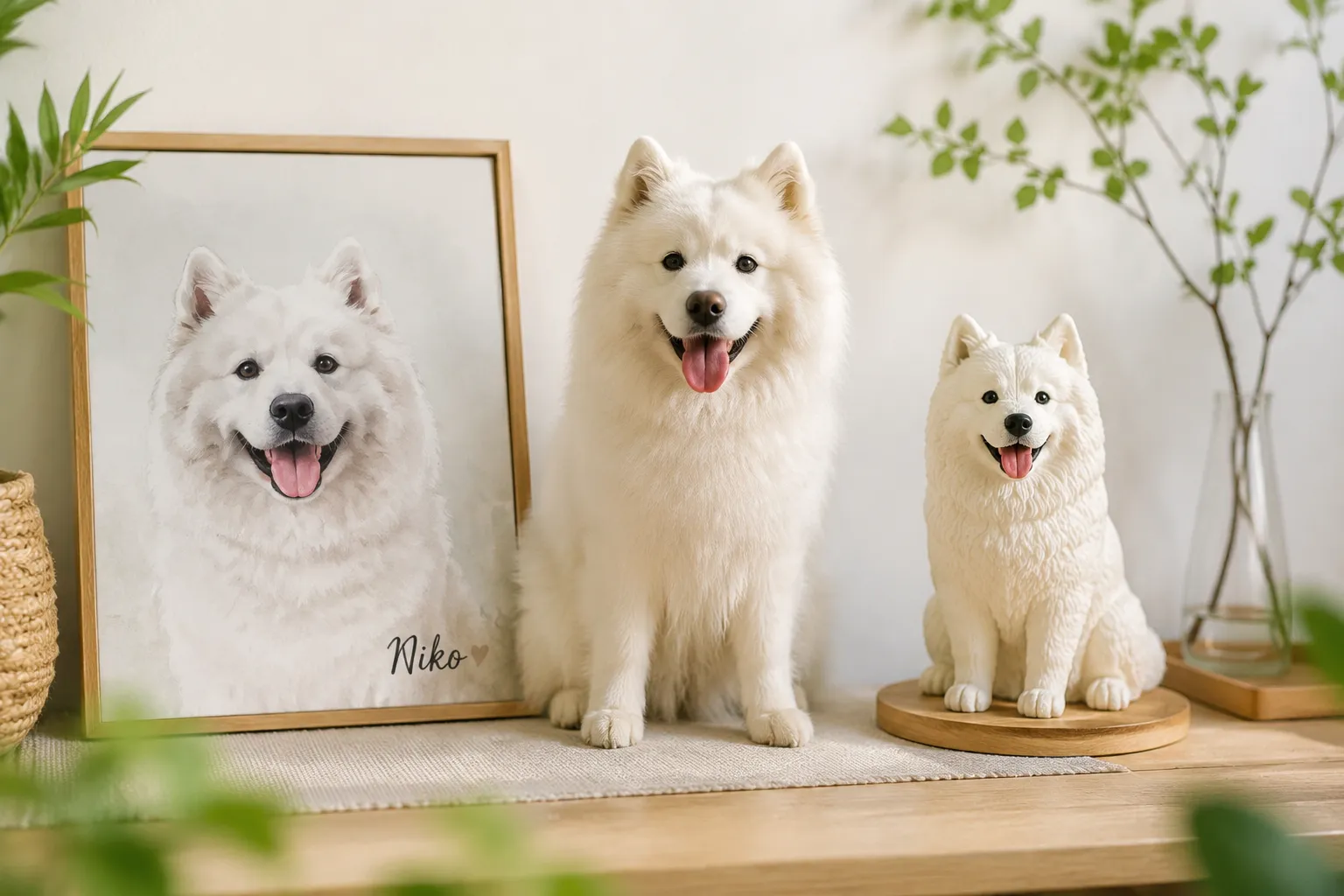
Your fingers still carry the sharp antiseptic scent of the vet's hand gel when the receptionist slides a pamphlet across the counter—eco-friendly pet memorial options, the header reads—and the Samoyed-shaped absence in your chest suddenly has a checkbox beside it.
Quick Takeaways
- "Green" isn't decided at checkout — a keepsake's true footprint is measured over decades, not at the moment you buy it.
- Samoyeds break the usual comparison — that thick white double coat renders differently on flat canvas than in dimensional form.
- Durability is the hidden sustainability metric — the object you never replace is the one that never adds to a landfill.
- Explore full-color 3D printed custom pet figurines to see how a dimensional keepsake holds a Samoyed's texture.
- Ritual matters more than material — a memorial you actually touch and return to earns its place in your home.
The Sustainability Question Everyone Gets Backwards
Here's the mistake most people make when they type "eco-friendly pet memorial" into a search bar. They assume the greenest choice is the one with the lowest footprint on the day it ships. Lightweight canvas, recycled frame, carbon-neutral shipping badge. Checkout, done, conscience clear.
But that math is incomplete. And for a Samoyed—a dog whose entire visual signature is a cloud of dense, light-scattering fur—it might be flat-out wrong.
Think in timelines instead of transactions. The real environmental cost of any object breaks into three phases: what it took to make, how long it lasts, and what happens when it's gone. Most memorial guides only discuss the first phase. They'll tell you canvas uses less raw material than resin, which is technically true at the moment of manufacture. What they skip is the part that actually determines your footprint over a lifetime.
"A keepsake replaced three times isn't three memorials. It's three-quarters of the landfill."
Consider the arithmetic. A printed canvas exposed to indirect light will show measurable color shift within roughly 7 to 15 years, faster if it hangs anywhere near a window. Humidity warps the stretcher bars. The fabric slackens. At some point—usually quietly, without ceremony—it gets taken down, and something new takes its place. Each replacement carries its own manufacturing cost, its own shipping, its own eventual disposal.
An object built to last 50 or 100 years, by contrast, amortizes its footprint across generations. The higher upfront material cost gets divided by a much larger number. This is the counterintuitive core of sustainable memorial-making: the "greener" object is often the denser, more durable one, precisely because you only make it once.
We've watched this play out with thousands of pet families. The people who come back to us aren't usually replacing a figurine. They're commissioning a second one—for a different pet, a different chapter. The first is still on the shelf, still holding its color, still carrying weight.
The energy nobody weighs
There's a second footprint here that no life-cycle assessment captures, and this is where the practical and the sacred start to blur.
When you keep an object for decades, it accumulates something. Not molecules—meaning. It becomes a fixed point in the household, a small anchor for the bond that didn't end when the heartbeat did. A memorial that gets swapped out every decade never gets to become that. It stays decorative. It never crosses over into sacred.
The most sustainable keepsake, then, is the one you never want to replace. Longevity of material and longevity of attachment turn out to be the same design problem, approached from two directions.
Canvas vs. Figurine for a Samoyed: The Honest Comparison
Let's be real about tradeoffs, because both formats have genuine strengths and anyone who tells you one is universally superior is selling something.
The comparison shifts dramatically depending on the breed, and Samoyeds sit at an extreme. Their coat isn't a color—it's a light behavior. That famous "Sammy smile" and the halo of white guard hairs work by scattering and refracting light in three dimensions. Flatten that onto a two-dimensional surface and you lose the mechanism that made it beautiful in the first place.
Here's how the two formats actually stack up for a white double-coated breed specifically:
| Factor | Canvas Print | Full-Color 3D Printed Figurine |
|---|---|---|
| Rendering white fur | Reads as flat gray or blown-out white under most lighting | Dimensional volume catches real light, mimics coat depth |
| Lifespan before fade | ~7-15 years, faster near windows | Decades; UV-resistant resin resists color shift |
| Tactile engagement | Visual only, discouraged from touching | Designed to be held, weighted, returned to |
| Footprint over 50 years | Multiplied by replacements | Single manufacture, amortized across generations |
| Space required | Wall real estate | Shelf, desk, bedside—portable |
| Best for | Large-scale wall presence, budget-first | Texture fidelity, permanence, ritual object |
Notice the table doesn't crown a winner. If your priority is a large statement piece for a specific wall and budget drives the decision, a quality canvas is a reasonable, honest choice. We'd never pretend otherwise.
But if you want the thing you can hold at 2 a.m. on the hard nights—the object with weight and cool-then-warming surface that responds to your hand—the dimensional form is doing something canvas structurally cannot.
Why white is the hardest color to remember
This is the insight that surprises people most. White is the most difficult coat to represent, and it's also the easiest to misremember.
Your brain doesn't store "white." It stores the way morning light pooled in the ruff around your Samoyed's neck, the faint cream at the tips of the guard hairs, the way the undercoat looked almost blue-gray in shadow. A flat print collapses all of that into a single value. You end up with something that's technically your dog and emotionally a stranger.
A dimensional surface preserves the shadows. The recesses between fur masses stay dark; the raised tufts catch light. That interplay is what your memory actually encoded. So the format that seems like "more material" is, for a Samoyed, often the one that returns more of the real dog to you.
The Weight of a Thing You Can Hold
Grief has a texture, and most memorials ignore it entirely.
A family we worked with described the first week after losing their Samoyed as a series of phantom sensations. The absence of the sixty-pound warmth against the bed. The reach, automatic, for a coat that wasn't there. The strange silence of a house that had been loud with that particular full-throated Sammy vocalization. Their hands, they said, didn't know what to do.
This is the part clinical grief literature underplays and the spiritual traditions have always understood. Loss is not only emotional. It is physical and it lives in the body—specifically, in the hands. We spend years touching our animals. The bond is literally built through fur under fingers, through weight and warmth. When that ends, the hands are orphaned.
"The hands grieve on their own schedule. Give them something to hold."
A flat image asks your eyes to remember. A dimensional object gives your hands somewhere to go.
There's real logic to why this matters, not just sentiment. The tactile system is one of the earliest and deepest ways we process attachment and safety—it's why weighted blankets calm the nervous system. A memorial with actual heft, cool to the touch when you first lift it and slowly warming in your palm, engages a channel that a wall-hung image simply can't reach. You're not looking at a memory. You're holding one.
Texture as a keeper of truth
Run your thumb across a full-color resin 3D print and you'll feel something the eye almost misses: a fine grain, a subtle topography where the printing process built the surface layer by layer, sealed under a protective clear coat that gives it a soft sheen without erasing the texture beneath.
This isn't a flaw. It's honesty. The surface isn't the glassy, dead-smooth perfection of a mass-produced trinket. It has tooth. It has presence. Under your fingers it reads as something that was made with intention rather than stamped out by the thousand.
For a Samoyed, whose whole aesthetic is about the richness of texture, that grain does quiet work. It refuses the plastic-perfect blankness that makes cheap keepsakes feel hollow. The object feels like it belongs to the animal it represents.
What "Sustainable" Actually Means for a Keepsake
The word "sustainable" gets stretched until it means almost nothing. Let's put a frame around it that actually helps you decide.
For a memorial keepsake specifically, sustainability breaks into four measurable dimensions. Run any option—canvas, figurine, photo book, urn, garden stone—through this grid and the honest answer usually reveals itself:
| Dimension | What to Ask | Why It Matters |
|---|---|---|
| Material footprint | What went into making it once? | The upfront cost, and the only phase most guides measure |
| Longevity | How many years before it degrades or gets replaced? | Divides the footprint; a 50-year object beats five 10-year ones |
| Emotional durability | Will you still want it in 20 years? | An object you discard early wasn't sustainable regardless of material |
| End-of-life | What happens when it's finally gone? | Resin is inert and long-lived; treated canvas and mixed frames are harder to recycle |
Here's the "if-then" that falls out of this grid. If an object scores low on longevity and emotional durability, then its low material footprint is almost irrelevant, because you'll manufacture and dispose of it multiple times. If it scores high on both, then even a heavier single manufacture can be the greener lifetime choice.
This reframes the whole canvas vs figurine question for a Samoyed. The figurine's slightly higher material cost at manufacture is offset—often many times over—by the fact that you make it once and keep it for the rest of your life, maybe longer than your life.
The overlooked footprint of "just in case"
One commonly missed factor: the memorials people buy and then quietly abandon.
We've heard versions of this story more times than we can count. Someone orders a memorial in the raw acute phase of grief, chooses fast and cheap because deciding anything feels impossible, and six months later the item feels wrong. Too generic. Doesn't look like the dog. So it goes in a drawer, and eventually they commission the thing they actually wanted.
That's two manufactures, two shipments, and one object in a landfill—all because the first choice prioritized speed over rightness. The single most sustainable move you can make is to get it right the first time. Not fastest. Right. That means picking a format that actually captures your particular animal, which for a light-scattering, heavily-textured breed points strongly toward dimensional form.
Why a Samoyed Specifically Changes the Calculation
Generic memorial advice treats all dogs as interchangeable silhouettes. They aren't, and a Samoyed proves the point better than almost any breed.
According to the American Kennel Club's breed profile, the Samoyed's double coat is one of its defining traits—a dense undercoat beneath a longer, harsher outer coat, engineered by centuries of Arctic life. That's not decorative background. That coat is the dog. Any memorial that flattens it has thrown away the signal.
Three things about Samoyeds specifically reshape the format decision:
- The coat is volumetric, not planar. Depth is the whole point. A dimensional keepsake preserves the ruff, the tail plume, the fullness that made your Sammy look twice its actual mass.
- White demands shadow to read as fur. Without recesses catching shade, white fur reads as blank. Dimensional surfaces manufacture their own shadow.
- The "smile" is a 3D expression. The upturned mouth corners that give Samoyeds their signature look depend on facial structure. It survives sculpting in the round far better than it survives flattening.
"A silhouette remembers the shape of a dog. Texture remembers the soul of one."
So when a Samoyed family asks us whether format really matters that much, the honest answer is: for your breed more than most, yes. A Labrador's short coat translates to flat surfaces with less loss. A Samoyed's cloud does not.
The digital sculpting difference
Here's where craft meets technology, and it's worth understanding what actually happens, because there's a lot of misleading language out there.
At PawSculpt, the work begins with master 3D artists who digitally sculpt your pet from your photographs—building the form, the coat masses, the specific tilt of the head your dog always did. Then that model is precision 3D printed in full color, where the color is printed directly into the resin, voxel by voxel, so the markings and coat tones are part of the material itself rather than a coating on top. The only manual step afterward is a protective clear coat that seals the surface and gives it its gentle sheen.
For a Samoyed, this process matters more than for almost any other breed. The technology reproduces the subtle gradient from bright ruff to shadowed undercoat directly in the resin—the exact tonal range that flat printing collapses. You can explore how this works in more detail through our 3D pet sculpture process, but the short version is this: the color lives inside the object, so it doesn't fade the way a surface layer would.
"A Samoyed isn't white. A Samoyed is a hundred whites catching light differently. Our job is to keep all hundred."
— The PawSculpt Team
What We Wish We Knew Sooner
A candid retrospective from our team, the things we learned the slow way so you don't have to:
- Grief distorts scale. People consistently order memorials too small in the acute phase, then wish they'd gone bigger. A keepsake you'll hold wants enough heft to feel real in the hand—err larger than your instinct in week one.
- The "perfect" photo isn't the professional one. The studio portrait with perfect lighting often loses the dog. The slightly blurry shot where your Sammy is mid-smile on the kitchen floor usually carries more of who they were. Personality beats resolution.
- Waiting is not the same as avoiding. Some families feel guilty for not memorializing immediately. There's no clock on this. A keepsake commissioned two years later, when you can see your dog clearly again, is often truer than one made in the fog of week one.
- You'll touch it more than you'll look at it. We designed for the eyes at first. Customers taught us they reach for these things. They hold them. That reframed everything about weight and surface finish.
- One right object beats three approximate ones. The families most at peace didn't buy the most. They bought the one that actually looked like their dog, and stopped.
The Ritual of Choosing: A Sacred Practice, Not a Purchase
Somewhere between the vet's pamphlet and the shelf where a memorial finally rests, there's a process most people move through without naming it. It deserves naming, because doing it consciously changes the outcome.
Choosing a memorial is a ritual of transition. In nearly every human tradition, the bond with the dead is maintained through a physical object—a portrait, a stone, a kept possession. The object isn't superstition. It's a technology for keeping a relationship alive across the boundary of death. The spirit of the bond needs a vessel, and you're choosing which vessel.
Treat it that way and the decision gets clearer. You're not shopping. You're building a sacred space in your home—a fixed point where the presence of your Samoyed remains available to you.
A quiet practice we've seen families adopt, and one we'd gently suggest:
- Choose the spot before the object. Decide where the memorial will live—a bedside table, a windowsill catching morning light, a shelf near where they used to sleep. Let the space call for the object rather than the reverse.
- Select the photo that makes you smile before it makes you cry. That expression is the one you want kept.
- Sit with the format decision for a few days. Not weeks of paralysis. A few days. Rightness usually announces itself quietly.
- When it arrives, hold it before you place it. Let your hands do the first greeting. Then set it in its space.
This isn't about being precious. It's about honoring that what you're doing has weight, literally and otherwise.
When the living deserve figurines too
One reframe worth offering, because it surprises people and it's genuinely useful: a memorial doesn't have to wait for a memorial.
Some of the most moving orders we receive are for Samoyeds who are very much alive—senior dogs whose families want to hold the current version of them before it changes, or perfectly healthy young dogs celebrated on a birthday. There's a spiritual generosity in honoring the bond while both parties are still in it. You're not preparing for loss. You're marking a presence.
If your Sammy is still filling your house with white fur and that particular full-body wag, there's something quietly profound about a custom pet figurine made now, while you can compare it side by side to the living original. The object becomes a marker of a specific season you're currently inside, rather than only a relic of one that's gone.
What to Expect When Creating a Dimensional Keepsake
If you decide the figurine route fits your Samoyed and your values, here's the general shape of the process, so it feels less like a mystery.
The creative flow moves through a few natural stages. Turnaround times, revision policies, and pricing shift over time, so for the current specifics we'd point you to the details on the site rather than quote numbers that might be stale. Visit our FAQ page for the up-to-date particulars.
| Stage | What Happens | Your Role |
|---|---|---|
| Photo submission | You share images that capture your dog's form and personality | Choose shots with clear light and true expression |
| Digital sculpting | Master 3D artists model your Samoyed's form and coat | Review and give feedback on the preview |
| Refinement | Adjustments to likeness, pose, coat detail | Confirm the details that matter most to you |
| Full-color 3D printing | The model is printed in full-color resin, color built into the material | Wait (the hardest part) |
| Protective finishing | A clear coat seals the surface and adds subtle sheen | — |
| Arrival | The keepsake reaches your home | Hold it first, then place it |
The photos that actually work for a Samoyed
Because white coats are the trickiest to capture, a few breed-specific pointers that go beyond generic advice:
- Shoot in soft, indirect daylight. Harsh direct sun blows out white fur into featureless glare. An overcast day or open shade near a window preserves the coat's subtle tonal range.
- Include at least one shot with visible shadow in the coat. Those recesses between fur masses are the information a sculptor needs to render depth.
- Capture the ruff and tail plume, not just the face. These volumetric features are signature Samoyed. A face-only photo loses the cloud.
- Get down to eye level. A shot from above flattens the dog and distorts the smile. Floor-level captures the expression the way you remember it.
- Don't over-clean the image. Heavy filters and brightness boosts strip the exact tonal data that makes your dog look like your dog.
The "so what" here is simple: for a light-coated breed, the quality of your source photos does more to determine the final likeness than any other single factor. Fifteen minutes choosing the right images pays off for the entire lifespan of the keepsake.
Being Honest About the Tradeoffs
We'd be doing you a disservice if we only sold you the upside. So, straight talk on where a figurine isn't the right call.
If you want a large-format statement for a big wall, a figurine won't scale to fill that space the way a print will. Dimensional objects live on shelves and tables, not across an entire wall. For pure architectural presence, canvas or a large framed print wins.
If budget is the single hardest constraint right now, a quality print is a legitimate, non-shameful choice. Grief shouldn't come with financial guilt. There's dignity in a well-chosen print, and a memorial's worth isn't set by its price.
If you're in the rawest days of acute loss and can't make decisions, don't force any purchase. The most sustainable and most emotionally sound move might be to wait until you can see your dog clearly again. Organizations like the Association for Pet Loss and Bereavement offer grief support that can help you get to that clearer place. We're not grief counselors, and for the hardest days, real support matters more than any object.
What we'll stand firmly behind is this: for a Samoyed specifically, and for anyone weighing lifetime footprint honestly, a durable dimensional keepsake makes a strong case on both the emotional and the environmental ledger. Made once. Kept for good.
Circling Back to the Vet's Counter
Return, for a moment, to that pamphlet on the vet's counter and the antiseptic still on your fingers.
The checkbox next to "eco-friendly pet memorial" felt, in that moment, like one more impossible decision layered onto a day already too heavy to carry. But you understand now what most of those pamphlets never say. Sustainability isn't a badge you buy. It's a measure of how long something lasts and how deeply you keep it.
The greenest memorial for your Samoyed is the one you'll still be holding in twenty years—the one that never becomes landfill because it never stops meaning something. The one with weight in your palm, cool at first and warming as you hold it, its surface carrying the fine grain of something genuinely made. The one that kept all hundred whites of your dog's impossible coat.
Your hands, orphaned this week, will find their way back to it. That's not sentiment. That's how the bond continues—through touch, through presence, through a sacred space you build one deliberate object at a time.
Choose the thing you'll keep. Then keep it well.
Frequently Asked Questions
Is a canvas print or a figurine more eco-friendly for a pet memorial?
It depends on the timeframe you measure. At the moment of purchase, a canvas uses less raw material. But over a lifetime, a canvas typically fades in 7 to 15 years and gets replaced, multiplying its footprint with each new manufacture and shipment. A durable figurine, made once and kept for decades, often wins the lifetime comparison. The greenest object is the one you never replace.
Why are Samoyeds specifically harder to capture in a flat print?
Because a Samoyed's coat isn't a color, it's a light behavior. That dense white double coat scatters and refracts light in three dimensions, and the "Sammy smile" depends on facial structure. Flatten all of that onto a two-dimensional surface and you lose the mechanism that made it beautiful. Dimensional keepsakes manufacture their own shadow, which is exactly what white fur needs to read as fur.
Does the color fade on a full-color 3D printed resin figurine?
Far less than on a print. With full-color 3D printing, the color is built directly into the resin voxel by voxel, so it's part of the material rather than a layer sitting on top that can lift or fade. UV-resistant resin resists color shift, and a protective clear coat seals the surface. That's why these keepsakes hold their appearance for decades.
What photos work best for a custom Samoyed figurine?
Soft, indirect daylight beats harsh sun, which blows out white fur into glare. Get down to your dog's eye level to preserve the expression and the smile. Include the ruff and tail plume, not just the face, and make sure at least one image has visible shadow in the coat so the sculptor can read depth. Skip heavy filters that strip the true tones.
Should I order a pet memorial right away, or is it okay to wait?
There's no clock on this. Ordering in the rawest phase of grief often leads to a rushed choice that feels wrong months later, which then gets replaced—costing more, emotionally and environmentally. Waiting until you can picture your dog clearly again frequently produces a truer keepsake. A memorial made two years later is no less loving than one made in week one.
Can I get a figurine made of a pet who's still alive?
Absolutely, and some of the most joyful orders we receive are exactly that. Celebrating a senior dog before their coat changes, or marking a birthday for a healthy young Sammy, honors the bond while you're both still in it. You also get to compare the keepsake side by side with the living original, which many families find deeply meaningful.
Ready to Celebrate Your Pet?
Every pet has a story worth preserving. Whether you're honoring a beloved companion who's crossed the rainbow bridge or celebrating your Samoyed's cloud-white presence right now, a custom PawSculpt figurine captures the volumetric coat, the signature smile, and the details that make your dog impossible to mistake for any other. As a sustainable custom pet keepsake made once and kept for a lifetime, it's an eco-friendly pet memorial that answers both the heart and the honest environmental math.
Visit pawsculpt.com to learn more about our full-color 3D printing process, preview turnaround, revisions, and quality guarantee.