Painted Portrait vs. Full-Color Resin: What a Redo Policy Means for Your Ragdoll
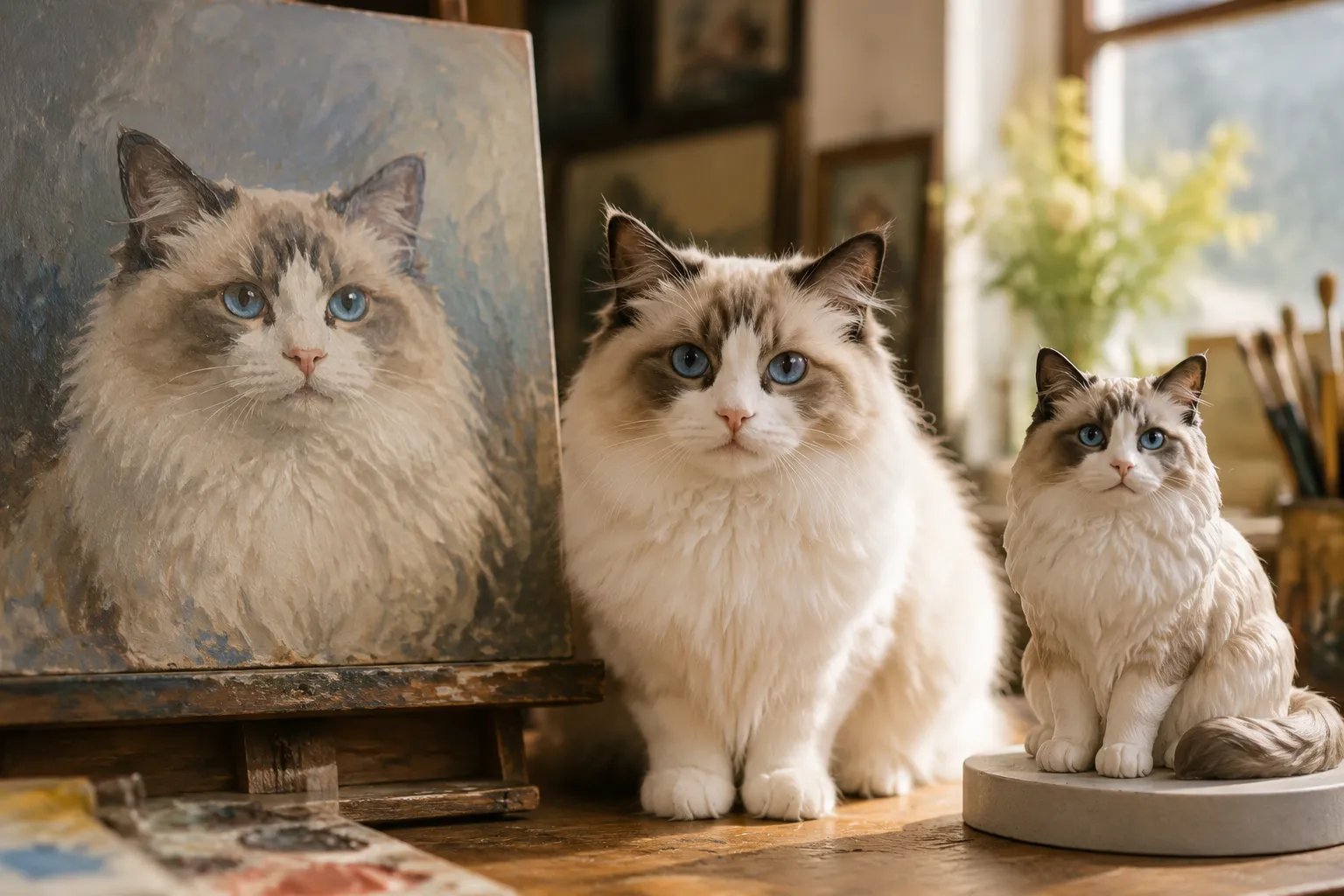
You're at your home office desk, two browser tabs open — a painted portrait glowing in one, a full-color resin figurine rotating in the other. Near your feet, that warm-biscuit smell of your Ragdoll's fur still clings to the rug. The ragdoll figurine vs portrait choice just got personal.
Quick Takeaways
- A redo policy protects you more than any price tag — it's the real signal a studio trusts its own process.
- Ragdolls break most portrait workflows — their point coloring shifts with light, and flat art flattens it.
- Full-color resin holds detail a painting can't — dimensional markings, tucked paws, that lopsided ear you love.
- Ask about revisions before you order, not after — the studios that welcome the question are the ones worth trusting, which is why our custom pet figurine process is built around previews.
- Durability lives in the finish, not the promise — UV resistance and a proper clear coat decide whether color survives a decade.
Why the "Portrait vs. Figurine" Question Is the Wrong Place to Start
Here's something most memorial studios won't put on their homepage: the medium matters far less than the redo policy behind it.
We've watched this pattern repeat across thousands of orders. Someone agonizes for two weeks over painted canvas versus resin, picks the prettier sample photo, and then discovers the thing that actually determines their happiness was buried in the fine print — or wasn't there at all.
A redo policy is the studio's answer to one question: what happens when the first version isn't quite your pet? And with a Ragdoll, the first version is almost never quite right. Not because anyone's careless. Because Ragdolls are genuinely hard to reproduce, and we'll get into exactly why.
So before you compare textures and price points, compare what each option does when it misses. That's the counterintuitive part. The best predictor of your satisfaction isn't the medium. It's whether the maker built a correction step into their workflow — or treated your feedback as a complaint.
"The first version rarely nails the ears. The studios worth trusting expect that — and build the fix into the process."
Let's walk through what that means for a painted portrait, for a full-color resin sculpt, and for the specific challenge your breed presents.
The Ragdoll Problem Nobody Warns You About
Ragdolls wreck standard portrait workflows, and it's worth understanding why before you hand over a photo.
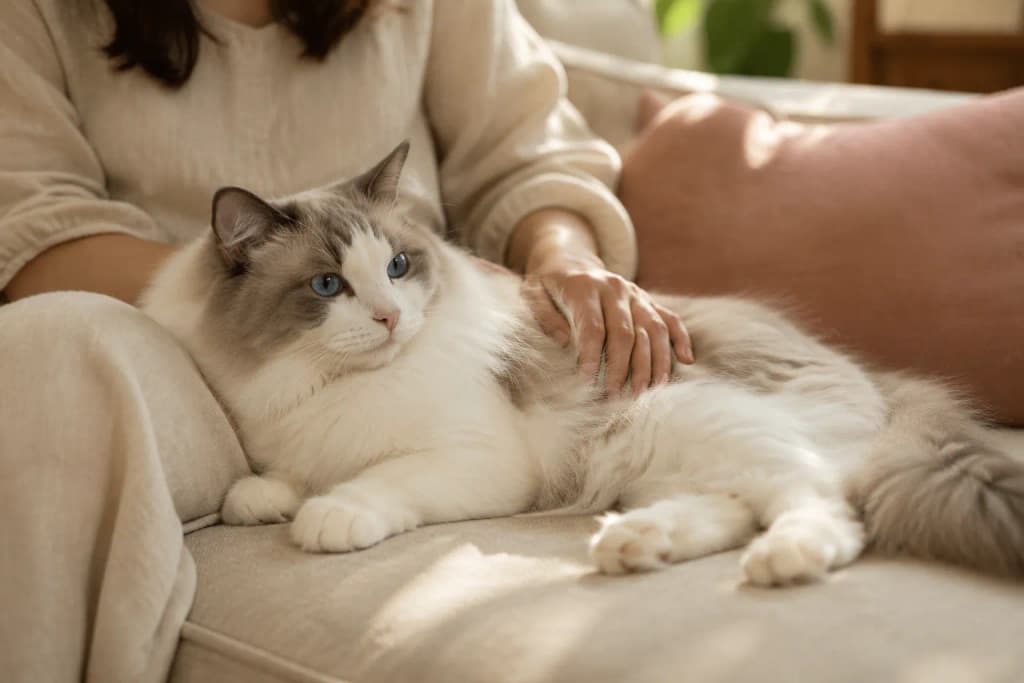
Your cat isn't one color. She's a temperature map. Ragdolls carry point coloration — the seal, blue, chocolate, or lilac concentrating at the ears, mask, paws, and tail, fading into a pale body. According to the Cornell Feline Health Center, that pointed pattern is temperature-sensitive pigment, which is exactly why the cooler extremities darken. That gradient is the whole personality of the coat. And gradients are where flat media struggle most.
What Light Does to a Ragdoll (and Why Your Photos Lie)
Take three photos of your cat in three rooms and you'll get three different cats. Morning window light turns a seal point almost violet. A warm kitchen bulb pushes the same fur toward chocolate. Overhead office LEDs flatten everything into gray.
Micro-story: a family sent us four reference shots of their blue point, Willow, insisting the studio had "changed her color." All four photos were of the same cat — under four light sources. None of them agreed. This is the single most common friction point we see with the breed.
So what? If you don't control for this, both a portrait artist and a 3D studio are guessing at your cat's "true" color from contradictory evidence. The redo policy is what saves you when the guess lands wrong. A portrait that missed the mask temperature might mean starting the canvas over. A digital sculpt can adjust the color values and re-render — a fundamentally different repair cost.
The Fur Texture Trap
Ragdoll coats are semi-long, plush, and low-density compared to, say, a Maine Coon. They don't clump into obvious tufts. They diffuse. That soft haze reads beautifully in person and terribly in reproduction, because there's no hard edge to anchor to.
A painting handles this with soft blending. A full-color resin 3D print handles it with actual dimensional geometry plus printed color variation across that geometry — the fur pattern is reproduced directly in the material, not layered on top. Neither is automatically better. But they fail differently, and knowing how they fail tells you which redo policy you actually need.
Painted Portrait vs. Full-Color Resin: An Honest Comparison
We'll be real — we make figurines, so treat our enthusiasm accordingly. But we've sent plenty of families toward portraits when that was genuinely the better call, and we'll tell you when it is.
Here's the comparison that matters, stripped of marketing.
| Factor | Painted Portrait | Full-Color Resin Figurine |
|---|---|---|
| Dimension | Flat, single viewing angle | 360°, every angle preserved |
| Color source | Pigment applied to surface | Color printed into the material itself |
| Correcting a color miss | Often requires reworking large areas | Adjust digital values, re-render, reprint |
| Displays like | Wall art, framed | Shelf, desk, tactile keepsake |
| Captures point gradient | Depends heavily on artist skill | Reproduced as printed color transition |
| Best for | Bold graphic style, wall presence | Lifelike form, "she's still here" tactility |
Notice what's not in that table: a winner. There isn't one. There's a fit.
When a Portrait Genuinely Wins
If you want a statement piece for the wall, if your aesthetic leans graphic or stylized, if you love the visible texture of the medium as its own art form — a portrait is the right answer. A great portrait artist turns your cat into an interpretation, and interpretation has its own emotional power. Nobody hugs a canvas, but plenty of people cry looking at one.
Portraits also tend to forgive the light-source problem better, because a skilled artist decides on a color story rather than reproducing a literal reading. That editorial choice is a feature.
When Full-Color Resin Wins
If what you miss is the form — the specific way she tucked her back paws, the weight of her sitting, the exact set of that one ear that never fully stood up — dimensional wins and it isn't close.
At PawSculpt, pieces are digitally sculpted by master 3D artists, then precision 3D printed in full color, so the markings and the geometry are captured together. The color is part of the resin, not a coating that can chip off the high points. The only manual step afterward is a protective clear coat for sheen and durability.
"You don't miss a color. You miss a shape — the way she folded herself into a loaf at 6 a.m."
That distinction — color versus form — is honestly the fastest way to decide. Grieving the way she looked in a photo points toward a portrait. Grieving the way she occupied space in your home points toward a figurine.
What a Redo Policy Actually Means (The Part Studios Gloss Over)
Now the heart of it. A custom pet figurine redo policy isn't a refund clause. It's a design philosophy made visible.
When a studio offers previews and revisions as a normal part of the process — not a grudging exception — they're telling you the workflow assumes iteration. That's the good sign. Because with a breed like yours, iteration isn't failure. It's how accuracy happens.
The Three Things a Real Redo Policy Covers
A redo policy worth trusting addresses three distinct moments, and most people only think about the last one.
- The preview stage — you see a digital proof before anything physical is made. This is where 80% of corrections should happen, when they're cheapest and fastest to fix.
- The color-match stage — you confirm the point coloration reads right, accounting for that light-source chaos we covered.
- The post-delivery stage — what happens if the physical piece arrives and something's off.
The mistake most people make is focusing entirely on stage three. They ask "what if I hate it when it ships?" and never ask "how many times can I refine the proof before it ships?" The second question prevents the first.
So what? A studio with a strong preview-and-revision culture rarely needs the post-delivery clause, because problems get caught digitally. When you're comparing options, ask specifically about the preview process. The answer reveals everything.
Myth vs. Reality: Redo Policies
We hear the same misconceptions constantly. Let's bust three.
Myth: "A redo policy means the studio expects to fail."
Reality: It means the opposite. A confident maker invites correction because they know their process gets there. It's the studios without a revision path that are quietly hoping you won't notice the misses.
Myth: "Revisions will cost me extra every time."
Reality: For digital sculpts, refining a proof is often part of the standard flow, not an upcharge — because adjusting a model file is nothing like repainting a canvas. Policies vary, so confirm the specifics on the studio's site. For PawSculpt's approach, the details live on our service and FAQ page.
Myth: "If I have a good photo, I won't need any redo."
Reality: Even a perfect photo captures one light condition. The redo step exists to reconcile the photo with the cat you actually remember — and those aren't always the same cat, as any Ragdoll owner learns fast.
Durability: The Question You'll Care About in Ten Years
Here's what nobody asks until it's too late: how does this thing age?
Resin pet sculpt durability comes down to two variables — the material's UV stability and the protective finish. Get both right and the piece looks the same in a decade. Get them wrong and you get yellowing, fading, or a chalky surface.
Where Color Actually Lives
This is the detail that separates full-color resin from painted objects, and it matters enormously for longevity.
In a full-color 3D print, the pigment is printed voxel by voxel into the resin itself — a voxel is just a 3D pixel, the smallest unit the printer places. The color isn't sitting on the surface waiting to scratch off. It's baked through the material. A protective clear coat goes on top for sheen and UV defense, but even if that finish wore, the color underneath wouldn't flake the way surface pigment on a painted figure would.
Compare that to any object where color is applied as a top layer. Those can chip on the raised edges — exactly the ears, nose, and paw points that define a Ragdoll. On a pointed breed, surface-applied color is most vulnerable precisely where your cat's identity concentrates.
The Care Routine That Keeps It Museum-Quality
Full-color resin is low-maintenance, but not no-maintenance. Here's the realistic care schedule.
| Task | Frequency | Why It Matters |
|---|---|---|
| Dust with soft dry cloth | Weekly | Prevents grime settling into fine print texture |
| Wipe with barely-damp microfiber | Monthly | Removes oils without soaking the finish |
| Keep out of direct window sun | Always | Even UV-resistant resin ages faster in constant glare |
| Avoid extreme heat (car dashboards, radiators) | Always | Resin softens under sustained high heat |
| Inspect clear coat sheen | Yearly | Catch any dulling early |
So what? None of this is hard. But the display-out-of-direct-sun rule is the one people ignore, and it's the one that actually protects the color decade over decade. Put her on the shelf across from the window, not on the sill.
"Color that's part of the material doesn't chip off the ears — and on a Ragdoll, the ears are the whole story."
— The PawSculpt Team
The Photos That Make or Break Your Ragdoll Sculpt
Whatever medium you choose, this section saves you a redo cycle. The reference photos matter more than anything else you'll do.
We've processed enough Ragdoll orders to know exactly what trips people up. It's almost always lighting and angle, and it's almost always fixable in five minutes if you know what to shoot.
What Actually Works
- Shoot in soft, indirect daylight. A window with a sheer curtain, midday, no direct beam. This gives the truest read of the point coloration.
- Get three angles minimum: straight-on face, full profile, and a three-quarter view. The three-quarter is where personality lives.
- Capture her natural pose. If she's a loaf-sitter, photograph the loaf. That specific shape is what you'll miss most.
- Include a detail shot of the mask and ears. These carry the darkest points and the most identity.
- Skip flash. Flash blows out the pale body and crushes the point gradient into mud.
Here's the reference-quality breakdown we wish every customer saw first.
| Photo Type | What to Capture | Common Mistake |
|---|---|---|
| Face straight-on | Mask symmetry, eye color | Shot from above, distorting proportions |
| Full profile | Body length, tail set | Cat mid-motion, blurred |
| Three-quarter | Personality, natural posture | Too far away, low detail |
| Point detail | Ear and paw coloration | Under warm bulb, false color |
| Full pose | The shape she makes | Cluttered background hiding the silhouette |
Micro-story: one of the cleanest sculpts our team ever produced came from a customer who apologized for her photos — she'd taken them on an old phone. But she'd shot them by a north-facing window, got the profile and the three-quarter, and included a shot of him in his signature curled-up pose. The camera didn't matter. The light and the angles did.
Pro tip: if your cat has already passed and you only have the photos you have, don't despair over lighting. A good studio's revision process exists exactly for this — you describe the corrections from memory, and the digital model gets adjusted. Memory is a valid reference. That's another quiet argument for choosing a maker with a real preview loop.
The Emotional Math: What You're Really Buying
Let's step back from technique, because this decision isn't really technical.
You're not buying a portrait or a figurine. You're buying a place to put the feeling. Grief and love both need somewhere to land, and an object gives them a landing spot. The Association for Pet Loss and Bereavement talks about this — the value of tangible focal points in processing the loss of a companion animal. A keepsake isn't sentimental clutter. It's an anchor.
The smell fades first, by the way. That's the thing families tell us again and again. The warm, slightly sweet scent of a Ragdoll's fur, the smell that lived in her favorite blanket — it goes within weeks, no matter how tightly you seal the blanket in a bag. You reach for it and it's just fabric now. The visual memory lasts longer, but it blurs too, softening at the edges like a photo left in sun.
"The scent goes first. Then the exact shape of her. A keepsake holds the shape when memory can't."
That's what a dimensional piece does that a flat one can't quite: it holds the shape. The tuck of the paws, the weight of the sit, the specific tilt of a head that leaned into your hand. When memory starts to soften those edges, the sculpt keeps them sharp.
Some families choose a portrait for the wall and feel completely held by it. Some need the three-dimensional presence — something they can pick up, turn, set on the nightstand. And plenty of families we've worked with do both eventually. There's no wrong answer here. There's only what your particular grief, and your particular love, needs to lean on.
If a tactile keepsake is what calls to you, a full-color resin pet sculpture captures the form and markings together, so the cat you remember and the cat on the shelf stay the same cat.
Making the Decision: A Simple Framework
You've got the information. Here's how to actually choose, fast.
Ask yourself three questions, in order.
- Do I grieve/celebrate the way she looked, or the way she moved and sat? Looked → portrait leans ahead. Moved/occupied space → figurine leans ahead.
- Where will this live? Wall → portrait. Shelf, desk, nightstand, somewhere you'll pick it up → figurine.
- How does each option handle a miss? Whatever you choose, confirm the redo policy before ordering. This is non-negotiable for a Ragdoll.
That's it. If you're still torn after those three, you're probably a both-eventually family, and that's completely fine.
What to Expect From the Creation Process
Without committing to specific timeframes — those vary and you should confirm current details on any studio's site — here's the general shape of a full-color resin commission.
- You submit reference photos using the guidance above.
- A digital sculpt gets built by 3D artists who model the form and markings.
- You review a preview and request refinements — this is your redo leverage, use it.
- The piece is 3D printed in full color once you approve the proof.
- A protective clear coat is applied for sheen and durability, then it ships.
The preview-and-refine step is the heart of it. Treat it seriously. Look at the ears, the mask temperature, the pose. Speak up. A studio worth its salt wants you to.
A Few Honest Limitations
We'd rather you trust us than oversell, so here's the straight talk.
Full-color resin has a natural 3D print texture — a fine grain or subtle layer character under the clear coat. It's authentic, not plastic-perfect, and some people expect a glass-smooth surface they won't get. We think the slight texture reads as lifelike. But you should know it's there.
A portrait, meanwhile, can achieve a painterly softness that a literal 3D reproduction won't chase — because a figurine's job is fidelity to form, not interpretation. If interpretive softness is what moves you, that's a genuine point for the portrait column.
And neither medium brings your cat back. We say that plainly because we've learned that families who expect a keepsake to fix the grief are often disappointed, while families who expect it to hold the grief tend to find real comfort. It's an anchor, not a cure. Set the expectation right and the piece does its quiet work for years.
Frequently Asked Questions
Is a figurine or a portrait better for a Ragdoll?
Neither is universally better — it comes down to what you miss most. If you grieve or celebrate the way your cat looked and want wall presence, a portrait is a strong fit. If you miss the way she sat and occupied space, a full-color resin figurine preserves that 3D form and her point markings from every angle. Many families eventually choose both.
What does a custom pet figurine redo policy actually cover?
A real redo policy addresses three moments: the digital preview before anything is printed, the color-match confirmation stage, and post-delivery corrections. The preview stage is where most refinements should happen, since it's the fastest and easiest to adjust. When comparing studios, ask specifically about the preview and revision process — the answer tells you how the whole workflow treats accuracy.
How durable is a full-color resin pet sculpture over time?
Durability depends on UV-resistant material and a proper protective clear coat. Because the color is printed into the resin voxel by voxel rather than applied as a surface layer, it won't chip off the raised points — the ears, nose, and paws that define a Ragdoll. Keep it out of direct sunlight and away from extreme heat, and it holds its appearance for years.
Why do my Ragdoll's photos show completely different colors?
Ragdoll point coloration is temperature-sensitive and reads very differently under different light sources. Morning window light can push a seal point toward violet, while warm bulbs shift it toward chocolate and overhead LEDs flatten it to gray. This is exactly why a revision step matters — it reconciles contradictory photos with the cat you actually remember.
What photos give the best result for a custom Ragdoll figurine?
Shoot in soft, indirect daylight with no flash. Capture at least three angles: a straight-on face, a full profile, and a three-quarter view where personality shows most. Add a detail shot of the mask and ears, since those carry the darkest points. And photograph her in a natural pose — the specific shape she makes is what you'll treasure.
What if I only have low-quality or old photos?
Don't panic. A studio with a genuine preview-and-revision process is built for this. You can describe corrections from memory during the proof stage, and the digital model gets adjusted accordingly. Memory is a valid reference — that's one more reason to choose a maker with a real redo loop rather than a one-shot delivery.
Ready to Celebrate Your Pet?
Every pet has a story worth preserving. Whether you're honoring a Ragdoll who's crossed the rainbow bridge or celebrating your companion's one-of-a-kind personality, the ragdoll figurine vs portrait decision really comes down to how you want to hold the memory — and a custom PawSculpt figurine captures the form, the markings, and the pose that made your cat unmistakably hers.
Visit pawsculpt.com to explore our full-color 3D printing process, preview turnaround, and quality guarantee.