
The Complete Guide to Comparing Corgi Figurine Companies: Real Prices, Real Photos
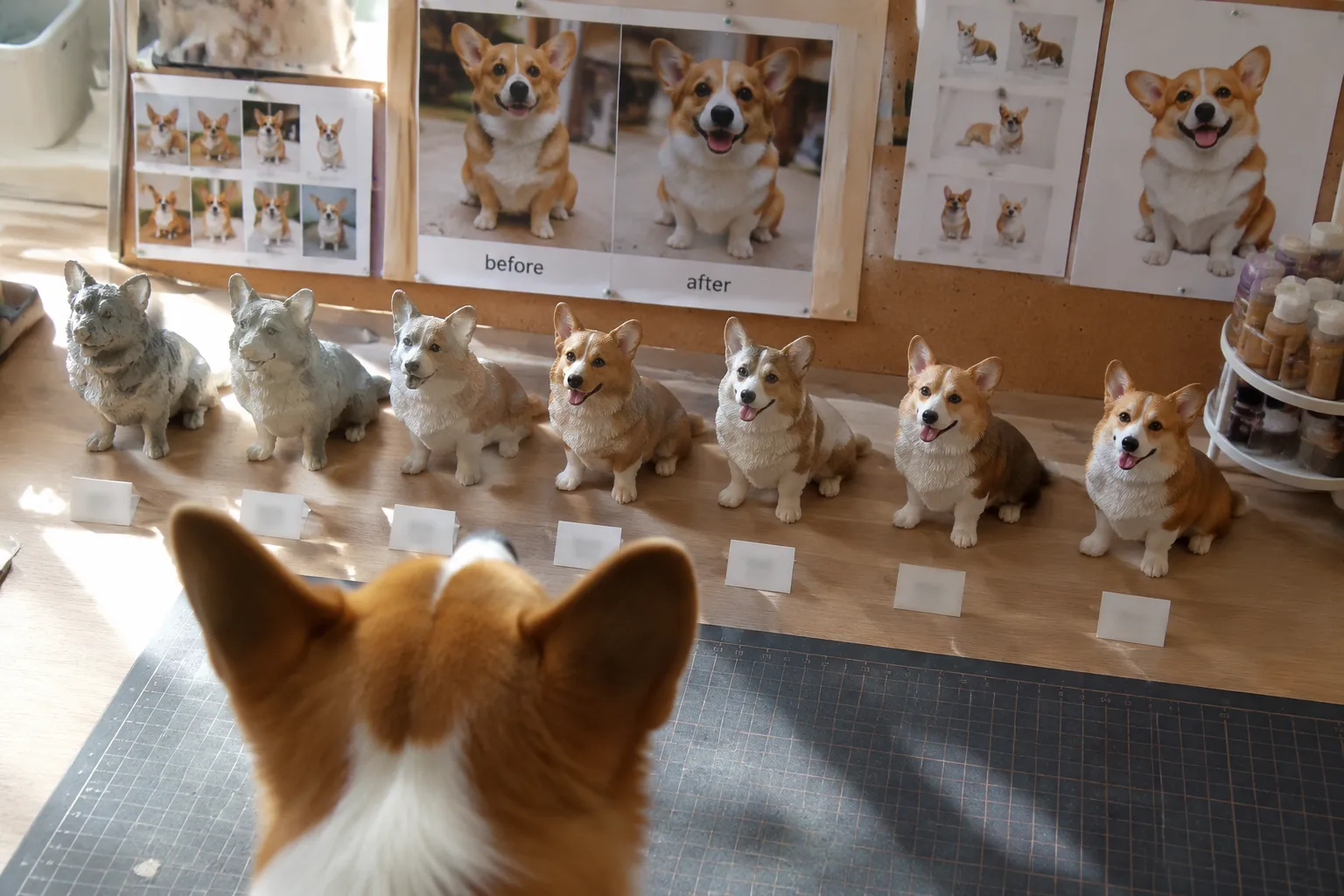
The box sat on her workbench for three days before she opened it, the garage still thick with the smell of motor oil and cut cedar. Inside was the corgi figurine she'd ordered after weeks spent trying to compare custom corgi figurine companies, and her hands actually shook as she lifted it toward the window light.
Her name is Maren. We'll come back to her.
Quick Takeaways
- Price transparency is the fastest trust filter — companies that hide pricing until checkout usually have a reason.
- Before-and-after photos matter more than glamour shots — real results come from real customer submissions, not studio setups.
- Corgis are uniquely hard to reproduce — the double coat, the markings, and the shape trip up cheaper makers.
- Know how the figurine is actually made — full-color 3D printing and hand-painting produce very different objects, so understanding the PawSculpt creation process helps you compare fairly.
- The photos you send decide 80% of the result — good source images beat any promise on a sales page.
Why Comparing Corgi Figurine Companies Is Really a Question About Trust
Here's the thing nobody tells you when you start shopping.
You think you're comparing products. Prices, materials, turnaround. You open ten browser tabs, you screenshot a few examples, you tell yourself you're being a smart consumer. But that's not actually what's happening under the surface.
What you're really doing is trying to decide who to trust with something irreplaceable.
Because a corgi figurine isn't a phone case. If it comes out wrong, you can't just reorder and shrug. You're asking a stranger to look at photos of a living creature you love — or one you've already lost — and translate that love into resin. That's an intimate request dressed up as a transaction.
We've worked with thousands of pet families, and the ones who feel burned almost never say "the price was too high." They say "it didn't look like him." That gap — between the corgi in your heart and the object in the box — is the only thing that matters. Everything else is just how you get there.
So when you compare custom corgi figurine companies, you're not grading photos on a website. You're reading for honesty. And honesty leaves fingerprints.
"You're not buying a figurine. You're buying the moment you take it out of the box and it looks back at you."
The three fingerprints worth hunting for: transparent pricing, real customer photos instead of curated hero shots, and a clear answer to how the thing is actually made. Get those three, and the rest tends to sort itself out.
The counterintuitive part
Most guides tell you to start with reviews. We'd push back on that.
Reviews are lagging indicators, and they're easy to game. A five-star average tells you a company is good at getting happy customers to click. It tells you almost nothing about whether your corgi, with his one crooked ear and the white blaze that goes slightly off-center, will come out right.
What actually predicts satisfaction is how a company behaves before you've paid a dime. Do they show you their misses alongside their wins? Do they explain their process without you having to email three times? A company confident in its work doesn't hide the process. It invites you into it.
The Price Transparency Test: What "Starting At" Actually Hides
Let's talk about money, because this is where the games begin.
You've seen it. A gorgeous figurine, a price that makes you exhale in relief, and the words "starting at" tucked underneath in gray. Then you build your order and watch the number climb. Bigger size. Add the second pet. Custom base. Faster preview. Suddenly the friendly starting price is a memory.
Pet figurine price transparency isn't about being the cheapest. It's about whether the number you see is the number you pay. Those are completely different virtues, and cheap companies love to blur them.
Here's a quick way to read a pricing page in about ninety seconds. Ask these questions and notice how hard you have to work for answers.
| What to check | Green flag | Red flag |
|---|---|---|
| Base price visibility | Shown before you enter any info | Hidden until email or checkout |
| Size and add-on costs | Listed clearly with each option | Vague "contact us for a quote" |
| Revision policy | Stated plainly on the page | Buried in fine print or missing |
| Rush fees | Disclosed up front | Surprise line item at the end |
| What's actually included | Itemized (base, coat, packaging) | Bundled with no breakdown |
If you have to give up your email address just to learn what something costs, that's a choice the company made. And it usually means the price is a conversation they'd rather have after you're emotionally invested.
We won't quote you specific dollar figures here, and honestly you should be suspicious of any guide that does — prices shift with materials, size, and complexity, and a corgi in a running pose costs differently than one sitting still. What we'll say is this: a company willing to show you the full picture before you commit is telling you something about how they'll treat you after.
Why corgis cost what they cost
A quick word on why corgi figurines aren't priced like, say, a smooth-coated greyhound.
The corgi's double coat is dense and layered, with that distinct texture along the flanks and the fuller "pantaloons" on the back legs. Reproducing that texture in three dimensions takes more digital modeling time than a short, sleek coat. The markings are fussy too — the way the white on the chest meets the fawn or sable, the subtle sabling on the ears.
So a slightly higher price on a corgi isn't a company gouging you. It's often a sign they're not cutting corners on the exact details that make your corgi look like your corgi. The trick is telling the difference between a fair premium and an opaque one. Transparency, again, is your tell.
How to Read Before-and-After Figurine Photos Like a Detective
This is the skill almost nobody has, and it's the one that saves you the most heartbreak.
Every company shows you photos. The question is which photos, and whether you know how to read them.
There's a world of difference between a hero shot — a figurine styled under perfect studio lighting, shot at a flattering angle — and a genuine before-and-after pairing that puts the customer's original photo next to the finished piece. The first shows you what the company can do on its best day with its best subject. The second shows you what happens to a normal photo taken by a normal person on a normal phone.
You want the second one. Always.
"A hero shot tells you what's possible. A before-and-after tells you what's likely."
When you find real before-and-after figurine photos, here's what to actually look at. Most people glance at the overall vibe and move on. Slow down and check these:
- The eyes. Corgis have soft, dark, expressive eyes. Do the finished eyes have depth, or do they look flat and glassy? This is the single hardest thing to get right and the fastest way a figurine looks "off."
- The markings' placement. Compare the white blaze, the chest bib, the leg socks against the original photo. Are they in the same spots? Cheap reproductions drift.
- The coat transitions. Where fawn meets white, is it a soft gradient like real fur, or a hard cartoon line?
- The ears. Corgi ears are big, upright, rounded at the tips. Undersized or pointed ears are a dead giveaway of a template-based model.
- The proportions. That famous low-slung body and short legs — is the ratio right, or did they stretch a generic dog model?
The micro-story that taught us this
One order that stuck with us: a customer sent in a photo of her corgi mid-zoomie, tongue out, ears back in the wind. She'd been quoted by another company first and shown a portfolio of gorgeous, static, sitting-pose dogs. Beautiful work. But every single example was the same calm posture.
She asked them if they could do the running pose. They went quiet, then offered to "adapt" it. That hesitation told her everything. A portfolio with only one pose isn't a style choice — sometimes it's the edge of what a company can actually build.
She came to us with that same wind-blown photo, and that's exactly the kind of specific, alive moment we love capturing. The lesson for you: look at the range in the before-and-after gallery, not just the quality. Variety proves capability. Sameness can hide its limits.
What Corgi Owners Get Wrong When Comparing Companies
We see the same three mistakes over and over, and they're all understandable.
Mistake one: judging by the cutest example. You find one company with a stunning corgi on the homepage and you're sold. But that's their trophy. What matters is their floor, not their ceiling — the worst result they'd let ship. You can't see that directly, but a broad, honest before-and-after gallery hints at it.
Mistake two: assuming all "3D" means the same thing. It absolutely does not, and we'll dig into this next because it's the most misunderstood part of the whole industry.
Mistake three: sending mediocre photos to a great company and blaming the company. More on this later too, but here's the short version — a master modeler working from a blurry, backlit photo is a chef cooking with wilted ingredients. The skill is there. The material isn't.
The deeper truth underneath all three mistakes is the same one we keep circling: you're comparing companies as if they're vending machines dispensing identical objects. They're not. Each one is a set of hands and a set of choices, and the outcome depends as much on what you bring to the table as what they do with it.
The Part Nobody Explains: How Your Figurine Is Actually Made
Okay. This is the section that'll change how you shop, and it's the one most comparison guides completely skip.
When you read "3D," you probably picture one thing. But there are two fundamentally different worlds hiding under that word, and they produce very different objects at very different price points.
World one: sculpt, then paint
In the traditional path, an artist creates a form — sometimes digitally modeled and printed in a single plain color, sometimes shaped from clay — and then a person sits down and applies color by hand with brushes and acrylics. This is skilled work. It can be genuinely beautiful.
But it has real tradeoffs you should know about. Hand-applied color varies from piece to piece, even by the same artist. On a corgi, where the coat has dozens of subtle color shifts, that variation gets expensive fast, because every gradient is human labor and human labor is the cost. And color sitting on top of a surface can chip or wear over years of being picked up and set down on a shelf.
World two: full-color 3D printing
The other path — the one PawSculpt uses — is fundamentally different. Here, master 3D sculptors build your corgi digitally, shaping every contour of that double coat and the exact placement of the markings on a screen. Then the model is precision 3D printed in full color, where the color is deposited voxel by voxel directly into the resin as the piece is built.
Read that again, because it's the key: the color is part of the material, not a layer painted on top. Your corgi's sable-and-white pattern isn't brushed onto a surface. It's baked into the object itself, all the way through, printed at the same time as the shape.
The only manual step afterward is applying a clear protective coat — a varnish that adds durability and a gentle sheen and guards the piece against UV fading. No brushes touching color. No waiting for paint to dry. No two "hand" versions drifting apart.
"Every whisker and every white sock is data before it's an object. Our job is to make sure the data remembers what you remember."
— The PawSculpt Team
Why this matters for a corgi specifically
The corgi's complexity is exactly where full-color 3D printing earns its keep.
Those intricate color transitions — the way sable darkens along the spine, the soft fade where the white chest meets the tan — reproduce with consistency because they're printed, not interpreted by a tired hand at the end of a long day. The finished piece has a natural fine texture, a subtle grain from the printing process, that reads as authentic rather than plastic-perfect. It looks like an object with substance, not a factory toy.
Now, is one world "better"? Honestly, it depends on what you want. A hand-colored piece has a painterly, artisanal quality some people love, and if that's your taste, chase it. Full-color 3D printing gives you consistency, durability, and fidelity to complex markings — which, for a corgi, is usually the deciding factor. We'll be real about that tradeoff so you can choose with open eyes.
Here's a plain comparison of how the two approaches tend to differ. Individual companies vary, so treat this as a framework, not gospel.
| Factor | Sculpt-then-color (by hand) | Full-color 3D printing |
|---|---|---|
| Color source | Applied to the surface | Printed into the resin itself |
| Consistency | Varies piece to piece | Highly repeatable |
| Complex markings | Labor-intensive, costly | Reproduced directly from the model |
| Surface durability | Can chip or wear over time | Color runs through, sealed with clear coat |
| Texture | Smooth or brush-textured | Natural fine print grain |
| Best for | Painterly, artistic look | Fidelity to real coats and patterns |
The takeaway isn't "one is right." It's that you now know what question to ask every company you're comparing: how, exactly, does the color get onto my corgi? Their answer, and how readily they give it, tells you which world you're in.
Maren's Decision (Customer Story, Continued)
Let's get back to Maren in her garage.
She'd lost her corgi, Pilot, in the spring. He used to sleep on an old flannel shirt she kept on the shelf out there, and for months after, she said, the garage still held a trace of him — that warm, slightly nutty, corn-chip smell corgi people know and secretly love. She couldn't bring herself to wash the flannel.
She'd started her search the way most people do. Overwhelmed. Ten tabs. She'd told us later that what stopped her at every company wasn't the quality — plenty looked good — it was that she couldn't tell what she was actually getting or what it would cost until she'd handed over her email and started an emotional conversation with a sales rep. That felt wrong for something this tender.
What tipped her toward us wasn't a discount. It was that she could see the process laid out plainly, see real before-and-after photos from other families, and understand how Pilot's markings would be reproduced before she committed anything. Clarity, in a moment of grief, felt like kindness.
She sent us a photo of Pilot on that flannel. One ear up, one ear doing its own thing, the way it always did.
We'll finish her story at the end. First, the practical stuff you came for.
What to Send Them: The Photos That Make or Break Your Figurine
This is where you have the most control, and where most people leave the most quality on the table.
We said it earlier and it's worth repeating because it's the highest-leverage thing you can do: the source photos determine most of the outcome. A world-class modeler can't invent detail that isn't in the image. If your corgi's face is in shadow, the face gets guessed at. If the photo is a tiny thumbnail, the markings get approximated.
So before you compare a single company, get your photos right. Here's what actually works.
| Photo element | What to aim for | Why it matters |
|---|---|---|
| Lighting | Soft, even daylight; avoid harsh sun | Reveals true coat colors and markings |
| Angle | Eye level with your dog, not from above | Preserves correct proportions |
| Focus | Sharp, especially the face | Eyes and expression drive the likeness |
| Coverage | Multiple angles — front, side, 3/4 | Lets the modeler build all sides accurately |
| Resolution | The largest file you have | More detail to work from |
| Expression | The look that's most "them" | Captures personality, not just anatomy |
A few corgi-specific tips we've learned the hard way:
- Shoot at their level. Get down on the floor. Photographing a corgi from standing height foreshortens that famous long body and short legs, and you end up with a model that reads as a different breed.
- Capture the ears clearly. Those big upright ears are signature. One photo where both ears are fully visible and lit does wonders.
- Get the markings in daylight. Indoor bulbs throw a yellow cast that muddies the line between white and tan. A cloudy day by a window is ideal — bright but soft.
- Include a "personality" shot. The mid-zoomie tongue-out chaos, the loaf pose, the side-eye. This is the one that makes people cry happy tears when the figurine arrives.
For dogs who've passed and where photos are limited, don't despair. A good team can work with what you have, and combining several imperfect photos often yields more than one "perfect" one. When you're comparing companies, ask specifically how they handle limited or older photos — the answer reveals a lot about their skill and their heart.
If you want a deeper breakdown of breed characteristics to help you photograph the traits that matter, the American Kennel Club's Pembroke Welsh Corgi guide is a solid, non-commercial reference for what makes the breed's silhouette and coloring distinctive.
The "So what?" on photos
Why obsess over this? Because it reframes your whole comparison.
Once you understand that photos drive the result, you stop looking for the company with the best marketing and start looking for the one that's clearest about what they need from you. A company that gives you a real photo guide, that tells you honestly when an image won't work, that treats your source material seriously — that's a company optimizing for your result, not just their sale.
Comparing on Service Without Falling for Empty Promises
Turnaround times, revisions, guarantees. Every company advertises these, and the words start to blur.
We'll be direct: we're not going to quote you specific numbers on preview timelines or revision counts, and neither should any guide, because those details change and vary by company and by how complex your piece is. What we can give you is how to evaluate the promises themselves.
Look for a preview step. The single most important service feature is whether you get to see a digital proof of your corgi before it's printed. This is your safety net. If a company prints first and shows you later, a mistake becomes an expensive problem instead of a quick fix. Ask: do I approve a preview? When something's off, this is where it gets caught.
Read the revision policy for tone, not just number. "Revisions available" written warmly, with an explanation of how the back-and-forth works, tells you they expect collaboration. Silence on the topic, or aggressively limited fine print, tells you they'd rather you didn't ask. You can explore how a company frames its process and guarantees by reading their detailed FAQ and service information rather than trusting a single marketing line.
Treat guarantees as a philosophy, not a coupon. A guarantee isn't really about getting money back. It's a statement of how confident a company is in its own work. Read what the guarantee actually covers and, more tellingly, how easy it is to find. Confidence is legible.
The through-line here connects back to where we started. Service claims are just another surface to read for honesty. The company that's transparent about pricing tends to be transparent about process, which tends to mean transparent about what happens if something goes wrong. These traits travel together.
Living Pets vs. Memorials: The Comparison Changes
One thing worth naming, because it quietly shapes what you should prioritize.
If you're celebrating a living corgi — a birthday, a "gotcha day," just because — your comparison can lean toward playfulness. Fun poses, whimsical bases, capturing that specific goofball energy. You have the luxury of taking fresh photos exactly the way you want them, so lean hard into the photo guide above.
If you're creating a memorial, the emotional stakes change the criteria. Now the source photos are fixed — you have what you have — so a company's skill with limited images matters enormously. And the emotional handling matters. You want a team that treats the request with the gravity it deserves, not a checkout flow that feels like ordering a phone charger.
Grief researchers and organizations like the Association for Pet Loss and Bereavement talk about the importance of tangible anchors in mourning — objects that give love somewhere to go. That's not sentimentality; it's a recognized part of how many people process loss. A figurine, for a lot of families, becomes exactly that anchor. Which means for memorial pieces, you're not just comparing craftsmanship. You're comparing care.
"Grief looks for a place to rest. Sometimes it finds one on a shelf, in a shape you recognize."
A Simple Framework to Make Your Final Call
You've got tabs open, you've read this far, and now you want to actually decide. Here's the framework we'd hand a friend.
Run each company through five questions, in this order:
- Can I see the full price before giving up my email? If no, be cautious. Transparency here predicts transparency everywhere.
- Do they show real before-and-after photos with variety? Not just hero shots. Range proves capability.
- Can they explain how color gets onto my corgi? You now know the two worlds. Pick the one that fits your priorities.
- Is there a preview step before production? Your safety net. Non-negotiable for something this important.
- Does the tone feel like care or like a funnel? Trust your gut. You're a person, and you can feel when you're being handled versus helped.
Whichever company checks the most boxes with the least effort on your part — that's usually your answer. The one that makes honesty easy is the one that'll make your corgi look right.
Maren, Finally
The figurine came out of the box into the garage light, and Maren said the first thing she noticed was the ears. One up, one at its stubborn angle. Pilot's exact geometry of imperfection.
She kept him on the shelf next to the flannel she still hasn't washed. She told us that some evenings the garage still smells faintly of him, and now there's something to look at while she breathes it in — not a replacement, she was careful to say, but a place for the feeling to land.
That's what all the comparing was really for. Not the best price or the shiniest photo. The moment an object looks back at you and, for a second, the gap between what you loved and what you're holding closes.
Frequently Asked Questions
How do I compare custom corgi figurine companies without getting overwhelmed?
Start with three filters: transparent pricing you can see before entering your email, real before-and-after photos rather than only polished hero shots, and a clear explanation of how the figurine is made. If a company handles those three openly, it usually handles everything else openly too. Trust how easy they make honesty.
Why are corgi figurines sometimes priced higher than other breeds?
The corgi's double coat and layered markings take more digital modeling time to capture correctly than a short, smooth coat. A modest premium often reflects real attention to the details that make your corgi recognizable, not a company overcharging. The concern is opaque pricing, not a fair breed-specific difference.
Is a 3D-printed figurine better than a hand-colored one?
Neither is universally better — it depends on what you value. Hand-applied color has a painterly quality some people love but varies piece to piece and can wear over time. Full-color 3D printing embeds color into the resin, giving strong consistency and durability, which tends to matter most for a corgi's complex markings.
What if I only have a few photos of a corgi who has passed?
You're not out of options. Skilled teams routinely combine several imperfect photos to reconstruct detail, and multiple decent angles often beat one "perfect" shot. When comparing companies, ask directly how they handle limited or older images. Their answer reveals both their technical skill and how much care they bring to memorial work.
How can I tell if before-and-after figurine photos are genuine?
Genuine galleries pair a customer's original snapshot with the finished piece and show variety in poses, breeds, and results. Look closely at the eyes, marking placement, coat transitions, and proportions between the two images. A gallery showing only one pose or only flawless studio shots may be hiding the range of what actually ships.
Ready to Celebrate Your Pet?
Every pet has a story worth preserving. Whether you're honoring a corgi who's crossed the rainbow bridge or celebrating your goofball's stubborn, wonderful personality, a custom PawSculpt figurine captures the exact details — the crooked ear, the off-center blaze — that make your pet one-of-a-kind. As you compare custom corgi figurine companies, we hope you choose the one that makes transparency and craftsmanship easy to see.
Visit pawsculpt.com to learn more about our full-color 3D printing process, preview step, and quality guarantee.