
Canvas vs. Figurine: Why Your Pet's 3D Portrait Wins on Speed (And Emotion)
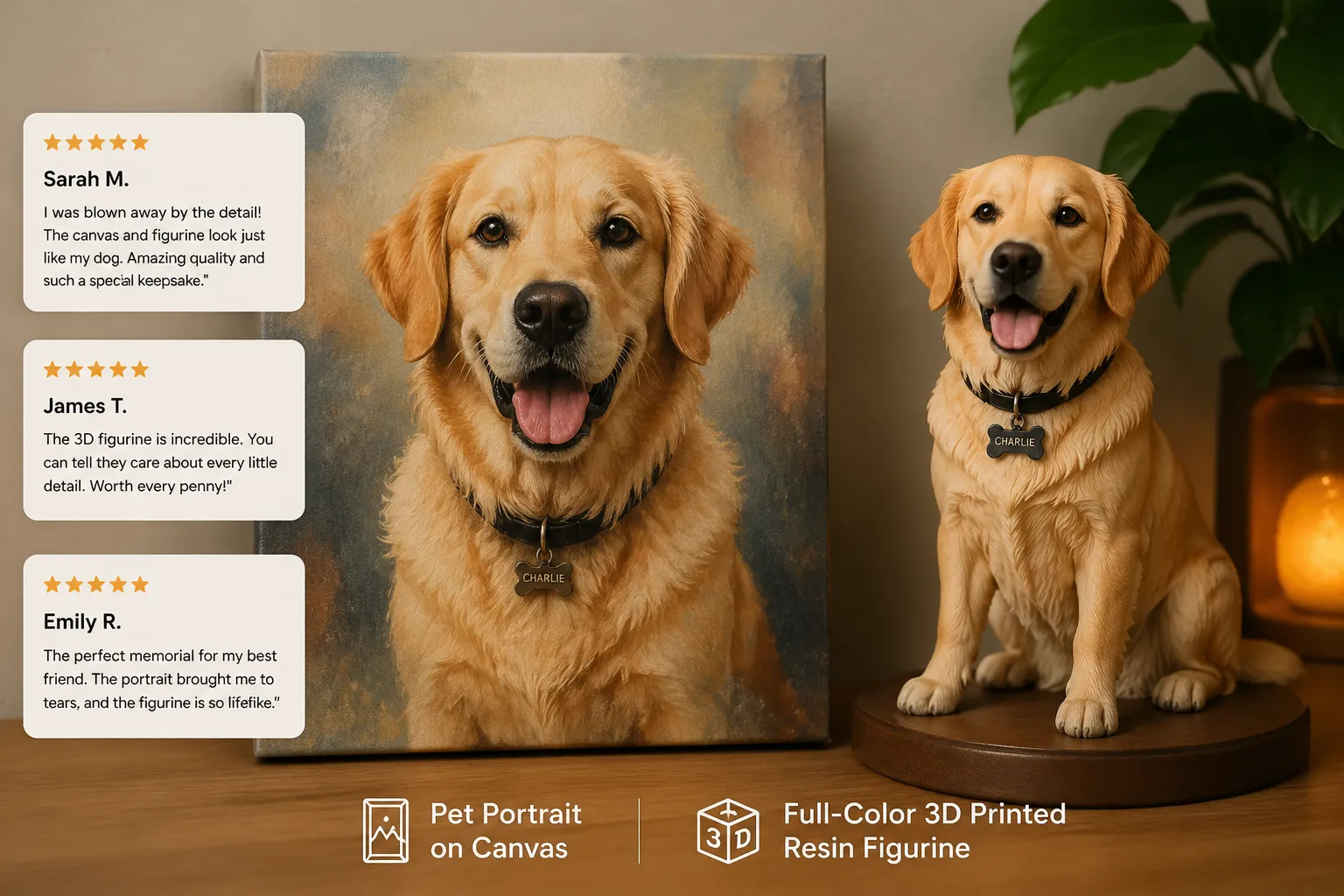
“Time is the coin of your life,” wrote Carl Sandburg; on a windy beach, a pet portrait on canvas can flap like a sail, but a figurine stays in your palm.
Quick Takeaways
- Speed isn’t just shipping — choose formats with faster approval and fewer subjective revisions.
- 3D often feels more immediate — dimensional likeness helps families recognize personality sooner.
- Best memorials use details, not scale — favorite bandanas, ear tilts, and paw stance matter most.
- Before ordering, compare custom pet figurines at PawSculpt — review photo guidance, process notes, and finish expectations.
- Customer reviews reveal the truth — scan for comments about resemblance, emotional reaction, and update clarity.
Canvas vs figurine: the speed question most people ask the wrong way
Most comparisons between canvas vs figurine start with the obvious: which one arrives faster. Fair question. But honestly, it’s not the smartest one.
The better question is this: which format feels finished faster emotionally?
That distinction matters because pet keepsakes are rarely neutral purchases. They’re ordered in a tender window—after a loss, before a birthday, during a health scare, or in that vivid season when a puppy still smells faintly of warm grass and sun-dried blankets. We’ve watched families obsess over calendar days when what they really wanted was relief. Recognition. Proof that the likeness was right.
A quick micro-story from orders we’ve seen: one family had both a painted-style wall portrait from another seller and a small 3D keepsake of the same senior dog. The wall piece arrived first. But the message they sent us later was revealing: the figurine was the one that made everyone in the house stop talking for a second, because “that’s his stance.” Not just his coat color. His stance.
That’s the overlooked angle here. Turnaround time is not only production time. It’s recognition time.
A canvas can absolutely be beautiful. In some homes, especially minimalist spaces with large open walls, it’s the standout choice. If your main goal is décor scale, canvas remains a strong contender. We’re not huge fans of pretending one medium replaces all others. It doesn’t.
But if your goal is speed of emotional connection, figurines often win for three reasons:
- They reduce the gap between image and presence.
- They make approval simpler.
- They live where grief actually happens.
That last point is rarely discussed in generic gift guides, and it should be. A memorial object doesn’t only compete on aesthetics. It competes on placement. The best memorial is the one your hand reaches for.
Speed has three layers, and only one is about the clock
Here’s the framework we use internally when comparing keepsakes with families.
| Speed Layer | What It Means | Canvas Tends to Do Well | Figurine Tends to Do Well |
|---|---|---|---|
| Production speed | How quickly the item can move through creation | Simpler workflows can help | Digital previews can streamline choices |
| Decision speed | How quickly families can approve the likeness | Subject to style preferences | Shape and markings are easier to judge |
| Emotional speed | How fast it “feels like them” | Best at mood and atmosphere | Best at presence and personality |
The standout here is the third row. Emotional speed is what customers describe in reviews, even when they don’t use that term.
They’ll write things like:
- “I cried when I opened it.”
- “It looks like she’s waiting by the door.”
- “My kids immediately said that’s him.”
- “The eyes and little chest patch were exactly right.”
Notice what’s missing: technical art language. People don’t usually praise memorial keepsakes for compositional brilliance. They praise them for recognition. For the split second where memory locks into form.
And that’s why reading customer reviews carefully is smarter than reading a feature list. Reviews tell you whether a product closes that emotional gap.
What reviews actually matter
Not all reviews are useful. Some are just “beautiful item, thank you.” Nice, but thin.
Our top pick for meaningful review clues is a simple three-part scan:
- Likeness language: Do buyers mention specific features—ear flop, nose spot, chest blaze, tail curve?
- Placement language: Do they say where it lives now—nightstand, office desk, memorial shelf?
- Reaction language: Do they describe a family member’s response, not just their own?
If a reviewer says, “My husband gasped because it captured our Lab’s crooked sit,” that’s gold. It suggests the piece didn’t merely resemble a dog. It resembled their dog.
That’s also why canvases can sometimes slow down the process in ways shoppers don’t anticipate. A flat portrait often invites broad stylistic opinions from the whole household. One person likes realism. Another wants softer color. A third wants the background changed. Suddenly the order is not about likeness anymore; it’s about interior design diplomacy.
A figurine narrows the brief. This is the pet. Not a room palette exercise.
"The fastest keepsake is the one your heart recognizes without negotiation."
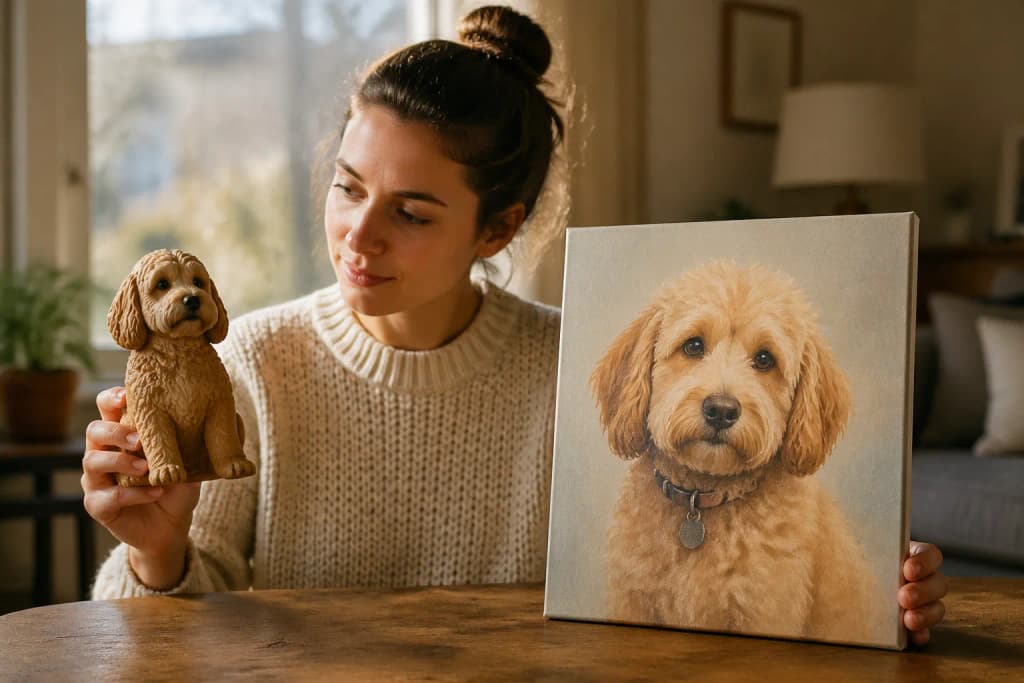
Why a 3D pet portrait often wins on emotion before it wins on logistics
Let’s talk about the part many articles skim over: why a 3D pet portrait can feel more powerful than a larger, more traditional wall piece—even when the canvas is objectively impressive.
The answer starts with how we remember animals.
We don’t remember them as still images first. We remember them as presence patterns. The low lean against the shin. The lifted paw before a treat. The way one ear listened while the other drifted sideways. The warm corn-chip scent on a dog’s paws after an afternoon nap. The sweet dust smell of a cat’s fur where the sun hit the windowsill. The faint musk in the blanket they claimed as their own.
Memory is physical. So the memorial that works fastest is usually the one that respects that.
A canvas gives you a scene. A figurine gives you a form. And in grief—or in love, honestly—form tends to strike deeper.
The counterintuitive insight: smaller objects can feel bigger
This surprises people. They assume a larger canvas creates a stronger emotional effect because it dominates the room.
Sometimes it does. But many of the most moving reactions we see happen with smaller 3D keepsakes. Why? Because intimacy beats scale.
Think about what people do with meaningful objects. They don’t just look at them. They move closer. They pick them up. They angle them toward the light. They set them beside another keepsake. They dust them carefully. They place them near the collar that still holds the clean-metal scent of the tag and a trace of dog shampoo. Small objects invite ritual.
That ritual is emotionally efficient. And efficient is the word that matters in this article.
A customer once told us her framed portrait of her cat was gorgeous, but it stayed in the hallway because that was the wall that made sense. The figurine, though, sat beside the reading chair where the cat used to knead the throw blanket that smelled like wool and lavender spray. She saw it ten times a day. Not in passing. Up close.
That’s why we’d rank proximity as one of the most overlooked buying criteria. If the keepsake will live near your body and your habits, emotion arrives faster.
What 3D captures that 2D often softens
At PawSculpt, our team works with families who often say the same thing in different words: “We don’t want generic cute. We want our pet.” That’s an important distinction.
A good figurine can emphasize details that matter more than many buyers realize:
- Body posture more than facial expression
- Weight distribution more than dramatic lighting
- Marking placement more than artistic mood
- Breed-specific silhouette more than decorative background
- The relationship between head tilt and chest shape more than eye sparkle clichés
And yes, a canvas can represent some of these beautifully. But 2D formats frequently prioritize composition and atmosphere. That’s the tradeoff. Mood goes up; physical immediacy can go down.
With PawSculpt, the process centers on a figure that is digitally sculpted by master 3D artists, then precision 3D printed in full color. The full-color resin carries the markings directly in the material itself, which matters for fidelity. The result is vibrant and dimensional, with a natural printed texture protected by a clear coat—not a slick, over-smoothed object that looks detached from real life.
That texture is worth noting. We’re actually in favor of it. Not because imperfection is trendy, but because authenticity often reads warmer than “factory flawless.” Pets themselves were never perfect surfaces.
The memory trigger people underestimate: profile
If you’re choosing between a canvas and a figurine, here’s a practical tip that almost no one puts front and center: test the profile effect.
Take your favorite phone photo of your pet and compare it to a side-view memory in your mind. Which one feels truer? For many families, the most recognizable angle isn’t head-on. It’s the side silhouette at the window, the loaf pose on the sofa arm, the sit-and-watch position by the kitchen threshold.
3D objects preserve profile naturally because they exist from every angle. That means the likeness can hit you unexpectedly as you walk by—especially in side light, morning light, or the amber wash of a lamp in the evening.
That matters more than it sounds. The strongest memorials don’t always announce themselves. They catch you unguarded.
A quick comparison worth saving
Here’s the practical side-by-side our team would actually use.
| Factor | Canvas Pet Portrait | 3D Figurine Pet Portrait |
|---|---|---|
| Best for | Wall décor, room impact, stylized art lovers | Desk display, memorial shelves, tactile closeness |
| Emotional trigger | Scene and atmosphere | Presence and form |
| Most common revision concern | Style, color mood, background choices | Pose accuracy, markings, silhouette |
| Works especially well for | Bold interiors, giftable statement pieces | Memorials, personality capture, daily proximity |
| Recognition speed | Sometimes slower if style is interpretive | Often faster because likeness feels immediate |
We’ll be real: if you want a dramatic focal point above a mantel, canvas may be your top pick. But if your question is the one in this title—why your pet’s 3D portrait wins on speed and emotion—the answer is that recognition happens closer to the body, and usually faster, in three dimensions.
Turnaround time isn’t just manufacturing—it’s photo quality, decision friction, and revision psychology
Most shoppers treat turnaround time as a backend issue. They imagine it lives entirely with the company. Not quite.
A big part of speed comes from what happens before production: the photos you choose, the clarity of your decision, and the number of people giving feedback. This is where many orders—canvas and figurine alike—either glide or stall.
The mistake most people make is sending their most sentimental photo instead of their most useful one.
Those are not always the same image.
A deeply loved image might show your dog sprinting through wet sand at dusk, ears flying, ocean spray silver in the air. Gorgeous memory. Terrible reference. A useful image is boring in the best way: clean light, visible markings, clear facial structure, true coat color, and enough angle variety to understand shape.
The fastest orders usually share these traits
In our years working with pet families, the quickest, smoothest projects typically have:
- One primary photo with sharp detail
- Two to five support photos from different angles
- Natural daylight rather than yellow indoor lighting
- Visible paws and chest shape, if possible
- No heavy filters
- A single decision-maker or one final voice
That last point may save you days of indecision. Families often assume more opinions produce a better result. Usually, they produce a slower one.
Here’s the thing: memorial purchases especially can become emotionally crowded. A sibling wants the “happy expression.” A parent wants the older years represented. Someone else insists the pet always looked best in a holiday scarf. All understandable. But a keepsake needs one coherent brief.
What photos work best for a figurine versus a canvas
This table clears up a common confusion.
| Photo Element | Best for Canvas | Best for Figurine | Why It Matters |
|---|---|---|---|
| Artistic lighting | Helpful | Less important | Canvas can lean into mood; figurines need readable structure |
| Sharp coat detail | Useful | Essential | Markings and texture transitions guide 3D accuracy |
| Front-facing portrait | Often ideal | Good, but not enough alone | Figurines benefit from multiple angles |
| Side view | Optional | Highly valuable | Side profile defines silhouette and posture |
| Visible full body | Nice to have | Very helpful | Body stance communicates personality quickly |
A micro-story here: one customer submitted a stunning close-up of her tuxedo cat, all whiskers and green eyes. Great image. But the support photo from across the room—showing the cat’s oddly formal, upright sit—was the one that made the likeness come alive. Everyone in the family recognized that posture immediately. Not because it was glamorous. Because it was true.
Why figurines can be faster to approve
This is where revision psychology enters the chat.
With canvas art, feedback often drifts toward abstraction:
- “Can the eyes be more soulful?”
- “Can the tone feel warmer?”
- “Can you make it less stiff?”
Those requests are emotionally valid but difficult to pin down. They can add rounds of uncertainty because they describe mood, not anatomy.
With a figurine, revision feedback tends to be more concrete:
- “The white patch should extend higher on the chest.”
- “Her ears sat lower.”
- “He leaned slightly forward when seated.”
Concrete feedback is faster to evaluate. Faster to approve. Faster to feel done.
That doesn’t mean figurines are magically simple. Capturing a pet well still takes judgment, skill, and good source images. But in practice, specificity accelerates decisions. And three-dimensional keepsakes invite specificity.
"A memorial feels right fastest when it captures posture before polish."
— The PawSculpt Team
Personal Aside
We’ll admit something slightly unfashionable: we’re not huge fans of overly “perfect” reference photos. The spotless studio shot can be useful, yes. But sometimes the image that helps most is the one on the porch after rain, with the dog’s chest fur a little tousled and that familiar damp-earth smell practically rising off the screen. That’s where personality lives.
What to expect from a modern 3D figurine process
Not a promise. Just a realistic overview of how a strong process generally works.
- You submit photos and preferences.
- Artists build the likeness digitally.
- You review the preview.
- The final piece is produced in full-color resin.
- A protective clear coat is applied.
If you want the current specifics on process details, examples, and what families are asking most often, the PawSculpt FAQ is the right place to check. Policies evolve. The emotional logic doesn’t.
For readers comparing broader memorial ideas, the PawSculpt blog is also worth browsing because it helps clarify what kind of keepsake suits different homes, timelines, and grief styles.
Pet memorial decisions: why figurines often help in the first 72 hours of grief
This section is the one many brands avoid because it asks for more honesty than marketing usually likes. The early days after loss are messy. Not poetic all the time. Messy.
You might keep reaching for the leash by habit. You might hear the food bin shift in your mind. You might notice the house by smell before sight—the corner where the bed still smells like warm fur and laundry detergent, the porch mat carrying that stale-rain scent from the last walk, the car blanket with a trace of vet-office disinfectant you can’t quite bring yourself to wash.
Grief is sensory before it is articulate.
And that’s why pet memorial choices should be judged not only by beauty, but by usability during disorientation.
What actually helps more than a “big tribute”
The common assumption is that the most healing memorial is the grandest one. Large framed art. A garden stone. An elaborate ceremony.
Sometimes, yes. But what often helps sooner is a small anchor.
By “anchor,” we mean an object that can sit inside ordinary life while grief is still raw. On a bedside table. Beside the ashes. Near the lamp where the cat used to circle twice before settling. In the kitchen, where the old dog supervised every meal with comic seriousness.
A figurine excels here because it occupies the same scale as habit. You don’t have to prepare yourself to look at it. It’s simply there.
That doesn’t make canvas inferior. It makes it different. A canvas asks for viewing. A figurine permits companionship.
That’s a subtle but profound difference.
The memorial options we’d actually rank for different grief styles
We’ve seen enough family responses to say this plainly: the best memorial depends on how you grieve in space.
| Grief Style | Usually Helps Most | Why | Possible Tradeoff |
|---|---|---|---|
| Need closeness | Figurine on a daily-use surface | Easy to see and touch often | Smaller visual presence |
| Need ritual | Memorial shelf with figurine, collar, candle | Supports repeated acts of remembrance | Requires a dedicated area |
| Need atmosphere | Canvas or framed portrait | Shapes the room emotionally | Less intimate in daily use |
| Need mobility | Compact keepsake | Can move from office to bedside | Less dramatic as décor |
| Need shared family focus | Mixed memorial setup | Different people connect in different ways | More decisions upfront |
One order that stuck with us came from a family who lost a senior beagle. They initially planned a large portrait for the living room. Then one child asked for “something that could stay by Dad’s coffee mug.” That line told the whole story. The memorial wasn’t about display. It was about companionship at the place where grief visited first each morning.
If you’re in active grief, narrow your choice with these three questions
If your mind feels foggy, don’t compare products forever. Ask:
- Where will this live on day one?
- Will I interact with it from three feet away or twelve inches away?
- Do I want art interpretation, or do I want physical recognition?
For grief support itself, we always recommend outside resources alongside any keepsake. The Association for Pet Loss and Bereavement offers compassionate support that many families find grounding, especially if guilt or anger is tangled into the loss. And for broader guidance on recognizing distress in surviving pets, the ASPCA’s pet care resources are helpful starting points.
We’re not vets, and no memorial product should pretend to solve grief. It won’t. But it can give grief a place to land.
"Grief moves through the hands as much as through the heart."
The emotion many people don’t admit: relief
This matters, so let’s say it without flinching. After a difficult illness or a long decline, some owners feel relief mixed with devastation. Relief that medications are over. Relief that labored breathing has stopped. Relief that the house no longer smells faintly of antiseptic wipes, accident cleaner, or stress.
That emotional blend can create hesitation around memorials. People worry that ordering one “too soon” means they’re performing grief incorrectly.
There is no correct schedule.
What we’ve learned from thousands of pet families is that clarity, not timing, is the better guide. If a tangible keepsake feels comforting now, trust that. If not, wait. A good memorial is not a race.
That said, if you want a keepsake while visual memory is still sharp, earlier can be easier. You remember the exact slope of the back. The asymmetry of the ears. The faded fur around the muzzle. Later, memory turns more symbolic. Beautiful, but less precise.
And precision is often what brings peace.
Customer reviews, common regrets, and how to choose the standout option without overspending emotionally
We read a lot of customer reviews in this category—not just our own industry segment, but the broader world of keepsakes, memorial objects, and pet décor. Patterns emerge fast.
The biggest regret is rarely “I chose the wrong medium.” It’s this: “I chose something generic when I wanted something specific.”
That sentence hides in many forms:
- “It was pretty, but it could’ve been any dog.”
- “The colors were nice, but it didn’t have her expression.”
- “I wish I’d sent better pictures.”
- “I picked the larger item, but the smaller one would’ve stayed near me.”
Look, this is where editorial judgment matters. Not all keepsakes deserve equal consideration. Some are lovely but generic. Some are customizable but flatten personality. Some are technically fast but emotionally thin.
Our top pick, in most situations where speed and feeling matter equally, is a 3D figurine based on strong photos and a clear pose preference. The standout here is the balance: enough realism to anchor memory, enough presence to function as a daily object, and a process that usually leads to more decisive approvals.
How to read reviews like an editor, not a shopper
Most buyers skim star ratings. We’d rather you do this:
1. Sort for the emotionally detailed reviews
You want the ones where people describe the opening moment.Phrases worth noting:
- “My daughter recognized him immediately.”
- “It captured her little head tilt.”
- “I keep it next to his collar.”
- “It gave me something to hold onto.”
These reviews reveal outcome, not just satisfaction.
2. Watch for specificity over politeness
A review that mentions “the brindle striping,” “the white sock on one paw,” or “his uneven ears” tells you the likeness mattered and likely landed.Vague praise is pleasant. Specific praise is evidence.
3. Notice if the product becomes part of routine
This is huge. If people mention moving the piece from room to room, setting it on a desk, or building a memorial shelf around it, the object is doing emotional work.The regrets we’d help you avoid
Here are the most common missteps we see across the category.
- Choosing by wall size instead of grief style A giant portrait may suit the room, but not your emotional habits.
- Using one favorite photo only Sentimental photos often hide important structural details.
- Asking five family members to direct revisions Too many opinions blur likeness and slow decisions.
- Ignoring finish expectations Full-color resin 3D printing has a natural print texture. That’s part of its authenticity, not a flaw.
- Delaying because you think you need certainty Sometimes the memory is clearest right now.
That fourth point matters especially with PawSculpt. The figurines are hand-modeled digitally with care, then brought to life through full-color 3D printing. The finish is vibrant, dimensional, and true to the printed process. If you expect a glassy, mass-manufactured perfection, you may misunderstand what makes the piece compelling. It’s not trying to erase the medium. It’s trying to honor the pet.
A practical scorecard for choosing canvas or figurine
If you’re still torn, use this.
| Question | If Yes, Lean Canvas | If Yes, Lean Figurine |
|---|---|---|
| Do you want the piece to shape the room? | Yes | Maybe |
| Do you want to keep it within arm’s reach? | No | Yes |
| Do you care most about atmosphere and décor impact? | Yes | Sometimes |
| Do you care most about posture and physical presence? | Sometimes | Yes |
| Is this primarily a memorial shelf piece? | Rarely | Yes |
| Do you want a gift that prompts immediate recognition? | Sometimes | Often |
A family we worked with once put it perfectly: the canvas was “for the house,” and the figurine was “for us.” That’s not universally true, but it’s true often enough to be useful.
Why PawSculpt enters the conversation naturally here
We don’t believe every reader should buy the same memorial. Some should absolutely choose a framed photo, a garden stone, a donation in their pet’s name, or a printed album. Those can be the right answer.
But if your shortlist includes a figurine, PawSculpt is worth serious consideration because the process is built around digital craftsmanship and full-color 3D printing rather than generic pet miniatures. The goal is not to make a cute stand-in. It’s to capture the specifics that your memory refuses to compromise on.
For inspiration on how other families think about remembrance, celebration, and display, the PawSculpt journal of pet stories and keepsakes offers useful context without forcing a one-size-fits-all answer.
And if you’re the type who likes to compare before committing (our kind of reader, honestly), spend time on the site’s examples, process notes, and custom memorial keepsakes guidance. You’ll make a better decision after seeing what detail-focused work actually looks like.
The best use cases for a 3D pet portrait: memorial, gift, and “celebrate them while they’re here”
Here’s one more blind spot in the pet portrait conversation: many people wait until loss to consider a three-dimensional keepsake. We understand why. Memorial urgency is real.
But some of the happiest reactions we’ve seen came from figurines ordered for living pets—birthday surprises, gotcha day gifts, retirement presents for a dog-loving grandparent, or just that private impulse to preserve a goofy face before the muzzle goes gray.
And yes, these often feel emotionally stronger than expected.
For memorials: choose the pose your body remembers
If this is a remembrance piece, our strongest recommendation is simple: pick the posture you saw most often, not the fanciest photo.
For some pets, that’s the sit by the door.
For others, it’s the curled loaf on the sofa cushion with the faint detergent-and-fur smell you still catch when the room warms up in late afternoon.
That everyday pose shortens the path between object and recognition.
For gifts: figurines create a reveal moment canvases don’t always match
A framed canvas is a lovely gift. But a figurine often creates a more immediate reveal because the recipient doesn’t need distance to take it in. They can hold it. Turn it. See the chest patch, the tail set, the little asymmetry that made the pet unmistakable.
That tactile reveal is powerful at birthdays, anniversaries, and sympathy moments alike.
One customer ordered a figurine for her mother after the family spaniel passed. The mother had received flowers, cards, and a framed print already. The figurine was the one she placed by the kitchen window—exactly where the dog used to wait, nose fogging the glass in winter. It became part of the room’s choreography, not just its décor.
For living pets: the emotional advantage is less guilt, more joy
This one surprised us early on. Families ordering for a living pet often sound lighter, freer, and more decisive. There’s less pressure to get every detail loaded with grief. More delight. More “that’s her ridiculous ears.” More laughter.
If you’ve been postponing because a keepsake feels too solemn, consider flipping the script. Celebrate now. A custom figurine can be just as meaningful when it’s rooted in joy instead of loss.
And practically, creating while your pet is here gives you advantages:
- Easier access to fresh photos
- Less urgency
- More confidence about coloring and markings
- A chance to involve the whole family in choosing the best pose
That last point is underrated. Children, especially, often choose the truest pose—not the prettiest one. They’ll say things like, “No, not that picture. She always sat crooked.” Listen to them.
"The best portrait doesn’t flatter your pet. It recognizes them."
A final buying framework: choose by relationship, not by product type
If the keepsake is meant to be:
- Seen across a room, canvas is strong.
- Reached for during coffee, work, or bedtime, figurine is stronger.
- Shared by a whole household in a common area, either can work.
- Carried emotionally by one person, 3D usually wins.
That’s our editorial cut through the noise.
Not every buyer needs the same object. But every buyer deserves the right criterion. And for this category, the criterion isn’t just art style. It’s how fast the object becomes part of your life.
The real winner in canvas vs figurine is the one that shortens the distance between memory and presence
Stand on that beach again for a second—the wind up, the salt hanging in the air, a collar tag cool in your hand. The question was never merely which keepsake is “better.” It was which one gets you back to your pet faster.
For many families, that answer is a figurine.
Not because wall art has no place. It does. But because a 3D keepsake often closes the gap between image and presence with less negotiation. It asks less translation from your memory. It lives where your habits live. And in the tender math of grief or gratitude, that closeness counts.
If you’re deciding this week, do one practical thing today: gather three to five clear photos that show your pet’s markings, profile, and most familiar posture. Then decide where the keepsake will live on day one. Desk, nightstand, shelf, kitchen window. That choice usually tells you more than any product description ever could.
And if what you want is not just a lovely object but a pet portrait that feels physically recognizable, trust the medium that meets your hand before it meets your wall.
Frequently Asked Questions
Is a figurine faster than a canvas pet portrait?
Sometimes the production pace may be similar, but approval speed and emotional speed often favor the figurine. A 3D piece usually makes it easier to judge shape, markings, and posture without getting stuck in subjective debates about style. That means families often feel “yes, that’s them” more quickly.
What photos work best for a custom pet figurine?
The best photos are clear, well-lit, and honest. Aim for natural daylight, visible coat markings, and at least one side angle along with a front view. If you can include a full-body image that shows your pet’s usual stance, even better—that’s often what makes the likeness click.
Are 3D pet figurines a good choice for a pet memorial?
Very often, yes. They’re especially strong if you want a memorial object that stays close—on a desk, beside an urn, near a favorite chair, or by the spot where the leash still hangs. For many people, that nearness matters more than having a larger piece on the wall.
What should I look for in customer reviews before ordering?
Skip the vague five-star praise and look for specificity. The most useful reviews mention recognizable details, family reactions, and where the piece now lives in the home. If someone says the figurine captured an ear tilt, chest patch, or familiar sit, that’s meaningful evidence.
How do I decide between canvas vs figurine?
Use placement as your filter. If you want room-scale décor and artistic atmosphere, canvas is a strong pick. If you want physical presence, everyday closeness, and a keepsake that feels immediate, the figurine usually wins.
Ready to Celebrate Your Pet?
Every pet has a story worth preserving. Whether you're honoring a beloved companion who's crossed the rainbow bridge or celebrating your furry friend's unique personality, a custom PawSculpt figurine captures those details that make your pet one-of-a-kind.
If you’ve been comparing canvas vs figurine, this is the moment to choose the pet portrait that brings memory closest—through form, color, and presence you can keep near every day.
Visit pawsculpt.com to learn more about our process and guarantees