
Canvas vs a Shiba Inu Figurine: Which Captures Expression More Faithfully
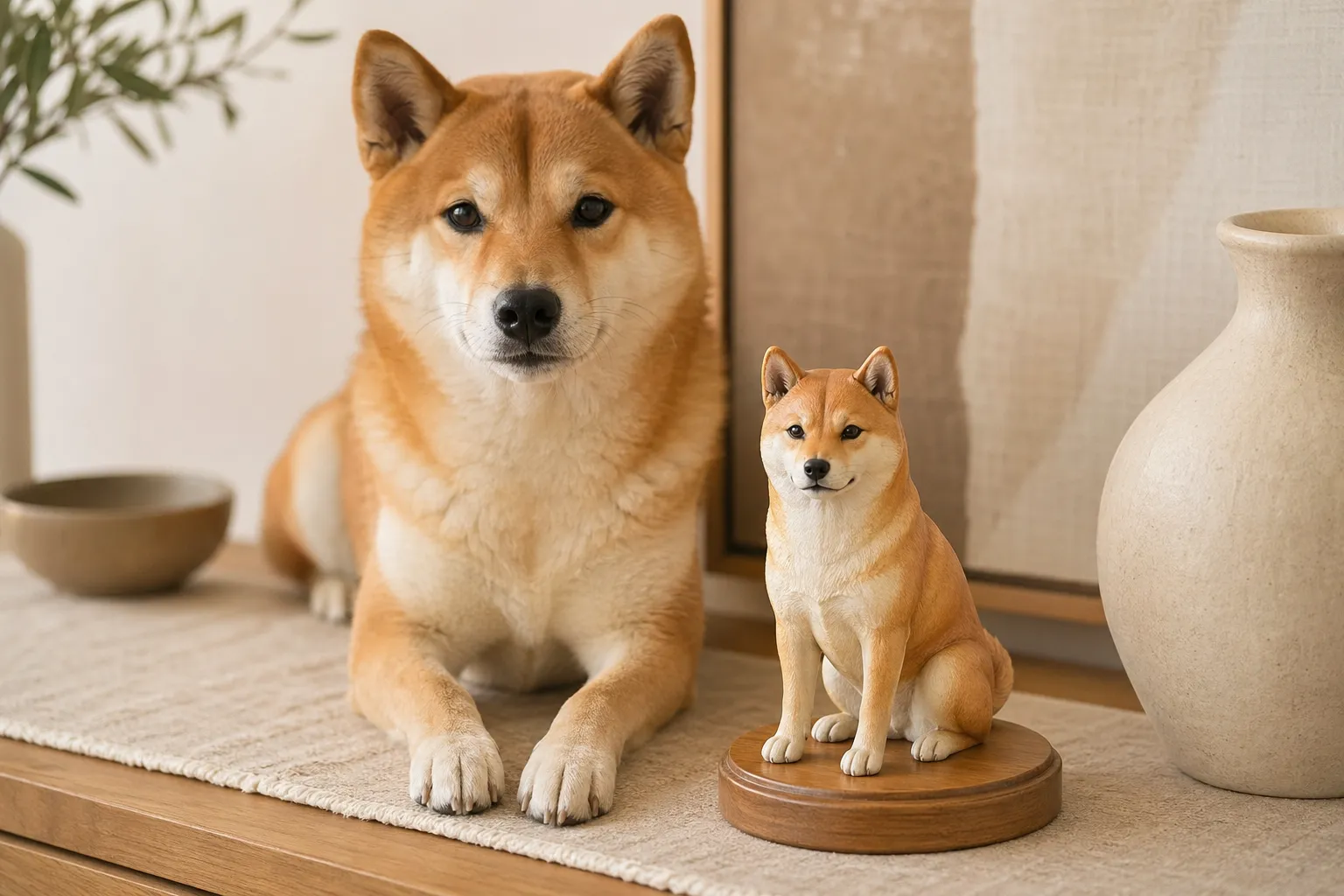
On a July afternoon in the attic, dust clung to a rough canvas sleeve; now the canvas vs pet figurine question sits differently when a Shiba Inu’s fox-bright stare must survive more than fading fabric can hold.
Quick Takeaways
- Expression lives in shape, not just color — compare muzzle tilt, ear tension, and stance first.
- Shiba memories are tactile — choose keepsakes that preserve posture, density, and visual weight.
- Flat art can flatter — but three-dimensional form usually captures breed-specific alertness more faithfully.
- Use high-angle, natural-light reference photos — then review custom pet figurines at PawSculpt if realism matters most.
Why the canvas vs pet figurine debate is really about structure
Most comparisons start too broadly. They ask whether a portrait or a sculpture is “better,” as if all pets present themselves the same way. That misses the standout issue with this breed: Shiba Inus communicate through compression.
A Shiba doesn’t just “look happy” or “look serious.” The expression often lives in small, structural tensions—the slight push of the cheeks, the set of the triangular ears, the way the tail changes the entire silhouette from the side. If you reduce that to a rectangle on the wall, some of the signal remains. But not all of it.
We’ve seen this firsthand from families deciding how to preserve a living pet’s personality or memorialize one after loss. The ones comparing options for a Shiba are rarely asking about décor alone. They are asking a harder question: what medium can hold attitude?
That’s the real editorial filter here, and it changes everything.
The overlooked truth: Shiba expression is partly physical, not purely facial
This is the point many generic gift guides skip. With some breeds, the face carries nearly the whole emotional message. With a Shiba Inu, the body architecture matters almost as much as the face.
A quick micro-story. One customer sent us two excellent headshots of their Shiba and one accidental full-body phone photo from the kitchen doorway. The headshots were sharp, well lit, technically stronger. But the kitchen photo told us more—the paws planted wide, chest forward, tail curled tightly, head turned in that almost theatrical refusal Shibas do so well. That single stance explained the dog better than the polished close-ups.
So if your question is “Which captures expression more faithfully?” the answer depends on what you mean by expression.
If you mean:
- coat color and facial contrast, canvas performs well
- pose, mass, and breed posture, figurines usually win
- the exact emotional read of a Shiba, 3D often has the advantage because attitude is spatial
That last point is worth underlining. A Shiba’s look is not flat. It projects outward. Literally.
Why flat images can misread a Shiba
Canvas has strengths. We’re not huge fans of dismissing it. A good canvas can capture warm cream markings, red coat variation, the bright almond eyes, and the elegant negative space around a seated dog. It can be graphic, modern, and striking from across a room.
But canvas also makes choices for you.
It compresses:
- the depth of the muzzle
- the rise of the brow
- the chest-to-leg proportion
- the spring-loaded curve of the tail
- the subtle forward pitch that reads as alertness
And Shibas are a breed of subtle forward pitch.
That’s why people sometimes say a Shiba portrait “looks beautiful” but doesn’t quite feel like their dog. The likeness is there. The presence is thinner.
"Some pets are remembered by color. Shibas are often remembered by geometry."
Canvas captures a moment; figurines can capture a habit
Here’s the counterintuitive insight: the most faithful keepsake is not always the one that reproduces the best photo. It’s the one that preserves the repeated posture your brain associates with that pet.
For many Shiba owners, that isn’t a smiling front-facing portrait. It’s something more specific:
- the side-eye from the hallway
- the compact loaf position on a cool floor
- the lifted front paw before refusing a command
- the tight fox curl of the tail when monitoring the room
A canvas often immortalizes a single photographic instant.
A figurine, especially one digitally modeled from multiple references, can preserve a behavioral shape—the pose your hands, eyes, and memory know by repetition. That difference matters more after time passes. Six months from now, you may not miss a particular photo. You may miss how your dog occupied space.
And that is where a well-made Shiba Inu figurine realism standard becomes far more demanding—and more meaningful—than most buyers initially expect.
Canvas vs pet figurine: what each medium gets right and wrong
This is where we get selective. Not all media are equally good at all jobs, and saying otherwise wastes your time.
Our top pick for facial immediacy from a distance is often canvas.
Our top pick for presence, posture, and breed-faithful realism is usually a figurine.
The standout nuance: these are not competing only on appearance. They compete on memory mechanics—how your mind retrieves your dog when you glance at the object.
A practical comparison table
If you’re weighing options, this quick table shows where each medium tends to excel for a Shiba owner.
| Feature | Canvas | Custom Pet Figurine | Best for Shiba Owners Who Value... |
|---|---|---|---|
| Facial color contrast | Strong | Strong | Coat markings and eye brightness |
| Body posture | Limited by flat perspective | Excellent | Signature stance and tail curl |
| Tactile presence | Minimal | High | A keepsake you can hold and feel |
| Room impact | High on large walls | High on shelves, desks, memorial spaces | Different display styles |
| Emotional realism over time | Good | Often stronger | Memory tied to physical presence |
The tactile row matters more than it seems. People often treat touch as secondary in memorial and celebration objects. We don’t. In our experience, touch changes attachment.
A canvas is seen. A figurine is often seen, lifted, repositioned, dusted, held for a second longer than expected. That brief contact—the cool surface warming in your hand, the slight weight, the fine printed grain under your fingertips—creates a different kind of relationship.
The mistake most people make: judging from the front only
We’ll be real: front-facing comparison is where many buyers go wrong. They line up a portrait and a figurine photo, then ask which face looks more accurate. For Shibas, that is an incomplete test.
- Front — eye placement, mask, expression
- Three-quarter — muzzle depth, cheek volume, ear angle
- Side — neck line, chest, back slope, tail carry
Why does this matter? Because breed truth emerges in profile. A side view often reveals whether the piece understands a Shiba or merely resembles one.
This is one reason many families exploring 3D pet sculptures start with expression but end up talking about silhouette. The silhouette is the memory shortcut.
A canvas can be more flattering. A figurine can be more honest.
That’s not an insult to canvas. It’s a function of the medium.
Canvas can soften awkward proportions, emphasize the eyes, and create a polished editorial mood. It can make a dog look noble, dreamy, cinematic. If your goal is elegance, that may be exactly right.
A figurine tends to be less forgiving—and better for fidelity. If your Shiba had a slightly oversized head, a famously compact body, a stubborn chin tilt, or asymmetrical markings that made them instantly recognizable, a three-dimensional object can preserve those quirks without flattening them into “generic cute.”
One family we worked with sent in references of a cream Shiba with an almost comically serious expression. The dog’s charm was not prettiness. It was judgment. A wall portrait made the dog look sweet. The figurine kept the sober little magistrate energy intact. Honestly, that was the correct choice.
Shiba Inu figurine realism: what actually creates a faithful likeness
Let’s narrow the conversation to what readers usually mean when they search Shiba Inu figurine realism. They are not asking whether an object is photorealistic in a generic sense. They are asking whether it gives that tiny jolt of recognition: that’s my dog.
That recognition comes from a curated stack of details, not from one hero feature.
Our ranking: the five details that matter most
If we had to rank what creates a strong Shiba likeness, here’s our editorial order.
1. Silhouette accuracy
This is our top pick because it is the fastest recognition cue. Before your eye notices markings, it notices the outline.
For a Shiba, that means:
- compact frame
- upright triangular ears
- balanced chest
- confident neck carriage
- tail curl with believable tension
If the silhouette is off, the piece may still be cute. It won’t be convincing.
2. Muzzle proportion
Shibas live or die on muzzle proportion. Too narrow, and the dog starts drifting toward fox caricature. Too blunt, and you lose breed elegance. The ideal likeness preserves that firm, clean wedge shape without exaggeration.
A micro-story here: we once reviewed a set of customer reference photos where every image was taken with a phone very close to the face. The result? The muzzle looked larger, the forehead broader, the whole dog slightly distorted. This is why reference variety matters so much. Cameras lie—especially at close range.
3. Ear set and tension
This is commonly overlooked. Not ear shape alone. Ear tension.
Shiba ears aren’t just triangles pasted onto a head. Their angle changes the emotional read. Slightly forward can look alert and interested. More outward can read relaxed. A little asymmetry can make a figurine feel uncannily alive.
4. Tail architecture
Not “a curled tail.” That description is too casual. Shiba tails vary in tightness, plume density, and the exact way they sit over the back. This is one of the breed’s strongest structural signatures.
Get the tail wrong and the whole figure loses rhythm.
5. Fur pattern transitions
Yes, color matters. But with Shibas, the important part is often the transition zone—where red shifts to cream, where the chest lightens, where the muzzle markings sharpen or soften. In advanced full-color 3D printing, those tones are printed directly into the resin material voxel by voxel, which allows more integrated color mapping than a simple surface effect.
That’s worth noting because many buyers still assume color is just added on top. In high-quality full-color resin printing, the color is part of the object itself, protected afterward by a clear coat for sheen and durability.
What good reference photos look like
Families often ask us what images produce the strongest result. The answer is not “the prettiest photos.” It’s the most informative set.
Use this table as your filter before ordering any custom piece.
| Photo Type | Why It Matters | Best Angle | Common Mistake |
|---|---|---|---|
| Eye-level face shot | Captures expression and markings | Straight on, natural light | Using flash, which flattens eyes |
| Three-quarter view | Shows muzzle depth and cheek shape | 45-degree angle | Cropping ears or tail |
| Full-body side view | Reveals posture and silhouette | Standing naturally | Shooting too close with wide-angle phone lens |
| Top-quality candid pose | Preserves personality habit | Daily relaxed setting | Forcing an unnatural “sit pretty” pose |
Natural light is your friend. Window light, shaded outdoor light, or indirect afternoon light often gives the most reliable coat information. Harsh overhead bulbs can turn cream areas muddy and red coats overly orange.
And don’t oversmooth your images with filters. That may help a social post. It hurts realism.
Why tactile realism is underrated
Search results talk constantly about visual accuracy. Fair enough. But what families mention after receiving a figurine is often tactile.
The weight matters.
The coolness of the surface at first touch matters.
The faint, natural 3D print grain under a protective clear finish matters.
Not because people are inspecting manufacturing. Because texture tells the brain, this object occupies space the way my pet did. It interrupts the slippery unreality that purely flat remembrance can create.
"The most convincing likeness is the one that brings back posture before it brings back tears."
— The PawSculpt Team
That’s why a figure can feel more emotionally exact even when a canvas has richer wall drama.
Myth vs. Reality: the most common misconceptions about pet portraits and figurines
This subject attracts a surprising amount of lazy advice, so let’s clear out the clutter.
Myth vs. Reality callout
Myth 1: A canvas is always more lifelike because it starts from a photo.
Reality: A photo records one perspective. Lifelikeness depends on whether the medium preserves the pet’s defining dimensions, not just image detail.
Myth 2: Figurines are mainly decorative, not emotionally accurate.
Reality: For breeds with distinctive posture—like Shibas—three-dimensional form can preserve personality cues that wall art loses.
Myth 3: Smooth equals premium.
Reality: Absolute smoothness can make a pet keepsake feel generic. Fine printed texture, sealed with a clear coat, often reads as more authentic than plastic-perfect polish.
That third point surprises people.
We’ve watched customers run a thumb lightly over a finished piece and pause at the subtle surface grain. Not because it is rough—it isn’t—but because it has material presence. Too much gloss and too much artificial smoothness can move an object away from memory and toward toy-like.
The medium should match the memory trigger
Here’s the thing. Different people retrieve memory differently.
Some are strongly visual. They want the way sunlight caught the coat. The exact look of the eyes from across the room. For them, canvas can be a smart choice.
Others remember through spatial habits: where the dog sat, how the tail curled against the spine, the compactness of the body against a blanket or hardwood floor. For them, a figurine often becomes the more faithful archive.
One order that stuck with us came from a family who had both. The canvas hung in the hallway and made guests smile. The figurine stayed near the reading chair because that was where their Shiba used to supervise the house. The family told us the wall piece was admired. The figurine was visited.
That distinction is everything.
Canvas vs pet figurine for memorials, gifts, and everyday display
The best choice changes with the purpose. And purpose should drive medium more than trend.
A lot of pet owners get stuck because they ask, “Which is nicer?” Better question: what job must this object do in your home?
For memorials: the standout here is physical presence
If the piece is meant to anchor grief, our editorial judgment leans toward a figurine more often than canvas—especially for a Shiba.
Grief is repetitive. It appears in loops:
- reaching down where the dog used to brush your leg
- glancing at the door at feeding time
- noticing the cool patch of floor where they liked to sleep
A three-dimensional keepsake can meet that repetition more directly because it exists in the room the way the pet once did. Not alive, of course. But spatially legible.
We’re not therapists, and for intense grief support we encourage resources like the Association for Pet Loss and Bereavement. Still, in our years working with pet families, we’ve seen that tangible objects often help people complete interrupted habits. They don’t erase pain. They give it somewhere to land.
"Memorials help most when they occupy the space your routines still reach for."
Canvas can absolutely work for remembrance. It often suits families who want a larger visual tribute without placing an object on a shelf or table. But if the ache is tactile—if you miss the pressure of presence more than the image—figurine is usually the stronger memorial format.
For gifts: canvas is safer, figurine is more intimate
If you’re buying for someone else, risk tolerance matters.
A canvas is often the safer gift:
- easy to understand
- familiar format
- simple to display
- visually flattering
A figurine is more personal. And because it is more personal, it can be more moving—or more dependent on accuracy.
For a Shiba owner who constantly talks about “that face” or “that pose,” a figurine can be a standout gift because it validates details outsiders usually miss. The owner doesn’t just receive a dog object. They receive recognition.
That said, if you have weak photos or uncertain tastes, canvas may be the more prudent path. We’re not huge fans of pretending every product suits every buyer. It doesn’t.
For everyday display: think in terms of viewing distance
This is a practical design note most articles skip.
Choose based on where you will usually stand:
- Across the room: canvas carries better
- Desk, bookshelf, bedside table: figurine rewards close inspection
- Entryway or memorial nook: figurine often feels more personal
- Gallery wall with other art: canvas integrates more easily
A Shiba’s expression is full of near-field details. That means figurines often outperform when viewed from 1 to 4 feet away, where texture, tilt, and proportion become legible.
At 8 to 12 feet, canvas often has more immediate impact.
So placement isn’t an afterthought. It’s part of the realism equation.
A second comparison table: choose by purpose
Here’s a cleaner way to decide.
| Use Case | Canvas Strength | Figurine Strength | Our Editorial Pick for Shibas |
|---|---|---|---|
| Memorial keepsake | Large visual tribute | Tangible, room-based presence | Figurine |
| Birthday or holiday gift | Familiar and easy | Highly personal and specific | Depends on photo quality |
| Office or desk display | Limited | Excellent close-up presence | Figurine |
| Gallery wall décor | Strong | Secondary | Canvas |
| Capturing signature pose | Moderate | Excellent | Figurine |
If the dog’s personality was mainly in how they looked at the camera, canvas can work beautifully.
If the dog’s personality was in how they stood in defiance of the camera, figurine usually wins.
What to expect from a custom Shiba figurine, and why process matters
Let’s talk process, because realism is not accidental.
The strongest custom figurines begin with selection—of photos, pose, and priorities. This is where editorial judgment matters more than buyers realize. The goal is not to include every possible detail. It is to choose the details that carry identity.
Step 1: Decide what you’re preserving
Before you upload anything, answer one question: What would be missing if this detail were wrong?
For a Shiba, common answers include:
- the skeptical side-eye
- the tail curl
- the compact chest-forward stance
- cream-to-red coat transitions
- the upright, almost listening ear set
This helps you avoid the classic error of overvaluing image sharpness while undervaluing personality structure.
A customer once sent us dozens of photos—beautiful, but scattered. Sleeping on a couch. Wearing a bandana. A holiday sweater. One in a car. None showed the dog standing naturally. The strongest result would not have come from the most festive image. It would have come from one honest standing pose plus two clear face references.
Step 2: Use reference images that show form, not just cuteness
This sounds severe, but it helps. Cute is not enough.
You want:
- one clear face photo
- one three-quarter angle
- one full-body standing image
- one candid that feels unmistakably “them”
If possible, include familiar scale cues, like the dog standing near a baseboard or favorite chair. Those cues help the modeling team read proportions more accurately.
For broader pet photo guidance and care context, the American Kennel Club's breed guide for Shiba Inus is useful because it reinforces what defines the breed structurally.
Step 3: Understand digital craftsmanship
This part matters, especially if you are comparing products casually online.
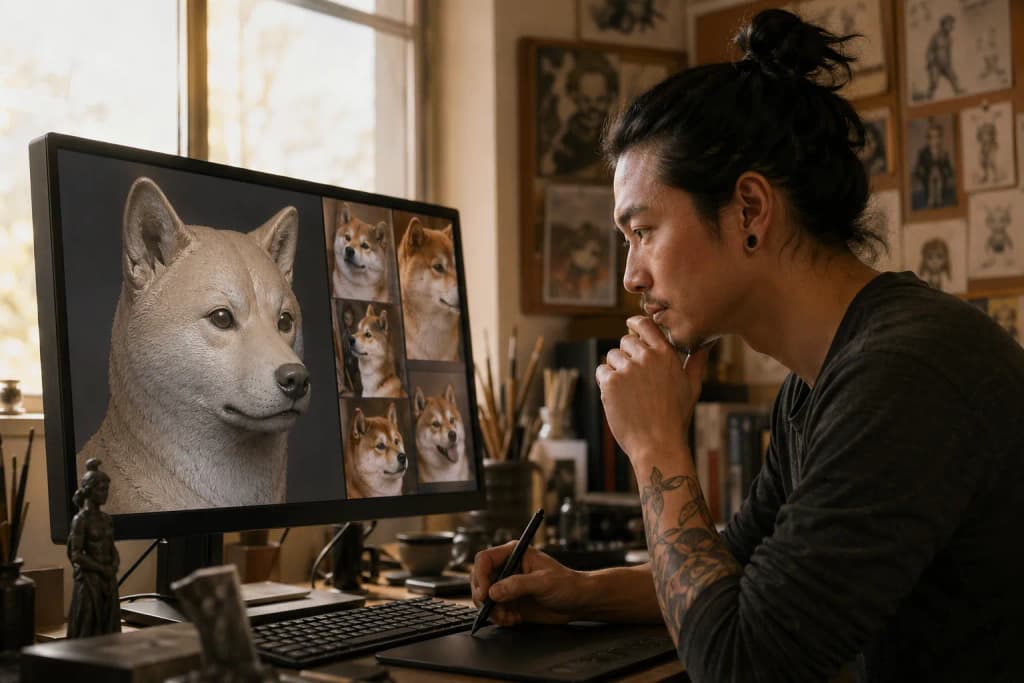
At PawSculpt, figurines are digitally sculpted by master 3D artists, then precision 3D printed in full color. That means the sculpting judgment happens in the digital model—where proportions, coat boundaries, posture, and expression are refined before production.
Then the object is produced in full-color resin, with color integrated directly into the material rather than added as a surface layer. After printing, a clear protective coat is applied to enhance durability and sheen.
Why should you care? Because this process affects realism.
Integrated color tends to preserve nuanced fur mapping more naturally than simplistic surface treatments. And digital sculpting allows corrections to posture and proportion that a single photo cannot solve on its own.
If you want service specifics, previews, or current ordering details, the best source is the official PawSculpt FAQ. We avoid locking in details here because they can change.
Step 4: Expect interpretation, not mere duplication
This is a healthy expectation to set. The best custom work is not a photocopier in object form. It is an interpretation guided by evidence.
That matters because cameras distort:
- close phone shots enlarge noses
- sitting poses shorten legs visually
- indoor yellow light muddies cream fur
- heavy shadows erase eye shape
A strong artist corrects for those distortions. So if the final piece looks more like your dog than one particular photo did, that is not a flaw. That is success.
Process overview table
This simplified table shows what a thoughtful creation process usually involves.
| Stage | What Happens | Why It Matters |
|---|---|---|
| Photo selection | Best references are chosen | Sets the ceiling for realism |
| Digital modeling | Proportions and pose are built in 3D | Captures structure, not just snapshot detail |
| Full-color 3D printing | Color is printed into resin material | Preserves markings with dimensional depth |
| Clear-coat finishing | Protective sheen is added | Helps durability and visual cohesion |
The practical downside no one mentions enough
A figurine asks more of you upfront.
That’s the tradeoff.
Canvas can often be created from one great photo. A high-realism figurine usually benefits from a more complete reference set and clearer decision-making about pose. If you are rushed, indifferent to stance, or working from poor images alone, you may not unlock the medium’s full advantage.
Honestly, that’s why we sometimes tell readers canvas may be the better fit. Better to choose the right medium than force the more complex one.
For readers still comparing formats, the broader PawSculpt blog can help you think through memorial, gift, and display choices without jumping straight to checkout.
How to choose the most faithful option for your Shiba
By now, the broad answer is probably clear: for many owners, a figurine captures a Shiba’s expression more faithfully than canvas because the breed’s personality is deeply bound up with posture, outline, and physical tension.
But “many” is not “all.” So here is the decision framework we’d actually use.
Choose canvas if these three statements are true
- Your favorite memory is a specific photo
- Wall display is the priority
- Your Shiba’s charm was mainly in facial softness or eye contact
This is especially true if you have one extraordinary image that already feels complete. The best canvas portraits function almost like punctuation marks in a room—clean, immediate, legible from a distance.
Choose a figurine if these four statements are true
- Your Shiba was known for a signature stance
- You miss physical presence, not just appearance
- Tail curl, ear set, and body compactness matter to the likeness
- You want a keepsake that rewards close viewing and touch
That last point may sound minor. It isn’t. Some keepsakes are meant to be passed by. Others are meant to be revisited.
A Shiba Inu figurine realism standard should include revisit value—the ability to notice, again and again, that the chest is set just so, that the ears carry that familiar readiness, that the whole object holds the dog’s elegant stubbornness.
If you’re torn, ask one uncomfortable question
Which loss would bother you more:
- losing the dramatic wall image, or
- losing the sense of your dog’s physical stance
That question cuts through aesthetics fast.
One family told us they had dozens of beautiful photos, but what they missed most was “the way he looked like he owned the room while weighing 22 pounds.” That sentence alone decided the format. They did not need a larger image. They needed volume, posture, and attitude.
Care and longevity considerations
Both media need sensible care, but they age differently.
For canvas:
- keep it away from prolonged direct sun
- avoid damp walls or high humidity spots
- dust lightly with a soft, dry cloth
For figurines:
- display on a stable surface
- dust gently with a soft brush or microfiber cloth
- avoid frequent handling by the tail or finer projections
- keep out of harsh direct sunlight when possible
The good news is that modern UV-resistant materials used in quality full-color resin printing are designed with display longevity in mind. Still, all keepsakes benefit from thoughtful placement.
The final judgment
So, canvas vs pet figurine—which captures expression more faithfully for a Shiba Inu?
Our answer is direct: the figurine usually does, because Shiba expression is not only visible; it is structural. It sits in the lift of the neck, the taut ear angle, the compact chest, the tail’s controlled curl, the poised stillness before movement.
Canvas can be beautiful. Sometimes breathtaking.
But beauty and fidelity are not always the same thing.
If your goal is to preserve the sensation of this exact dog occupied space in this exact way, a custom figurine is often the more faithful medium. And if you decide to go that route, choosing a studio like PawSculpt—where pieces are hand-modeled digitally with care, then brought to life through full-color 3D printing—can make the difference between a generic breed object and a deeply recognizable companion in miniature.
The choice that lasts
Years from now, the attic shelf or hallway wall won’t just hold an object. It will hold a retrieval system for memory.
That is the part buyers rarely hear stated plainly.
If you want a keepsake that dramatizes a beloved image, canvas is still a worthy choice. If you want one that preserves the compact gravity of a Shiba—the slight forward lean, the dense little fox body, the air of private opinion—a figurine is usually the stronger editor of memory. It keeps more of the dog’s architecture intact.
So your next step is simple. Pull out four to six photos and sort them into two piles: best face and most familiar stance. If the stance pile hits harder, trust that reaction. It tells you what you are actually trying to save.
And in the long run, that is what decides the canvas vs pet figurine question more honestly than style ever will: the keepsake that lets your dog’s presence return before the details fade.
Frequently Asked Questions
Is a canvas or figurine better for capturing a Shiba Inu's expression?
For most Shibas, a figurine has the edge because expression in this breed is carried by structure as well as face. Ear set, tail curl, chest posture, and that characteristic alert stillness all read more completely in three dimensions. Canvas is still strong for color contrast and dramatic wall display.
What photos work best for a custom Shiba Inu figurine?
The best set includes one straight-on face shot, one three-quarter view, one full-body standing photo, and one candid pose that feels unmistakably like your dog. Natural light is ideal because it preserves accurate cream and red coat transitions. Avoid heavy filters, harsh flash, and close phone shots that distort the muzzle.
Why does Shiba Inu figurine realism depend so much on silhouette?
Because your brain identifies a Shiba quickly by outline. The compact body, upright triangular ears, confident neck carriage, and curled tail create an immediate recognition signal. If those proportions are wrong, even a nicely colored piece can feel slightly off.
Are full-color 3D printed pet figurines painted afterward?
No. With advanced full-color 3D printing technology, the color is produced directly in the resin material rather than added later as a surface layer. The manual finishing step is a clear protective coat, which helps with sheen and durability.
Can a canvas still be the right choice for a Shiba owner?
Absolutely. Canvas is a smart choice if you have one exceptional photo, want larger visual impact on a wall, or are buying a gift for someone whose taste you don’t know well. It’s often the easier format—but not always the most structurally faithful one.
Where can I compare options for custom pet figurines?
If you’re considering a figurine, start by reviewing examples, process notes, and current service details at PawSculpt. You can also browse their memorial keepsakes and pet tribute resources or check the customer FAQ for custom figurines before deciding.
Ready to Celebrate Your Pet?
Every pet has a story worth preserving. Whether you're honoring a beloved companion who's crossed the rainbow bridge or celebrating your furry friend's unique personality, a custom PawSculpt figurine captures those details that make your pet one-of-a-kind.
If your canvas vs pet figurine decision comes down to what feels most faithful, start with the details your hands and eyes still reach for—stance, tail, expression, and presence.
Visit pawsculpt.com to learn more about our process and guarantees