Custom Rottweiler Figurine vs DIY 3D Scan: Which Holds Up Longer at Home
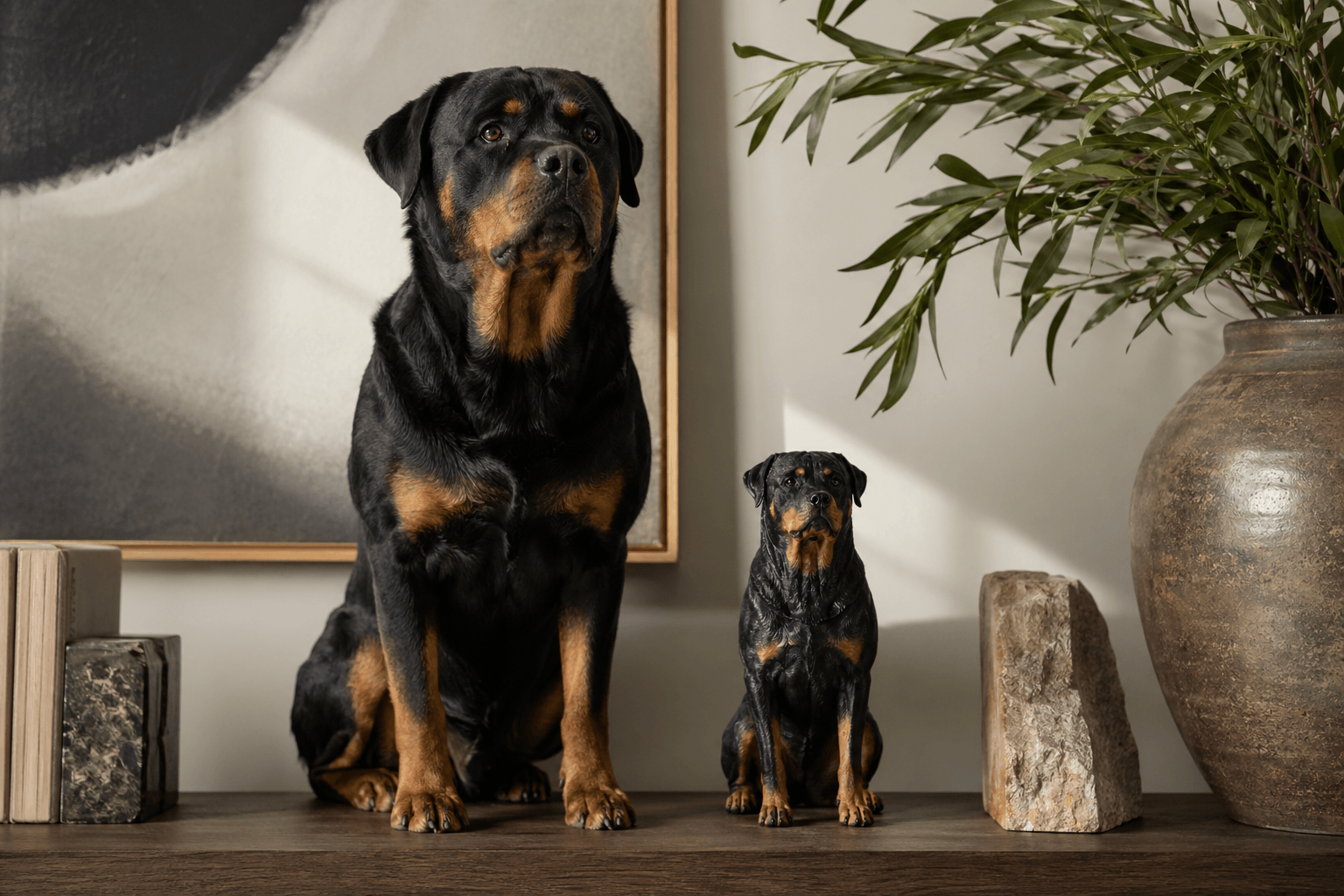
Which would still feel solid in your palm six summers from now—a DIY 3D scan vs custom figurine tucked beside the dog treats at the pet store, while your thumb remembers the dense, velvet weight of a Rottweiler head leaning into your knee?
Quick Takeaways
- Durability starts before printing — the source photos or scan data decide long-term structural strength.
- Smooth-looking isn’t always stronger — thin ears, tails, and open-mouth poses often fail first.
- Display habits matter most at home — sunlight, shelf vibration, and curious kids shorten lifespan fast.
- If you want a lasting keepsake, compare custom pet figurines at PawSculpt with scan-based shortcuts before ordering.
- The best memorial object is touchable — if you’re afraid to handle it, it won’t anchor memory well.
Why DIY 3D scan vs custom figurine is really a question about home life
Most articles compare these two options as if the only issue is tech. File quality. Printer type. Cost. Resolution. That's useful, but it's not the whole truth.
The real test happens at home.
A shelf gets dusted. A vacuum bumps the table leg. A child reaches up with sticky fingers. Winter light turns sharp in the window. Summer heat settles near the glass. The object that represents your dog doesn't live in a lab. It lives in your ordinary days, which is where durability becomes emotional, not just physical.
We've learned this from years of working with pet families. They rarely write to us saying, "Tell me the tensile properties." They ask softer questions with harder edges: Will it last? Will the ears chip? Can I keep it near the window? If I move house twice, will this still be okay? What they're really asking is whether their dog's presence can survive daily life without becoming too fragile to love openly.
That distinction matters.
Because a keepsake you can't comfortably touch becomes a museum object in the worst sense. Distant. Cautious. Almost sacred in a way that keeps you from it. But the strongest pet memorials aren't only seen. They're handled. Lifted during cleaning. Turned toward the light. Held in the hand on rough anniversaries.
And with Rottweiler figurine durability, this matters even more than it does for many other breeds. Rottweilers carry visual weight. Broad chest. Dense head. Thick neck. Deep markings around the muzzle and brows. If a figurine makes them look hollow, flimsy, or too delicate, the spirit of the breed gets lost before the material even fails.
That's the overlooked angle most shopping guides miss: durability is partly emotional design. An object holds up longer when it's built to be lived with, not merely admired.
The first break usually isn't where people expect
People obsess over color fading. Fair enough. But the first failure point in many pet figurines isn't color. It's protrusion.
Think ears.
Think tail tips.
Think a slightly open tongue.
Think one front paw lifted in a playful pose.
One of our customers once told us their previous pet model looked beautiful for exactly three weeks. Then it met the edge of a dresser during a routine dusting, and one ear snapped clean at the base. Not because the owner was careless. Because the design asked a thin structure to survive a life full of ordinary contact.
This is where many DIY scan workflows struggle. A scan can capture shape, yes, but it often captures a shape without interpretation. And interpretation is where durability lives. A skilled digital artist doesn't just reproduce what the camera sees. They strengthen vulnerable transitions, refine unsupported areas, and preserve likeness while quietly improving survivability.
That invisible adjustment? That's the difference between a shelf object and a household heirloom.
"The best keepsakes don't avoid life at home—they're built to endure it."
Rottweiler figurine durability starts with anatomy, not material
Here's the counterintuitive part: Rottweiler figurine durability is often better than people expect—not because every material is strong, but because the breed's natural structure can support a sturdier sculpture if it's modeled well.
A Rottweiler is compact in all the right ways for a figurine. Compared with breeds that have whip-thin tails, spindly legs, or large feathered ears, the Rottweiler offers a sculptural advantage. Broad skull. Stable stance. Muscular proportions. Lower visual fragility. That can translate beautifully into a durable figurine.
But only if the maker respects what should be thick, grounded, and connected.
Why breed shape changes the durability conversation
Picture two figurines on the same shelf.
One is a greyhound mid-stride, all air and narrow ankles. The other is a seated Rottweiler, chest square, paws planted, chin slightly lifted. Even before material enters the conversation, you know which one has the better chance of surviving a move.
That's not bias. That's physics.
The Rottweiler's shape naturally supports:
- Wider load-bearing legs
- Shorter, sturdier neck proportions
- More mass close to the center
- A pose that can read powerfully without extreme extensions
This is why pose selection matters so much. A Rottweiler doesn't need theatrical motion to feel alive. Sometimes the most durable pose is also the most emotionally true—the calm sit by the door, the alert look toward the kitchen, the quiet leaning posture that says "I'm here."
And honestly, that's one of our favorite things about this breed. Their spirit often lives in stillness.
The common DIY scan problem: raw data mistakes bulk for strength
A phone scan or budget turntable scan can make a dog look "chunky" enough to seem safe. But chunkiness isn't the same as structural integrity.
We've seen scans where:
- The legs look thick from one angle but are warped thin from another
- The ears have ragged edges that print as weak points
- The chest loses definition and becomes a generic block
- The tail is captured unevenly, creating stress lines in printing
- Dark markings flatten into muddy color transitions
Rottweilers are especially tricky because their coats are visually dark, glossy, and subtly patterned. Those tan points above the eyes, around the muzzle, and on the legs carry a lot of expression. A poor scan can miss them or blur them into shadow, which means the final piece may look less like your dog and more like "a black dog, probably."
And that matters more than people admit. Durability isn't only about whether the figurine breaks. It's also about whether the likeness stays emotionally alive.
The small design choices that make a big difference
Here are the adjustments that often improve longevity without making a figurine look heavy-handed:
- Slightly reinforced ear bases
- Tail positioning with support in mind
- Paw contact that feels natural but broad enough to stabilize
- Closed-mouth or minimally open expressions
- Balanced chest-to-leg proportions
That last one is huge. A figurine that feels top-heavy in your hand will usually feel risky on a shelf too.
A quick comparison of where strength really comes from
This table shows the practical difference between scan-first and artist-refined approaches.
| Factor | DIY 3D Scan | Custom Figurine by Digital Artists | Why It Matters at Home |
|---|---|---|---|
| Body proportions | Captured as-is, including distortions | Refined for likeness and stability | Better balance reduces tipping and stress |
| Ear/tail thickness | Often inconsistent | Intentionally reinforced where needed | Fewer chips during dusting or moves |
| Facial markings | Can blur in dark-coated dogs | Corrected from photo references | Keeps your Rottweiler recognizable over time |
| Pose support | Limited by source scan posture | Chosen or adjusted for strength | Stronger figurines survive everyday handling |
| Emotional realism | Technically literal | Interpretive and breed-aware | Feels more like your dog, not just data |
What actually wears out first in a home display
People often imagine a dramatic accident—a figurine falling from a shelf, shattering in one terrible second. That can happen. But more often, wear arrives by accumulation.
A little sunlight every afternoon.
A little shelf vibration from a slamming front door.
A little skin oil from being picked up the same way every week.
A little pressure on the neck while dusting around it.
That's the real story.
Sunlight doesn't only fade color—it changes how you use the object
Let's talk color, because with a Rottweiler, color is identity.
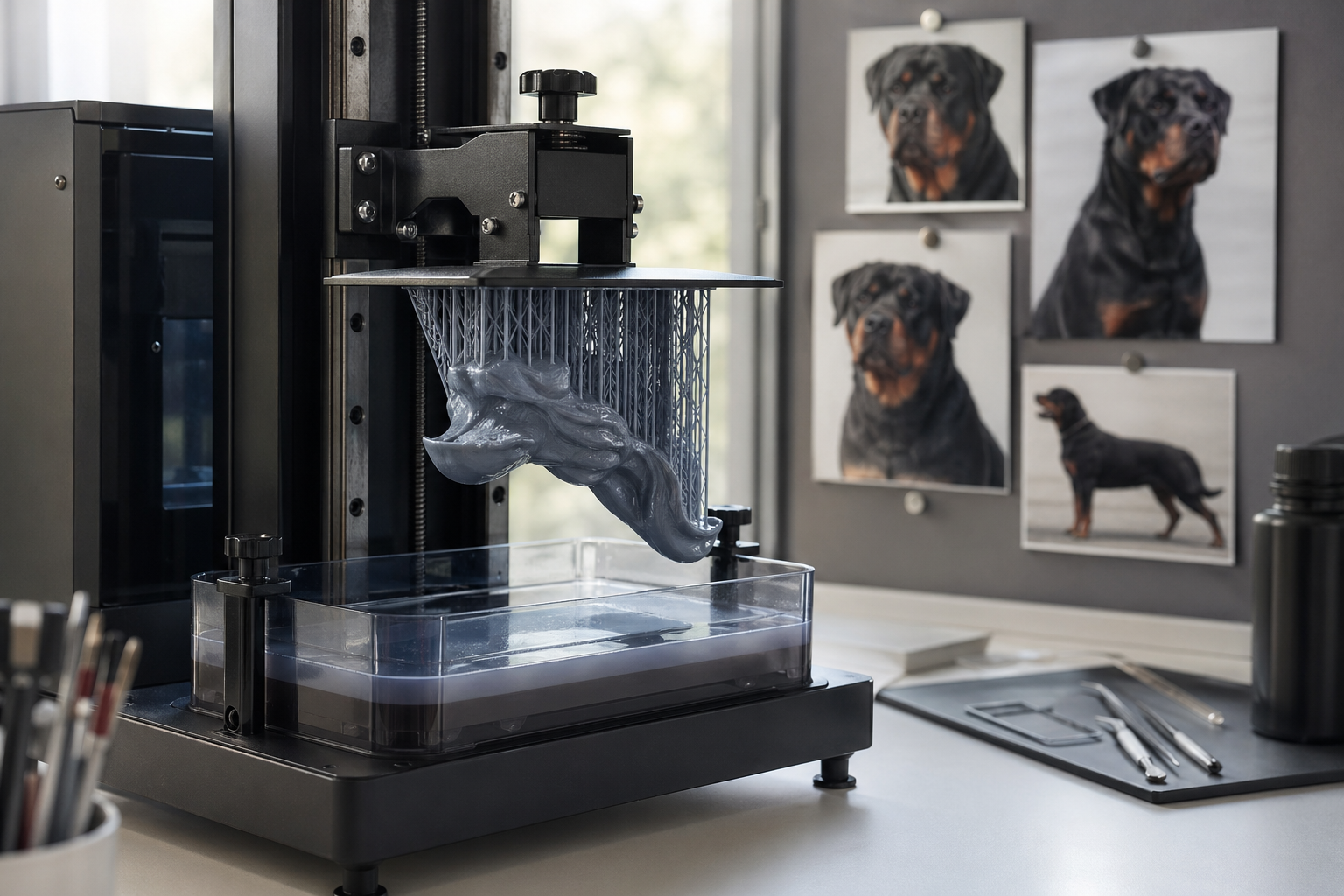
At PawSculpt, figurines are digitally sculpted by master 3D artists, then precision 3D printed in full color. The color isn't sitting on top like a cosmetic layer. It's integrated into the full-color resin during printing, then protected with a clear coat for sheen and surface protection. That construction changes the durability conversation in a meaningful way.
Why? Because surface scratches don't behave the same way they do on objects where color is only skin-deep.
Still, even durable color benefits from smart placement. Constant direct UV exposure can challenge almost any display object over time. That's not a flaw unique to pet figurines. It's just the material reality of living on Earth, under sunlight, in houses with windows.
So yes—window display can be beautiful. But filtered light is kinder.
If you're trying to protect detail, especially the warm tan points on a Rottweiler's face, choose:
- Indirect natural light
- Shelves away from south-facing windows
- A stable indoor temperature
- A spot above wagging-tail height if you have other dogs
That last point sounds obvious, but it's the one families forget most.
Dusting is a durability event
Here's the overlooked home-care truth: cleaning is usually the highest-risk moment for pet figurines.
Not because owners are rough. Because cleaning combines friction, divided attention, and awkward grip. The figurine is in one hand, a cloth in the other, and you're half-thinking about the groceries still in the car.
We've seen it again and again.
The safest cleaning rhythm is simple:
- Dust weekly with a very soft, dry brush or air blower
- Handle from the most solid mass—usually the body, not the head, ears, or tail
- Avoid wet wipes or chemical cleaners
- Set the figurine on a folded towel while cleaning nearby shelves
That folded towel matters. Hard counters create the kind of cold, sudden impact that causes tiny chips.
And texture plays into this too. A figurine with a natural fine print grain and clear protective coat often gives your fingers a bit more control than an ultra-slick surface. That's one reason "perfectly smooth" isn't always better in the real world. Some texture can be visually honest and physically practical.
"We've found that the keepsakes families hold onto longest are the ones sturdy enough to become part of a ritual."
— The PawSculpt Team
Shelf placement can either honor your dog or endanger the piece
A family we worked with created what they called their dog's "morning corner"—not an altar exactly, just a small sacred space near the bookshelves. Leash hook. Framed photo. Candle used only on adoption day and gotcha day. Figurine in the center.
Beautiful idea.
But they placed it on a narrow floating shelf above a heat vent.
Looks lovely in photos. Bad for long-term stability.
The better setup is surprisingly modest:
- A deeper shelf with a lip or enough surface area
- A room with stable humidity
- Some distance from vents, radiators, and kitchen grease
- Placement below eye level only if children won't grab it
- Enough surrounding clearance so you don't knock it every time you reach for something else
That last point is crucial. A figurine shouldn't live in the traffic lane of your house.
The most durable object is the one you don't have to baby
This is the heart of it.
If your keepsake is so fragile that every interaction fills you with tension, you'll stop interacting with it. Then it becomes emotionally distant. Present, but not present.
The better object invites contact without punishment. Not rough handling, of course. Just normal life. Lifting. Turning. Relocating during holidays. Packing carefully for a move. Holding for a minute on a hard anniversary.
That kind of durability creates continuity. And continuity is what memorial objects are for.
DIY 3D scan vs custom figurine: where the quality gap really shows
Let's be fair. DIY scanning has come a long way.
If you're comfortable with apps, lighting setups, mesh cleanup, and trial prints, you can create something meaningful. For some families, that process itself becomes the ritual. They walk around the dog slowly with a phone. They laugh when the pup wiggles. They try again. It becomes a living memory while the pet is still with them.
We respect that.
But the quality gap appears in three places that matter more than most buyers realize: expression, structural cleanup, and color truth.
Expression is not just geometry
A scan captures surface. It doesn't always capture character.
A Rottweiler's expression lives in very small tensions: the set of the brow, the softness around the eyes, the calm confidence in the muzzle. A raw scan might preserve dimensions but miss the spirit. And once the spirit is missing, durability alone won't save the object.
This is the part that can feel almost metaphysical. You know your dog is more than measurements. There is an energy in the face, a watchfulness, a grounded loyalty that belongs to this breed in a very specific way.
A family can forgive a tiny texture line.
They rarely forgive a dead expression.
Structural cleanup is where professionals earn their keep
A good custom figurine isn't simply "more detailed." That's too shallow. It's better resolved.
That means a skilled artist can look at the source material and make decisions a raw scan won't:
- Close tiny mesh holes that become weak points
- Correct asymmetry caused by movement during capture
- Clarify the edges of tan-point markings
- Strengthen under-supported anatomy without losing likeness
- Rebuild features hidden in shadow
This is especially useful if your best photos are imperfect—which, let's be honest, most beloved dog photos are. One ear cropped. Tongue out in one shot. Motion blur in the yard. Nose too close to the camera. The custom route can reconcile those fragments into a coherent whole.
DIY methods generally leave that burden on you.
And for many people, that burden becomes the project they never finish.
Color truth matters more for black-coated breeds
Rottweilers are not "just black and tan." Their coat has depth. Warmth. Contrast. Shadow. Light catches the bridge of the nose differently than the chest. The eyebrows—the tiny rust points above the eyes—can make the difference between alert, sleepy, gentle, or goofy.
A low-end scan often compresses dark tones. It loses separation. The figurine may print looking flatter or muddier than expected.
By contrast, a full-color resin 3D print captures your pet's unique markings directly in the material. That matters for longevity in an emotional sense: the object still reads correctly from across the room, not only from six inches away.
And yes, practical longevity too. Integrated color simply behaves differently than a finish that's only skin-deep.
Here's a side-by-side you can actually use
If you're trying to decide, this comparison is the one we'd want on our own kitchen table.
| Question | DIY 3D Scan | Custom Figurine |
|---|---|---|
| Who controls accuracy? | Mostly you and your raw scan quality | A trained digital artist interprets and refines |
| How good does your source need to be? | Very good, especially for dark coats | Good photos can still produce strong results |
| Best for | Tech-savvy hobbyists who enjoy process | Families who want a finished heirloom |
| Biggest risk | Lopsided anatomy, weak points, muddy detail | Higher emotional expectations if you choose poorly |
| Long-term at-home strength | Variable | Usually more consistent when professionally modeled |
What to expect if you go custom
People often imagine the custom process as mysterious. It doesn't have to be.
In broad terms, here's what usually happens with a company like PawSculpt:
- You gather photos of your Rottweiler from helpful angles.
- Digital artists model the figurine based on those references.
- The piece is precision 3D printed in full color resin.
- A clear protective coat is applied for protection and sheen.
- You receive a keepsake designed to live in your home, not a prototype.
For specifics on current process details, options, and service terms, it's best to check the PawSculpt FAQ or browse the wider PawSculpt blog. We won't pretend static article details stay current forever.
The commonly overlooked insight: DIY often costs more in emotional energy
Not always in money. In energy.
A customer once described their failed DIY project this way: "I thought I was saving effort. Instead, I spent three weekends trying to rescue a file that never looked like him."
That stuck with us.
Because the hidden cost of DIY is often not financial—it's the fatigue of troubleshooting during a season when you wanted comfort, not another task. This is especially true for memorial projects. If your dog has recently passed, you may not have the emotional bandwidth for software errors and mesh repairs. And if your dog is still with you, you may not want to spend your good days together circling them with a phone, begging them not to move.
Sometimes convenience is shallow.
Sometimes convenience is mercy.
"A lasting keepsake doesn't just preserve shape. It preserves your willingness to keep loving it openly."
The photo factor: why pictures often beat scans for Rottweiler figurine durability
This one surprises people.
A lot of buyers assume a 3D scan must be more accurate than photos because it's "3D." But in practice, good photos often produce a stronger final figurine than a mediocre home scan.
Why? Because photos can reveal what scans miss: expression, markings, texture transitions, and true proportions across multiple moments.
Why scans struggle with living animals
3D scanning loves stillness.
Dogs do not.
Even calm Rottweilers shift weight, blink, breathe, tilt, and glance away. A tiny movement during capture can distort:
- The jawline
- Ear placement
- Front paw symmetry
- Tail alignment
- Eye shape
Humans often don't notice those distortions until the figurine arrives. Then something feels "off." Maybe one shoulder reads melted. Maybe the face seems too narrow. Maybe the chest looks caved in. It's not always dramatic. But it drains the spirit from the piece.
Photos give artists multiple truth points. One image for stance. Another for markings. Another for the exact softness around the eyes. Together, they can tell a fuller story than one imperfect scan orbit.
What photos work best for a custom Rottweiler figurine
You don't need a professional camera. You need clarity and variety.
This table shows the most useful image types.
| Photo Type | Why It Helps | Best Tip |
|---|---|---|
| Front-facing head shot | Captures eye placement and tan-point expression | Stand at your dog's eye level |
| Full side profile | Shows body proportions and tail set | Use natural daylight, no harsh flash |
| Three-quarter angle | Adds depth to face and chest structure | Great for broad-headed breeds like Rottweilers |
| Standing full-body shot | Clarifies leg placement and stance | Keep paws visible, not hidden in grass |
| Close-up of markings | Preserves muzzle and eyebrow detail | Take one photo in bright indirect light |
A bonus tip from our team: slightly overcast outdoor light is often better than indoor lamp light for black-coated dogs. It softens glare and keeps dark fur from turning into one flat shadow.
Texture is memory too
Most people think likeness means face. It does. But it also means texture.
The short, dense coat of a Rottweiler has a very particular visual rhythm. Not fluffy. Not wispy. More like velvet stretched over muscle. Smooth, but not slick. Subtle changes over the shoulders and neck. A good figurine doesn't need to mimic every strand of fur to feel right. In fact, trying to over-detail short fur can create noise.
What helps more is honest surface behavior:
- Clean form
- Controlled texture
- Clear markings
- A finish that catches light without looking greasy
This is where high-quality full-color 3D pet sculptures can feel so satisfying in the hand. The slight surface grain, the cool initial touch of resin, the weight concentrated through the body—those things make the keepsake feel real in a tactile sense, not just visual.
And tactile truth is often what unlocks memory. Your hand knows before your mind does.
A ritual for choosing the right source images
If you're gathering photos for a memorial piece or celebration figurine, don't do it in a hurry. Build a small ritual around it.
Set aside 20 uninterrupted minutes.
Open your photo library.
Choose:
- One photo that shows your dog's true face
- One that shows their stance
- One that shows a detail you never want forgotten—paw freckles, chest patch, the slight bend of the tail
- One image that makes you feel their presence, even if it's not technically perfect
That last image matters more than people think. It gives the artist a north star.
For more help on preparing for a custom order, our pet memorial keepsake resources can help you sort practical details without rushing the emotional ones.
The Counter-Point: when DIY is the better choice
We said we'd be honest. So here it is.
A DIY 3D scan vs custom figurine decision does not always end in "custom wins." Sometimes DIY is the right call.
DIY can be better if the project itself is the memorial
For some families, making the object is the healing act.
They want to learn the software. They want to retry the scan. They want the imperfections because those imperfections hold the date, the room, the dog's patience, the whole messy little chapter. If that sounds like you, outsourcing everything may actually strip the process of meaning.
A flawed object can still be sacred.
If you are:
- Comfortable with 3D tools
- Emotionally steady enough for trial and error
- Interested in process more than polish
- Making this with older children or as a family ritual
...then DIY may be deeply right.
And we'll say something else that some brands won't: if you only want a rough desk token, not an heirloom, DIY is often enough.
Custom isn't magic if your expectations are unrealistic
A custom figurine is still a figurine. Not resurrection. Not fur under your fingernails. Not the thud of paws in the hallway.
Sometimes buyers place impossible spiritual pressure on the object. They want it to end grief, replace absence, or reproduce every hidden angle from memory. No keepsake can do that.
What it can do is anchor love.
That's different. And better, actually. Because anchors don't erase the sea. They steady you in it.
Memorial objects can become emotionally "too precious"
This is the other side few people talk about.
Sometimes a high-value custom piece becomes so emotionally loaded that the owner is afraid to display it. It stays boxed. Wrapped. Protected. Untouched.
If that might be you, ask yourself one hard question:
Do I want an object to preserve, or an object to live with?
The answer should guide your choice.
For some people, a modest DIY scan on a private shelf feels less intimidating and more usable. For others, a professionally made figurine becomes the center of a sacred space they return to every day.
Neither is morally better. The right one is the one you'll actually welcome into your life.
If you choose DIY, protect it like this
We won't leave DIY readers hanging. If you go that route, improve your odds:
- Choose a seated or standing pose with four strong contact points.
- Avoid dramatic tail curves and open-mouth details if you want longevity.
- Print slightly larger than your first instinct if possible—tiny parts fail faster.
- Use your best lighting during scanning, especially for black-coated dogs.
- Display away from direct sun and traffic-heavy shelves.
- Make a second file backup in cloud storage and on a local drive.
That last point is the most practical of all. Physical objects can break. Digital files can disappear. Losing both hurts in a very modern, very specific way.
How to choose a figurine that becomes a sacred space, not shelf clutter
This is where the conversation turns inward.
Because in the end, you are not only buying or making an object. You're deciding what kind of ritual presence you want in your home.
A Rottweiler's energy is grounded. Protective. Quietly immense. The best figurines honor that by feeling stable and intentional, not decorative in a throwaway sense.
Ask what role the figurine will play
Before you choose between scan and custom, answer this:
Will this piece be for:
- Daily display in a living room or office?
- A memorial corner with candles, collar, tags, or ashes nearby?
- A gift for someone whose dog is still living?
- A family heirloom meant to move from home to home?
- A celebration object for a birthday, adoption anniversary, or recovery milestone?
Role shapes durability needs.
A gift for casual desk display may not need the same emotional weight as a memorial centerpiece. A figurine meant for a sacred space should be stable, touchable, and detailed enough to withstand repeated looking—not just first impressions.
Weight matters more than most product pages admit
This isn't only about ounces. It's about perceived gravity.
When a figurine has reassuring heft, your hand relaxes. It feels less like a toy and more like an object of care. That tactile confidence changes how often you engage with it. Too light, and people tend to treat it like something temporary. Too fragile-feeling, and they stop touching it.
One of our customers described receiving their figurine and immediately noticing "that grounded feel." We loved that phrase. Grounded. That's exactly right for a Rottweiler memorial piece. The breed itself teaches solidity.
Build a small ceremony around placement
Don't just set it down between a candle and a random stack of mail.
Take five minutes.
Wipe the shelf.
Place the figurine with both hands.
Stand back.
Adjust the angle until the gaze feels right.
This sounds small. It isn't. Ceremony tells your nervous system, this matters. It transforms a purchase into a marker of relationship.
And if the figurine honors a dog who has passed, that first placement can become a threshold moment—the point where memory shifts from raw to held.
A practical decision guide
If you're stuck, use this framework:
| Your Priority | Better Choice | Reason |
|---|---|---|
| Lowest upfront effort | Custom figurine | Less technical burden on you |
| Creative involvement | DIY 3D scan | You control the process directly |
| Best likeness for dark-coated Rottweiler | Custom figurine | Artists can refine markings and expression |
| Most predictable at-home durability | Custom figurine | Structural decisions are made intentionally |
| Meaningful family craft project | DIY 3D scan | The making process becomes part of the story |
What to expect from a good custom service
Not every custom provider is equal. Here's what to look for:
- Strong breed-specific examples
- Clear explanation of digital modeling and full-color 3D printing
- Honest discussion of finish and texture
- Support on what photos to submit
- Realistic care advice
At PawSculpt, the process centers on hand-modeled digitally with care, then brought to life through full-color 3D printing. That distinction matters because the artistry happens in the digital sculpt, while the color is reproduced directly in resin and protected with a clear finish—not manually applied afterward. If you're comparing providers, that's one technical detail worth understanding.
And for breed context, it helps to revisit the American Kennel Club's Rottweiler breed guide. The temperament and structure described there—calm confidence, strength, alertness—are exactly the qualities a strong figurine should preserve.
Care instructions that actually extend lifespan
Let's end the practical side with what really works:
- Dust lightly every 7-10 days
- Reposition by holding the torso
- Keep out of direct long-duration sun
- Avoid humid bathroom shelves and hot kitchen windows
- Store in padded wrapping during moves
- Photograph the figurine after arrival in case you ever need reference for placement or condition
If you're unsure whether a shelf location is safe, trust this rule: if you'd worry about a glass keepsake there, don't put the figurine there either.
And because pets in the home can still affect memorial displays, the ASPCA's pet care library is a good general resource for managing multi-pet households and environmental safety. We're not vets, and for behavior or safety concerns, those expert resources matter.
So which holds up longer at home?
In most real households, a professionally modeled custom figurine will hold up longer than a DIY scan-based piece.
That's the plain answer.
Not because DIY is worthless. Not because professionals possess magic. But because long-term survival at home depends on a chain of decisions that many DIY workflows simply don't solve well: pose support, anatomy correction, dark-coat color clarity, reinforced delicate transitions, and display-worthiness you won't be afraid to engage with.
For Rottweiler figurine durability, custom has another advantage: it can preserve the breed's grounded power without pushing the design into fragile drama. A broad chest can stay broad. The head can keep its dignity. The expression can remain calm, watchful, and deeply known.
If your goal is a process, DIY may serve your heart better.
If your goal is a keepsake that can survive years of dusting, moving, changing rooms, and being lifted gently on hard days, custom usually wins.
And here's the final thing. The figurine that lasts longest is often the one that enters your life as a ritual object, not just decor. You make room for it. You care for it. You let it witness ordinary mornings. That is how memory hardens into legacy—not through perfection, but through continued presence.
Frequently Asked Questions
Is a custom figurine more durable than a DIY 3D scan?
Usually, yes.
A professionally modeled figurine is more likely to have balanced proportions, reinforced vulnerable areas, and cleaner structural transitions. Those quiet decisions matter a lot once the piece is living on a shelf, being moved during cleaning, or packed for a future move.
What photos work best for a custom Rottweiler figurine?
The most useful set includes a front-facing face photo, a full side profile, a three-quarter view, and a full-body standing shot.
Try to shoot in bright indirect daylight. For black-and-tan breeds, that helps preserve the subtle eyebrow points, muzzle warmth, and chest contrast that make the likeness feel alive.
Does sunlight damage a pet figurine over time?
Direct, prolonged sunlight can challenge almost any display object over time.
The safer choice is indirect natural light in a temperature-stable room. If you love window placement, pull the figurine a little back from the glass and avoid the hottest, brightest afternoon exposure.
Why do DIY scans of black dogs often look less accurate?
Because dark fur is hard for casual capture tools.
Black coats can collapse into shadow, especially indoors or under uneven lighting. That means a scan may miss the shape transitions and warm markings that define a Rottweiler's expression, leaving the final piece flatter than expected.
How should I clean a custom pet figurine safely?
Use a soft dry brush, compressed air designed for delicate dusting, or a very gentle microfiber cloth.
Hold the figurine by the strongest central mass—usually the torso—not the ears, head, tail, or paws. And skip wet wipes, sprays, and household cleaners.
Ready to Celebrate Your Pet?
Every pet has a story worth preserving. Whether you're honoring a beloved companion who's crossed the rainbow bridge or celebrating your furry friend's unique personality, a custom PawSculpt figurine captures those details that make your pet one-of-a-kind.
If you're weighing DIY 3D scan vs custom figurine options, the question isn't only how it looks on day one. It's how it lives with you—through dusting, sunlight, memory, and the quiet rituals that keep love present.
Create Your Custom Pet Figurine →
Visit pawsculpt.com to learn more about our process and guarantees