How to Capture a Bichon Frise's Curly, Off-White Coat in Full-Color Resin
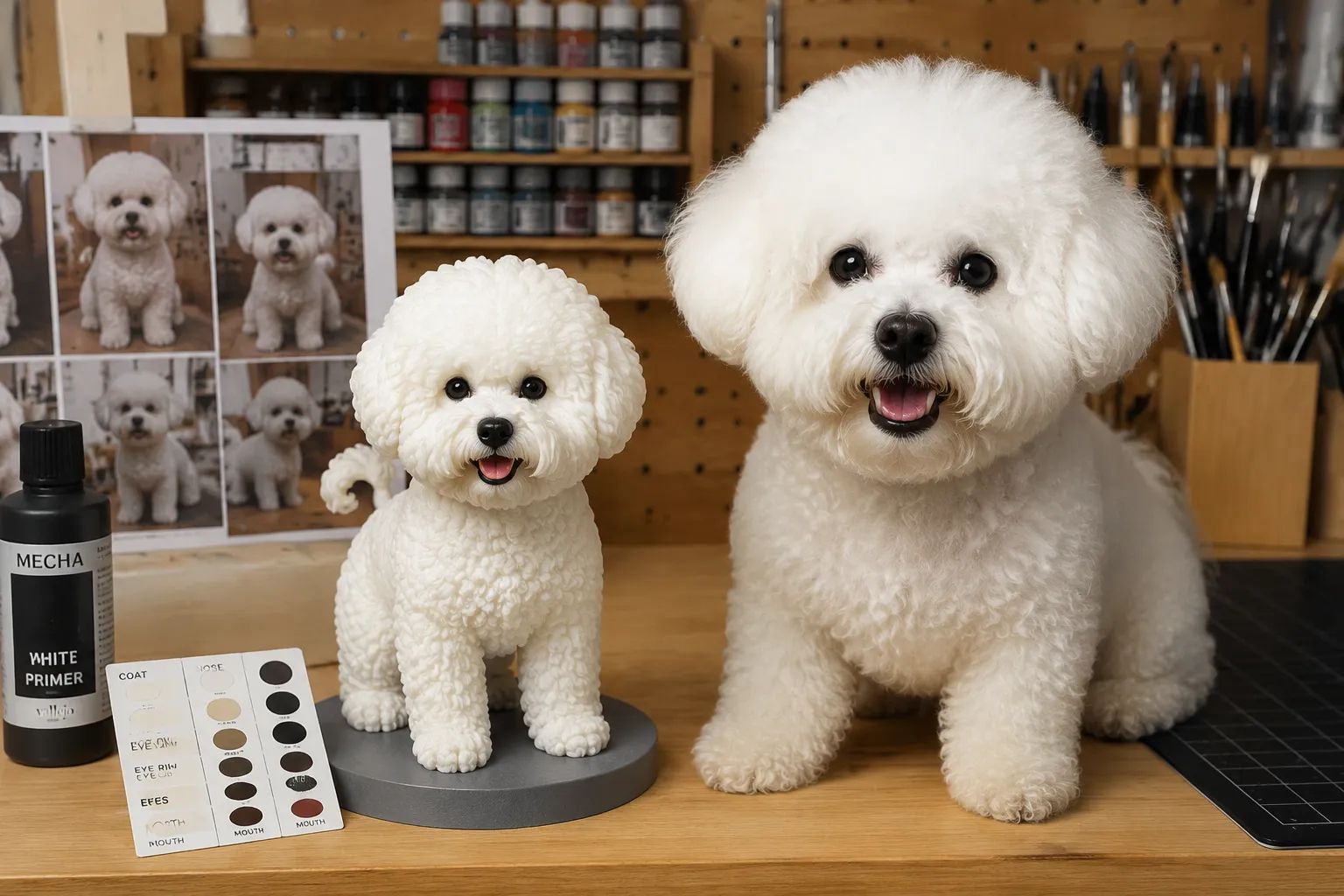
Show-ring rules let a bichon frise's "white" coat carry shadings of buff, cream, or apricot around the ears — which is exactly why a bichon frise figurine finished in flat, chalky white always looks a little dead. On a beach at dusk, that same coat catches the low light and glows faintly pink.
Quick Takeaways
- A bichon's coat is off-white, not white — capturing the warm undertones is what makes it read as real.
- Curl is about light, not just shape — the corkscrew texture scatters light and softens every edge.
- Photos beat descriptions every time — soft, indirect light in the late afternoon shows true coat color best.
- Color lives inside the material, not on top — our full-color resin 3D printing prints pigment into the resin itself, so it won't chip off a curl.
- Ask to see a digital preview before printing — this is where coat tone and curl flow get dialed in.
The Quiet Cruelty of the Color "White"
Here's a thing that took us years of digital sculpting to really understand: white is the hardest color there is.
Not because it's complicated. Because it isn't. Pure white has nowhere to hide. Every shadow, every dip, every strand of fur has to do the work of describing the form, because the color itself refuses to help. Give a sculptor a black lab and the deep tones forgive a lot. Give them a bichon frise and there's nowhere to fake it.
And a bichon isn't even white. That's the trick most people miss.
If you've lived with one, you already know this in your hands before you know it in your head. You've buried your face in that coat — that clean, slightly powdery smell, a little like warm cotton and the faint sweetness of a dog who was just outside in the cold. And you've noticed, maybe without ever saying it out loud, that the fur near the ears runs warmer. Creamier. A whisper of apricot that the light finds at certain hours and loses at others.
"A bichon isn't white. It's a hundred shades of almost-white, and the love is in the almost."
The American Kennel Club breed standard actually accounts for this. It permits shadings of buff, cream, or apricot on the ears and body — up to a point. So when a bichon frise figurine comes out looking like a bar of soap, it isn't just a color miss. It's a failure to see the dog the way you saw the dog.
That's the whole game. Seeing the almost.
Why Curly Coats Break Most Attempts at a Faithful Finish
Let's talk about the curl, because this is where a lot of well-meaning keepsakes fall apart.
A bichon's coat is a double coat — a soft, dense undercoat beneath a coarser outer coat that grows in that signature loose corkscrew. Groomers scissor it into that rounded, powder-puff silhouette. But under the shape, the surface is doing something wild. It's a landscape of tiny curls, each one catching and throwing light in a slightly different direction.
Here's the counterintuitive part. Curl isn't really about shape. It's about light.
Most people assume that to capture a curly coat you need to model every single curl. You don't. You couldn't — not at figurine scale, not without the thing turning into a fragile mess of hair-thin spikes that snap the first time a kid picks it up. What you're actually capturing is how the curl behaves with light. The soft scatter. The way no edge is ever truly sharp on a bichon. The way the coat reads as a cloud more than a texture.
The failure mode: too much detail
We've seen it plenty. A hyper-detailed sculpt where every curl is individually modeled, razor-sharp, and technically impressive. On screen it looks incredible. As a physical object it looks like a sea urchin, and it feels brittle because all those thin peaks are stress risers waiting to chip.
The mistake most people make is chasing detail when they should be chasing behavior. A great bichon sculpt suggests thousands of curls through rhythm and flow — clusters, directional sweeps, the way the coat parts over the shoulders — rather than counting them out one by one.
"You don't sculpt every curl. You sculpt the way the curls remember the light."
Coat flow is anatomy in disguise
The second thing curls do is hide the dog. Under all that fluff there's a small, sturdy little body with real structure — the set of the shoulders, the tuck of the waist, the way the neck carries the head. A good digital sculptor builds the anatomy first, then grows the coat over it, so the fluff sits on a real animal instead of floating like a shapeless pom-pom.
When a bichon figurine looks "off" but you can't say why, this is usually it. The coat is fine. The dog underneath got lost.
From Photo to Sculpt: Capturing Unusual Coat Colors in Resin
This is the part pet parents have the most control over, so pay attention here. The single biggest factor in capturing unusual coat colors in resin isn't the technology. It's your reference photos.
We say this constantly, and we mean it: a great photo can rescue an average sculpt, and a bad photo can sink a brilliant one.
What actually happens when a photo comes in
When your images land with our team, a master 3D artist opens them the way a portrait painter would study a face. They're reading proportions first — head-to-body ratio, leg length, the specific roundness of your dog's trim. Then coat flow: where the fur parts, which way it sweeps, where it bunches. Then, last, color.
Color comes last for a reason. Because color, in a photo, lies.
Your phone camera is constantly "correcting" white. Point it at a bichon and the auto white-balance panics — it sees all that bright coat and tries to neutralize it, often draining out exactly the warm cream and apricot tones that make your dog look like your dog. Shoot near a blue-ish north-facing window and the coat goes cold and gray. Shoot under a warm kitchen bulb and suddenly your bichon is beige.
So here's the practical fix.
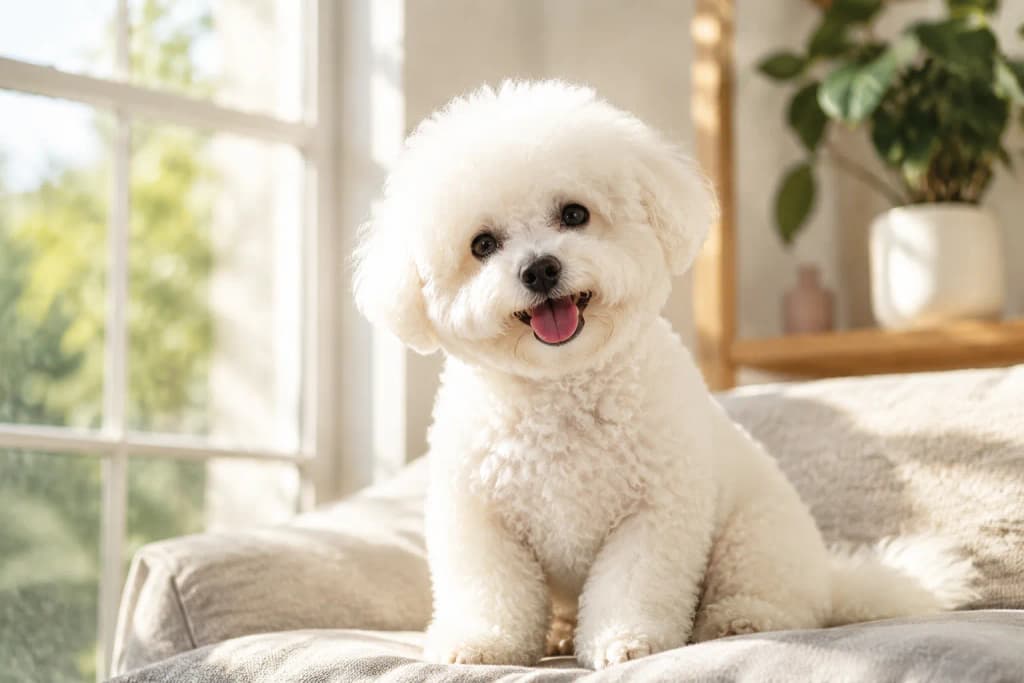
The best bichon photos are taken outdoors, in soft, indirect light, in the hour or two before sunset. Not direct sun (blows out the highlights and erases the curl). Not deep shade (goes muddy and blue). That soft, warm, low-angle light is the one moment your camera and your eye agree on what color your dog actually is.
Here's a quick reference for what we're looking for.
| Photo Element | What Works | What Hurts |
|---|---|---|
| Lighting | Soft, indirect, late afternoon | Harsh midday sun or dim indoor bulbs |
| Angles | 4–6 shots: front, both sides, 3/4, top | A single straight-on snapshot |
| Distance | Close enough to see curl texture | Far-away shots where the coat blurs |
| Color truth | One shot near a neutral gray or white object | Photos heavily filtered or edited |
| Expression | The face they actually make at you | A stiff, unnatural "sit" pose |
That neutral-object trick is one insiders lean on. Set a plain white sheet of paper or a gray card in one of the shots. It gives our artists a reference point to correct your camera's white-balance guesswork and pull the true coat tone back out. Small thing. Big difference.
The "So what?" of good reference
Because here's what it protects: the specificity. The reason you want a figurine of your bichon and not a generic one is the specific stuff — the slightly lopsided ear, the tea-stain shadow under one eye, the way the fur on the chest grows a hair longer. That lives in your photos or it lives nowhere.
"The camera flattens. Your memory doesn't. Good reference photos are how we translate one into the other."
Digital sculpting, in plain English
Once the references are set, the artist digitally sculpts your dog in 3D software — think of it as building the dog out of virtual clay on a screen, pushing and pulling a digital surface, rotating it in space, checking it from every angle. Nothing physical is carved or shaped by hand at this stage. It's modeling, entirely in the computer.
They block in the body, refine the proportions against your photos, then build the coat flow curl by curl in pattern — sweeping fields of texture rather than isolated strands. Color gets applied as a digital "paint" onto the model's surface data (this is texture-mapping, not physical paint), so the software knows that the ears should run warm apricot while the back stays cooler cream.
Then that full-color digital file — geometry plus color, baked together — goes to the printer.
Inside the Print: How Full-Color Resin Holds a Bichon's Ivory
Now the shop-floor part. This is where the real difference lives, and it's worth understanding because it changes what you should expect to receive.
PawSculpt uses full-color resin 3D printing. The key idea, and the thing that separates it from the figurines you grew up with: the color is printed directly into the resin, voxel by voxel. A voxel is just a 3D pixel — a tiny cube of material. The printer lays down the object one microscopic droplet at a time, and each droplet already carries its own color. Cream here, apricot there, a warm shadow tone in the crease of an ear.
So there's no coat of paint sitting on the surface waiting to chip. The ivory of your bichon isn't on the figurine. It is the figurine, all the way through the material at that spot.
That matters for a white dog more than almost any other. On a hand-finished piece, white is where flaws scream loudest — a slightly uneven layer, a smudge, a thin spot. When the pigment is embedded in a UV-cured photopolymer resin and locked in the moment it's laid down, you get a consistent, luminous off-white that doesn't go blotchy the way a surface layer can.
Layer height, and why it's a tradeoff
The printer builds in layers. Typical full-color work often lands in the 25–50 micron range per layer (a micron is a thousandth of a millimeter — for scale, a human hair is roughly 70 microns thick). Thinner layers mean smoother curves and finer curl definition. But thinner also means slower and, past a point, more fragile.
This is the constant tug-of-war in our world: detail versus durability. Push resolution too hard and you get gorgeous, delicate features that don't survive a real household. Back off too far and the curl texture goes soft and generic. The sweet spot is a piece that reads crisp at arm's length and still feels solid in your palm.
Orientation and supports: the invisible decisions
Before printing, someone decides how to orient your dog in the machine — nose up, lying on its side, tilted. This isn't arbitrary. Orientation affects three things at once:
- Surface quality — the down-facing surfaces and any overhangs need temporary support structures (little scaffolds that hold up parts that would otherwise sag mid-print).
- Support scars — wherever a support touches the model, it leaves a tiny mark when removed. Good orientation hides these in low-visibility zones (under the belly, inside the legs) rather than across the face or the top of the coat.
- Strength — thin points like tails and ear tips are oriented to avoid becoming weak seams.
An experienced operator will tuck the support contact points where you'll never look, so the visible curl surfaces come off clean.
Hollowing, drain holes, and warping
Larger pieces often get hollowed — printed with an empty interior instead of a solid block. Two reasons: it saves material, and, more importantly, a big solid mass of resin can build internal stress as it cures and warp (bend or twist slightly out of true). Hollow walls cure more evenly.
Hollowing needs drain holes — small openings, usually hidden underneath, that let uncured liquid resin escape from the inside. Skip them and you get trapped resin that never fully hardens, or worse, a sealed pocket that can crack later. It's the kind of unglamorous detail that separates a piece that lasts from one that fails in a year.
Post-processing: washing, curing, and the one manual step
Fresh off the printer, the piece is cleaned to remove residual uncured resin, then cured under UV light to bring the photopolymer to full hardness. Cure it too little and the surface stays slightly tacky and soft. Cure it too much and resin can grow brittle or develop a faint surface haze we call bloom. There's a window, and hitting it is craft.
Supports come off, and any contact points get gently sanded smooth. Then comes the single manual finishing step in the whole process: a clear coat. A thin protective varnish that seals the surface, adds UV resistance so the color stays true over years, and lets us tune the sheen.
That last part is a small secret for bichons specifically. A bichon's coat isn't glossy — it's soft and matte with just a faint sheen where the curls catch light. So a high-gloss clear coat would fight the whole illusion and make the dog look wet or plastic. A satin-to-matte clear coat is what keeps that powdery, cloud-like quality intact.
Quality control under raking light
Before anything ships, it gets inspected. Dimensional checks against the model. Symmetry checks — ears level, eyes even, legs matched. And a surface inspection under raking light: a lamp held low and to the side so light skims across the surface at a shallow angle. Raking light is brutal and wonderful. It exposes every tiny support pitting mark, layer inconsistency, or dust speck that straight-on light would hide.
For a white dog, this step is non-negotiable. Off-white shows everything, so off-white gets looked at hardest.
"Every whisker tells a story. Our job is to capture the ones that matter most — even the crooked ones."
— The PawSculpt Team
Myth vs. Reality: What Pet Parents Get Wrong About Coat Color
We hear the same assumptions over and over. A few worth clearing up, because they change what you ask for and what you expect.
Myth #1: "My dog is white, so just make it white."
Reality: Print a bichon in true white and it looks fake — like a toy, not a dog. The warm cream and apricot undertones, and the soft shadows in the coat, are what your brain uses to recognize a real animal. Flat white removes exactly the information that says alive.
Myth #2: "The figurine gets painted after it's printed."
Reality: Not in full-color 3D printing. The color is embedded in the resin during printing, droplet by droplet. There's no painting step and no paint layer to chip. The only thing added afterward is a clear protective coat.
Myth #3: "More detail is always better."
Reality: Past a point, more detail makes a bichon worse — brittle, spiky, and oddly artificial. The coat is supposed to look soft. Restraint in the curl texture is what makes it read as fluff instead of wire.
That second one surprises people the most. We grew up with figurines that were molded and then finished by hand, so the assumption that someone sits there with a brush is deeply baked in. Here, the machine lays the color down as it builds the form. Different craft entirely.
What to Expect When You Order a Bichon Frise Figurine
Let's walk through the actual journey, minus the specifics that change over time (for current turnaround, revision details, and guarantees, check the details on the custom pet figurine site directly — we won't quote numbers here that might be outdated by the time you read this).
The rough shape of it looks like this.
| Stage | What Happens | What You Do |
|---|---|---|
| Photo review | Artists study proportions, coat flow, color | Send your best 4–6 reference shots |
| Digital sculpt | Your dog is modeled in 3D software | Wait for the first preview |
| Digital preview | You see the model before it prints | Request adjustments to coat, pose, tone |
| Full-color print | The approved file prints in color resin | Nothing — this is our part |
| Post-processing | Cure, support removal, clear coat, QC | Nothing |
| Delivery | The finished piece ships to you | Unbox somewhere quiet |
The preview stage is where you actually win or lose
Here's insider advice most people skip past: the digital preview is the moment that matters most, and it's the one people rush.
Slow down there. This is where you look at the coat tone and say "warmer around the ears" or "her trim was rounder than that." This is where the pose gets tweaked — the specific tilt of the head your dog does when you say her name. Once it prints, it prints. The preview is your leverage, so use it.
We remember one order — a senior bichon named for a jazz singer — where the family kept coming back to the eyes in the preview. Not the coat, not the pose. The eyes. They finally sent one more photo, an old one, the dog mid-yawn on a sunny floor, and there it was: a particular softness they'd been trying to describe. We adjusted, and the mom wrote back that she cried when she opened the box. Not sad crying. The other kind.
That's the preview doing its job.
Living pet or memorial — the approach shifts
Most bichon figurines fall into one of two camps, and honestly the emotional weight is different.
For a living dog — a birthday, a "just because," a way to hold onto this exact age before the muzzle goes gray — people tend to want energy. The play-bow. The mid-trot bounce. Capture the personality that's right in front of you and changing every month.
For a memorial, it's quieter and more specific. Families almost always fixate on one detail — the particular way the ears sat, a scar, the color of the coat in a certain light. That one detail is the anchor. Grief needs somewhere to land, and a physical object gives it a place.
"A keepsake doesn't bring them back. It gives your hands somewhere to go when they reach for the dog that isn't there."
The Smell of a Coat, and Why We Keep a Figurine at All
Let me sit with something for a moment, because it's the real reason any of this matters.
You will forget the sound of the nails on the floor before you forget the smell. That's how memory works with dogs. The visual fades slowly, the sound fades faster, but the smell — the warm-bread, sun-on-fur, faintly-earthy smell of a bichon who just came in from the yard — that one ambushes you. Years later. A stranger's dog on a beach walks past and suddenly you're undone, standing there in the wind because the wind carried something.
We can't print that. Nobody can. A figurine will never smell like the blanket in the crate, the one you can't bring yourself to wash.
But here's what it can do. It can sit on the shelf and hold the shape of the memory steady, so that when the smell ambushes you, you have somewhere to look. The Japanese have that phrase, mono no aware — the tender ache of knowing that everything you love is temporary. Every dog owner lives inside that phrase whether they have a word for it or not. You knew, from the day you brought the puppy home, roughly how the story ends. You signed up anyway. That's the bravest ordinary thing people do.
A figurine is a small argument against forgetting. Not a denial of loss — an answer to it. Something with weight and edges that says: this one was here, this one was specific, this one mattered, and here is the exact tilt of her head to prove it.
That's why we obsess over the off-white. Get the color wrong and it's a generic little dog. Get it right — the cream, the apricot at the ears, the soft matte cloud of the curls — and it's her. The difference between those two things is the whole point of the work.
A Few Practical Care Notes
Once your piece arrives, it asks almost nothing of you. But a few things help it last.
- Keep it out of long, direct sunlight. The clear coat has UV resistance, but no material loves years of harsh sun. A shelf that gets bright but not blazing is ideal.
- Dust with a soft, dry brush or microfiber cloth. The curl texture catches dust in its low points. A soft brush gets in there without scratching.
- Skip household cleaners and solvents. They can dull or cloud the clear coat. If you must, a barely-damp cloth and then dry immediately.
- Handle by the body, not the thin bits. Ear tips and tails are the delicate points on any dog sculpt. Lift from the sturdy middle.
None of this is fussy. Treat it like a nice ceramic and it'll outlast the shelf it sits on.
When a Figurine Isn't the Right Answer
We'll be real with you, because trust matters more than a sale.
A figurine isn't for everyone, and it isn't the only way to hold onto a dog. Some families do better with a photo book they can flip through. Some plant a tree and watch it grow across seasons. Some frame the collar. Some do a paw-print casting because it's the actual physical trace of the actual dog. The Association for Pet Loss and Bereavement has good, gentle resources if you're in the thick of grief and not sure what you need yet.
A sculpture is for the person who wants to see the dog — the whole silhouette, the pose, the personality in three dimensions — sitting in the room with them. If that's you, it's a deeply good choice. If it's not, there's no wrong way to remember someone you loved. Pick the thing your hands and your eyes actually want.
That honesty is part of the craft too.
Frequently Asked Questions
Why does my bichon frise figurine look too white?
Because a real bichon isn't actually white. The breed's coat carries warm cream and apricot undertones, especially around the ears, plus soft shadows throughout the curl. When those are stripped out for a flat, pure white, your brain reads it as a toy instead of your dog. Capturing the "almost-white" is what makes it look alive.
Are PawSculpt figurines hand-painted?
No. We use full-color 3D printing, where the color is embedded into the resin itself as the piece is built, one tiny colored droplet at a time. There are no brushes and no paint layer that can chip. The only manual finishing step is a thin clear protective coat, which also lets us tune the sheen to that soft, matte bichon look.
What photos give the best result for capturing unusual coat colors in resin?
Shoot outdoors in soft, indirect light an hour or two before sunset — not harsh sun, not deep shade. Send 4 to 6 angles: front, both sides, three-quarter, and top-down. And include one shot with a plain white or gray object in frame. That reference lets our artists undo your camera's white-balance guesswork and recover the true coat tone.
How do you get a curly coat pet sculpt finish that actually looks soft?
By sculpting behavior, not strands. Our artists build the curl as flowing patterns and directional sweeps rather than modeling thousands of individual corkscrews, which would look spiky and brittle. The texture is then printed directly into the resin and sealed with a satin-to-matte clear coat, so the coat reads like a soft cloud rather than wire.
How long does a custom figurine take, and can I make changes?
Timelines and revision details shift over time, so we'd rather point you to the current specifics than quote something that goes stale. Visit pawsculpt.com for up-to-date turnaround and revision info. The one thing we'll say: use the digital preview stage fully — that's where coat tone, pose, and those tiny personal details get dialed in before anything prints.
Can you capture a dog that has passed away?
Yes, and it's a lot of what we do. Older photos work fine as long as they show the coat and face clearly. Families usually center a memorial piece on one specific detail — the tilt of the head, a particular expression, the coat in a certain light. Tell us what that anchor is, and we'll build toward it.
Ready to Celebrate Your Pet?
Every pet has a story worth preserving. Whether you're honoring a beloved companion who's crossed the rainbow bridge or celebrating your bichon's bouncy, curly-coated personality right now, a custom PawSculpt bichon frise figurine captures the off-white warmth, the soft curl, and the specific tilt of the head that make your dog unmistakably yours — printed in full color, all the way through the resin.
Visit pawsculpt.com to learn more about our full-color 3D printing process, preview stage, and quality guarantee