How Long Does a Custom Boxer Figurine Take? A Prosumer's Sculpt-to-Doorstep Timeline
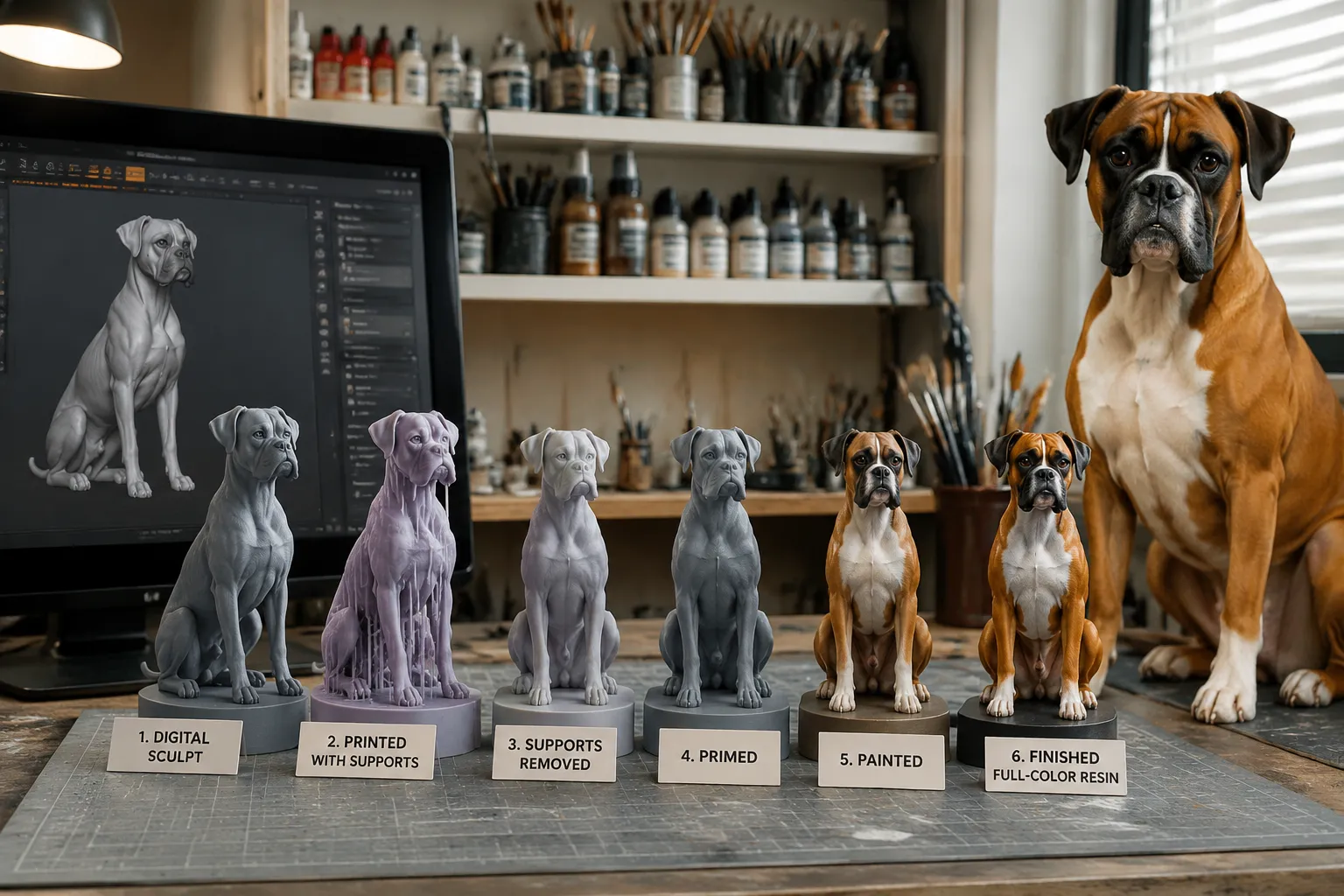
You're wiping resin dust off the garage workbench when the finished Boxer catches the light—that brindle stripe printed right into the material, not brushed on top. That's where a custom Boxer figurine timeline actually ends. Let me walk you back to where it starts.
Quick Takeaways
- The printer isn't your bottleneck — your photos and approval speed decide most of the timeline.
- Boxers are deceptively hard — jowls, underbite, and brindle patterning eat sculpt hours.
- Full-color 3D printing bakes color into the resin — there's no drying paint to wait on.
- Curing and clear coat are the quiet time-sinks — good shops don't rush the finish.
- See how the stages actually break down by exploring the custom pet figurine process before you order.
Why the Timeline Isn't What You Think
Here's the thing nobody tells you when you ask "how long does a pet figurine take": the machine is rarely the slow part.
We've watched hundreds of Boxer commissions move through the studio, and the pattern repeats almost every time. People assume the wait is technical—that some printer is chugging away for weeks. It isn't. The print itself, once we hit "go," is usually the shortest chapter of the whole story.
The real clock runs on decisions. Yours and ours.
Think about it like building a house. The framing goes up fast once the blueprints are locked. But the blueprints? That's where weeks disappear—the back-and-forth, the "can we move this wall," the "actually the ears sit higher than that." A custom Boxer figurine timeline lives almost entirely in that blueprint phase, which in our world means the digital sculpt.
"The printer takes hours. The likeness takes days. The decision to approve it takes the longest of all."
And there's a psychological reason approval takes so long, especially for memorial pieces. When you're looking at a sculpt of a dog you love—or a dog you've lost—you're not evaluating a product. You're checking whether it feels like them. That's a much harder question than "is this accurate." Your brain is running the sculpt against an emotional memory, and emotional memories don't come with reference dimensions.
The counterintuitive part: the customers who get their figurine fastest aren't the ones who accept the first sculpt blindly. They're the ones who send great photos up front and give clear, specific feedback. Vague notes like "something's off around the face" send everyone back to guessing. Precise notes like "the lower jaw juts out about 20% more than that, and the left ear folds forward" close the loop in one round.
So before we even talk stages, internalize this: you are part of the timeline. Not a passive recipient of it.
The Photo-to-Sculpt Stage: Where Days Are Won or Lost
Everything downstream depends on what you hand us at the start. This is the single biggest lever you control, and most people fumble it without realizing.
A customer once sent us fourteen photos of their Boxer, Nova. Beautiful dog. Problem was, thirteen of them were shot from above, phone pointing down at a dog looking up with those big pleading eyes. Adorable. Useless for sculpting. That angle foreshortens the muzzle and hides the actual proportions of the head. We had exactly one usable side profile, and we built the whole first pass off it.
What our sculptors actually need
When our master 3D artists sit down to digitally sculpt your Boxer—hand-modeling the geometry in software like ZBrush or Blender before anything gets printed—they're reconstructing a three-dimensional animal from flat images. The more angles, the more accurate the reconstruction.
Here's what genuinely helps, and why:
| Shot | Why It Matters | Common Mistake |
|---|---|---|
| Straight side profile | Locks in muzzle length, skull shape, chest depth | Shooting at a downward angle |
| Front-on, eye level | Captures jowl width, eye spacing, underbite | Dog looking up, distorting proportions |
| Three-quarter angle | Shows how planes of the face transition | Too far away, face is a blur |
| Full standing body | Establishes leg proportion and posture | Only headshots, no body reference |
| Coat/marking close-up | Reveals brindle direction and white placement | Blurry or heavily filtered photos |
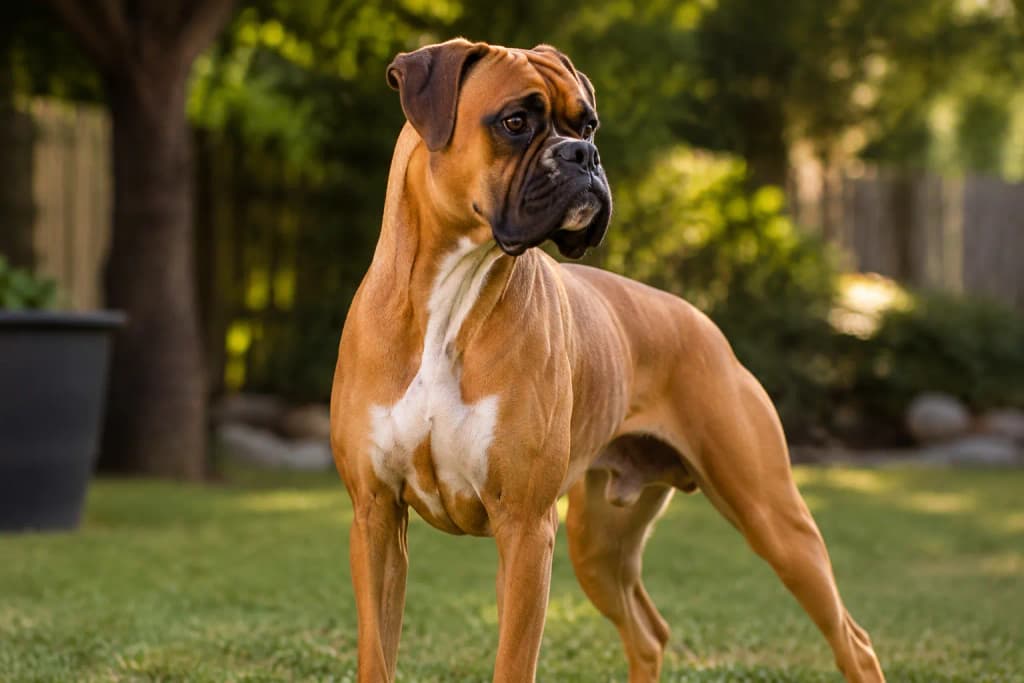
Notice a theme? Eye level. Get down on the floor. A Boxer photographed from a human's standing height always looks slightly wrong in 3D because you've flattened the exact features that make a Boxer a Boxer—the depth of the muzzle, the set of the jaw.
So what? Every hour a sculptor spends guessing at a hidden feature is an hour added to your timeline, and often a revision round added on top. Ten minutes on the floor with your phone can save days.
The Boxer-specific challenge
Let's be real about this breed. Boxers are one of the trickier dogs we model, and it's worth understanding why so you set realistic expectations.
That signature Boxer face—the brachycephalic structure (that's the technical term for the short, pushed-in muzzle) with the undershot jaw—has almost no room for error. Push the underbite too far and it looks like a snarl. Pull it back and you've lost the breed entirely. The jowls have to hang with the right weight. The forehead wrinkles need to read as soft folds, not scars.
Then there's the coat. According to the American Kennel Club's Boxer breed standard, the two main colorings are fawn and brindle, and brindle is where sculptors earn their keep. Brindle isn't a pattern you can fake with a generic texture. Those tiger-like stripes flow with the muscle and the curve of the body—they get denser at the shoulders, stretch thinner across the ribs. In full-color 3D printing, where the color is printed directly into the resin voxel by voxel (a voxel is just a 3D pixel), that striping has to be built into the digital model itself. It's not applied afterward. So the sculptor is essentially mapping your specific dog's specific stripes onto the geometry before anything prints.
This is why a Boxer can take longer at the sculpt stage than, say, a solid-colored Lab. More markings, more decisions, more chances to get it beautifully right or slightly off.
Inside the Print: What Full-Color 3D Printing Actually Does to Time
Okay. Sculpt's approved. Now the part everyone thinks is the whole process—but really isn't.
Let's clear up a myth first, because it comes up constantly. People imagine we print a plain white figurine and then someone sits at a bench coloring it in. That's not what happens. Not even close.
Color lives inside the material
PawSculpt uses full-color resin 3D printing—the same family of technology as PolyJet and MJF-style systems where pigment is deposited as the object builds, layer by microscopic layer. The color isn't a coat on the surface. It's embedded in the UV-cured photopolymer resin itself. That brindle stripe on your Boxer runs through the material, the way a stick of rock candy has the letters running through it.
Why does this matter for your timeline? Because there's no separate coloring stage waiting in the queue. No drying time between colors. The geometry and the color arrive together, in one build.
"We don't add your dog's colors after the fact. The printer lays them down in the same breath as the shape."
Orientation, supports, and the tradeoffs we sweat over
Once the file is ready, the print isn't just "press a button." How we orient your Boxer on the build plate is a genuine craft decision, and it affects both quality and time.
- Orientation determines where support structures attach. Supports are temporary scaffolding that hold up overhanging parts—think of a Boxer's tucked chin or an outstretched paw—so they don't sag while the resin is still soft.
- Wherever a support touches, it leaves a tiny mark when removed. We call these support scars or pitting. The goal is to hide them on the underside or belly, never across the face.
- Get the orientation wrong and you either get scars in visible places or a longer, riskier print. Get it right and cleanup is faster and cleaner.
Layer height is another lever. Finer layers—often in the 25 to 50 micron range (a micron is a thousandth of a millimeter, so we're talking finer than a human hair)—give crisper detail on wrinkles and coat texture, but each layer takes time, so more layers means a longer build. Coarser layers print faster but soften fine detail. For a detail-heavy breed like a Boxer, we lean finer, and we accept the longer build to keep those facial folds sharp.
Hollowing is the last piece. Solid resin is heavy, wastes material, and can trap stress as it cures. So many figurines are printed partially hollow with small drain holes so uncured liquid resin can escape from the inside. Skip the drain holes and you get trapped resin that keeps curing, expands, and can crack the piece weeks later. That's a failure mode we design around, not discover later.
The build itself
The actual print—depending on size, detail, and the specific system—is typically a matter of hours, not weeks. This surprises people every single time. You waited days for the sculpt and the approval, and the physical object forms overnight.
But "printed" doesn't mean "done." Not by a long shot.
Post-Processing and the Clock Nobody Talks About
Here's a chapter that never makes it into the marketing, and honestly it should. What happens after the print is where a rushed shop cuts corners and a good one refuses to.
Pull a freshly printed Boxer off the plate and it's not ready for your shelf. It's tacky. Coated in a film of uncured resin. Still soft in places. The texture at this stage is unmistakable—slightly sticky, cool, a little slick under your fingers, like something pulled from water that hasn't dried.
The steps that actually take time
- Washing. The piece gets cleaned to strip off that uncured resin film. Miss a spot and you get bloom—a hazy, greasy residue that surfaces days later and ruins the finish.
- Curing. This is the one people underestimate. The resin needs controlled UV exposure to reach full hardness. Under-cure it and the figurine stays slightly soft and brittle over time. Over-cure it and the material can grow brittle and yellow-prone. There's a window, and you don't rush the window.
- Support removal and sanding. Those supports come off, and wherever they touched gets carefully sanded smooth. On a Boxer we're especially careful around the jawline and paws—the spots most likely to catch a support.
- Quality control. We inspect under raking light—a light angled low across the surface so every ridge, pit, and asymmetry throws a shadow. It's the same trick furniture makers use to catch flaws you'd never see head-on. We check dimensional accuracy, symmetry of the ears and eyes, and surface cleanliness.
- Clear coat. The only manual finishing step. A protective clear coat goes on to seal the surface, add UV resistance, and give that subtle sheen. It also deepens the printed colors slightly—that brindle looks richer under a good coat.
So what does this mean for your wait? Curing and clear coat can't be microwaved. If a company promises a wildly fast turnaround, ask what they're skipping. Usually it's cure time, and you'll feel it eventually when the piece gets brittle or the finish clouds.
"Every whisker tells a story. Our job is to build the ones that matter right into the resin—not rush them out the door."
— The PawSculpt Team
The texture you end up holding
Let's talk about what your finished Boxer actually feels like, because this is where full-color 3D printing has its own honest character.
Run your thumb across it and you'll feel a faint, fine grain—the ghost of those print layers, softened under the clear coat. It's not glassy-smooth like injection-molded plastic, and that's the point. It has a slight tooth to it, a subtle texture that catches the light and reads as real rather than mass-produced. The weight sits comfortable in your palm—substantial enough to feel like something, light enough thanks to the hollowing that it won't tip a shelf.
People expect cold, hard plastic. What they get is warmer to the touch, a little organic, with colors that sit inside the surface instead of on top of it. That difference is exactly why we use this process.
What to Expect: A Realistic Sculpt-to-Doorstep Journey
I'm not going to hand you a fake "ships in X days" number, because any shop that promises the same timeline for a simple sitting pose and a complex action pose with brindle striping is guessing. What I can do is show you honestly where the time actually goes, so you can plan and push the right levers.
Here's the general shape of the pre-order pet sculpt process, stage by stage:
| Stage | What Happens | Biggest Time Variable |
|---|---|---|
| Photo submission | You send reference images | How complete/clear your photos are |
| Digital sculpting | Artists build the 3D model | Breed complexity, pose, markings |
| Sculpt preview & revisions | You review, request changes | Your response speed & feedback clarity |
| Printing | Full-color resin build | Size and detail level |
| Curing & post-processing | Wash, cure, sand, inspect | Never rushed for quality |
| Clear coat & final QC | Seal, inspect, pack | Minimal, but not zero |
| Shipping | Ships to your door | Your location |
Look at that middle band—sculpting, preview, revisions. That's the fat part of the timeline for almost everyone. The print and finish are more predictable. Shipping is out of everyone's hands to a degree.
For exact current turnaround windows, revision policies, and how their preview stage works, it's worth checking the details on PawSculpt's process page directly, since those specifics evolve and I'd rather you get the real numbers than a stale guess from me.
How to genuinely speed things up
Since you asked how long it takes, the more useful question is "how do I not make it take longer than it has to." Practical moves:
- Send more photos than you think you need, at eye level, in natural daylight. Overcast days are ideal—no harsh shadows hiding the jaw structure.
- Respond to the sculpt preview quickly. A sculpt waiting three weeks for your feedback is three weeks added, flat.
- Batch your feedback. Send all your notes in one clear message instead of trickling "oh, one more thing" over five days.
- Be specific with revisions. Reference the exact feature and the exact photo. "The chest is too narrow compared to photo 4" beats "he looks a little skinny."
- Order early for deadlines. If it's for a birthday or a memorial anniversary, the number one regret we hear is "I wish I'd started sooner." Anticipation stretches time; a rushed order stresses everyone.
There's actual science under that last point. The psychology of anticipatory waiting tells us that time we can't control feels longer and raises low-grade stress—cortisol, the stress hormone, quietly ticks up when we're waiting on something emotionally loaded with a hard deadline looming. Give yourself buffer and the whole experience shifts from anxious to excited. Same wait, completely different feeling in your body.
What We Wish We Knew Sooner
A few candid ones from our side of the bench, the stuff that took us real orders to learn:
- Fawn Boxers photograph deceptively. That warm tan reads totally differently under indoor yellow light versus daylight. We wish we'd asked for daylight photos from day one instead of color-correcting guesses.
- The underbite is emotional, not just anatomical. Owners have strong feelings about their Boxer's specific "chin." Some love a pronounced jut, some want it softened. We learned to ask directly rather than assume the breed standard is what the owner wants.
- People don't know they can request a specific pose. So many customers only realized after the fact that we could have captured their dog's signature head-tilt or that goofy play-bow. Tell us the pose that is your dog. That's the detail that makes people cry when they open the box.
- A great figurine amplifies a mediocre photo's flaws. If the reference is blurry, the sculpt has to interpolate, and interpolation is guesswork. We wish we'd been firmer early on about photo quality instead of trying to be heroes with bad source material.
"The features that make a Boxer a Boxer are the same ones a phone camera flattens. Get on the floor."
Where a Figurine Fits in the Bigger Picture
Let's zoom out for a second, because the timeline question usually hides a bigger one: is this worth it?
For a lot of families, the answer connects to why we hold onto physical objects at all. Attachment theory—the framework psychologists use to explain the bonds we form—doesn't stop applying just because the bond is with a dog. When that relationship is central to your daily life, your brain encodes an enormous amount of sensory memory: the weight of them leaning on your leg, the specific texture of that short Boxer coat, the sound of those jowls flapping on a head shake.
A tangible keepsake gives that memory an anchor in the physical world. There's real cognitive weight to holding something versus scrolling a photo. Your hands remember differently than your eyes.
One family we worked with had lost their Boxer suddenly. The mom told us she'd kept reaching for the leash by the door out of pure habit, weeks after. When the figurine arrived, she said she finally had something to hold in that reaching-hand moment instead of grabbing empty air. That's not a sales story. That's the actual function these objects serve.
For memorials, for birthdays, for celebrating a dog who's very much still around and snoring on your couch right now—a custom figurine is one option among many. Some families do photo books. Some plant a garden. And increasingly, folks choose custom pet figurines precisely because they capture the three-dimensional presence of a pet in a way a flat photo can't. If you're weighing it, the details on their process and guarantees are the place to start.
I'll be straight with you about a tradeoff, too. Resin figurines are durable and built to last, but they're not indestructible—a hard drop onto tile can chip a thin element like an ear tip. That's a downside worth knowing. Keep it off the edge of a shelf where a cat can send it flying, and it'll be around for decades.
"Your hands remember what your eyes forget. That's what a figurine gives back to you."
Frequently Asked Questions
How long does a custom Boxer figurine take?
Honestly, most of the wait isn't the machine—it's the digital sculpt and your approval of it. The physical print is often just hours. The full custom Boxer figurine timeline hinges on how complete your photos are, how detailed the pose and markings are, and how quickly you review and approve the preview. Faster feedback, faster figurine.
Why does the sculpt take longer than the actual printing?
Because the sculpt is where the likeness is built and where every revision round lives. Printing happens once, fast, after everything's locked. The back-and-forth to get your dog's face right—that's the part that stretches, and it's time well spent.
What photos give the best result?
Get on the floor and shoot at your dog's eye level in natural daylight, ideally on an overcast day so harsh shadows don't hide the jaw and muzzle. Send a side profile, a front-on shot, a three-quarter view, and at least one full standing body shot. More good angles mean fewer revision rounds.
Is my figurine hand-painted after it's printed?
No. This is a common assumption, but the color is printed directly into the resin using full-color 3D printing—it runs through the material, not on top of it. The single manual step afterward is a protective clear coat that seals the surface and makes those printed colors pop.
Why are Boxers trickier than other breeds?
That pushed-in muzzle, the undershot jaw, and the hanging jowls leave almost no margin for error, and brindle patterning has to be mapped onto the 3D model to flow with the body. More detail means more careful sculpt work, which can add time compared to a solid-colored breed.
Can I ask for a specific pose?
Absolutely, and you should. A lot of owners don't realize this. If your Boxer has a signature head-tilt, a play-bow, or a particular way of sitting, tell us. That personality detail is usually what turns a nice figurine into one that stops you in your tracks.
Ready to Celebrate Your Pet?
Every pet has a story worth preserving. Whether you're honoring a Boxer who's crossed the rainbow bridge or celebrating the goofy, jowl-flapping companion still leaning on your leg right now, a custom PawSculpt figurine captures the exact details—the underbite, the brindle, the pose that's unmistakably them—printed right into full-color resin.
Now that you understand how the custom Boxer figurine timeline really works, the best move is simple: gather your daylight, eye-level photos and get the sculpt started early, especially if there's a date attached.
Visit pawsculpt.com to learn more about their process, preview stage, revisions, and quality guarantee.