
Will It Really Look Like My Poodle? A Beginner's Guide to Displaying a Curly-Coat Sculpt
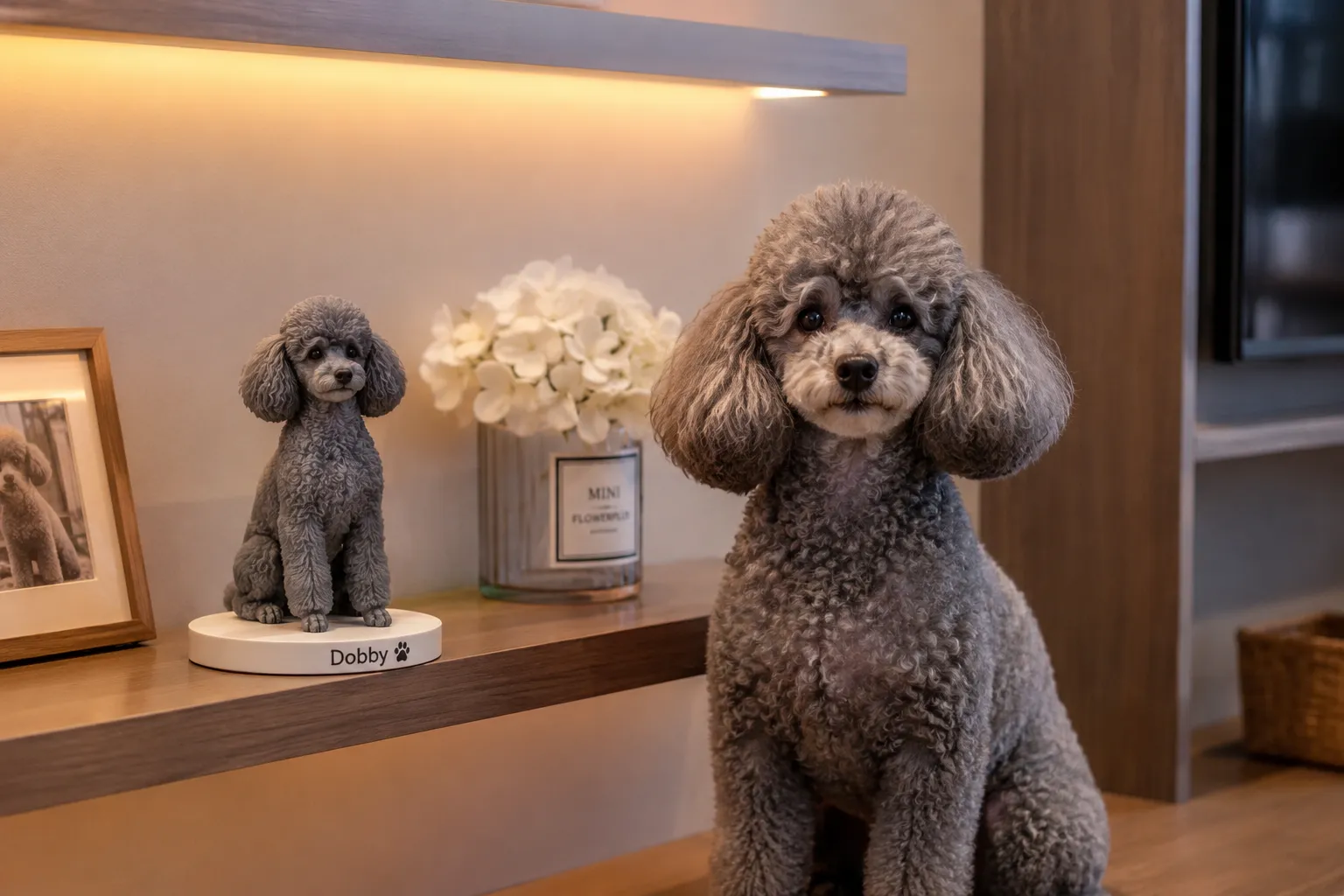
You're standing in the garden at golden hour, your poodle's silver curls glowing like spun wool, and one question keeps circling: will a figurine really look like my dog, or just a fluffy, generic approximation of one? It's a fair worry. Curly coats are the hardest thing in this whole craft to get right.
Quick Takeaways
- Curly coats read as pattern, not strands — a good sculpt captures curl clusters and coat flow, not individual hairs.
- Your reference photos decide 70% of the outcome — flat, even lighting beats dramatic lighting every single time.
- Display lighting can make or break the likeness — the same sculpt looks like your dog or a stranger depending on the light.
- Full-color 3D printing bakes color into the resin, so the markings won't chip or flake like a painted surface would — see how the custom pet figurine process works before you order.
Why a Curly Coat Is the Hardest Assignment in This Whole Craft
Here's the thing most guides skip: not all coats are created equal. A short-haired Lab is, honestly, an easy day at the shop. Smooth planes, clear muscle definition, light that behaves predictably. A poodle? A poodle is a puzzle box.
The reason comes down to how light and geometry interact. A curly coat isn't a surface — it's thousands of tiny overlapping curved forms, each catching and scattering light in a different direction. Your eye reads that chaos as "fluffy" and "soft." A camera reads it as noise. And a 3D sculptor has to translate that noise into something a printer can actually build.
Let me break down why that matters, because it changes what you should expect and how you should judge the result.
Curly coats hide the body. With a short-coat breed, the sculptor works from clear anatomical landmarks — the shoulder, the tuck of the waist, the line of the spine. On a groomed poodle, all of that is buried under curl. So the artist has to infer the body underneath from the way the coat drapes and bunches. Get that wrong and the figurine looks like a cloud wearing a collar.
Curls read as texture, not strands. This is the single biggest mindset shift. When you picture your poodle, you think you're seeing individual hairs. You're not. You're seeing curl clusters — little rosettes and waves that group together in a rhythm across the body. A skilled digital sculpt captures the rhythm and flow of those clusters. It does not try to model every hair, because that's neither possible nor, frankly, convincing at figurine scale.
"A curly coat isn't detail you add. It's a language you learn to read — the flow, the clumping, the way light pools in the valleys."
Groom style is basically a second identity. A poodle in a puppy clip and the same poodle in a continental show clip look like two different dogs. So before anything else, decide which version of your dog you want immortalized. We've had families realize halfway through that the photos they loved were from a groom their dog hasn't worn in two years.
So what? So the likeness of a curly-coat resin sculpt lives or dies on decisions made before a single layer is printed. The technology is remarkable, but it's answering the question you ask it. Ask a vague question, get a vague poodle.
From Photo to Full-Color Print: What's Actually Happening Behind the Scenes
People imagine a machine scans a photo and spits out a dog. That's not it. Let me walk you through the real workflow, because understanding it tells you exactly where things can go right or wrong.
Step 1: Digital Sculpting (The Part That Takes Real Skill)
A master 3D artist opens software like ZBrush or Blender and starts building your dog from scratch — digitally. Think of it like sculpting with light and math instead of clay. They pull, push, and carve a 3D model on screen using your photos as reference.
This is where the human expertise lives. The artist does proportional checks (is the head-to-body ratio right?), anatomy checks (does the leg bend where a real leg bends?), and coat-flow mapping (which way do the curls travel across the chest, the topline, the ears?). For a poodle, that coat-flow map is the whole game.
The output is a purely digital file. Nothing physical exists yet. And this is the stage where a preview matters most — you can catch a wrong ear set or a too-long muzzle before it's ever printed.
Step 2: Full-Color 3D Printing (Where the Magic Gets Physical)
Now here's the part that separates PawSculpt's approach from the resin figurines you might've seen elsewhere.
A lot of resin printing you'll read about online is single-color SLA, MSLA, or DLP — those machines cure liquid resin one layer at a time with a laser or UV light, and everything comes out one solid color (usually gray or beige). That model then has to be colored somehow afterward.
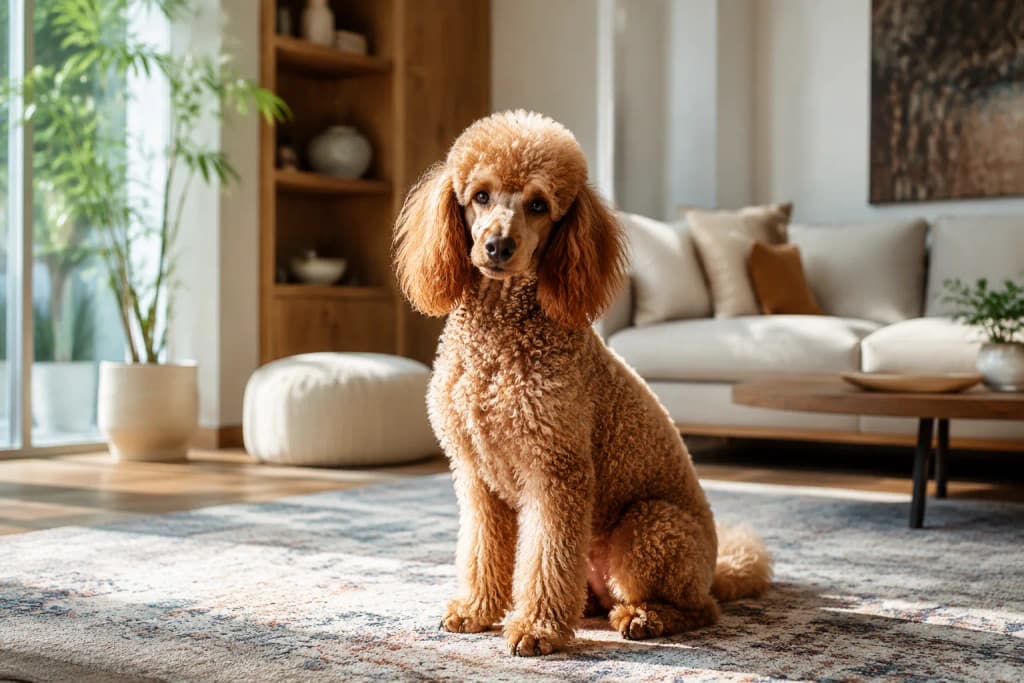
We don't work that way. PawSculpt uses full-color 3D printing — a PolyJet/MJF-style technology where color is deposited voxel by voxel (a voxel is just a 3D pixel — a tiny colored dot of material). The printer lays down UV-cured photopolymer resin with the pigment already embedded inside it. Your dog's apricot fur, the black nose, the amber eyes — those colors are printed into the material as it's built, not added on top later.
"The color isn't a coat of anything. It's baked into the resin itself, the way color runs all the way through a marble, not just across its surface."
Why does this matter to you, practically? Because color that's part of the material can't chip, peel, or scratch off the way a surface layer can. There are no brushes involved anywhere in this process, no acrylics drying overnight, no touch-ups. The machine builds the form and the color simultaneously.
Step 3: Post-Processing (Cleaning, Curing, and the Clear Coat)
Straight off the printer, a model isn't ready. It's covered in uncured resin residue and support structures — little scaffolding the printer builds to hold up overhangs like ears and tails while printing. Here's the sequence:
- Washing removes the sticky uncured resin from the surface.
- Curing finishes hardening the resin under controlled UV light, so it reaches full strength.
- Support removal takes off that scaffolding, followed by light sanding of the contact points where supports touched the model (those leave tiny marks called support scars or pitting).
- Clear coat application — the one and only manual finishing step. A protective varnish that adds UV resistance, a subtle sheen, and a barrier against dust and handling oils.
That clear coat is doing more work than it gets credit for. It unifies the surface, deepens the colors slightly (dry resin can look a touch chalky), and protects the piece for the long haul.
Here's a quick map of the whole journey so you can see where your input actually moves the needle:
| Stage | What Happens | Where You Have Influence |
|---|---|---|
| Reference & consult | You submit photos, pick a pose and groom style | Huge — this sets the entire direction |
| Digital sculpting | Artist builds the 3D model, maps coat flow | High — via preview feedback and revisions |
| Full-color printing | Voxel-by-voxel resin print with embedded color | None — it's executing the approved sculpt |
| Post-processing | Wash, cure, support removal, clear coat | Low — but affects final finish quality |
| Quality control | Dimensional, symmetry, and surface checks | None — but it's your safety net |
The Photos That Make or Break Your Poodle Sculpt
If you take one thing from this entire post, make it this section. Your photos are the raw material. A brilliant sculptor working from bad photos is a chef cooking with spoiled ingredients — skill can only stretch so far.
We had a family send us fourteen gorgeous, moody photos of their black standard poodle. Every single one was backlit against a sunset. Beautiful for Instagram. Nearly useless for a sculpt, because we couldn't see a single curl on the coat — just a black silhouette. The sculptor spent more time asking for new photos than sculpting.
So let's get practical. Here's what actually works.
Lighting Beats Everything
Flat, even, bright light is your best friend. Overcast daylight is ideal — it wraps around the dog and reveals coat texture without harsh shadows. Direct midday sun does the opposite; it blows out the highlights and crushes the curls into black holes.
Why does this matter so much for a curly coat specifically? Because the sculptor needs to see the depth of the curls — where they pile up, where they lie flat, where the valleys fall between clusters. Harsh light erases that information. Soft light hands it over on a plate.
Avoid colored light, too. Golden-hour warmth is gorgeous but it lies about your dog's actual coat color. An apricot poodle under sunset light photographs almost red. The sculptor then has to guess the true color, and guessing is where likeness goes to die.
Angles: You Need More Than a Headshot
One photo is never enough. Curly coats hide the body, remember — so the artist needs to triangulate the true shape from multiple views. Here's the coverage that gives a sculptor everything they need.
| Shot | Best For | Common Mistake |
|---|---|---|
| Straight-on side profile | Overall proportions, topline, tail set | Dog turning head, throwing off the body line |
| Front-on face | Eye spacing, ear set, muzzle width | Shot from above, distorting the head shape |
| Three-quarter view | How the coat flows around volumes | Too far away, losing curl detail |
| Close-up of the coat | Curl size and pattern for texture reference | Blurry — must be sharp and well-lit |
| Full standing body | Leg length, stance, posture | Legs cut off or dog sitting when you want standing |
Shoot at your dog's eye level. Phone-height-looking-down is the most common error we see. It makes the head look huge and the body look stubby — the "big head" distortion. Get down on the floor. Your knees will complain; the sculpt will thank you.
Prioritize sharp over pretty. A slightly boring, perfectly-focused photo in good light beats an artsy blurry one every time. The camera on a modern phone is more than enough — you don't need a fancy setup. You need light and focus.
One counterintuitive tip: a recent grooming photo is worth more than your all-time favorite photo. People send us the heart-melting shot from three years ago. But if your dog's coat, weight, or groom has changed since, that photo works against the likeness. If you want the sculpt to match the dog you cuddle today, photograph the dog you cuddle today.
"Every whisker tells a story. Our job is to read the flow of the coat and translate it into something you can hold."
— The PawSculpt Team
So, Will the Figurine Really Look Like Your Dog?
Let's answer the headline honestly, because you deserve a straight answer instead of a sales pitch.
Yes — but you need the right mental model for "looks like." The question "will this figurine look like my dog" hides a trap, because people are secretly comparing it to a photograph. A figurine is not a photo. It's a physical object in three dimensions, and it plays by different rules.
Here's the framework we use to set expectations, broken into what the technology nails and what it interprets.
What a full-color resin sculpt reproduces faithfully:
- Color and markings — because the pigment is printed into the resin, your dog's specific coat colors and patches come through vividly and accurately.
- Proportion and pose — the digital sculpt can match your dog's build, stance, and signature posture.
- Signature features — the set of the ears, the shape of the muzzle, the expression in the eyes. These are the "that's him" details.
What it interprets rather than copies:
- Individual hairs — as covered, curly coats are built as clusters and flow, not strand-by-strand. At figurine scale, that's actually more convincing.
- Softness — resin is a hard material. It can look soft through clever texturing and light, but it will never feel like fur. That's physics, not a shortcoming.
- Micro-texture — full-color 3D prints have a fine natural grain from the layered build process, often at layer heights in the 25–50 micron range (a micron is a thousandth of a millimeter — thinner than a human hair). Under a magnifying glass you'll see subtle layering. At arm's length, you see your dog.
Here's the reframe that helps most: the goal isn't to trick a stranger into thinking it's a real miniature dog. The goal is that you walk past the shelf, catch it in your peripheral vision, and your chest does that little flip because for half a second, it's him.
That "half-second flip" comes from silhouette, posture, and expression far more than from hair-level detail. Which is exactly why photos and pose selection matter more than people expect.
The Display Guide Nobody Actually Gives You
This is the part that separates a figurine that lives on a shelf from one that stops you in your tracks every day. And almost nobody talks about it.
Everyone obsesses over the sculpt. Almost no one thinks about where and how they'll display it. But here's a truth from the shop floor: the same figurine can look like your dog or like a random poodle depending entirely on the light you put it under. Lighting isn't a finishing touch. For a curly coat, it's half the likeness.
Let me explain the cause and effect, then give you an actual setup plan.
Why Light Rules a Curly-Coat Sculpt
Remember how curls read as texture — a landscape of tiny hills and valleys? That landscape only reveals itself when light rakes across it at an angle. Light from a low or side angle catches the top of each curl cluster and drops shadow into the valleys. That contrast is what your brain translates into "fluffy, dimensional coat."
Flat, dead-on lighting (like a ceiling light directly overhead, or a camera flash) does the opposite. It fills in the shadows and flattens the coat into a smooth blob. Your beautifully textured sculpt suddenly looks like a bar of soap.
This is the raking light principle — and it's literally what our quality control team uses to inspect surface detail. We tilt a light across the piece at a low angle to make every curl and every flaw pop. You can use the exact same trick at home to make your dog's coat come alive.
A Practical Display Setup, Step by Step
- Pick a spot with a light source to the side, not directly above. A table lamp off to one side, or a display shelf with a small angled spotlight, does wonders.
- Add a single directional light if you can — a mini puck light or picture light aimed across the sculpt at roughly 30–45 degrees. This is the raking-light effect working for you.
- Choose a background that contrasts with your dog's color. A white poodle vanishes against a white wall. Put it against a darker wood or a deep-toned backdrop and the silhouette snaps into focus.
- Keep it out of direct sunlight. More on why below — but a windowsill in full sun is the one spot to avoid.
- Give it a little breathing room. Cramming it between books flattens the visual. A small clear zone lets the eye read the whole shape.
Here's how different lighting choices actually change what you see:
| Lighting Setup | Effect on a Curly Coat | Verdict |
|---|---|---|
| Side light / angled spot | Curls gain depth and shadow, coat looks alive | Best — do this |
| Overcast window (indirect) | Soft, even, flattering — colors read true | Great everyday light |
| Overhead ceiling light only | Flattens texture, coat looks smooth | Weak — add a side source |
| Direct camera flash | Blows out highlights, kills all depth | Worst for photos |
| Direct sunlight | Great short-term look, long-term fade risk | Avoid for placement |
Color and Light Temperature — A Small Detail With a Big Payoff
Warm-white bulbs (around 2700K) flatter warm coats — apricots, reds, creams glow beautifully. Cool-white or daylight bulbs (4000K+) suit black, silver, and blue poodles, keeping those cool tones crisp instead of muddy-yellow.
It's a tiny tweak. But swap a warm bulb for a cool one over a silver poodle sculpt and you'll swear someone re-printed it. The resin didn't change. The light did. That's the whole lesson of this section.
Counter-Point: When a Figurine Isn't the Right Call (Yet)
We'd be doing you a disservice if we only cheerled. So let's be real about when you should wait or reconsider.
If your only photos are bad, don't rush it. A sculpt is a long-term keepsake. If all you have are blurry, backlit, or wrong-groom photos — and your dog is still with you — take a weekend, get down on the floor, and shoot a proper reference set first. The extra effort pays off for years. We'd rather you wait two weeks and get the right photos than order today and feel "eh" about the result forever.
If you want something that feels like fur, a figurine will disappoint you. Resin is hard. Beautiful, durable, colorfast — but hard. If what your heart wants is softness you can squeeze, a plush or a fabric memorial might genuinely serve you better than any resin sculpt, ours included. Know your own need.
If you're in the raw first days of loss, there's no deadline. We've worked with thousands of grieving families, and here's what we've learned: there is no expiration date on a memorial. Some folks order the week after; some wait a year until they can look at photos without falling apart. Both are completely normal. The Association for Pet Loss and Bereavement has good, gentle resources on the grief timeline if you're in that fog right now. Order when you're ready, not when a calendar says so.
That's the honest version. A figurine is a wonderful thing — for the right person, at the right time, with the right photos. Not a universal fix.
Caring for Your Curly-Coat Resin Sculpt So It Lasts
You invested in this. Let's keep it looking sharp for decades. The good news: full-color resin is low-maintenance. The bad news: there are two or three ways to damage it that people don't see coming.
Dust it dry or barely damp. A soft, dry microfiber cloth handles routine dust. For anything stuck, a slightly damp cloth — then dry it right away. The clear coat is protective, but you don't want moisture lingering in the tight valleys between curls.
Skip the household cleaners. Solvents, alcohol wipes, ammonia-based sprays — these can cloud or degrade the clear coat and, over time, the resin. Water and a soft cloth is genuinely all it needs. We're not being precious here; harsh chemicals are the number-one avoidable damage we hear about.
Keep it out of direct, sustained sunlight. Here's the tradeoff nobody mentions: the materials are UV-resistant, and the clear coat adds another layer of protection — but "resistant" isn't "immune." Years of a sunny windowsill can still slowly fade any pigment on earth. Display it where it's lit, not baked. A picture light beats a sunbeam.
Mind the heat. Photopolymer resin is solid and stable at room temperature, but a hot car dashboard or a spot right above a radiator can, over enough time, invite warping — the piece slowly bending out of true. Normal indoor temps are perfectly fine. Just don't cook it.
Handle by the base. Thin extremities — a raised paw, a slender tail, ear tips — are the most fragile points on any figurine, ours included. Resin is tough but it's not indestructible; a hard fall onto tile can crack a delicate part. When you move it, lift from the sturdy base or body, not the delicate bits.
Here's a simple care routine you can actually stick to:
| Task | How Often | What to Use |
|---|---|---|
| Light dusting | Weekly | Dry microfiber cloth |
| Deeper clean | As needed | Barely damp cloth, then dry |
| Position check | Seasonally | Confirm it's out of sun and heat |
| Full inspection | Yearly | Raking light to check for chips or dust buildup |
Do this and there's no reason a well-made resin sculpt won't outlive the shelf it sits on. If you ever want the specifics on the materials or the guarantee behind a piece, the details are laid out on the figurine care and process pages.
What to Expect If You Decide to Move Forward
Every studio runs a little differently, and specifics like turnaround, revisions, and guarantees change over time — so we won't quote numbers that might be out of date by the time you read this. Check the current details straight from the source at pawsculpt.com. But here's the general shape of the creative journey, so nothing surprises you:
- You share photos and preferences. Pose, groom style, whether it's a memorial or a celebration of your very-much-alive troublemaker.
- An artist digitally sculpts your dog and you typically get to see a preview of the 3D model before anything is printed. This is your moment to speak up — wrong ear angle, muzzle too long, tail carried differently. Use it.
- Once approved, the piece is printed in full color, then washed, cured, cleaned of supports, and clear-coated.
- Quality control inspects it — dimensional checks, left-right symmetry checks, and a surface pass under raking light — before it ships to you.
The single biggest thing you control is that preview stage. Families who engage with the preview — who point at the screen and say "his eyes sit a bit closer than that" — consistently get the strongest likeness. The ones who rubber-stamp it and hope for the best sometimes wish they'd spoken up. So speak up. That's what the step is for.
If you're deciding between celebrating a living pet or memorializing one you've lost, know that the process is identical either way. Some of our most joyful orders are healthy dogs mid-zoomies; some of the most meaningful are goodbyes. For broader context on the human-animal bond that makes any of this matter, the research summaries from the AKC are a nice, non-salesy read.
Frequently Asked Questions
Will a figurine really look like my dog?
Yes, when it's built from good reference photos. The color and markings are printed directly into the resin, and the pose, proportions, and signature features are digitally sculpted to match your dog. The trick is remembering a figurine captures likeness through silhouette, posture, and expression — the "that's him" details — rather than trying to copy every hair.
How do you get a curly coat to look right?
A curly coat is sculpted as curl clusters and coat flow, not hair by hair. That's actually why it works: at figurine scale, capturing the rhythm and grouping of the curls reads far more convincingly than attempting individual strands ever could. Good reference photos of the coat texture are what make this possible.
What photos work best for a poodle figurine?
Sharp, well-lit photos taken in soft, even light — overcast daylight is perfect. Send multiple angles: a straight side profile, a front-on face shot, a three-quarter view, a close-up of the coat, and a full standing body shot. Shoot at your dog's eye level, and use a recent grooming photo so the sculpt matches your dog as they look now.
Is the color painted on, or is it permanent?
It's not painted at all. PawSculpt uses full-color 3D printing, where the pigment is embedded inside the resin as the piece is built — color runs through the material, so it can't chip or peel. The only manual finishing step is a protective clear coat that adds durability and a subtle sheen.
How should I display a curly-coat resin sculpt?
Light it from the side or at an angle rather than straight overhead. Side lighting rakes across the curls, creating the shadows and depth that make the coat look alive — overhead light flattens it. Place it against a background that contrasts with your dog's color, and keep it out of direct, sustained sunlight.
Can I put the figurine on a sunny windowsill?
We'd advise against it. The materials are UV-resistant and the clear coat helps, but "resistant" isn't "immune," and years of direct sun can slowly fade any pigment. Display it somewhere it's well-lit by a lamp or picture light instead of baked by a sunbeam.
Ready to Celebrate Your Pet?
Every pet has a story worth preserving. Whether you're honoring a beloved companion who's crossed the rainbow bridge or celebrating your curly-coated troublemaker's unique personality, a custom PawSculpt figurine captures the details that make your dog one-of-a-kind — the exact color of the coat, the set of the ears, the posture that makes you smile. If you've ever wondered whether a figurine will really look like your dog, the answer starts with great photos and a full-color 3D print that bakes those markings right into the resin.
Visit pawsculpt.com to learn more about our full-color 3D printing process, preview options, and quality guarantee.