The Unspoken Language of Ears: Capturing the Alertness of a Doberman
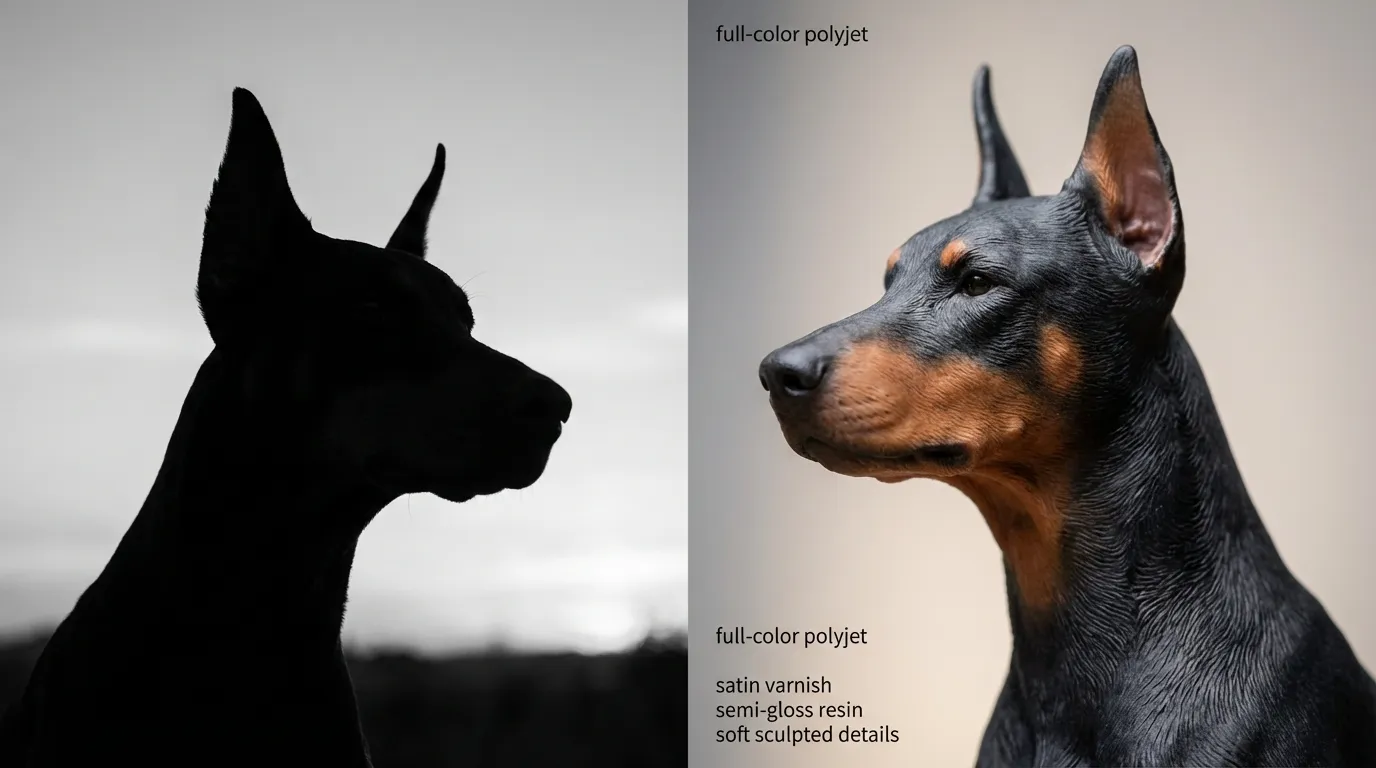
You glance at the empty spot on the rug, expecting to see those signature cropped ears twitching at the sound of a car door slamming outside. For a split second, the silence in the room feels heavier than usual, missing the sharp, attentive silhouette of your Doberman Pinscher guarding the threshold.
Quick Takeaways
- Ear posture defines personality — slight tilts or pins change a Doberman's expression entirely.
- Photos need eye-level angles — top-down shots distort the crucial ear-to-snout geometry.
- Lighting reveals texture — use side lighting to capture the velvet sheen of the ear leather.
- 3D printing captures micro-details — PawSculpt's full-color process preserves the exact ear set without manual painting errors.
The Geometry of Alertness
When we talk about Dobermans, we aren't just talking about a dog breed; we are talking about a masterpiece of biological engineering designed for perception. As someone who has spent over a decade translating organic forms into digital sculptures for additive manufacturing, I can tell you that the Doberman is one of the most challenging and rewarding subjects to model. Why? Because their entire emotional range is often encoded in the geometry of their ears.
Most people think a Doberman’s "look" is about the teeth or the muscular chest. They’re wrong. It’s the tension in the auricular cartilage. Whether natural or cropped, the way a Doberman holds their ears acts as a radar dish for their mood.
In our digital sculpting studio, we don't just "add ears" to a generic dog head. We look for the "base tension." Is the ear rotatable? Is it locked forward in what we call "high-alert mode"? When we prepare a custom pet statue for printing, we have to account for the thickness of that cartilage. If we model it too thin, the physics of 3D printing (even with our advanced support structures) can make it fragile. If we model it too thick, you lose that signature elegance.
"A Doberman doesn't just hear a sound; they physically orient their entire being toward it, starting with the ears."
The "Crop" vs. "Natural" Debate in 3D Space
From a manufacturing perspective, these are two completely different engineering challenges.Cropped Ears:
These are vertical structures. In 3D modeling terms, they have a high center of gravity relative to their attachment point. When we set up the print job, we often have to orient the head so the ears build up gradually, avoiding "island" issues where a layer prints in thin air before connecting to the main body. We look for the "bell" shape at the base—that curve is critical for structural integrity.
Natural Ears:
These are complex, folding surfaces. They create "overhangs" that require careful support generation. The shadow cast by a natural ear changes the color perception of the cheek below it. Because our full-color 3D printing technology embeds pigment directly into the voxel (the 3D pixel), we have to ensure the digital lighting in the model accounts for how the physical ear will cast shadows in your living room.
Capturing the "Radar" Look: Photography Tips
You might have thousands of photos of your Dobie, but when it comes to creating a high-fidelity figurine, 90% of them might be unusable for the sculptor. Why? Because of perspective distortion.
When you take a photo of a Doberman from standing height looking down, their ears look smaller and their nose looks giant. It's the "fisheye" effect of smartphone lenses. To get the ears right, you need to change your approach.
The Surveyor’s Angle
Get on the floor. I mean it. Lie on your stomach if you have to. You need the camera lens to be exactly parallel with your dog's eyes. This flattens the field of view and shows the true height of the ears relative to the skull.What we look for in your reference photos:
- The "V" Shape: For cropped ears, we need to see the exact angle of the inner edge. Do they stand parallel like the number 11, or do they tip inward?
- The Fold Line: For natural ears, where does the cartilage break? Is it high on the head, creating a "flying nun" look when alert, or does it hang heavy and low?
- The Backside: This is the one everyone forgets. We need to see the back of the ears to model the muscle attachment correctly.
| Photo Angle | What It Reveals for the Sculptor | Common Mistake |
|---|---|---|
| Direct Front | Symmetry and ear set width | Lens too close (big nose effect) |
| Profile (Side) | Neck arch and ear tilt (forward/back) | Flash washing out ear definition |
| 45-Degree Angle | Depth of the ear canal and cheekbone | Blurry motion (ears moving too fast) |
| Rear View | Head width and neck muscle connection | Ignoring this angle entirely |
The Science of Texture: Why "Hand-Painted" Fails Dobermans
Here is a counterintuitive insight from the production floor: Dobermans are harder to reproduce than fluffy dogs like Golden Retrievers.
With a fluffy dog, the chaotic fur texture hides a multitude of surface sins. With a Doberman, you have a sleek, aerodynamic surface that reflects light. It is unforgiving. If you have a hand-painted figurine, the brushstrokes will inevitably create a texture that shouldn't be there. Doberman fur isn't textured like paint strokes; it's a tight, smooth pelt.
This is why we use PolyJet/MJF-style full-color resin 3D printing. Our machines spray millions of tiny droplets of photopolymer resin, curing them instantly with UV light. We aren't painting on top of the model; we are building the model out of color.
- Subsurface Scattering: The way light passes through the thin edges of a Doberman's ear (making it look pinkish-orange in the sun) can be mimicked by adjusting the opacity of the resin at those specific coordinates.
- The Black/Tan Transition: On a hand-painted model, the line between the black coat and the rust markings is often hard and jagged. In our digital process, we can create a soft gradient (dithering) that mimics the intermingling of hair follicles.
- Smoothness: The surface finish of our prints, once the support material is cleaned away and the clear coat is applied, mimics the natural luster of a healthy coat without the artificial ridges of acrylic paint.
"A Doberman’s coat is a gradient, not a paint-by-numbers. The transition from rust to black happens over millimeters, and only voxel-level printing captures that."
— The PawSculpt Team
The Technical Workflow: From Photo to Polymer
Let’s pull back the curtain on what happens after you upload those photos. It’s not magic; it’s engineering.
Step 1: The Digital Armature
Our artists start with a "base mesh"—a digital skeleton. For a Doberman, they dial in the specific breed standards: deep chest, tucked abdomen, and that distinct wedge-shaped head.
Step 2: The Ear Sculpt
This is where the artistry meets anatomy. The artist manipulates the digital clay to match your specific dog. If your Dobie had one ear that stood a little lazy at 2 PM, we sculpt that laziness. We check the "normals" (the direction the surface faces) to ensure the ear canal has depth but won't trap uncured resin during printing.
Step 3: Color Mapping
We project your photos onto the 3D model. This isn't just pasting a picture; it's texture mapping. We have to blend the seams where the photos meet. If your dog has a tiny scar on the left ear tip or a patch of white on the chest, we paint that digitally into the texture file.
Step 4: The Print Strategy
When I set up a Doberman print, I usually orient the model at a 30-to-45-degree angle. Why? If I print it standing straight up, the layer lines (though microscopic, often 20-30 microns) would run horizontally across the legs, making them look like stacked coins. By angling the model, the layers run along the length of the muscle, making them virtually invisible to the naked eye.
We also place "drain holes." A solid block of resin is heavy and expensive. We hollow out the body to a specific wall thickness (usually 2-3mm). We place tiny holes, usually under the paws or belly, to let the liquid resin escape from the inside.
Preserving the "Velvet" Look
The final step is crucial for Dobermans. When the print comes out of the machine, it has a matte, slightly frosted look. It doesn't look like a dog yet.
We clean it in a specialized solution to remove support wax or fluid. Then, we apply a specific grade of UV-resistant clear coat. This isn't just varnish. It "wets out" the surface, turning that frosted look into deep, rich blacks and vibrant rusts. It gives the figurine that specific sheen of a well-groomed Doberman standing in the sunlight.
We don't use brushes for this. We use air-assisted spraying or dipping to ensure no streaks. The result is a surface that feels organic, not manufactured.
Frequently Asked Questions
Can you fix a floppy ear in the figurine if I only have photos of them cropped?
Technically, yes. Because we sculpt digitally first, we can alter the geometry. If you want to remember your dog with their ears standing perfectly (even if they were a bit lazy in real life), we can model that. However, we usually advise keeping those little imperfections—they are what made your dog yours.How fragile are the ears on a 3D printed Doberman?
They are the most delicate part of the model. While our full-color resin is tough and has a slight amount of "give" (unlike ceramic which shatters instantly), a drop onto a hard floor could snap a thin ear tip. We treat these as fine art collectibles, not toys.Do I need professional photos for a good result?
Absolutely not. In fact, professional studio photos can sometimes be too perfect and lack personality. Clear, well-lit smartphone photos taken at eye level are often the best reference because they capture the dog in their natural element.Will the black color fade over time?
Black is a robust pigment, but UV light is the enemy of all color. Our protective clear coat contains UV blockers to preserve the vibrancy of the rust markings and the depth of the black coat. That said, we recommend displaying your figurine out of direct, scorching sunlight to ensure it lasts a lifetime.Ready to Celebrate Your Pet?
Every pet has a story worth preserving. Whether you're honoring a beloved companion who's crossed the rainbow bridge or celebrating your furry friend's unique personality, a custom PawSculpt figurine captures those details that make your pet one-of-a-kind.
Free instant AI preview • 3D artist preview within 7 days • 5 free revisions